
saveasteading
-
Posts
10890 -
Joined
-
Last visited
-
Days Won
93
Everything posted by saveasteading
-

Stabbed by the soil investigation!
saveasteading commented on mike2016's blog entry in The Fun Irish (House)
I don't know the detail of course, but I think the design is cautious. 100kN/m2 is perfectly normal and takes standard footings. 70kN/m2 is not great but should be ok. Making footings wider spreads the load and is preferable to taking the whole area out. So I would be proposing standard trench footings at 1.3m. 70kN/m2 is also fine for a floor slab...nobody will fall through, otherwise it wouldn't be safe to walk in the garden. Therefore the ground between footings can stay in place. Yes have a chat with the BCO. What would be necessary is close inspection of the excavation as it proceeds, perhaps tending higher or lower as the ground is exposed. Perhaps the SE is avoiding the uncertainty, which some clients would prefer. -
At least insect mesh. I think I would fix it inside for security and outside too, to keep the vents empty of creatures. When the beads are glued together is it a mass, or are there gaps?
-
Hello - Self build on the coast of Scotland
saveasteading replied to Clubtropicana's topic in Introduce Yourself
Welcome ClubTropicana. Looking forward to hearing of your intentions and methods. I was trying to work that out from the sun's position...but it doesn't match the shadows, so I think it is random. My guess is that the wing curtains are to hide behind if necessary, and the rest is optionally exposed to the world, or is one of those blackout windows (pixels within the glazing, by pushing a button) . Balconies would be nice, perhaps depending whether you have a clear view of the Clyde or Dumbarton is in the way. -
Can one paint a red expansion vessel white?
saveasteading replied to Question's topic in Boilers & Hot Water Tanks
Box them in. Everything is black in the dark, so they will match. -
EDF and 3 phase meter replacing single phase
saveasteading replied to Andeh's topic in Electrics - Other
We thought we had 3 phase (amateur me looking at the wiring, and it being a redundant farm building). But it wasn't , and it would have been expensive to bring in, and the standing charge would increase. With research and the advice of ProDave and others we confirmed that our single phase was plenty, even for ASHP for 400m2. SSE were helpful too, but I know they don't stretch to Suffolk. With SSE agreement, we put in an oversized cable just in case things change. After years of asking electricians what 3 phase was, I now realise they didn't really know. they just knew how to do the wiring. Great for heavy machinery, but we don't have any. -
I can't see anything wrong with it. My concern would have been getting approval from BCO for a hybrid design but there is NHBC confirmation so should be ok. so do not have air bricks. Make sure that the dpm is utterly seales so that water cant get in (there is no way out again) presumably the superbead is placed slightly prod so that there are no gaps. How do you keep the superbead in place against the wind, and dry until the vcl goes in? or is this within a constructed house?
-
EDF and 3 phase meter replacing single phase
saveasteading replied to Andeh's topic in Electrics - Other
If I may, why do you want 3 phase? -
Company accounts overdue
saveasteading replied to Kelvin's topic in General Self Build & DIY Discussion
Our business bought very big orders of steel buildings, and our credit level rose over the years. We got significant discounts for prepayment....much more than the interest. So most clients jumped at the saving but were rightly nervous of the risk. But the supplier got a personal guarantee from their bank to our client. It was a single page saying that if the materials were not delivered or were wrong, the bank would reimburse " without argument". So it can be done. But the bank is not taking the risk, and won't. A small supplier would have to provide guarantees to the bank. -
At £1.50 for 3m, the rod could be continuous, base to eaves.
-
Costs more of course as the blocks are fancy compared to normal cuboid ones. It is very clever and may avoid or reduce putting pir over the floor.
-
Yes a little. The crack below the window has already been filled by the look of it, but has continued to grow. We can't see the context to see if this has been the house settling in or something more concerning. I think have an SE look at it. In the first instance this could be a verbal opinion to put your mind at rest or suggest there may be problems.
-
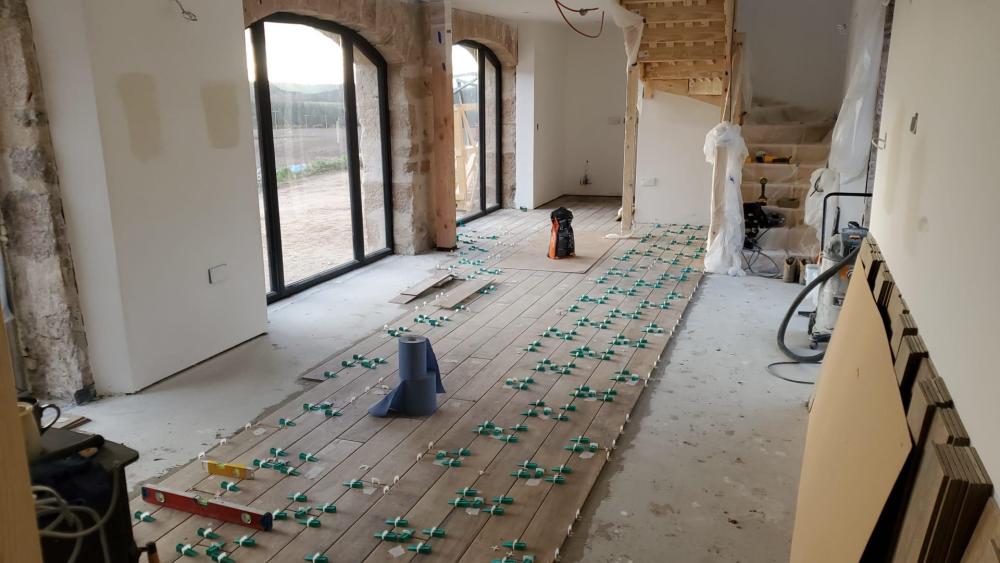
I relayed your info to the family. They report back that the ufh is already off because there is plenty of heat from a hint of sunshine. Big windows to that section of the building. Promising for the winter heating performance. Will be interesting come the summer. Blackout curtains touching the floor, stair and veluxes as a cooling flue, open the wbs for stack ventilation, and park a van in front of the windows?
-
Beam and block comfortably spans 4m. Polishing the slab is ok, but a bit specialist for domestic. I prefer concrete screed, pir, screed with ufh. Control. Or b and b, then pir and screed. 150 slab with 1 bottom layer of mesh is a surprise as a suspended slab. That will require great precision. Crack control is simple enough. For later discussion.
-
M8 very much cheaper if it would suffice.. Direct Channel Support Systems Limited M10 Threaded Rod - High Tensile Steel (8.8 Grade) - 1 Meter Product Code: TR1-10T M10 Threaded Rod - High Tensile Steel (8.8 Grade) - 1 Meter High Tensile Steel 8.8 G.. £1.50 inc VAT (£1.25 exc VAT) M8 THREADED ROD - 3 METER Product Code: TR3-8 £1.62 inc VAT (£1.35 exc VAT)
-
My opinions: Beam and lock preferable to void formers. Above void formers need a structural (ie expensive) slab. perhaps 200 thick and with 2 layers of heavy reinforcement. If the ground heaves it crushes the former, but if it shrinks it then leaves a gap....so might as well have used B and B. If you need fibres in the screed and it is only for crack control, then use plastic fibres, which add typically £100 to the job, as compared with very much more for metal fibres. From my experience, Engineers (I am one) and Architects have been sold 'a solution' by void former suppliers but don't always know the cost implications. I am more used to severe shrinkage clay, so it should work for you with your lovely 'medium shrinkage'.
-
Garden shredder advise Spring 2023
saveasteading replied to JohnBishop's topic in Landscaping, Decking & Patios
Saves going indoors, but my compost heaps are right next to the pavement and road, and a bit high. And once mulched round the roses, I'm not going that close. -
I have done many big projects with b and b, always dense blocks. Then a cement wash over the lot to fill any cracks, seen or unseen. Then brush in sand and cement to the bigger gaps. Not only houses, but offices and assembly spaces, I think the biggest area was 800m2. The eps blocks seem very expensive. Therefore over that area , any price difference can be a lot of cash. My belief is that housing developers use b and b for certainty. The certainty that some subby of a subby isn't building on loose fill. Do they use eps blocks? I don't know. My default is always to build on the ground, which adds insulation in itself and doesn't have airflow under the slab, even though not fully acknowledged. B and B only to overcome site conditions or on steep slopes. I had not heard of using metal fibres over eps blocks. Is this for strength or crack control? It is very expensive too.
-
Workshop build using shipping containers - Electrical Advice
saveasteading replied to Walrus's topic in Introduce Yourself
.....also keeps us interested and the OP (and others) can learn other stuff, eg planning and structure came up here. As long as we don't get whimsical when there is a serious problem...ahhh but I digress from the current discussion Out. -
Garden shredder advise Spring 2023
saveasteading replied to JohnBishop's topic in Landscaping, Decking & Patios
Nitrogen is lost. This is good on the subject https://www.rhs.org.uk/soil-composts-mulches/woody-waste-using-as-mulch -
Workshop build using shipping containers - Electrical Advice
saveasteading replied to Walrus's topic in Introduce Yourself
Sorry, wandered a bit, as is happening in the car discussion. -
Garden shredder advise Spring 2023
saveasteading replied to JohnBishop's topic in Landscaping, Decking & Patios
I can't remember the science, but the act of it rotting takes one of N, P or K out of the soil around it. But if it is in the compost, that happens benignly and it is all useable and useful compost next year. -
Hope is good! But joists will be warped in length and vertically, so every cut will be different and approximate. The thicker the pir the more difficult to fit accurately. Also, many talk of pir shrinking in time. You will get a better theoretical rating with pir, but perhaps better insulation with more pliable materials.
-
Garden shredder advise Spring 2023
saveasteading replied to JohnBishop's topic in Landscaping, Decking & Patios
Lay it on the surface to kill weed seedlings, and to keep the ground moist. Any thickness helps but 50mm is often recommended. If you dug it in , it would rot in the ground and reduce nutrients. Or mix it in with compost for next year -
Just Google mortar calculator.
-
The BM will know the ratio to order. I would have to find my wee black book. 'sand and cement for 226m2 of brick' / 100mm block or whatever. you will have waste through spillage and spreading on the ground.