
saveasteading
-
Posts
10890 -
Joined
-
Last visited
-
Days Won
93
Everything posted by saveasteading
-
 Excuse me going way back on this. Building on bedrock. Why do you need the cordek, which is for the severe expansion of clay?
 -
Commencement before New Building Regulations re-submission?
saveasteading replied to Deejay_2's topic in Building Regulations
Possibly. But it would be dangerous to fall into. Also the base of the trench will soften and more need to be taken out later. Backfill but loosely? Ie no need to compact it. You will have about 1/4 of the earth left over. -
Design and build turnkey options
saveasteading replied to Bournbrook 's topic in Surveyors & Architects
This earlier statement seems to contradict what i just posted. I was being general. In our business I worked out a formula on adding risks and overheads and applied it whether in competition or negotiating. It was only fair, and negotiating causes less overhead anyway. Not all businesses will do that. In general the parties share risk. But risk can be reduced through knowledge and collaboration. -
Design and build turnkey options
saveasteading replied to Bournbrook 's topic in Surveyors & Architects
That exists. That was my business, but not in housing. Architect/Engineer in house. No outside fees, and knew how to do what we did. It is very efficient, and someone round you must do it. The other benefit is that a contractor knows the costs attached to decisions and can advise from the start. Disadvantages ? Only that they are not going to pass on free advice until appointed, and that some clients don't like to/ can't put their trust in one party. I took on risks, but preferred that to being beholden to project managers who often like to show how tough they are and create disputes. I don't know where you should start to look. -
Design and build turnkey options
saveasteading replied to Bournbrook 's topic in Surveyors & Architects
That is good then. Standard footings. Also helps when a building can be simple construction, as no fancy Engineering is needed, and normal builders can build it. Next risky things....can the drains simply be coonected to the main sewers, and can mains supplies come straight from the rosdside? Then choose a nice standard house design. -
Design and build turnkey options
saveasteading replied to Bournbrook 's topic in Surveyors & Architects
Contingency decreases but price increases. Sycamore is a big, thirsty tree which requires deeper foundations if in clay. But sandstone is not affected in the slghtest. How deep to the stone? -
Design and build turnkey options
saveasteading replied to Bournbrook 's topic in Surveyors & Architects
Yes you can pay people to take your stress, but they are taking on your risks and will charge tidily for it. Costs rise from the lowest level at skilful self build, increasing every time the responsibility is handed over to consultants and contractors. Highest cost for complete turnkey with project manager and a single main contractor on a fixed price. Could double the cost. But probably a better job. On second thoughts, the highest cost will be with an overconfident, non-skilled self builder who has to do things twice, and has chosen the wrong contractors. -
Design and build turnkey options
saveasteading replied to Bournbrook 's topic in Surveyors & Architects
Correct. Once the structure is up, with vapour layer on, the shell is dry. So you can even add roof finishes to the list. Be aware though that all the trades will be slower, and more expensive, if constrained by partial occupation. -
Design and build turnkey options
saveasteading replied to Bournbrook 's topic in Surveyors & Architects
I think if there was a survey, almost every self builder on BH would report going over budget. There are always surprises, and very few of these can ever be good. So allow a substantial contingency on any figures you are quoted. Staying in the village is a very good reason for proceeding. Making money is not, unless you will manage the process closely, know (or learn) a lot about construction, and include a lot of diy. But get it right and your house will be just what you want, and to a high standard. Let's get rid of one risk. What type of tree is it, and what is the ground type? -
Acceptable gap between frame and structure?
saveasteading replied to ggc's topic in Windows & Glazing
This is getting very Daily Mail. I'm turning this discussion off. Ggc good luck with your windows. Start the question again if you want to. -
Absolutely right. In fact the guidelines for school sports halls forbids cooling, on the basis of summer closure. Can be very hot for summer schools. No shading was added, and the client is still very happy, 10 years on. It was all appropriate. The client was being facetious and practical. Of course if temeperatures were ever too high, then the patients would have been in the old miserable lounges for a while, instead of the bright cheerful one. In reality it hasnt been necessary. My point was about balancing the building regs rules and formulae against reasonable judgement, and client requiremnts. A known and expert client is essential.
-
Acceptable gap between frame and structure?
saveasteading replied to ggc's topic in Windows & Glazing
I'm not responding again because it is so off the subject. -
Acceptable gap between frame and structure?
saveasteading replied to ggc's topic in Windows & Glazing
They don't equate. No comment on 'the stabber' because i know nothing of the case. I wouldnt normally get drawn into this, as being political, but it is to do with drainage and the environment so is a diversion, but construction relevant. Here is what the farmer did to an SSI. For some reason, some farmers seem to think that deepening a river locally makes it flow faster. I've come across this before. Taking away the banks does, and increases flooding downstream, and aids his fertiisers and runoff passage to the river. I suspect he just thought he would get away with it.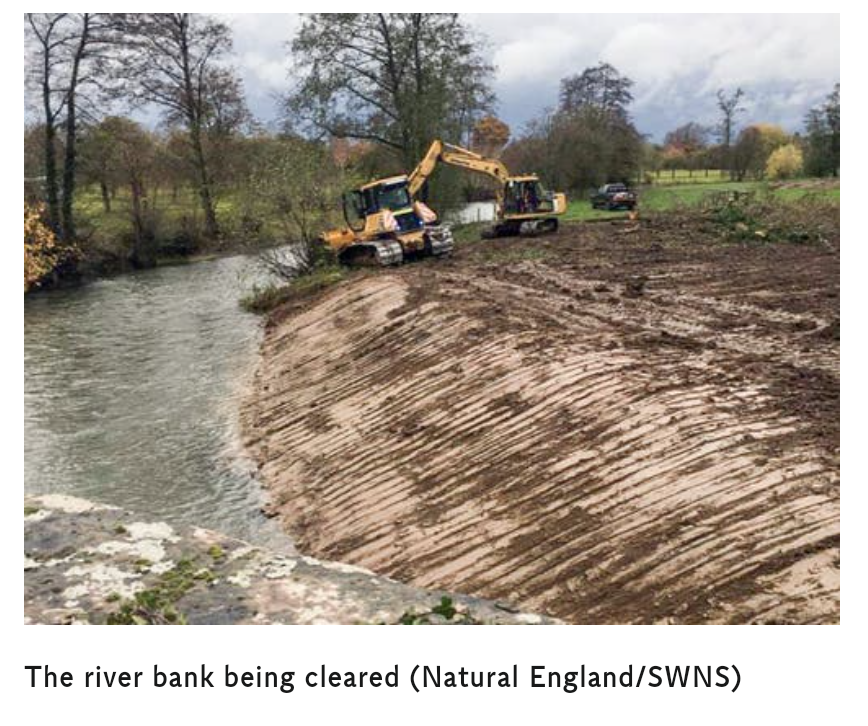

-
We can't trust energy companies
saveasteading replied to Radian's topic in General Self Build & DIY Discussion
I thought the same of OVO. Quick to respond and sort stuff, polite, fair, interest paid on any surplus. Shook up the market too. But they were so good that they were handed the failed companies and are now huge. Not saying they are bad now, but they have slipped down the "Which" ratings. If Octopus are as good as you all say, there will probably be a plan to change that. Cynical me. -
The good thing about a glass roof in the UK is that the sun doesn't get very high, so we get lots of daylight and not too much direct sun. I once put huge amounts into a school classroom with the clients blessing (and their accepting the risk) because it was an art studio. Did it ever get too hot? Yes, for a few days per annum. Teachers hung assemblages resembling clouds to stop direct rays. It wasn't as hot as we feared. They had windows. "The best art practicing space I have ever known". Vaguely relevant...again lots of windows and skylights in a big lounge for a nursing home. The building inspector claimed it failed regs on overheating. We pointed out the french doors, that aircon was bad environentally and hinted we would box the skylights in until signed off. Then the client killed the subject by saying to the bco " if ever my residents get too hot, I will take one of their blankets off". My point is that there are calculations and hunches, but individual preferences vary. You can always add greenhouse shading or louvres ( or a sheet of ply) to a skylight, perhaps even only in extreme summers. And when it is that hot, you can usually open doors and windows.
-
Acceptable gap between frame and structure?
saveasteading replied to ggc's topic in Windows & Glazing
Yes Ruxley indeed. The number of times I have heard this quoted by lawyers, either in seminars or real cases. The main point they were making was that this judgement seemed ludicrous but was strictly what the law stipulated. In Ruxley, if I remember, the minimum depth of the pool was even stressed as a fundamental requirement, yet the ruling was that it was not so important. Logically if your windows end up 1% smaller*, I can see the judgement being for a credit of 1% of the contract. * smaller than what? We don't have the drawings or spec. The last thing ggc needs is to be famous (and impoverished) for the case of ggc v Bloggs Glazing. I'm not saying for a moment that the glazing co is blameless. Just to stress...is it such a big deal? And don't get legal. (I think there was another swimming pool case where an Olympic pool was short between touch pads. That was however judged to be crucial.) i Irrelevant to ggc of course. We should have a button for " transfer discussion to new topic". -
Acceptable gap between frame and structure?
saveasteading replied to ggc's topic in Windows & Glazing
Because judges "don't get it wrong. They make a decision based on the law. Then at appeal that may be reversed and at reappeal it may be reinstated. Common sense does not necessarily have anything to do with it. Try reading the judgments. If it was simple then there would be no need for juries or judges. -
I'm not altogether comfortable that a bco can overrule an SE. I had one on site who didn't understand the tree root business. Many more situations too, on other matters of structure or fire. Work together perhaps. You would certainly want proof that the changes were approved by the bco in case of issues. Will the SE update the drawings? In which case all is ok.
-
Somtimes there is good news! Yes let's see the drawings when you can, but i think you won't need root barriers, with the trees being long gone. I've just been looking at some online. Expensive stuff, plus the trenches. I have never used it in hundreds of projects on heavy clay. In reality, would a tree grow roots down and under a building, where the ground is much drier? Is this a product looking for a market?
-
MOT type 1 is to a strictly controlled specification, specifically to provide certainty. It covers grading of material and hardness. I think angularity too. I'd be surprised for there to be inferior material...unless described as an "equivalent". Having said that, there is some confidence in having granite or hard limestone, rather than crushed gravel. You are right about slipperiness if the limestone turns to dust. That would imply too much fines on top. Ie not properly mixed A bit mucky too.
-
You might ask what it is for. Sounds like a collapsible board to allow for tree root growth or soil expansion, neither of which seems an issue.
-
I've done lots of this for car parks. Very successful with cars only, but gets trashed when bigger vehicles run on it. Then you need the appropriate grids at double the cost. A bit strange to use on bends, using plastic square modules. Quite expensive too.
-
These would be sensible, but I would simply use membrane beneath the stone.
-
The original Macadam road is stone without the bitumen binder. It is very durable for normal forwards driving and highly appropriate for a rural drive. Easy to repair too. Beneath that you can have cheaper stone to spread the load. Discussing with your local quarry can be helpful, and can achieve best value with decent appearance and durability. You must decide whether you will allow heavy vehicles to use it. Type 1 is the other good option. It will be smooth when rolled.
-
Retaining walls required before garage foundation
saveasteading replied to wertert's topic in General Structural Issues
The red bar is structurally elegant but a pain to work with. They have to be exactly placed. I would stick with epoxy and inserted bars. The pullout strength is huge. I can tell from the drawings that uou will be precise. Mesh in the base is appropriate as the vertical bars will be trying to bend the base. One layer middle if being mean. Still add 25mm drain pipes out of the wall above ground level in case your other drain fails. NB your land drain is going through the piers. Make it smaller, or settle for the front pipes.


