


markocosic
-
Posts
979 -
Joined
-
Last visited
-
Days Won
1
Everything posted by markocosic
-
Board on board cladding - fixing advice / critique
markocosic replied to markocosic's topic in General Joinery
FWIW you can't see screws on the roof even before paint. Or the difference between anthracite base coat and black top coat. -
Convinced this was fine.... last night
markocosic replied to ToughButterCup's topic in General Joinery
M6 bolts through a piece of alloy channel spaced so that they pick up one edge of each board. Outer two long enough to sit on batten. Inners only touch boards. Drill holes for screws then slot to outer edge.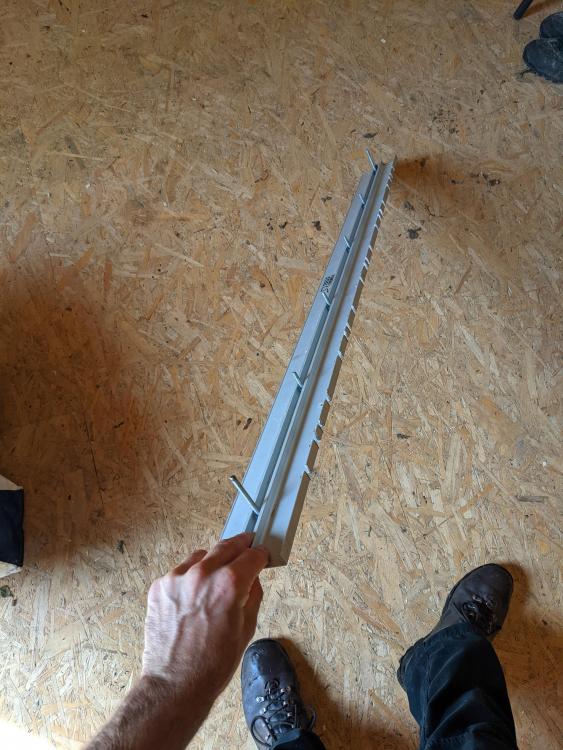
-
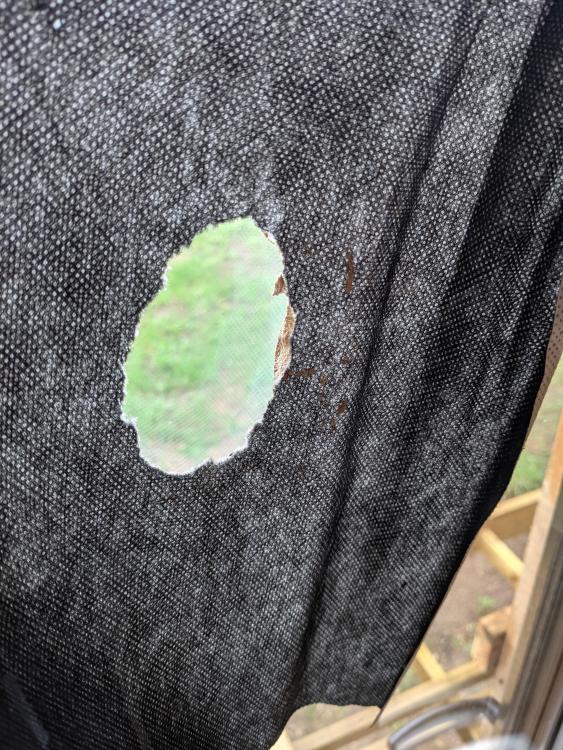
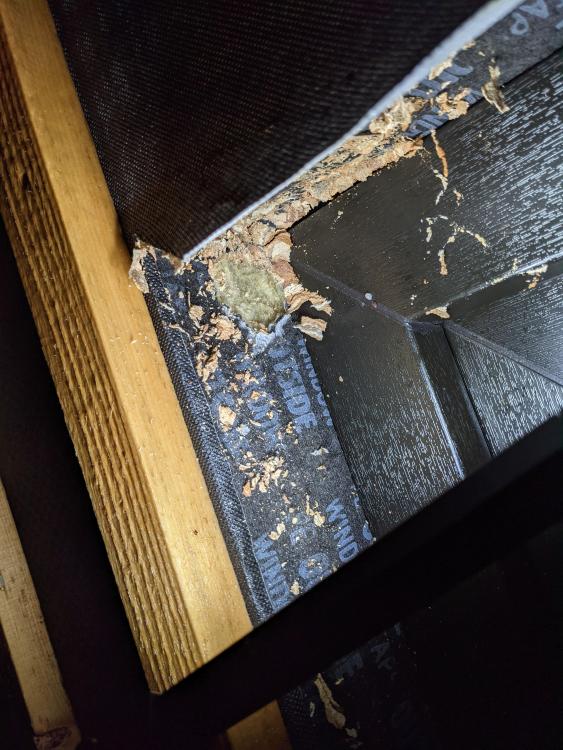
These were hornets (yay) but wasps do the same
-
If the bees do come you can say bye bye to the membrane...
-
Will puraflex anything on the roof that needs it later. You can't see colour mismatch fun the ground ?
-
Thanks gents! 18C and raining in August... perfect time to be fitting them, heh! We found that priming then one topcoat, stack and wait, then fit to roof and wait for some sun baking and raining, then topcoat and get a good dollop of the acrylate topcoat in each check mark/screwhead has hidden a multitude of sins. Much better than doing all painting then fitting. Looks like no need for "fine" filler but time will tell. The more visible wall boards will be getting done in October at current rate of progress. Roof needs to go on now (whilst I have hols) though!
-
Convinced this was fine.... last night
markocosic replied to ToughButterCup's topic in General Joinery
For what it's worth we found fixing one end then moving (hoiking) the free end about and fixing in every batten on the way helped to tame the banana boatds into straighter lines. Small gaps are a swine though! Jig to sit on the battens (hooking through gaps with small bolts) helped align screws where eyeballing through gaps isn't viable / borrowed helpers can't eyeball for toffee. Will try to find a pic! -
Convinced this was fine.... last night
markocosic replied to ToughButterCup's topic in General Joinery
Then you wait until the sun comes out and dries all the wood for you just to really annoy you! -
You pedant! ? Thermal mass = joules per degree K difference Thermal mass = (the mass that you have) * (specific heat capacity of the material) To avoid short cycling when the output of the emitters is less than the minimum output of the heat pump; the heat pump requires enough directly coupled thermal mass to have adequate cycle times. The dumb ass header design decouples the thermal mass of the UFH from the heat pump, so to introduce mass you need to put a 2-pipe buffer on the output of the heat pump before the header. 100-200 litres. If you eliminate the header and pump everything directly from the heat pump then you may not need the buffer, or if you do it can be smaller and between the heat pump and the UFH such that you're not heading it when you only prepare DHW. The OEM is being very cynical in their installation recommendations (that design can only ever work on paper) and the application support from their dealers/distributors is rubbish in the UK. I'd go against their advice. Graham has some decent direct connect schematics: https://silo.tips/download/schematic-diagrams-of-systems-using-samsung-ehs Don't use his district / multiple pump designs with hearts without specialist advice. Observe minimum flowrate and system volume requirements of heat pump. You may require additional circulation pump in series with the one in the heat pump to meet system head requirements. (and I'd buy from them when the Mitsubishi dies of you need design support)
-
When it comes to removing the header entirely. You say: "The Ecodan documentation says that the flow rate for the heating primary for a 14kw Ecodan is between 17.9 and 40.1 L/min" Can you provide the manual? I suspect this means that if you want a space heating system to work with an ecodan without the header then the flowrate needs to be between 18 and 40 litres per minute at ALL times that the heating is on. Your smallest zone needs to be 18 litres/min (1.08 M3/HR) and your system still needs to function (remain adequately balanced at 40 litres/min (2.4 M3/HR) with all zones open. And the pump(s) need to provide enough pressure head to drive this flowrate thorough not just the heat pump but also the pipework and emitters. Your non short cycling problem (with both zones on) is a secondary flowrate exceeding the primary flowrate. Your header is being "circulated" by the radiator circuit. It draws hot water from the heat pump from the top AND because the flowrate for the secondary exceeds the primary it is also drawing return water from the radiator circuit up through the header. No amount of baffling etc will correct this. You need to reduce the flowrate on the secondary circuit to be equal to or less than the flow from the ecodan. That's easier. Limit flowrate through the radiators and you're done. No getting wet. I would set UFH to 18l/min, DHW to 18 l/min, and radiators to 22l/mum (max, with all TRVs full open) Now you can run: - DHW only - UFH only - UFH and DHW - UFH and any amount of radiator up to 100% open Whilst remaining within the (rather limited) operating range of this heat pump. (with poor installation instructions and a worse dealer/installer network) No to a low loss header. Yes to 2-pipe buffer direct on heat pump output to increase system volume. (a 100-200L unvented cylinder with the heat pump feeding the cold water inlet and the hot water outlet feeding the heating will do)
-
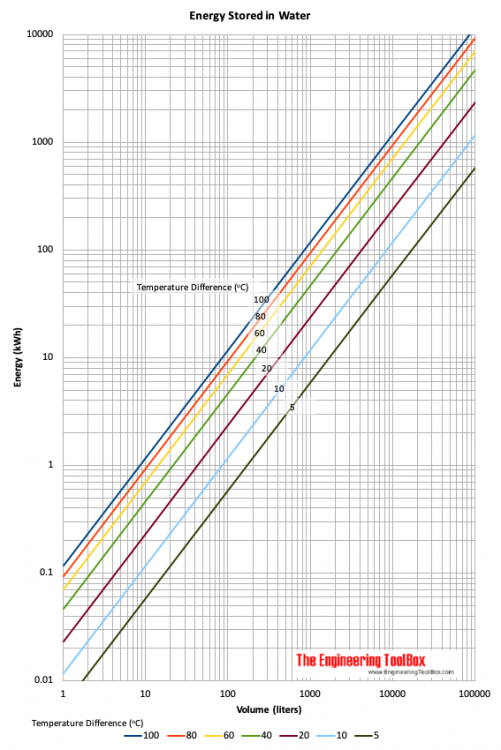
Joules per kg per degree Kelvin. E = m (CP) dT https://en.wikipedia.org/wiki/Specific_heat_capacity Or: 100 litres gives ~2.5 kWh for a 20C temperature rise. Many heat pumps ask for a minimum (directly fed) system volume to use as thermal mass to minimise cycling. This can be substituted for screed to a degree. The thermal mass of radiators and pipework can be ignored here. (minimal compared with the water)
-
Low loss headers shouldn't be used with heat pumps. 4-pipe buffer vessels also shouldn't be used with heat pumps. They destroy efficiency in operation. (and on condensing boilers for that matter) You want: heat pump > 2-pipe buffer > emitter (UFH / radiators) > heat pump. If the emitters have a large enough output or thermal mass you can lose the 2-pipe buffer. A quick and dirty bodge world be to introduce a 2-pipe buffer on they output of the heat pump before it goes to your low loss header/4-pipe buffer. This will give enough (effective) system volume to avoid cycling. The short cycle issue you have is that your (effective) system volume is just the heat pump and pipework up to the low loss header. The thermal mass in the UFH / radiators has been decoupled by the header and your data / observations show this nicely! Awful system design from an OEM that ought to know better...but wanted to avoid getting sucked into explaining flowrates and design on the 'emitter' side by decoupling using the low loss header. Bash in a 2-pipe buffer between ashp and header on the flow to add in some thermal mass quickly. Work out how to design UFH and radiators that can deal with the full flowrate the heat pump requires later. Crummy units throw a hissy fit at anything other than constant flow. That might be why the header is there...
-
Seconded for mcalpine top access waste / trap. Easy to clean compared with the hairballs that hang from a regular waste.
-
Depending on the floorplan (how open is it?) I'd buy: An air to air heat pump (mini split) for your base load heating. Later it can be occasional us cooling or backup heating. £750 to £1000 and should pay for itself within the two years on electricity savings. R290 based units are legal for DIY fit. Oil filled rads for supplemental heat to bedrooms. Shouldn't be needed much at all later go in the attic for emergencies. Get ones with good thermostats. Funny but anything with an exposed wire heating element. They fill with skin dust and smell of old people. (hot skin dust) The above leaves you with something useful at the end whereas storage heater and economy 7 option leaves you with a pile of rubbish to get rid of again. If you can pick them up for literally free then perhaps worth it but I don't like them. If there's a backup immersion heater for hot water then use it. Or fix it. Else: An electric shower for sure. Maybe an under sink heater for the bathroom (if you care - a mirror in the shower works just as well for shaving...) but I'd try without as it's less faff. A dishwasher that you'll reuse later. Screw hand washing. The dishwasher gets it cleaner and makes its own hot water. A kettle and one of those portable induction hobs. For emergency got water on the occasion it's needed for cleaning other things. Rarely if you have a dishwasher. Stats the status of the old oil system? Tank and boiler dead? Are the rads and hot water tank viable?
-
Thanks, makes sense. Wood will be dry. An excess of the stuff here vs foreseeable usage so plenty of time to dry. It was more when the stove wasn't in use that I had in mind. It sounds like that isn't a thing. ?
-
Do we need to worry about condensate? SWMBO would like a wood burning stove with a completely vertical flue that exits out the top of the appliance and runs straight up through the roof. This is instead of exiting the back of the appliance and running through an outside wall into a "T" with the flue on top and a drain on the bottom. Will we need to do anything special for condensate or can plain flue (we propose black painted double wall all the way from the appliance up) sit directly on top of the appliance? The house is a timber frame. It is a warm pitched roof with no attic/sloping ceiling. The flue would run for ~2.5 metres internally, ~0.5 metres through roof structure, then ~2 metres externally. This is the stove we're considering: (2.5-7 kW, 130 mm flue, external air feed, a semblance of convection hating / shielding to avoid surfaces being too hot) https://www.senukai.lt/p/kietojo-kuro-krosnele-abx-viking-i-black-7-kw/ejvd?cat=b88&index=16 http://www.abx.cz/cs/viking-i--cerny-korpus-oplasteni-cerny-plech-p805v17
-
Do draw the schematic and I suspect you'll be fine without dhw recirculation - depends on your desired flowrates and wait times.
-
You don't open vent the DCW and DHW Nick. You do a "break tank" off the mains (so that you're allowed to pump) and feed the whole house with boosted DCW. Tank can be sited anywhere. They're usually in basements (of blocks of flats) not in roof spaces. You can't do that with an accumulator setup because you're not allowed to pump the incoming mains. Accumulator setups are cleaner if you have high pressure low flow mains. Boosted setups are the only option if your mains is low pressure.
-
Hybrid: Fill a tank from mains. Pump from tank into your dcw/dhw. Rely on pump for pressure. Total independence from incoming mains so works even if incoming pressure is gash-tastic. (e.g. leaky pipe London where the water board dial down delivery pressure to 1 bar) You have a tank open to air to keep clean though. Accumulator: Fill a balloon from mains. Rely on balloon to sustain pressure. Reliant on mains pressure to fill balloon and drive flow. (e.g. countryside where pressure is high but small pipes mean low flowrate) No tank open to air but won't work if incoming mains pressure is gash-tastic. I wouldn't do gravity. I just said that it often works well...if the fixtures are correct...to highlight the need to start with fixtures then work backwards.
-
The reason they recommend higher setpoints is thermostatic mixers by the way Cheap thermostatic mixer showers can't create 40C water using hot at 45C and cold at say 10C. They need 10C "headroom" on the hot supply temperature. So 50C to generate 40C at the outlet. Add in heat loss en route from big old uninsulated pipework or pipework direct buried in a masonry wall (e.g. shower feed) and you can find that a supply of 55C is needed to hit 40C blended. Avoid poor quality fixtures and bad pipe routing and you can safely drop to 48C. It's bum covering on their part not a technical requirement in all scenarios. Safety and efficiency aside (the cooler the less risk, the higher generation efficiency, and the lower the losses), you also get a response benefit by running the DHW cooler. Making 40C out of 10+45 rather than 10+55 means a greater fraction of hot water and means the hot pipework purges faster; thereby improving responsiveness. I work in the district heating sector and plumbers - including the NHBC whilst a prize muppet by the name of Peter Gray used to be in charge of heating - specifying 22mm pipe and 55-60C delivery temperatures then whining about response time are one of the banes of my day job. "Turn it down to 45" is a standard band aid to improve response. (and safety/efficiency) You're always fighting backside covering equipment vendors and unthinking 'more is better' specifiers though. Fire over fagpacket schematic showing fixtures and runs and we can size the flowrates and pipes on this thread ?
-
If your boiler can't modulate down to meet minimum load then you need to introduce thermal mass. (such as a thermal store) For example: wood burners, some oil boilers, ye olde gas boilers. If your boiler can modulate down then you have no requirement for a thermal store. Design CH for a maximum FLOW temperature of up to 55C (even with rads) and you can't fail to condense in operation even if the balancing is awful. Well designed gravity systems will spank unvented cylinders for everything but high pressure drop showers on upper floors. They don't work well over you start adding fixtures designed for high pressure (most mixers on market today) or fitting low flow fixtures onto pipework sized for high flow (again most fixtures on market today) or indeed fitting low flow fixtures full stop (pressure drops at the velocities needed for fast response are too large on smaller pipes) Also plumbers that aren't numerate, which is most working on the domestic sector, can't design gravity systems. Flowrates, velocities, and pressure drops are beyond them. Mixed systems (gravity cold tank feeding the house via a booster set) spank everything. You're in total control of your supply at this point. Direct mains fed unvented cylinders and direct mains fed heat exchangers (combi or thermal store) are a workable compromise in most situations. Unvented cylinders have low pressure drop on the potable water side and higher on the heating side. Thermal stores are the opposite. Your application suits the former. Just because the previous install sounds like a fudge up (I keep banging on about starting from the fixtures and blended flowrates for a reason - you probably had naff taps (low flowrate/high pressure drop) on oversize pipe (causing slow response but you dare not downsize because flowrate was poor and plumber will always blame pipe) doesn't make this one the same - and the thermal store will only be worse than the unvented in terms of pressure/flowrate/response. G3 isn't worth the paper it's written on IMO. The mucking fuppets can't even fit the systems right let alone inspect for proper operation. Fair enough if you actually intend to pay for the paper each year then yes there will be a saving. Most don't service unvented cylinders or boilers to no ill effect.
-
Don't buy a non modulating boiler. There's no reason not to have over that can dial itself down for when it is in space heating mode. Personally I'd KISS with an unvented cylinder. The pressure drop on the DHW side will be lower so better flow. And they're cheaper. Go for one with a big coil in it though, and check what the power it can accept at say 70/50 flow return is rather than t he e old school non condensing 82/71C. Personally I wouldn't be fussed about reheating at 24 kW (almost as quickly as it is used). Go bigger rather than faster. 210L is nothing. Reheating at anything over 12 kW ought to recharge it more than fast enough. Don't set to 50C. You need (or should have according to regs) thermostatic fixtures for bath fill if you do this. (Low flowrate) Set to 48C and have no thermostatic fixtures at all. (again kiss) Do look at the fixtures - something like a bristan 1901 bath filler (for gravity systems) has 3/4" inserts not little ones and can do bath fill at over 100 litres/minute of you've got more than one bar available at the fixture - whereas cheapie high pressure only fixtures all have widdly little cartridges. In the interim before mains upgraded: https://product-selection.grundfos.com/products/up-a-home-booster Totally illegal to direct fit this these to the mains without asking the water board...just in case you drop the line pressure enough to suck in nasties upstream...but for adding 1+ bar at up to 30L/minute the 15-160 works well and for 0.8 bar at up to 15L/min the 15-120 works well. (e.g. the latter overcomes the 0.6 bar pressure drop in most combi boilers at their rated flow) Common in Europe where regs less strict.
-
Central cylinder with all runs to fixtures meeting AECB guide will work nicely. (nothing 22mm unless serving bath fill taps capable of high flowrates) If incoming DCW is 22l/min and you're expecting DHW of 18-19l/min then you may have a problem though. What are your blended flowrates? What are the DHW and DCW flowrates needed to meet these? DCW temp varies. Assume 10C. Blended temps vary. Assume 40C. DHW production temps are flexible. Assume 45C for HP or 55C for gas. (being conservative) 40C shower uses about 86:14 in HP scenario or 66:33 in gas scenario. So you have enough DCW to satisfy your wishes or would you be putting in DHW capacity that goes unused? https://www.spiraxsarco.com/resources-and-design-tools/calculators/water-mixing/water-mixing
-
Will widening my connection to Thames Water make a difference?
markocosic replied to hendriQ's topic in General Plumbing
Sorry replied to wron thread in a different tab! -
Will widening my connection to Thames Water make a difference?
markocosic replied to hendriQ's topic in General Plumbing
Central cylinder and system boiler will work well. Resist temptation to run any 22 mm anywhere though (except perhaps the bath IF you have bath fill fixtures capable of high flowrates) AECB water standards a good one to aim for / tell you what dead legs are. 15 mm pex is usually the answer to everything.




