

ProDave
-
Posts
30861 -
Joined
-
Last visited
-
Days Won
427
Everything posted by ProDave
-
Well my single garage is less than 30 square metres so I have no requirement to ventilate it. I did not use any air tight tape on the garage itself so I have not "tried" to make it air tight. The insulated garage door is due to arrive tomorrow. I don't expect it to be air tight in any way, but probably less gaping great holes than an up and over door. There is a letterobox in the pedestrian door so that's "ventilation" I have insulated the walls of the garage to almost the same standard as the rest of the house. The (fire) door between the house and garage has the usual intumescent strip, and a draught proof strip around all 4 sides.
-
These are the only 2 paragraphs you need Small garages - garages of less than 30m2 do not require the ventilation to be designed. It is expected that a degree of fortuitous ventilation is created by the imperfect fit of ‘up and over’ doors or pass doors. With such garages, it is inadvisable for designers to attempt to achieve an airtight construction. A garage with a floor area of at least 30m2 but not more than 60m2 used for the parking of motor vehicles should have provision for natural or mechanical ventilation. Ventilation should be provided in accordance with the following guidance: where the garage is naturally ventilated, by providing at least 2 permanent ventilators, each with an open area of at least 1/3000th of the floor area they serve, positioned to encourage through ventilation with one of the permanent ventilators being not more than 600mm above floor level or where the garage is mechanically ventilated, by providing a system: capable of continuous operation, designed to provide at least 2 air changes per hour and independent of any other ventilation system and constructed so that two-thirds of the exhaust air is extracted from outlets not more than 600mm above floor level.
-
It's a local distributor thing. TNC-S is often supplied here even on an isolated single dwelling supplied from it's own transformer
-
There are specific rules about caravans and site sockets in the wiring regs that prohibit them being connected to a TNC-S earth. The danger with TNC-S is there is a combined neutral and earth. In the event of a neutral fault (not as uncommon as you might think) the combined neutral and earth can rise to near L potential. That is BAD news if you are standing on the ground and reach out and touch the earthed metal door handle.
-
Okay a different way of doing things over there. You electrician just needs to fill that in. It sounds like he has to install his CU, test it and then submit the form and they will come and connect it. Best he issues an EIC for the install as well.
-

Cable & conduit for a temp static caravan supply?
ProDave replied to epsilonGreedy's topic in Electrics - Other
Yes definitely a SWA cable buried where it won't come to harm. Don't go burying the wrong sort of cable. Remember the 'van should be connected to a TT earth, so be careful where / how you earth the arnour. Your electrician should know that. -
What is this "connection card" you talk about? Id the supply is lve and a meter is installed, there is nothing stopping the electrician connecting a CU and site supply socket, remembering to use a TT earth, not the TNC-S that is probably supplied. If the DNO want to be a PITA he can issue an EIC for that CU and 1 socket, and issue another EIC leter when the house is complete.
-
Is there no bank left in Wick or Thurso?
-
Yes the end of the room with "correct" sized joists has noticable bounce, the end of the room with oversized joists does not. Had I spotted this on the plans, I would have asked for the same over sized joists throughout.
-
One thing that annoyed me and I would have changed if I had noticed: Most of our posi joists span end to end of the house in one go. so they are sized for the longest unsupported span which is about 5 metres. The other shorter spans are therefore over specified. But where the stair well cuts the house in half, the SE in his wisdom decided that in one bedroom, the joists didn't need to be that big, so a few that but up to the stairwell are smaller. So we have the situation where one end of the bedroom has over sized joists and the other end of the same room has "correct" sized joists. Needless to say this is the one part of the house where I do notice some floor bounce at that end of the room. Had I noticed this detail, I would have changed it at design time so all joists were the same size, but I did not spot it until it was too late.
-
My LG unit only heats the hot water for half an hour at a time (you can set that duration) with a pause before the next round of hot water heating (another parameter you can set) It doesn't explain why it does this. One theory of mine is they don't want to stop space heating for too long (not that my house would even notice the heating has been off for half an hour). But another possibility might just be a way to try and minimise icing by only doing the "hard work" in short bursts.
-
Under certain conditions, I am surprised at just how much condensation pours off the evaperator. I can imagine when it gets closer to 0, there is going to be a lot of cold condensate just wanting to freeze.
-
This is the sort of sample chamber I used http://www.drainstore.com/premier-tech-aqua-conder-sample-chamber.html I too don't understand your pipe 1500mm down. The inlet invert on my tank is about 700mm down. If your pipe is really 1500mm down, you are going to have to dig a very much deeper hole, and fit an extension piece to the top of the treatment plant, that is of they make one.
-
Why is my hot water tank making a noise?
ProDave replied to ProDave's topic in Boilers & Hot Water Tanks
The noise is not related to domestic hot water flow. It is the sealed system primary flow from the heat pump to the heat input coil that is causing the noise. -
I lifted with the bucket on. If you lower it into the hole, and it's not quite deep enough, you don't want to be faffing about putting the bucket back before you can dig further. (even when you have the luxury of a quick hitch)
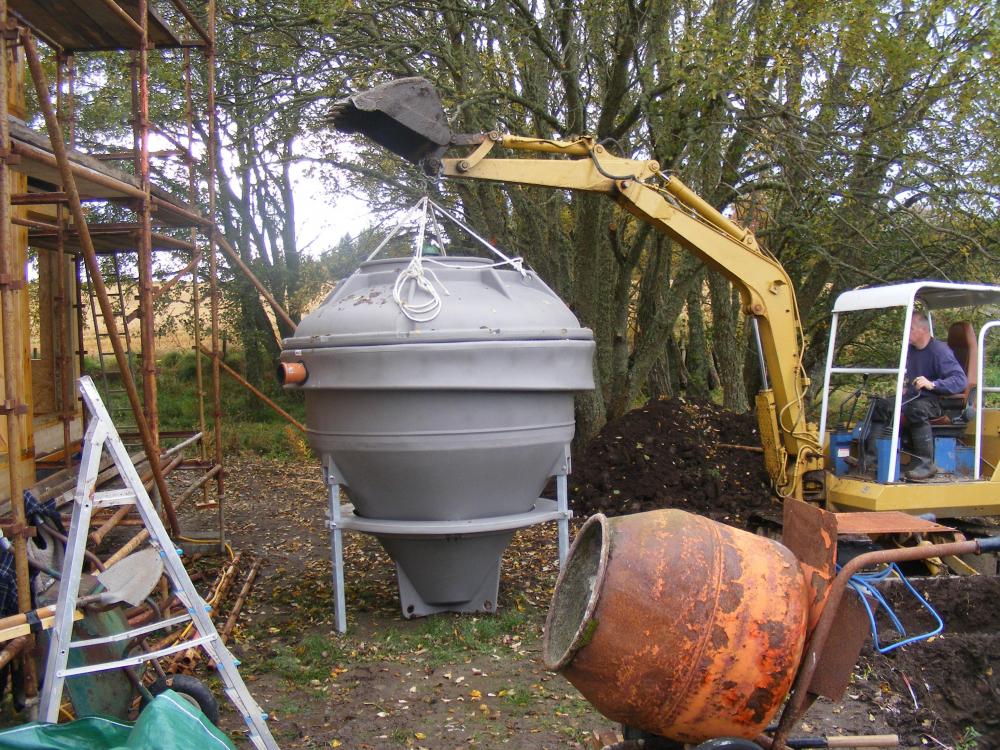
-
Why is my hot water tank making a noise?
ProDave replied to ProDave's topic in Boilers & Hot Water Tanks
Automatic air bleed valves on all the high points of the pipework. It did take a while for the last of the air to gradually bleed out, but the bottles are not collecting any more air now and the pressure has stopped dropping, so I am confident there is no air. I was wondering if the LACK of air now is what started it making the noise. -
My 5KW heat pump would have been a little over £2K if I had paid full list price, so with a 300L tank as well, £3K for parts. Lets add another £500 for pipe, fittings and controls so a total cost of £3.5K So if an installed price starts at £9K, someone is charging £5.5K to install it. Lets be generous and say the plumber gets paid £300 per day, that's 18 man days of labour you are paying for, and it is not going to take anything like that. SOMEONE is making a LOT of profit out of that job. I have long suspected that MCS installers deliberately inflate the price, to just about the level of RHI payments you will will get, so it is not YOU the customer benefiting from RHI, but the installer who gets away with inflated prices. I really think the government should investigate the high MCS prices. Failure to do so suggests they are happy for most of the RHI payments to go straight into the pocket of MCS installers, rather than benefiting the customer.
-
Why is my hot water tank making a noise?
ProDave replied to ProDave's topic in Boilers & Hot Water Tanks
I don't think it is the heat pump. That's about 10 metres away, and connected with flexi pipes. But crucually there is a short delay before the fan and compressor starts up, and the noise in the tank starts immediately the pump starts. So it is just the water flowing through the pumps that starts the tank making it's noise, and nothing changes when the fan and compressor start. -
Telford 300L stainless, unvented cylinder with heat pump input coil, heated by LG 5KW air source heat pump. Was fine when first comissioned. But for the last week or so, when the heat pump is running heating the tank, the tank is making a hell of a racket. I can best describe the noise as like an old PC fan with worn out bearings grinding and rattling away. The noise is coming from within the tank, not from the pipework. So it has to be something like the heat input coil inside thew tank vibrating and resonating. It did not do this to start with. Nothing has changed. Flow rate is about 15L per minute, I can't reduce that otherwise the heat pump will trip, but even if I do reduce it, it does not stop the noise. I have tried increasing and reducing the pressure (of the heating loop) and that made no difference (can't see why it would but it was something to try) Any ideas. This is driving me nuts.
-
^^ The parts cost for that system are likely to be in the order of £5K so that is a HUGE installation cost, confirming my opinion of the MCS rip off scam.
-
God I hate light fittings like that. INCOMPLETE. They expect you to make it up as you go along. WHAT secures and takes the strain of the flex? WHAT connects the flex to the fixed wiring? I would take it back as not fit for purpose unless you are prepared to sort out the missing bits. Earthing, which is the original question, you could to a lot worse than a ring terminal under one of the screws that fixed the bracket thing to the ceiling.
-
Yes but I am sure you will always be able to get a lead from the original USB A to USB z or whatever they choose to call it next week. We have 3 different phones in the house, with 3 different "USB" sockets, but all have a lead to fit the standard USB A
-
The bit that fixes to the ceiling. All I see at the moment is the cover, but not what the cover goes over.
-
All things being equal yes. But I had the unique requirement of wanting the socket to collapse into a 70mm wide void. This one appears to be the only one that will do that, and without USB sockets. Others are typically 90mm or more diameter.
-
Received loud and clear. Some people seem to see the poor search facilities of some websites as a "challenge".