
ProDave
-
Posts
30861 -
Joined
-
Last visited
-
Days Won
427
Everything posted by ProDave
-
Don't complicate it. Use the proper kit designed for the job. Keep and use the 2 port valves (making the non return valves redundant) Each manifold will be controlled by something presumably, e,g a time switch to say when that UFH system will be on? So connect that time switch to control the manifold controller that each UFH manifold should have. The manifold controller takes care of switching on the pump and the actuators when each zone calls for heat from it's thermostat and if no zone is calling for heat the pump will stop. The manifold controller has a relay output contact that you use to energise the 2 port valve for that manifold. Each 2 port valve has a switch contact. Connect all these in parallel to fire the boiler when any 2 port valve is open. That is it. If your heat source is an ASHP it may get more complcated as some ASHP's want to take over control of the 2 port valves so you have to alter the sequence of the wiring a bit.
-
I thought the activity space was 1000mm long, you would have to find a very small toilet indeed to fit a toilet and the activity space in a 1600mm long space. The obvious question, if this is a new extension, can you not find more room to make it comply? And swing the door outward so it does not swing over the activity space.
-
And how much will a 40m long horizontal dry riser with all the right fittings and certification cost? My guess is about the same as a sprinkler system?
-
Strip foundations and insulated suspended timber floor. The main issue for me is the slop of the site and I wanted to raise, not lower, the ground level. At the back, the house floor is 1 metre above ground level (and that is after the ground level was raised using all the spare soil) To do that with a passive slab would have been a lot of material to import, and would have meant building up a raised platform that extended beyond the perimiter of the house and would not have worked so well with the landscaping plans.
-
This sounds very much like my own site. For strip foundations you would dig through the made up soil down to 3ft or so until you are into original firm sand / gravel. You might have to remove all / some of the made soil under the house as well. The passive slab can probably best be described as an insulated raft foundation. You would have to strip most if not all the made ground and build up in layers of compacted stone before laying the passive slab system. It usually incorporates a perimeter French drain.
-
so @recoveringacademic have you tried adjusting it?
-
Any ideas on this large external crack?
ProDave replied to iSelfBuild's topic in General Structural Issues
Fill the crack, paint the whole outside (painting pebbledash is a lousy job) and sell on. It will smarten it up and look a lot less drab. -
Floorplan - Any thoughts/suggestions?
ProDave replied to Coops85's topic in New House & Self Build Design
I would swap lounge and Kitchen / diner. At the moment Kitchen / diner gets the best view and best sun. The curved pantry wall does not work for me. -
I'll bet the heater is set for Kerosene and to burn Diesel will need some adjustment, perhaps even different jets.
-
Roof sarking boards. Treated, untreated.
ProDave replied to Russell griffiths's topic in Building Materials
What is wrong with OSB? Cheap and solid. But our box profile rood sits on top of that on battens and counter battens, not directly onto the OSB. -
For just a hand wash basin, how about a low volume storage water heater, typically anything from 10L to 20L and with a 3KW element or similar size. This sort of thing just as an example not a recommendation to buy. https://www.ebay.co.uk/itm/10L-2kW-Under-sink-Water-Heater-by-ATC-3-sinks/142934692689?epid=2254439348&hash=item2147925351:g:OxYAAOSwnXpbl8P4
-
Whilst we wait (and hope)... things to do - ?
ProDave replied to Bored Shopper's topic in Project & Site Management
Not with me it would not. The first thing I do on a new build is go round with the customer and mark with a marker pen where all the switches and sockets are going. Then change or add any that the want. The electrical stuff shown on the plan is only ever a rough guide and in most cases things change. Sure it might cost a bit more if it ends up with more lights and sockets, but it does not cost more because it is a "variation" -
My guess re the PPE is he didn't know what service head he would find. A modern one like you have is usually perfectly safe, but if he had found an old cast iron one, I'll bet the PPE would have been used.
-
Interesting. What's the betting to be eligible you still have to have it installed my an MCS registered installer?
-
Likewise I used Ebico's no standing charge tariff that is no longer available. So the principle is sound, you just need o hunt out if anyone is still doing a no standing charge tariff.
-
Tilt & Swivel TV Bracket For 32" TV
ProDave replied to Onoff's topic in Networks, AV, Security & Automation
There is this one, that has a larger than normal bit on the wall so should stand a better chance of finding a stud to fix to https://cpc.farnell.com/electrovision/a195fe/dual-pivot-tilt-swivel-tv-brkt/dp/ST03901?st=pull out tv bracket -
Holiday let house in top of garage - idea
ProDave replied to jamiehamy's topic in General Self Build & DIY Discussion
Don't exclude us from your market (couples with child / children) The space you have is big enough for 2 bedrooms As an ex B&B proprietor I certainly would not want to run a B&B into retirement, that is too much work so the idea of the self catering sounds a lot less work. From a trade point of view, we found AirBnB very disappointing. Booking.com gave us (and continues to give our tenants) a steady stream of guests. You could follow the model we have (unintentionally) of just letting the whole thing to someone else that wants to run it. You would not get as much income, but you would not have to do much work either. The "portable building" / no building regs route frees you from some of the accessibility and circulation space requirements so may allow better use of space. You get into a grey area as a portable building can only be single storey. Some may argue being on top of a garage, it is 2 storey. Perhaps a phone call to the duty building control officer to clarify is you can build a portable building (caravan in building regs terms) on top of a concrete garage roof and still be BR exempt. -
The latter question, simply get a number of identical freesat boxes so they all function exactly the same. You might need identical televisions as well if you want them to really operate the same.
-
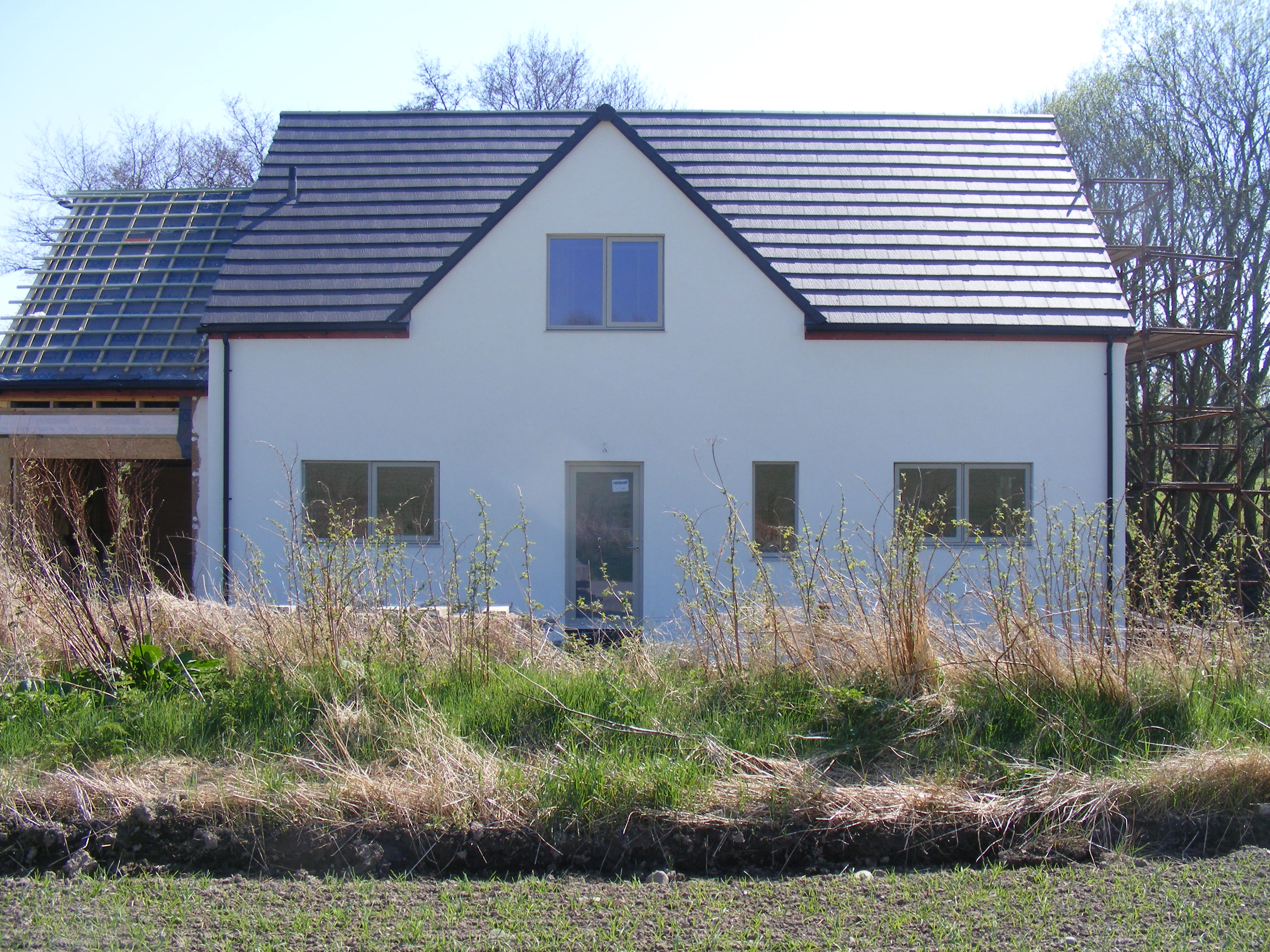
Any ideas on this large external crack?
ProDave replied to iSelfBuild's topic in General Structural Issues
The obvious questions have to be does the render sound loose or blown either side of the crack? Are there corresponding cracks on the plaster on the inside? and if you can see the often bare courses of brick at ground level below the pebbledash, are there any signs or movement, cracks or steps in those? That window cill does not seem to stick out much or have a drip bead, so chances are water is getting in behind the render. -
Tilt & Swivel TV Bracket For 32" TV
ProDave replied to Onoff's topic in Networks, AV, Security & Automation
The problem with swivel, is they tend to fix to one narrow point as the one @jack has shown. Fine if it lines up with a stud but you are lucky if that is the case. You can get tilting brackets that like the flat ones, tend to be wide so span across 2 joists usually. Would just tilt do? -
Different heat pumps work in different ways. My LG, you set the hot water tank temperature and it measures that with a probe in a pocket in the tank. I have that set to 47 degrees. You can also set a limit on the "water leaving temperature" in DHW mode, and I have that set for 55 degrees. Another quirk of mine is that it only heats hot water for 30 minute bursts before switching back to space heating for at least another 30 minutes, one of the reasons it can take so long to heat the tank. I can also read from the control unit what the actual HW tank temperature is so I know if it has reached the target temperature or not. The worst temperature point for an ASHP is just above freezing. That is when they are likely to freeze and need to defrost. Once it is well below zero there is usually very little moisture in the air to it tends to run for long periods without icing.
-
No, not yet. But by accident I do have a spare electricity meter, so I might just consider connecting to log how much energy it uses. There have not been any "multiple ladies showering" incidents since I fitted it, so I am sure it has not saved the day yet.
-
The issue, is under certain weather conditions (very close to 0 degrees, high humidity) an ASHP may ice up, so it has to stop what it is doing, defrost itself (which will take some heat out of your HW tank) and then start heating again. This has 2 effects, it will take longer, and use more electricity to heat the hot water. I have concluded there is a big issue of understanding. A conventional gas or oil boiler will pump perhaps 20KW of heat into a hot water tank and heat it up very quickly. An ASHP will put perhaps 5KW of heat into the tank and take very much longer. If you have just had a bath or several long showers and used up all the hot water, the recovery time will be much longer than a boiler. If you are not expecting that, you will be disappointed. I have fortified my own system by adding a Steibel Eltron instant water heater in line with the output. This is a modulating electric heater. The output temperature is set for the same as the HW tank temperature. So under normal use, it does very little. But if the tank runs low and the water starts to go cold, it will boost it in real time.
-
How did you get away fitting windows without trickle vents if you don't have mvhr?
-
Silly question, what do they want to watch on the tv? If just freeview, then can you get a "simple" remote or a simple programable remote? My (now departed) MIL complained about the complication and number of buttons on a modern tv remote. She just wanted on/off, volume and buttons 1-5. It nearly killed her fighting with a separate remote for a freeview box, until we could get her a digital tv. I had one customer where no matter how many times I showed her and gave written instructions she could just not understand her tv. She ended up leaving it switched on and just turned the volume down hen not watching it. I am convinced there a market for a "simple" no frills tv for the "older person" with most of the fancy functionality hidden.


