ProDave
-
Posts
30862 -
Joined
-
Last visited
-
Days Won
427
Everything posted by ProDave
-
An ASHP normally runs to either heat DHW or heat the house, never both at the same time. The details vary a bit from one ASHP to another, but mine has a different "water leaving" set point temperature depending on whether it's heating the house or the hot water. Motorised valves determine where the water from the ASHP goes, either to the HW tank or to the heating (with or without buffer tank) and only one motorised valve is open at a time. so when heating the DHW nothing is going to the heating or buffer tank so you won't over heat it.
-
I have fitted the one I have for now leaving the edge of the butchered hole on show and will swap it for the Chinese one when it arrives.
-
Mine is a 5kW LG ASHP and I run it with no buffer vessel. I don't see any issues at all. My max heating demand when -10 outside is just over 2kW
-
Fibaro switch wiring lack of knowledge!
ProDave replied to Pocster's topic in Networks, AV, Security & Automation
The button is open circuit when the light is on, so if fed from 5V there will be 5V across the bell push. Connect that to an input and it will read as "ON" Push the button and the light is shorted out by the switch. that's why the 5V feed should have some form of current limiting e.g a resistor. While the button is pressed there will be 0V across it, so the input will read as "OFF" hence the need to invert it in software. Where is this 5V from that is illuminating the light? -
Fibaro switch wiring lack of knowledge!
ProDave replied to Pocster's topic in Networks, AV, Security & Automation
I am not entirely sure how you have it wired, but an illuminated bell push has the lamp in parallel with the switch contact. the current that flows (from a door bell transformer) through the lamp is not enough to activate the door bell. When the button is pressed much more power is drawn activating the bell. To use that same illuminated bell push you would have to feed it with say 12V dc via a resistor. The resistor value would determine the brightness of the light. Connect the bell push to an input and in the non pressed state it would read high or "on" when you press the bell push it would short circuit the lamp and pull the input down to 0V and it would read as low or "off" . You would therefore have to invert that input in software to activate something when the button is pressed. -
But are you wanting mains for televisions etc? Another good read is this https://lifeattheendoftheroad.wordpress.com/ He lives at the north end of Raasay and there is quite a bit in his blog about his off grid energy system.
-
But they DO still insist on an EIC whatever the installation. One of my more unusual jobs was to wire a remote public toilet. All it had was a 12V battery, a solar panel and a small (caravan) wind turbine to charge it. The battery powered a fan to ventilate the composting toilet, and power for a 12V LED light. And building control still insisted I produce an EIC before they would sign it off.
-
The alternative and possibly more useful solution is run a 2.5mm ring circuit from the end of your 10mm cable to several sockets and feed it from a 32A mcb. This has earned the nickname of a "lollipop circuit"
-
@SeanK What are you trying to achieve? Do you have a mains connection? Or are you trying to power an off grid house? And presumably in any case you still need electricity for normal stuff? I like the concept of NiFe batteries and if I ever implement battery storage that is probably what I will use but so far I am just about able to self use all I generate without batteries.
-
That big terminal box from TLC is the only way I know of making that sort of connection.
-
Wanted: Broadband speed monitoring / logging program
ProDave replied to ProDave's topic in Boffin's Corner
I have just modified the script to just ping 8.8.8.8 once a minute and save the output from that to a log file. I'll see if that picks up any anomalies. But so far, since connecting the new router I am not aware of any drop outs -
My only thought is why limit PV to just water heating? Mine powers all sorts of things like the washing machine etc that we only run in the daytime close to mid day. When nothing else is using the electricity it goes to water heating but why not use it for other things as well?
-
Which brings into question is it really worth paying an MCS company to install a complete system so you can claim the RHI? Many of us have found it way cheaper to source the parts ourselves and self install and forget all about the RHI. Personally I have long concluded that with the inflated MCS prices often charged, the only winners are the MCS companies. My heating cost is a little over £200 per year via the ASHP. So assuming a COP of 3, that would me more like £600 with resistance heating. So saving £400 per year. The price I paid for my ASHP by the end of this year, the saving in heating costs will have paid for it.
-
Pros and cons of mains pressure hot/cold water to taps?
ProDave replied to arg's topic in Boilers & Hot Water Tanks
When you have had mains pressure water from all taps, hot and cold, you would never ever want to go back to 19th century plumbing. Beware of finding leaks in the pipework that has been fine for the last 40 years at low pressure. -
Semi permanent ladder setup for a stairwell.
ProDave replied to epsilonGreedy's topic in General Self Build & DIY Discussion
Howdens do a cheap straight staircase flight. I have never found a use for one as they only do one stock floor to floor height so have never been right for me, but would make a cheap temporary staircase. -
Semi permanent ladder setup for a stairwell.
ProDave replied to epsilonGreedy's topic in General Self Build & DIY Discussion
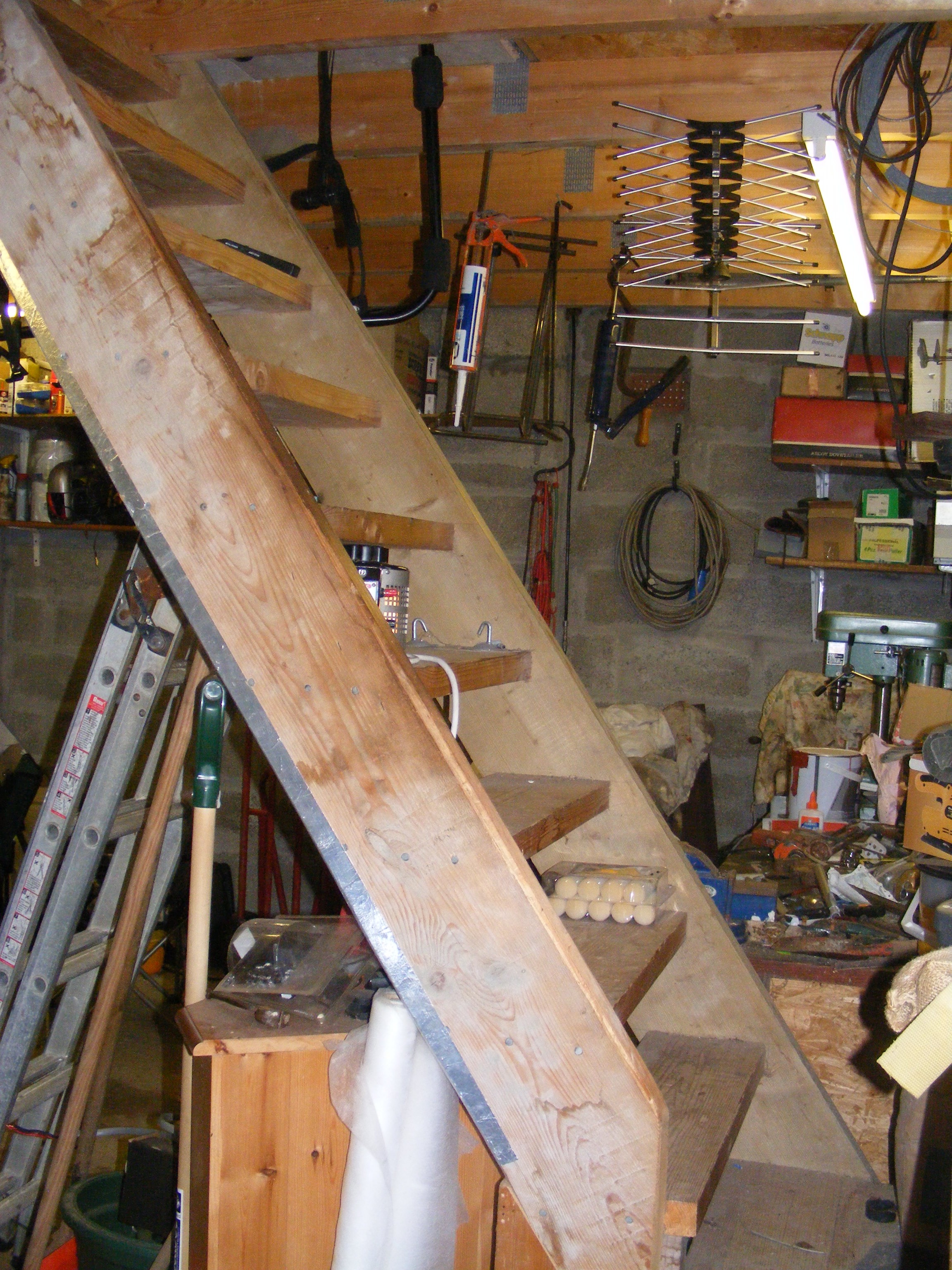
Like the one I made for the garage roof at the last house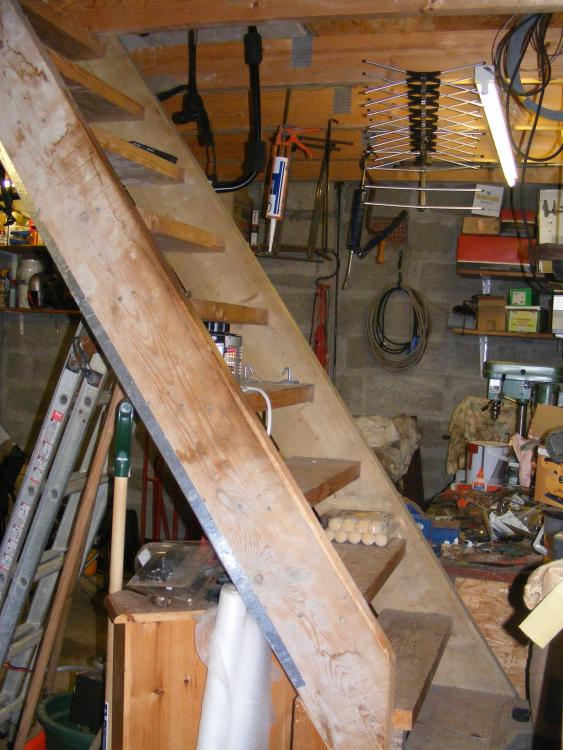
-
Semi permanent ladder setup for a stairwell.
ProDave replied to epsilonGreedy's topic in General Self Build & DIY Discussion
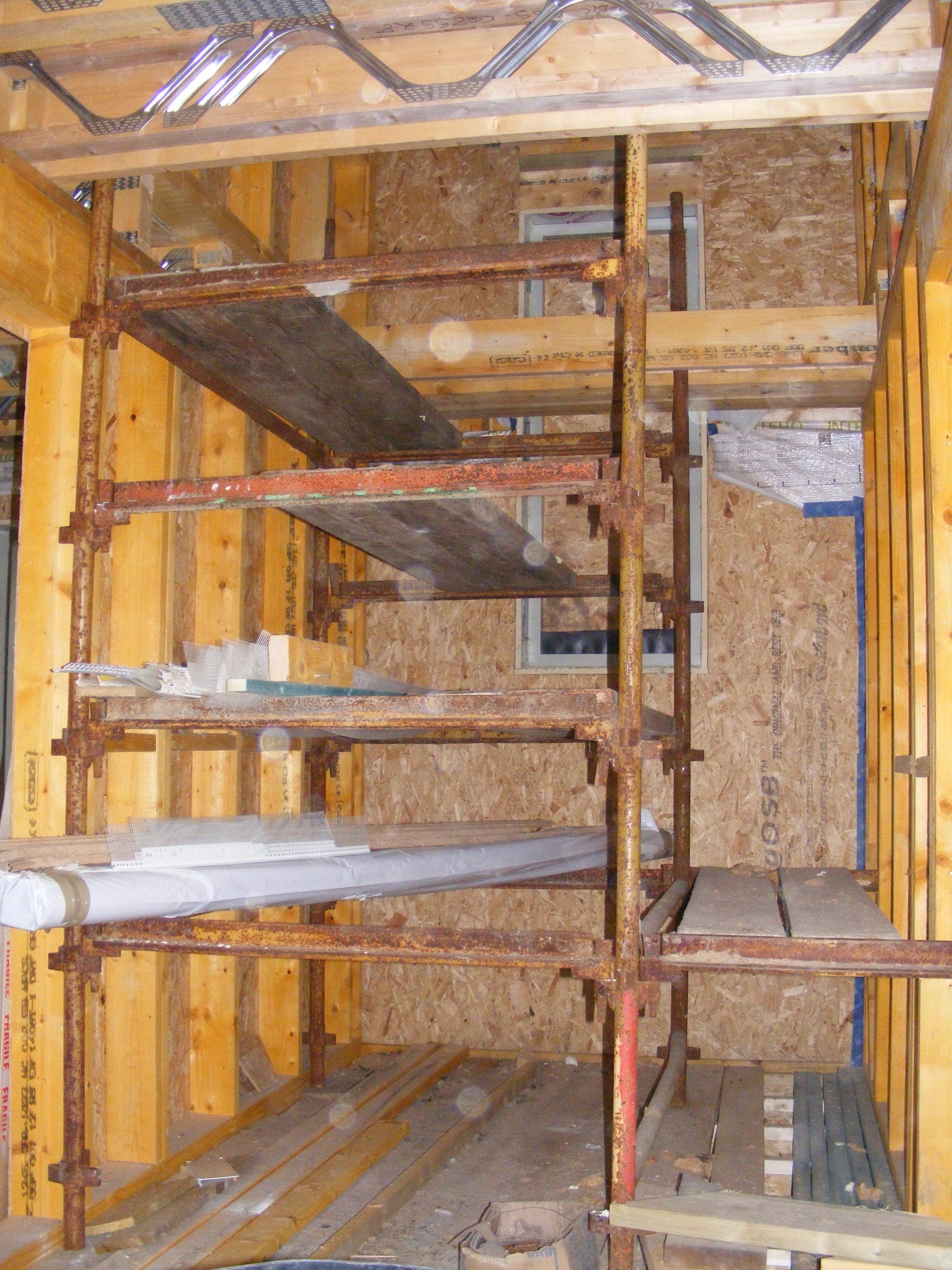
I found a Kwikstage scaffold staircase worked better, dead easy to lift materials up in stages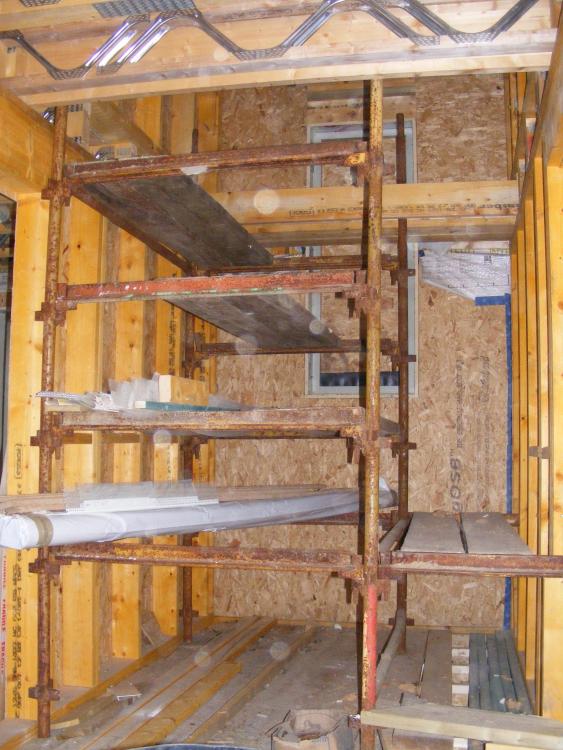
-
Wanted: Broadband speed monitoring / logging program
ProDave replied to ProDave's topic in Boffin's Corner
Yes I am not being clear. At the moment we only have copper all the way back to the exchange. I have seen the "super fast fibre" vans at the pit at the top of the road pulling something from a drum so I assume they are pulling fibre throughout the network, and one day, when they can be bothered, they might install a cabinet and some hardware at the top of the road and offer us FTTC still with the last few hundred metres through the old copper network. -
Solar DHW with UniQ and PV Diversion
ProDave replied to DamonHD's topic in Boilers & Hot Water Tanks
I made life even simpler. My home made solar PV diverter now switches on a wireless relay for an auxiliary load when it is approaching 100% power to the immersion heater. I just have a 750W electric convection heater plugged into that. It just ensures I can self use more of my own generation as at mid day with not much else on in the house, more can be generated than the immersion heater on it's own can absorb. I don't need much extra heat in the house now, so in summer I might put the wireless relay and heater out in the garage, just out of spite to stop it getting exported for no payment. -
Wanted: Broadband speed monitoring / logging program
ProDave replied to ProDave's topic in Boffin's Corner
On my first call to BT over this, the man got my hopes up by saying FTTC was available and an upgrade would be the best way to fix the fault. But when he tried to book it, it turned out FTTC was available at the exchange but not at "my cabinet" Just to show how clapped out the copper network is, when the line was installed we took the last spare pair in the cable down our street, and it then took them a week to find a working pair from the junction pit at the top of the road to the exchange. -
Floor bounce - PosiJoist Floor Vibration checks
ProDave replied to readiescards's topic in Floor Structures
I would start buy cutting an exploratory trap in the ceiling to have a better look. Squeaking and creaking boards, even with a missing or not secured strongback says to me not glued, just laid dry and nailed. If that is the case the boards need to come up, which would allow you to fix the strong back, and then re lay the boards glued and screwed. -
New member about to go on a trip of a lifetime
ProDave replied to crispy_wafer's topic in Introduce Yourself
What size of build? I am expecting to complete for £1000 per square metres for a nearly 150 square metre house, so within your budget. that was getting a builder to put up the bare shell and me doing everything else myself. It has taken 5 years so far but that has been budget contrained not just that I am a slow worker. £1000 per square metre is the lowest you can expect and that is with you doing a lot of work. -
A big thank you. That looks just like the one I have only the flange part (which is a separate part) is a larger diameter and will cover my bodged hole. Just off to order it. EDIT: only after ordering it and looking at the expected delivery date, do I find it's coming from China. Amazon don't seem to make that as clear as Ebay.
-
Wanted: Broadband speed monitoring / logging program
ProDave replied to ProDave's topic in Boffin's Corner
That chart would suggest the exchange is closer than I thought at more like 4Km for the speed we are getting. The new router has not dropped out yet, so who knows it could have fixed the problem? Time will tell. -
Phase one implementation is going to likely be anounced on 28th May for implementation immediately or within a few days, This phase 1 will also allow you to meet 1 other person from outside your household outside, and will allow outdoor non contact sports and limited travel to get to them. Our sailing group is discussing this and we think there is enough to allow us to launch the boat and go sailing. But only because we cans slipway launch. I can't see crane in for the larger boats happening any time soon as that involves too many people in one place.