ProDave
-
Posts
30688 -
Joined
-
Last visited
-
Days Won
424
Everything posted by ProDave
-
UK Power Networks survey visit; what questions do I need to ask?
ProDave replied to Thorfun's topic in Electrics - Other
What part of the UK are you? I have never heard of Kelly communications. Normally if you are getting BT to install a line, you pay a modest connection fee of about £56 and that covers anything. You normally only get charged by Open Reach if the cost of the connection exceeds £3000 which is the amount allocated for each new connection. -
How much electric do you all use and how to calculate storage
ProDave replied to Conor's topic in Energy Storage
Ignoring heating and hot water, we use typically 60=70kWh per week powering "stuff" Which is a one word way of saying the washing machine, the dishwasher, the tumble dryer, the fridge freezer, the televisions, computers, lights, vacuum cleaners and anything else you care to mention. We use a lot more powering "stuff" than we do heating the house and the hot water. If you could store 6kWh in batteries that could pretty much eliminate what "stuff" uses in the summer. Instead without batteries I just use the big appliances in the daytime to self use the solar PV generation and that, plus dumping excess to hot water, uses up almost all we generate.- 1 reply
-
- 2
-

-

-
UK Power Networks survey visit; what questions do I need to ask?
ProDave replied to Thorfun's topic in Electrics - Other
Since when did open reach charge for a survey? they did not here. Our water, electricty and telephone all had to cross a single track road. the cheapest way to achieve that was get the road up once, for the water connection and before the road was closed in went a black duct for electricity and a grey duct for telaphone ("Duct 56") Your OR guy should have free issued you with any cable and duct they need. So while the road is up just the once all you need goes in. you then bury the cable from there to your house again with the duct they provide if they want it in duct. Then when BT come to connect they just have to complete the cabling from the other side of the road. It is shocking how the utilities do not coordinate with each other at all and you have to sometimes be a little creative with your thinking to make things work. P.S that all reminds me about a very old black and white silent movie about a building site, where indeed on 3 consecutive days, each of the utilities came and dug up the road and re layed it, only for the next utility to come the next day and dig up the exact same spot...... -
This suggests that after 12 months, building control cannot enforce building regulations compliance https://hoa.org.uk/services/ask-an-expert-2/ask-an-expert-i-am-selling-questions/selling-without-building-regulations/ They can issue a dangerous building notice, but it would have to be in a pretty bad state for that. If it looks solid and is showing no sign of falling down, I suspect you have nothing to worry about. Just don't go asking building control to look at it.
-
Help with hanging things please.
ProDave replied to Moira Niedzwiecka's topic in General Self Build & DIY Discussion
If you are going to hang heavy things like shelves, then you want those fixed into solid wood. Think ahead and before you fit the plasterboard, work out where shelving goes and make sure you install plenty of noggins / dwangs to screw through the plasterboard and into. -
I would still delete loop 1-2 in the hall and just space out the rest of the pipes that are passing through the hall on their way to other places.
-
ASHP should be fine. to size it and the heating system you need to know the heat demand of the building usually from the SAP assesment Meeting building regs for insulation does not always mean it is "good" air tightness is important as well. 3 phase may be helpful particularly with regard the fast charger. No problem with the heat pump some distance away but you really want the hot water cylinder as close as possible to the bathrooms and kitchen, not 10 metres away. So in the house. they do not usually make noise. A sun amp is a different means of storing hot water, one that is not well suited to being heated by an ASHP. I heat hot water to 48 degrees with an ASHP that is hotter than I can hold my hand under so I doubt your wife needs her shower any hotter. You might not need much heat upstairs. What is wrong with UFH there as well to make everything simple? Solar PV is useful but bear in mind there is no feed in tariff any more so you have to cost it entirely on self used energy.
-
To clarify, I have an LG heat pump and it works well (with the occasional niggle) I don't have an Ecodan but I am familliar with them and have heard nothing but good things about them.
-
Check the regs for boxing in. I am sure it needs to be ventilated, needs access for inspection, and needs a CO alarm (at least in a recent new build I was tasked with installing a CO alarm in a flue void)
-
Assuming that is TWIN wall then it will be the manufacturers specification, which is usually something like 50mm or 60mm to combustibles. So some more of that celotex will need trimming a bit more.
-
If you had bought them from the place I did, you could have bought an "insulating sleeve" made just for that job. Oh look only 1 post up.
-
You have put a lot of work into that. Clearly going for the 3 phase version. I look forward so seeing the results.
-
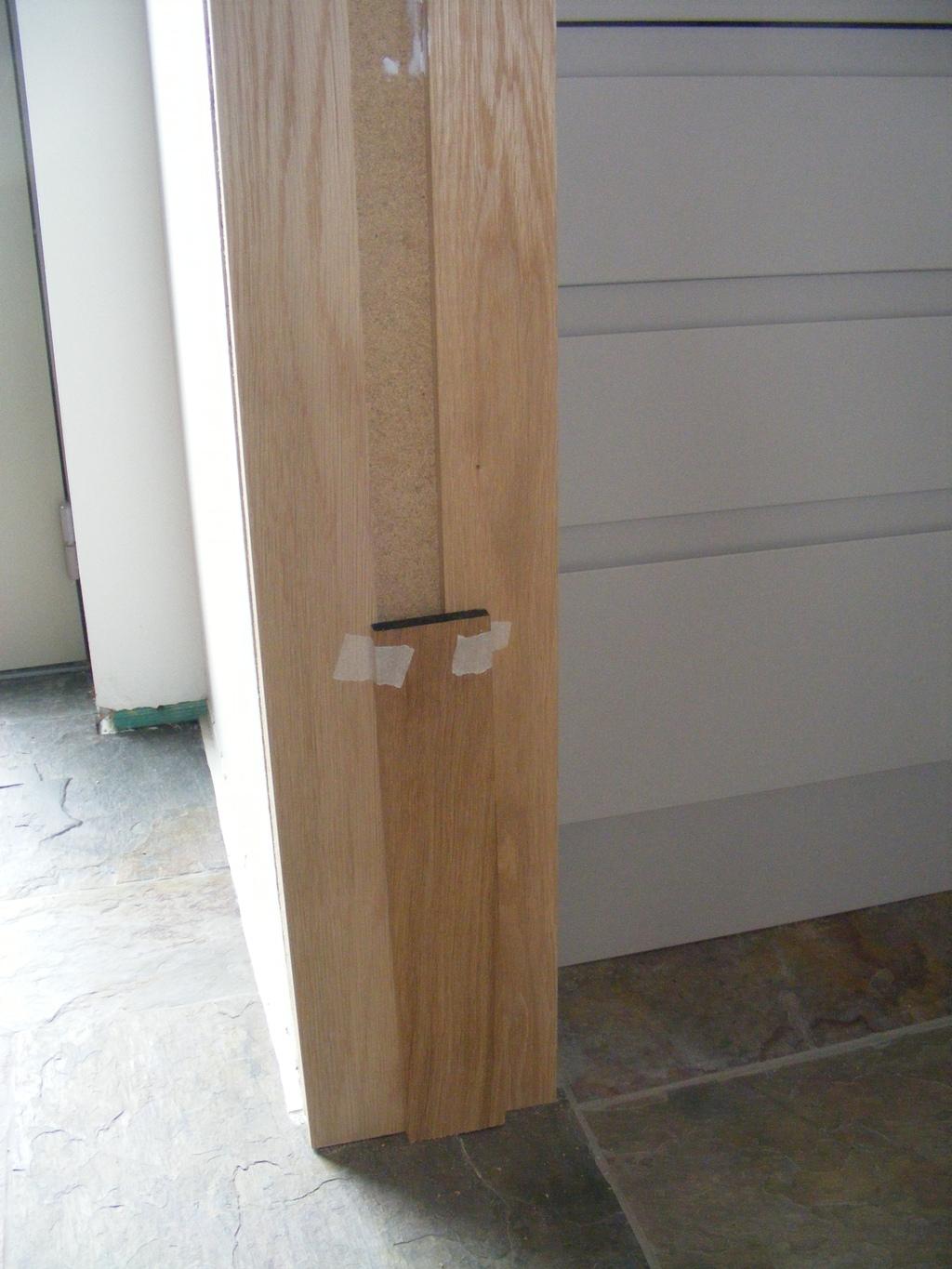
DIY OAK door frames MK2: The upstairs ones based on engineered oak floor boards ended up good, apart from "that join" Try as I might I could not find any engineered floor boards long enough to not need a join, and it has been decreed there will be no join in the downstairs door frames. I looked at buying planed oak and making my own, but it is hard finding it large enough and the cost, and the chance of it warping or cracking. In the mean time I bought strips of 12mm by 70mm solid planed oak for the door stops, and got experimenting with the offcuts. And came up with this: First build a "door frame" out of 22mm chipboard making it 24mm over size in width and 12mm over size in height. Then glue and screw (where possible) a 70mm by 12mm strip of planed oak each side. In this case the door will be fixed to the right hand of the two strips of oak. Then when the door has been hung, a third strip of planed oak will be fitted (depicted here by the short strip) to bridge the gap and act as the door stop. I am awaiting the joiner to fit the first door and try this. If it works I have 2 more to make each for a double door set.
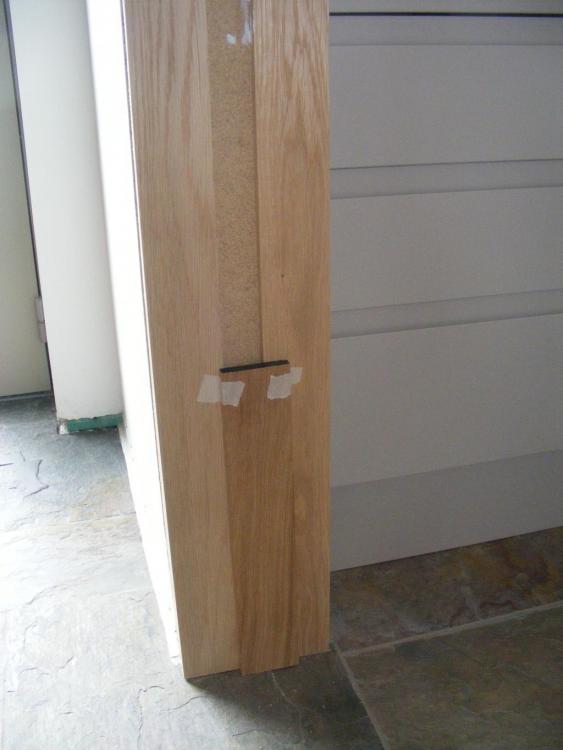
-
Just my obbservations with a near passive house and heating only on one floor. We only heat the downstairs with UFH and the room thermostats set to 20 degrees. In the depths of winter, the upstairs bedrooms get down to about 18 degrees. We find this just acceptable. Swap the rooms around and you would have unecessarilly hot bedrooms and a living room that was too cold. So you will want some (not very much) heating in the upstairs living space. That would allow you to run the downstairs (bedroom) heating lower. I can't see a scenario where you can only heat one floor. If you only heat the upstairs, then there is a good chance the bedrooms would get too cold.
-
I am a bit confused now. Does it work at all? If not what is the battery voltage at rest? And what does the battery voltage drop to when you try and move it? Even without a manual, surely all you want is the battery type fitted and get a new one(s) of the same type.
-
You are trying to "fix" it with a tiny ladder, than fix the issue stopping you getting a decent ladder in. If you want to be going up and down carrying stuff, AND without keep banging your head, you need a decent size loft hatch.
-
So now find out if the pipe still connects to a drain.
-
Are you sure? I used 2 layers of the pink fireline plasterboard with staggered joints.
-
Hi, I'm a novice and restoring an old church
ProDave replied to NotJustin's topic in Introduce Yourself
The bottom left section of that roof is in a bad way. The more I see of this, the more I am convinced roof off and full refurbishment adding insulation is the only way. That is going to want scaffold inside and out I would expect to attend to the interior planking that I assume you want to keep. I see little point in trying to do this piecemeal. I would buy a few large tarpaulins and fix those over the roof to keep the weather out until you have the finds to do it properly and thoroughly. -
Thinking about this again. Should that sort of "brown field" site not be exactly where we are encouraging houses to be built? It is of no agricultural value like that so you might as well re develop it in a useful way. Or would you prefer it to be left derelict and of not use and force people to build their house somewhere else?
-
Cut one of the joists and frame round it to fit a ladder the correct way.
-
Will that brick down in the bend lift out? If so get your hand down and clear as much rubble as you can and then try some water down it. Is the extension solid floor or suspended? Are there any manholes in the vicinity? I wonder if the extension has been built over the manhole that pipe used to connect to? You can see which direction it is heading in, so go looking in that direction for a manhole. Perhaps go and find all the manholes you can and do a sketch of where they are around the house and in relation to this room?
-
Best plasterboard lifter for damaged hands
ProDave replied to ToughButterCup's topic in Tools & Equipment
You have managed plenty else with your 8 digits. Seriously I regard plasterboard as a 2 man job. If you are macho you might manage on your own, but seriously it is far easier with two. Me and SWMBO between us fitted the 200 odd sheets used in this house and most of that without a lifter, just grunt force and a pair of dead men. -
We found - water!
ProDave commented on canalsiderenovation's blog entry in Canalside Bungalow Renovation
Did he "find" it without severing it? Nice tidy foundation trenches. -
Table top tap height for a 150mm high sink
ProDave replied to ToughButterCup's topic in Kitchen & Household Appliances
Both hot and cold to my basins are fed from the PRV that came with the unvented cylinder. The water pressure at the basin is just fine, at full tilt it does not spill out of the basin.