
ProDave
-
Posts
30683 -
Joined
-
Last visited
-
Days Won
424
Everything posted by ProDave
-
We have a small loft area in the top V of the vaulted roof that is inside the thermal envelope (warm roof) but separated from the room below by the floor and ceiling, and the only "ventilation" of that space is leakage around the loft hatch. I never find the air stale or in any way damp when I go up there.
- 1 reply
-
- 1
-

-

Heat Pump vs Gas Boiler: Relative Climate Impact
ProDave replied to Green Power's topic in Air Source Heat Pumps (ASHP)
So at last someone is talking about the real problem. How to deal with the lousy insulation and air tightness of the uk's old housing stock. Properly upgrade the insulation and you can get a massive reduction in energy usage. You still get that reduction in use if you kept the old heating system, changing it for a heat pump is almost incidental. But anyone reading this and not fully understanding will think the heat pump is an essential part of this. -
I have long moaned about my roughly 75kWh "non heating" electricity use each week, and finding out what it is and how to reduce it. I have finally made a start tackling that. The under stairs cupboard contains a lot of essential stuff most of which is on 24/7 so seemed an easy place to start. This includes satellite tv receivers, the printer, and all the network gear including the router, VOIP phone base unit, NAS storage etc. All stuff than needs to be on 24/7 but I know it consumes a lot of power. So time to measure it. I rigged up a couple of extension leads to power all this kit from one plug and made a loop of cable to allow my clamp ammeter to measure the power consumed, and came up with a total of 0.5 Amps, rising to 0.6 of the printer is printing. That's 120 VA If I assume most of it will be a poor power factor, lets take a guess that it translates to 100W as seen and metered by the electricity meter. that's 2.4kWh per day or 16.8kWh per week or 22% of my "non heating" usage. And at the present capped electricity rate of about 33p per kWh it is costing £289 per year to power that lot. So thoughts are turning to how to power that lot by adding more renewable power? Being an almost constant load and low power, and all together in one place, this seems a possible candidate for a little bit of off grid renewable power generation with a small amount of battery storage. Initial thoughts? A 12V system based on a large leisure battery for storage, charged from a few more solar PV panels and also a small wind turbine. Rough costings: Cheap "500W" wind turbine £150, leisure battery £100, solar PV panels £200 Add in sundries and that is going to be about £500 of expense. Theoretical payback of 2 to 3 years perhaps. So I expect that will be the main content of the thread, to design such a system, work out if it will actually work, and cost it properly, including an estimate of battery life and periodic replacement costs. The choice of PV and a small wind turbine to charge the battery are to try and get more generation in the winter. And it will once and for all confirm if a small cheap wind turbine is any good in a domestic setting. Control will probably be an Arduino Nano. All it has to do is monitor the battery voltage, switch out some generation or switch in a dump load if the battery voltage gets too high, and switch on a mains charger if there is insufficient renewable power and the battery voltage gets too low.
-
Unfortunate or relevant names
ProDave replied to CalvinHobbes's topic in General Self Build & DIY Discussion
Sorry I must have lived a sheltered life as it doesn't strike me as odd. -
Heat Pump vs Gas Boiler: Relative Climate Impact
ProDave replied to Green Power's topic in Air Source Heat Pumps (ASHP)
If I read it right, they updated all the insulation levels to meet current building regs requirements, then fitted a heat pump to achieve that 65% reduction? -
I would tackle all of this from above. Re the living room ceiling, that will be what is known as the eaves or coombe space. If there is a trap door on the bedroom wall below the window, then you are laughing. If not, cut a section of the plasterboard wall out and make one. That will enable you to get in and see what is what, see what insulation you have, how well it is fitted and what you can do to improve it. Same for the dormer, plasterboard off and see what is there. Expect to strip and re board the entire front wall of the bedroom to do it properly.
-
DIY MVHR - design, spec?
ProDave replied to Andeh's topic in Mechanical Ventilation with Heat Recovery (MVHR)
For simple DIY you want a radial system where semi flexible ducts run individually from each room vent back to a pair of plenum boxes near the actual MVHR unit. Start by looking at https://www.bpcventilation.com/ That is where I and a lot of other forum members have bought from. In my case the actual MVHR unit was an ebay bargain and I bought all the pipework, vent terminals and plenum boxes from BPC. What aspect of your quoted install has doubled? the parts cost, the labour, or both? EDIT: Just seen your quote. Don't buy kit like this from an electrical wholesaler, get a new quote for supply only, radial duct system from BPC -
Heat Pump vs Gas Boiler: Relative Climate Impact
ProDave replied to Green Power's topic in Air Source Heat Pumps (ASHP)
No the biggest reduction would be remove yourself from the planet. But nobody talks about population growth. -
Heat Pump vs Gas Boiler: Relative Climate Impact
ProDave replied to Green Power's topic in Air Source Heat Pumps (ASHP)
All it shows is using ANY form of heating is going to produce CO2. There is no neutral option available YET. That might come, one day, when ALL of our energy is produced by renewable sources, but only then if the CO2 produced actually making the generators can be offset somehow. We need to be honest, stop talking about CO2 neutral, and just talk about doing the best we can to reduce CO2. People might respond better when real achievable targets are set rather than some theoretical unachievable target that we all know will not happen so why bother trying? In my case I have done that by building a well insulated house that does not need much heat input, installed an ASHP to heat it, and some solar PV for some local renewable generation. I will probably do more in due course to increase local generation but to do that I will have to either fight stupid rules that limit the amount of PV I can have or just treat them with the contempt they deserve. -
If you want value, the little entrance "extension" will cost more per square metre than other bits of the build and add little of value. Consider designing the layout so you can add a second floor and another bedroom to the single storey rear annex.
-
Self build council tax. backdated?
ProDave replied to Water's topic in General Self Build & DIY Discussion
We were legally living on site in a static caravan paying band A council tax so they did not seem so bothered about hounding us, but I think Covid helped in that. I had to notify them on completion to get the house banded for council tax and the static van removed from the valuation list. -
Garage Loft Conversion Layout Advice Please
ProDave replied to Iceverge's topic in New House & Self Build Design
Workbenches against a sloping ceiling? It depends what you want to do. My workshop is just for that, working on stuff, so I actually have 2 workbenches one in front of the other. the slightly lower back one holds all the test gear and tools, and the front one, larger and higher is for the "work" but this puts it further from the sloping ceiling.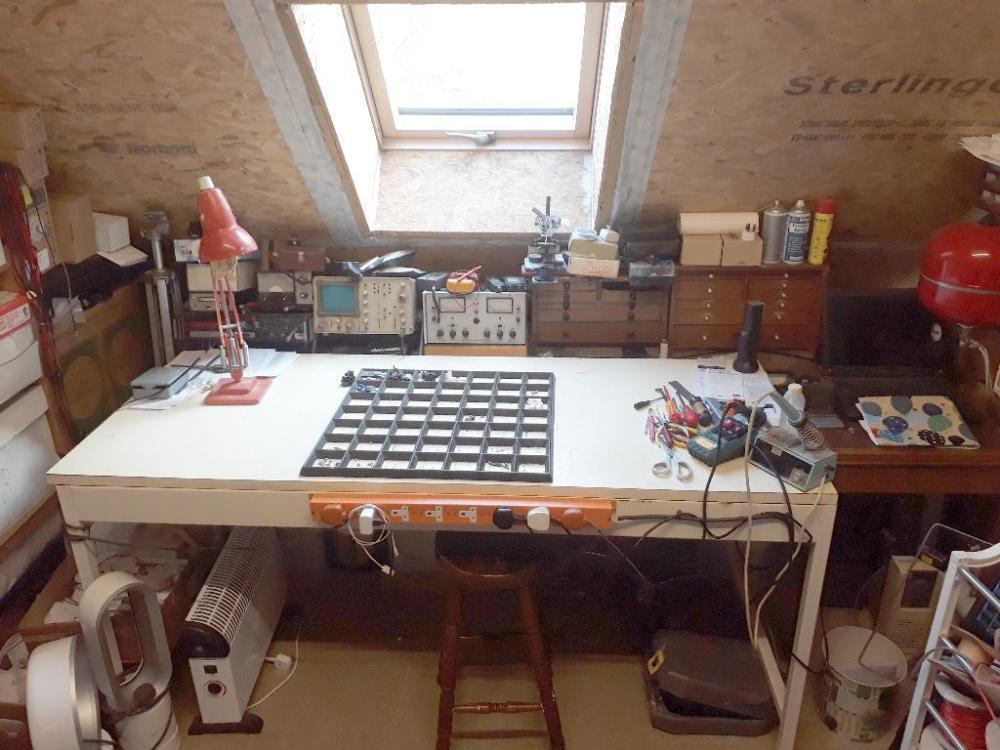
-
And use a stick to listen with to save sticking your head down in the trench.
-
What exactly is this "pumping station" If it was literally that, it would not matter what was in the ground water. So I assume it is in fact a borehole extracting water from an aquifer or something? Look up building regs, they have a bit about how close a treatment plant discharge field can be to a borehole. If you knew exactly where this borehole was you could ensure you met the building regs distances. you could try baiting them and send a recorded delivery letter stating you are intending to install a treatment plant and discharge field and if you don't get a reply by a nominated date, you will take that as them agreeing this does not breach the covenants.
-
What frost settings are you talking about? My ASHP seems to turn on it's circulation pump as a frost protection measure and seems to do so at about 10 degrees but it is an undocumented function and so not adjustable. IMHO 10 degrees is way too high, especially as the water contains antifreeze. I would love to be able to lower it to at least 5 degrees but it does not seem possible.
-
What stage did you find the hardest?
ProDave replied to BadgerBadger's topic in General Self Build & DIY Discussion
11 months from the start and "half way there" you are doing well. Ours took about 6 years. It's hard to pinpoint which bit was hardest, all have their challenges but in totally different ways. Financial issues were our problem but that was an ongoing thing throughout the build which is why it took so long. EVERYONE says "never again" at the end of a build. We did after our first one, and we said it again after our second one. You never know? -
So does that company exist? If not, just who do you expect to come trying to enforce an old covenant?
-
+1 for scaffold boards. Support them at least mid span with anything that will fit, any old blocks of wood, pile of blocks, sand bags etc. I would want two side by side secured together somehow, one is just a little narrow for a barrow unless you are careful.
-
Do you know who imposed this covenant, when and more importantly WHY? Does that person or body still exist? Does the reason for the restriction still exist?
-
How much land comes with these barns? What adjacent land is there and does any of the adjacent land have similar covenants? If not would you be able to negotiate with an adjoining land owner, to have a treatment plant on your land draining to a soakaway under adjacent land not subject to such a covenant? This is quite common here for individual houses to have a soakaway under adjoining farmland where there is not enough room for such a soakaway on their own land.
-
I would want to know why it was having issues draining away in dry conditions. More likely a foreign body has got into the drainage field pipe work and blocked something.
-
Re heat pumps and solar PV. DON'T think of it as "PV powering the heat pump" Think of it as "PV helping to power the whole ALL ELECTRIC house" Like many on here, we are in the country with no mains gas, so for our present house, designed to be well insulated and air tight, an ASHP made sense. The only practical alternatives were LPG gas or oil. I find is it easy to self use just about all our PV generated electricity just by time shifting big loads like washing machine etc to the middle of the day, and using excess otherwise unused PV to heat hot water via a diverter.
-
The tiles themselves don't do much to keep the heat in. It is the loft insulation and how well it is fitted that does that. So changing the roof tiles at great expense would not reduce the heat loss. If your house is the first picture with the bonnet hip tiles, I would not be replacing that with plain concrete tiles like the second picture.
-
Discharges in Groundwater Source Protection Zone 1
ProDave replied to Drellingore's topic in Building Regulations
What I found (SEPA in Scotland, so slightly different) is you choose your treatment plant, apply for a permit stating the manufacturers quoted figures, and that is what is put on your permit. -
I should have posted this one earlier. How to avoid the saniflow? Raise the WC to match the drain invert level