SimonD
-
Posts
2215 -
Joined
-
Last visited
-
Days Won
13
Everything posted by SimonD
-
In that case, simply install a normally open 2-port vale on the flow to the heating system that is wired to close when the cylinder calls for heat and opens the normally closed 2-port - that way all your high temp flow will go to the cylinder and not your heating circuit. This is pretty easy to plum and wire in and gives you your priority hot water.
-
When running a mixed circuit with an unmixed circuit (UFH and Rads) you really should have hydraulic separation. Does the system currently have hydraulic separation with all the pumps - how many do you actually have? With your UFH figures, they seem low given the 10kW load. At between 5-7 delta T your flow rate is going to be more like 20-28lpm. Your flow rates with a delta 20 across the boiler will be about: 12lpm at the boiler for 16kW 4.3lpm through the rads (Delta 20) Ignore the flow rates for DHW as part of the heating load as you really should be running priority hot water. As mentioned above, you definitely don't want a CCT just before the mixer. So design for a flow of 55 from the boiler, return of 35, then a 40 flow ufh (unless there's specific need to run hotter due to floor coverings) and 35 return. Then ideally choose a new boiler capable of priority hot water, or is Opentherm compatible and use something like the EPH priority hot water Opentherm Pack. I personally prefer systems that have load compensation and weather compensation, as I think it is always good to have room temp data for the system, but just weather comp and priority hot water work fine.
-
UVC Retrofit: Tundish D2 Discharge Pipe in a Passive House
SimonD replied to TerryE's topic in Boilers & Hot Water Tanks
I've used both Hotun and Macalpine self sealing tundishes, but not the Altechnic one. Your plumber should be on top of this as it's nothing unusual for an unvented installation. -
Supporting 250kg steel beam on nothing?
SimonD replied to knobblycats's topic in RSJs, Lintels & Steelwork
Proper self-build solution! Kwikstage is just magic for everything 😁 -
The copper
-
Can't be entirely sure but it looks like they've used and compression reducing coupling like this https://www.bes.co.uk/22-mm-x-15-mm-reducing-set-17738/ In that case it should be fairly straight forwards to remove the coupling and 15mm to replace with something else. In a previous house we had black plastic mains supply too.
-
Intumescent paint for use on OSB – who would you recommend?
SimonD replied to Chris HB's topic in Building Materials
Get in touch with either Envirograf or Flametect, both companies of which provide coatings but it needs technical input for the corrct certification. -
When is a cold bridge a cold bridge?
SimonD replied to SimonD's topic in Energy Efficient & Sustainable Design Concepts
Oh, I missed that. You're very patient. It's a Topdon TC001. I've now been using it for over a year for work and it has been invaluable for diagnosing and fixing heating systems and boilers. -
When is a cold bridge a cold bridge?
SimonD replied to SimonD's topic in Energy Efficient & Sustainable Design Concepts
If you look at the below picture, you'll see the knee stud wall fixed to the top of the steel which also supports the glulam beams with the triple studs. This was designed to be the external wall by the architect. As you'll see from the picture, there is an additional stud wall behind. This is my redesign. This new exterior wall sits on my roof joists just behind the steel. Hope that makes sense.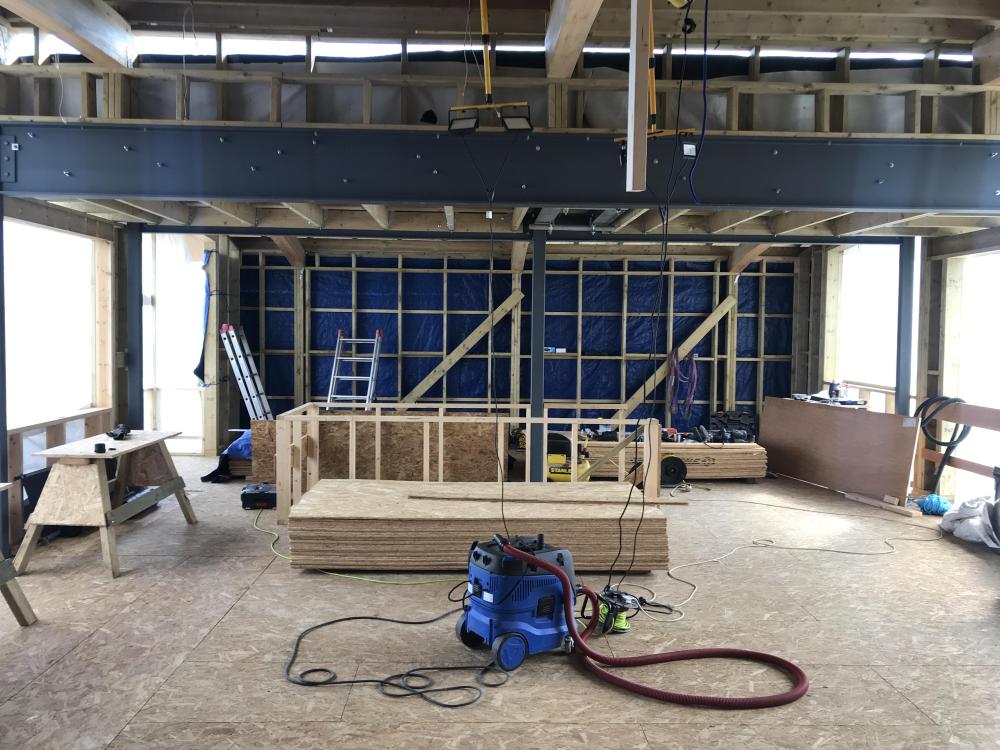
-
Do you also need an arbor to drill a hole with this?
SimonD replied to Adsibob's topic in General Construction Issues
Both your options will probably do the job. Personally I'd opt for something from the likes of Starrett, like this one made for sheet steel: https://www.amazon.co.uk/Starrett-FCH0400-102-Hole-Saw/dp/B01AWFCKDM?th=1 together with the appropriate arbor: https://www.amazon.co.uk/Starrett-Quick-Hitch-Arbor-Extra-Length/dp/B001LF8F0A?ref_=ast_sto_dp The arbor holds the hole saw in place, allows you to attach it to the drill and it drills a pilot hole in the centre of the hole and acts as a guide. For the size of hole you're looking to make, use a slow speed on the drill and be patient. A little cutting fluid like CT-90 can also help to prevent heat build up and eases the whole operation a little bit. -
Aquabion removal -what should I expect from my plumber?
SimonD replied to buenobear's topic in General Plumbing
On the site, they promise the same guarantee for merchants and trades: If your customer is not satisfied you can return the product within 365 days of your purchase for a full refund. So it's up to the plumber to remove it and send it back With the guarantee provided by the company, it seems it is on him. If the product genuinely doesn't do what you were told it would do, then I think you're completely within your rights to ask him to come and remove it and he can get his money back from the manufacturer. He's currently just fobbing you off. -
If this is the case, I'd recommend getting a cheap green lazer level, a folding rule and a piece of string/rope with 1m and/or 0.5m markings on it. Set up the level, lay the string on the slope, unfold the folding rule and then walk away from the level and take measurements off the folding rule. Much better for distance work as in some case you might need to walk up to 20meters..
-
Don't seal up the air bricks. The fact that there is no moisture penetration visible does not mean you don't experience humidity within the space and if what you're referring to as raft foundation is just concrete oversite, it isn't generally moisture impermeable either. Depending on the type of insulation you're using, you don't always have to have a breather membrane but can use a mesh to hold the insulation in place. You then use a membrane over the insulation and floor joists for airtightness and then install your subfloor/flooring.
-
I don't think it is easier to solve in a lossy house. It's our perspective and design criteria plus a cultural perspective on heating. Lots of other countries that have far better and therefore less lossy housing don't appear to have the same issues. Take Sweden for example. Building regulations there changed to specify heating system temps to 55C in the mid 80s, our regs only changed to this the last couple of years. Also, heat pumps are not designed to deal with full load in Sweden - this is managed using auxiliary heat source. From a cultural perspective, we've also essentially moved in the wrong direction for the last 30 years by throwing out hot water cylinders in preference of dreaded combi boiler. For me one of the major problems is that in the process of sizing whatever heat source we use, we have contradictory requirements. We want low running costs, high efficiency, comfortable warm space immediately, and we want immediate hot water supplies. Now, in theory it's perfectly possible to achieve this through careful and proper whole system design, installation, and commissioning, but there is a real reticence to accept in part the real-world upfront costs of this on a commercial basis. The discussions on this forum aren't really helpful or representative of the larger majority out there in terms of tendency to understand and tinker with systems, which is what leads to a scewed view of the time and costs of putting a system in that works properly for the long term. This forum also presents lots of single personal system design and setup, which isn't really a very secure foundation for determining a reliable methodology for sizing systems, it just gives us an idea of various approaches used but rarely to we get the full picture. This is not a MCS assumption. This kind of figure, if used consistently throughout the heat loss calc is down to the person completing the heat loss calc. Most input from the MCS (based on the CIBSE design guide) is 0.5 - 1.5ACH so what you've seen is a fault with the installer not the underlying calculation method. In truth, like I suggested earlier, we need a more balanced approach to calculating heat loss and system loads, which will inevitably require amixture of real world data combined with some theoretical calculations to arrive at solutions that are good enough and then use the learning from the good enough to interatively improve the process, but for that we need lots of data and time since we're so behind the curve.
-
Just looked this up. The older CIBSE guide uses Degree-Day Factors and interestingly what they say about using degree-days is that if using the UK standard of 15.5C, normalisation errors can exceed 30% where a house only needs heating if outdoor temp is below 10C. It also says that using degree days at 15.5C for highly insulated and passivhaus is inappropriate due to large normalisation errors. Maybe it is due to confusion and potential errors? 🤷♂️
-
No, I'm not. I was explaining in the context of boiler sizing that you cannot assume measurement figures without knowing the system particularly given the traditional tendency to over-size boilers and what the efficiency losses are in a gas boiler due to short-cycling and system design flaws. You asked for figures, I gave them to you. Don't take comments out of context, it doesn't help anyone. Read the rest of what I said and you'll find the figures. As I said: Heat system sizing is not and should not be a steady state question!
-
The CIBSE heat loss calc doesn't use any of this data nowadays although previous versions did. I have my own spreadsheet that uses degree days and provides estimated energy consumption which is helpful. I don't have cooling degree days in mine. SAP obviously does but that's not really a tool used for most heating system/boiler sizing exercises.
-
You can design a system to cope with the low load, that's actually not a problem. The real problem I think is a methodological one. We design systems and size boiler from the outset at maximum required load, which we know does not suit the technology available because temperature and demand varies across the year - significantly and the technology available can't modulate for this demand. This means that we really need to look at alternative basic assumptions, one of which might be to design the system to the greatest window of function across the heating season -i.e. it is designed to modulate to at least 80% of heat demand window, with a recognition that it might struggle a little bit on the coldest if days and short-cycle on the warmest. However, realistically, if you installed max 12kW boilers where now we've got 18-30kW boilers going in they're going to modulate pretty well across the season. Then there is the problem of actually getting a boiler small enough. Try buying a 6-8kW gas boiler. The smallest I can get I think is a 12kW heat only unit. Then there's the combi situation, which is pretty dire because of the dual usage. In all these examples, you can see that none of the thinking is joined up to look at the problems systemically.
-
I'm aware the suggestion was about measuring gas consumption, but the point is that mean home heat demand across the UK is something like 6-8kW - how many boilers of that size actually get installed, if you can even buy one at that input. Efficiency loss from boiler short cycling is exponential rather than linear so the more short cycling, obviously the more waste. Assume an average loss of 6-9% but can be up to 11.8%. However, this is not all. With a poorly set up system - e.g poor radiator balancing, badly set up pump etc. - you can lose up to 30% efficiency in the system. Not only that, with frequent boiler cycling you also lose methane to the atmosphere through the ignition cycle. Your typical condensing gas boiler is about 89% efficient out of the box. It only becomes rated at 90-94% efficient depending on the controls fitted to the boiler. This is lab measured efficiency and assumed steady state. You've got to take care to set up a retrofit system to be this efficient on an ongoing basis, so 85% is optimistic for a typical installation that receives little attention.
-
Because they could be running a 40kW boiler that was slung in by some old school plumbing wizard that thinks they can size a boiler using their finger, a bit of spit and sticking it in the air - these are the ones complaining the most about heat loss calcs....probably. So the boiler is set to heat the house intermittently, without having any radiators balanced and it short cycles every 3 minutes. The customer is happy because the radiators are burning hot at 80C. All when the house only needs 8kW of heat input when it's -3 ..... Whilst in no way perfect, heat loss calcs actually do represent a leap forward in heat system design and installation in this country, believe it or not.
-
Try here: (Used to be JTM Plumbing) Good supply of all types of pipe insulation: https://www.plumbingsuperstore.co.uk/browse/pipe-insulation.html
-
This is where your difference lies as a glycol solution has less heat capacity than water (at 100% it's about 2500 J/kg K). Also, don't forget you'll need to add extra pumping resistance as a consequence of this.
-
Domestic Heating Design Guide I think you're slightly low on your figures. My calculation at Delta T 5 and 12kW equates to 0.67 kg/s mass flow rate which is about 40.20 l/m and 16l/m if your assumption of 40% distribution to the cylinder works out. So you're looking at a higher flow rate that you expected, I think. Formula taken from Domestic Heating Design Guide.
-
Maybe I've missed something but this calculation doesn't seem to include how much heat you're moving through the system, which is what you need to determine the flow rate in your heating system. What Delta T are you assuming? At what temperature are you heating your cylinders to? Your system currently works because I'd assume that your oil boiler was commissioned to work at a 70C flow with 50C return - so as an approximate difference, at Delta T 20 and a flow rate of 0.9m/s you'll move about 11kW in water, if you're running a heat pump at 7C Delta T this will move about 4kW. With glycol this will be less as you'll only move about 3,600J/kg K with 20% glycol content. Max velocity is usually considered to be 1.5m/s but more ideally around 1.
-
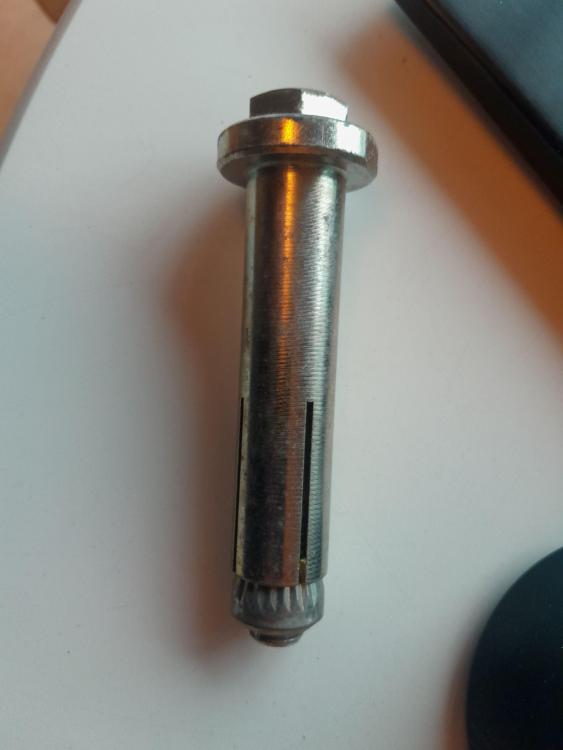
This is what they look like as used for fixing all the joists to the steels. No possibility of removing and then replacing the bolt as the whole fixing is the structural element. Thanks both, you've put me onto Rivnuts as an alternativ option but I'm struggling to find structural data for the rivnuts used for wider sections. This is something I briefly considered but followed the guidance of the SE and suggested fixings. I may just review this as an option. It's 3 meters drop so yes, I need to ensure it's robust enough. Currently the only option I know I can use is Interclamp/Kee Clamps tube clamp arrangements and depending on post diameter, I can install them up to 2m centres. Essentially what I want to do is come up with a design we like and then pass it by the SE as a final nod.