


Alan Ambrose
-
Posts
3392 -
Joined
-
Last visited
-
Days Won
15
Everything posted by Alan Ambrose
-
What is Ubakus really doing? And what is that 2/3 - 1/3 rule?
Alan Ambrose replied to Garald's topic in Heat Insulation
That's sad, it looks like it was going well. Re Ubakus: yes, here are the moisture models. The OP seems to have vanished, but I would encourage him to try the model options and see what difference it makes.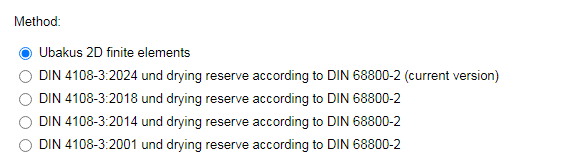
-
"The cables would stretch more than 2,000 miles across the entire floor of the Atlantic Ocean to connect places like the United Kingdom’s west with eastern Canada, and potentially New York with western France." https://edition.cnn.com/2024/06/26/climate/green-energy-wars-undersea-cables-intl/index.html
-
>>> @Dave Jones what are you considering fall challenged ? About 45m as the crow flies (these can fly straight-ish but not dead straight) with strictly speaking only 35cm of fall from GL to IL of culvert ... including the drops in gullies, inspection (x2 maybe x3) and a join into 300mm twinwall. This is for rainwater & SuDS set-up. @ETC - thanks for the tip on Wavin
-
Where is best to by an electric mains kiosk?
Alan Ambrose replied to saveasteading's topic in Barn Conversions
I see there are a bunch of suppliers, it seems to be a little cottage industry. -
Where is best to by an electric mains kiosk?
Alan Ambrose replied to saveasteading's topic in Barn Conversions
If you're going to pay £600, then you might just as well pay £800 for a stainless steel one (assuming UKPN doesn't outlaw metal ones): https://ritherdon.myshopify.com/collections/rb-cabinets/products/rb-800-cabinet?variant=21256431272015 -
HELP, failed perc test and on clay soil
Alan Ambrose replied to nowtie's topic in Rainwater, Guttering & SuDS
@nowtie >>> Is there anyway I can private message you with the report? I think you can attach it to a private message, but you could just post the link up here, or just the strata bit if you don't want to post the whole thing. -
I would think that's important info, particularly if you're 'fall challenged'? For the 2nd product below, I'm guessing it's ~75mm as this is 225mm twinwall into 300mm twinwall and the tops of the pipes look roughly in line, but whatever ... ?


-
HELP, failed perc test and on clay soil
Alan Ambrose replied to nowtie's topic in Rainwater, Guttering & SuDS
>>> I have just gone to the BGS website and it looks like there's something on the same road but I'm struggling to interpret the data, can you help? Ping me your site's postcode and I'll take a look at BGS. Or post up any nearby reports here and more knowledgeable people than me will chip in too. This is the kind of thing (from a 1941 borehole report maybe 3/4 mile away from my plot). It shows clay to about 20m and then sand under. If you found, say, sand closer to the surface, that would help a lot...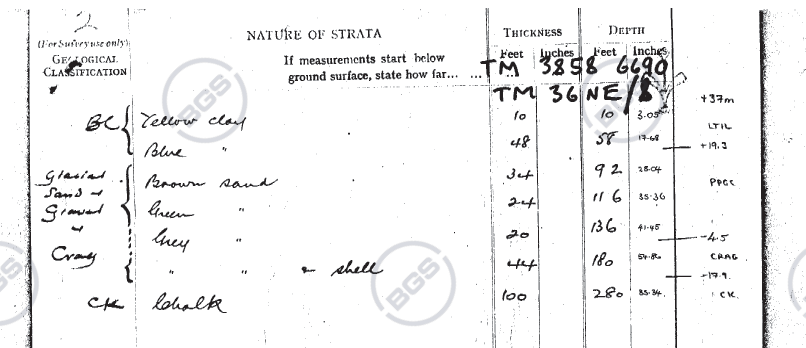
-
Selling house and boundary issue
Alan Ambrose replied to vik2001's topic in Party Wall & Property Legal Issues
Ah boundaries are complicated - read some of the old threads here. The Land Registry plans are not definitive. It could be that your neighbour is right unless you have other evidence. Easiest is to sell with boundaries as is and file more accurate boundaries with the Land Registry this time. -
HELP, failed perc test and on clay soil
Alan Ambrose replied to nowtie's topic in Rainwater, Guttering & SuDS
>>> I mean that's just not feasible right? I think that's possible. On my site, it's mostly clay with a small amount of 'sand lenses'. Next door, hearsay says they started digging out their 'moat', hit some sand, and all the water ran away. Find similar sand lenses that drain and you're in business. I don't know if such a thing is possible on mudstone though. -
Where is best to by an electric mains kiosk?
Alan Ambrose replied to saveasteading's topic in Barn Conversions
Wow, these are expensive for how well they are made. Anyone know - are you allowed to put a CU and say a router inside too? -
What is Ubakus really doing? And what is that 2/3 - 1/3 rule?
Alan Ambrose replied to Garald's topic in Heat Insulation
From memory doesn’t ubakus allow you to choose from a bunch of different moisture models? I’m guessing that a typical moisture analysis usually isn’t so marginal that the choice of moisture model means much anyway. -
You might be able to slip it into fulfilment of a condition - do you have to confirm materials, planting etc? Or the straight forward way is to file a non-material amendment - no rush as presumably you'll do this near the end?
-
This? "You will also need to provide one of the following: + An approved claim for a VAT refund for DIY house builders + A self-build warranty + An approved self-build mortgage" So, the VAT claim will do it?
-
Yeah, good quality diamond drills will do it, but even then, they take a while. I found the erbauer drill guide a bit b.....x.
-
HELP, failed perc test and on clay soil
Alan Ambrose replied to nowtie's topic in Rainwater, Guttering & SuDS
Do you have a soil investigation and/or have you looked up BGS records of any bores nearby. It would be interesting to see how deep the clay is and what’s under it. -
Certificates needed for site clearance
Alan Ambrose replied to MariaD's topic in New House & Self Build Design
To go to a proper waste plant, the dirt would need to be tested if there’s any amount of it. (A single wheelbarrow full probably gets through the system unscathed.) There’s restrictions on knotweed etc. Look up ‘WAC testing’ (not some kind of sanity test). If it’s going to be left in a layby somewhere you won’t need any certs. Check he’s not being an idiot over one wheelbarrow worth, but suggest the answer is ‘yes’. -
Not much. Probably fencing, hedging, tree planting, grass cutting, vegetation clearing. Soil investigation, percolation tests etc. Demo maybe. I email my LPA’s CIL people to check before I do anything much.
-
Fire protection of steels and this example?
Alan Ambrose replied to Alan Ambrose's topic in Building Regulations
Apologies - I was not intending to cause controversy - I was just asking, as a fire regs newbe, 'how does this meet the regs'. Reading this article and looking at the pictures more closely, I think that structurally it is probably a steel frame building entirely (i.e. not a few random steels dropped in for span purposes). It actually appeals to my meccano-kid 5-year old self. So, I suppose nicely coloured intumescent paint is the simple answer. -
French renewables boost causes negative electricity prices…
Alan Ambrose replied to Alan Ambrose's topic in Housing Politics
>>> Instability? Surely this is a good thing I imagine the nuclear plants are already bugging the French regulator suggesting that they have to pick up the cost (and risk?) of wind and solar putting random spiky amounts of power onto the grid. That is 'it was all very safe and stable until the new boys came along'. -
Wind and solar glut forces 6 French reactors to shut temporarily: https://fortune.com/2024/06/16/electricity-prices-france-negative-renewable-energy-supply-solar-power-wind-turbines/ I wonder whether there will be some future intervention on the electricity marketplace to reduce this kind of grid instability?
-
Fire protection of steels and this example?
Alan Ambrose replied to Alan Ambrose's topic in Building Regulations
And this: "The basement is not counted when assessing the numbers of storeys for fire resistance and means of escape. Typically, for a two-storey house over a basement, 30 minutes fire resistance is required for the structure..." https://www.basements.org.uk/TBIC/Basements/Fire-Safety.aspx -
Fire protection of steels and this example?
Alan Ambrose replied to Alan Ambrose's topic in Building Regulations
OK school day for me apparently: "A pack with 4,400+ matt and eggshell colours with sufficient intumescent basecoat (Bollom Brosteel Ultra 60) and coloured topcoat (Bollom Flameguard Ultra Vinyl Matt, Bollom Flameguard Ultra Acrylic Eggshell) to protect suitably primed, standard ‘ɪ’ shape structural steel beams and columns in internal environments to 30 minute fire resistance." https://www.rawlinspaints.com/products/5402-zeroflame-aquasteel-wb-30min-system-for-universal-beams-columns.html https://www.rawlinspaints.com/products/5232-bollom-brosteel-ultra-60-30min-system-for-universal-beams-columns.html -
Getting broadband/WiFi to my garage.
Alan Ambrose replied to Russdl's topic in Networks, AV, Security & Automation
As an alternative, I can't think there would be a problem running two or more SWA cables (e.g. one power, one network) in the same duct. Yeah, theoretically heating if there were two power cables, but you're unlikely to be doing that. -
Fire protection of steels and this example?
Alan Ambrose replied to Alan Ambrose's topic in Building Regulations
But it looks like, from the article, they do:.thumb.jpg.1f9858dff5a0460129224193be946908.jpg)




.jpg.33e8550e3f4bdbd5c3171081d2b49713.jpg)