Alan Ambrose
-
Posts
3129 -
Joined
-
Last visited
-
Days Won
13
Everything posted by Alan Ambrose
-
Good solutions for service voids and ....ing plasterboard
Alan Ambrose replied to Alan Ambrose's topic in Electrics - Other
OK I'm leaning towards the 'drop down from service void above' (I guess that could also work 'from below' if you have a basement) and 'duct/flexible conduit' solutions. Of course, cable trays are used everywhere in offices for this purpose. Maybe there's a way to build them into the walls at socket height. Alan -
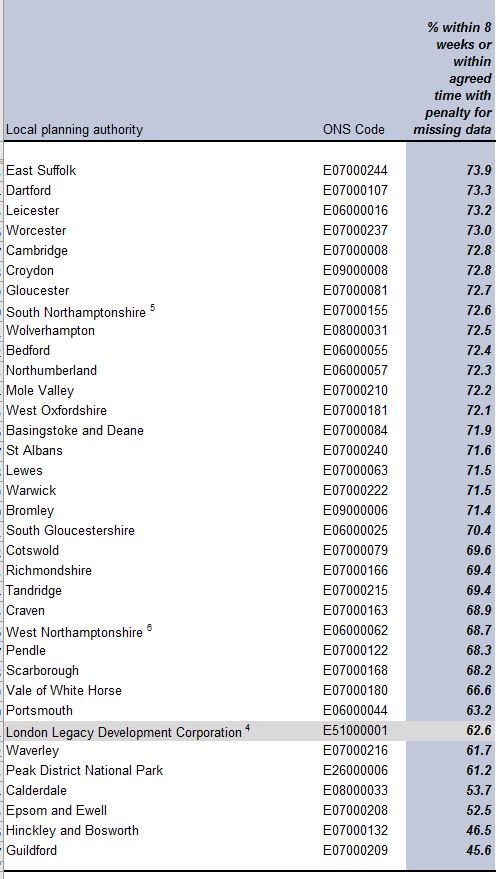
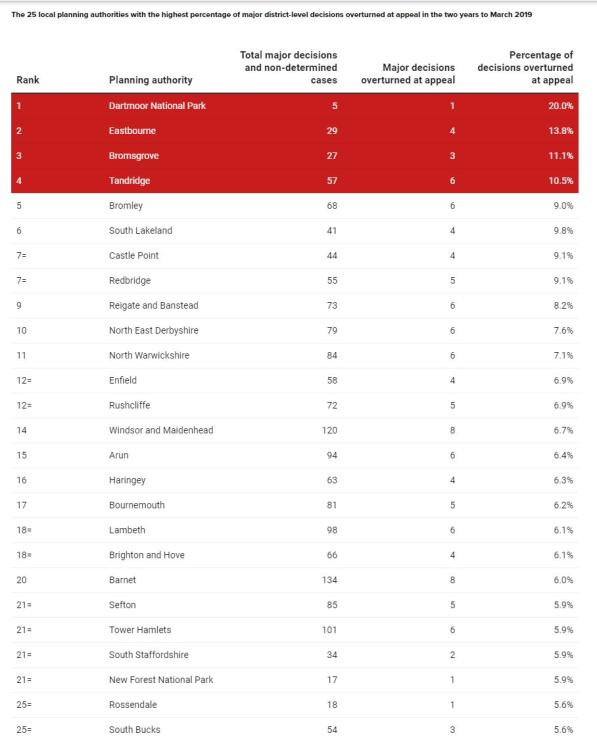
>>> @Mr Punter - East Suffolk seem to be taking about 3-4 months. Probably typical. Can you actually see the planning delay stats somewhere or is that a single data point? >>> @DevilDamo - What’s the reason for you not having Appealed as a result of non-determination? Well I'm looking at existing application delays with a view to 'planning my planning application'. I was just looking at my neighbour's application. In my investigations I came across these (not very readable) stats: https://www.gov.uk/government/statistical-data-sets/live-tables-on-planning-application-statistics Table P153 'district planning authorities performance - speed of non-major decisions' seems to be the most relevant: https://assets.publishing.service.gov.uk/government/uploads/system/uploads/attachment_data/file/1125509/Table_P153.ods I can see East Suffolk is 295th out of 329 i.e. in the bottom 10%. The others at the bottom are as below. I also found out that planning departments can be in 'special measures' although I can't see a current list of those anywhere. I did find this 2020 list though: https://www.planningresource.co.uk/article/1690460/authorities-danger-special-measures-designation-poor-appeal-records Alan
-
Good solutions for service voids and ....ing plasterboard
Alan Ambrose replied to Alan Ambrose's topic in Electrics - Other
>>> It’s got nothing to do with building control I was meaning BCO love plasterboard for fire reasons. >>> What have you against plasterboard? It's crumbly cut-once stuff. If a 'professional' had done the wire pulling job I just did - for time reasons they would have made a swiss cheese of the plasterboard and roughly patched up the holes. That's fine - until the next time. >>> I would do it like on the continent with a large duct that I can pull new cables through. Like a square plastic ventilation duct? Or a cable tray kind of thing? Alan -
Mine (East Suffolk) is taking a year to do simple non-contentious single dwelling stuff atm. From their org chart, they seem to be fully staffed and I can't imagine a huge increased in demand for their services as there's so little building land available. They seem to be getting back responses from the various consultation bodies reasonably quickly and then just sitting on the applications. So much for ... the statutory determination period for validated planning applications, which local planning authorities should not exceed, is 8 weeks. https://www.designingbuildings.co.uk/wiki/Planning_permission_-_how_long_does_it_take Did I miss something? How are other local planning departments doing these days? Alan
-
Hi, In our 'old build' I have been running some new cables over the last few days in a crazy awkward place behind a consumer unit (as it happens) and through some metal studs and voids containing properly itchy fiberglass. Super time consuming (unless you want to hack the wall to pieces) and annoying. Also some of the plasterboard had already been hacked about a bit and some had gone a bit soft in places (or was that just me). So the finish leaves a lot to be desired. Well it reminded me that in our 'new build', I would really, really, really like (a) to have a proper service void that I can pull new services through easily when needed, and (b) walls clad preferably with something other than plasterboard. I know that's ... unconventional, BCO will hate it etc. But somebody somewhere must have figured out (a) a better approach to service voids; (b) not expecting all services to be 100% designed up front and stay like that for the life of the building; (c) an alternative to plasterboard. Alan
-
>>> One other point, my property deeds state that I have now right of easement. Can it be assumed therefore the Neighbours would say the same please? You don't say over what? Probably not safe to assume unless the buildings are similar and built and sold at the same time. >>> They said I have to take their rainwater by virtue of easement, and since the arrangement has been in place unchallenged for >20 years it has to remain. So ask them to produce the easement as proof together with the original plans. It would also be useful to ask the BCO why they think the neighbour's gutters should be capped. Get the answer in writing (an email will do). Ask the BCO nicely 'as you're getting some pushback, if they wouldn't mind informing the neighbour in writing of their decision'. >>> The builder even commented on the black soil whilst excavating for the foundations. Your builder? Ask them to send you an email with their opinion too. There are two basic directions - either design to take your neighbour's rainwater (probably not a big deal) and forget about it. Or, call the bully neighbour out: write them a letter saying that you have proof their drainage wasn't built to spec. and is causing a nuisance. And you will be fitting your caps as instructed by the BCO. They should take the matter up with the BCO if they disagree. Alan
-
Insulation woes; Jetrock 2? (Alternatives?)
Alan Ambrose replied to Garald's topic in Heat Insulation
While cellulose has low embedded energy, I think I would go with Rockwool for its fire and damp behaviour. It'll be boxed in, so the ongoing irritant factor will be negligible. Alan -
Insulation woes; Jetrock 2? (Alternatives?)
Alan Ambrose replied to Garald's topic in Heat Insulation
>>> I don’t think any insulation manufacturer would market a product that was inherently dangerous to health either in its install or use. Ha ha ha, ha ha ha, ha. Grenfell maybe? Asbestos was only completely banned as a building material in ... 1999. The building I'm in right now has 50mm of (very flammable) expanded polystyrene in the walls and it was built in the '90s. The manufacturer is still selling this as a building material. Maybe you were being sarcastic. Alan -
Ah, interesting discussion as always on BH, Thanks for the pointer to 'co-heating test', I see e.g.: https://www.designingbuildings.co.uk/wiki/Co-heating_test https://www.nhbcfoundation.org/wp-content/uploads/2016/05/NF54-Review-of-co-heating-test-methodologies.pdf I guess I was thinking similar to ProDave - to verify that the actual build was close to the design calcs. Also, to measure the actual numbers for buildings where you don't have the original design calcs (or buildings old enough that there were no/minimal calcs). I have a couple of those and I would be interested to see what the numbers look like. The results could be used as an input to 'non-AI' heat controllers (a 'building model') for better temperature / energy optimisation. Good points about air movement, solar gain, thermal mass etc. I'm thinking that you could actually measure wind and solar inputs and distill down the answers by regression and/or simple AI (actually I see that's what the NHBC researchers did in their analysis). Also a good point about taking out the thermal mass effect by aiming for steady-state. The SAP and Passivehaus calcs are static ones and. in time (maybe) you could build up a dynamic model. Curiously the NHBC paper suggests that in some circumstances they were able to get within 4% of the SAP calcs. I've never thought of SAP as particularly accurate, so that surprised me. Alan
-
Hi, Am I right in thinking it should be pretty easy to figure out whole house U values and even some room level U values by blipping the heating with known heat inputs (e.g. on full power for a few hours) noting the outside temperatures and observing the inside temperature response curves? Alan
-
What do you think of Flextron for a zinc roof?
Alan Ambrose replied to CalvinHobbes's topic in Photovoltaics (PV)
Interesting. I see that working on metal seam and maybe slate. Wonder where the connections are? Alan -
There's some downlighter insulation thingies that might be useful. Not seen any that install from below, but it's not impossible. If working from above: this kind of thing: https://www.wickes.co.uk/Loftleg-Loft-Lid-Downlight-Protector-Hood/p/148851 ... and then patch the insulation and membrane? Alan
-
Anyone bought an OK stud finder on Amazon?
Alan Ambrose replied to Radian's topic in Tools & Equipment
I rest my case. -
Anyone bought an OK stud finder on Amazon?
Alan Ambrose replied to Radian's topic in Tools & Equipment
From the PMD 7 manual: Manual Calibration If the signal LED 2 illuminates red or yellow, even when no metal is in the vicinity of the measuring tool, the tool must be recalibrated. – To do this, switch the measuring device on using the On/Off switch 3. – Remove a battery from the switched on measuring device. – While the battery is removed, switch the measuring device off using the On/Off switch 3. – Reinsert the batteries into the measuring device (pay attention to the polarity!) – Now remove all objects in the vicinity of the measuring device (including wrist watches or rings of metal) and hold the measuring tool up in the air. – Switch the measuring device on using the On/Off switch 3 and off again within 3 seconds. The signal LED 2 of the measuring device will flash red in slow succession during the 3 seconds to indicate that it is ready to calibrate. – Switch the measuring device back on within 0.5 seconds. The calibration is initiated and takes about 6 seconds. The signal LED 2 will flash green for 6 seconds in quick succession, the calibration is being performed. Now the device is once more ready for operation and the signal LED 2 illuminates solid green. Note: If the sequence of switching off then on again is not followed, no calibration is performed. The signal LED 2 remains either yellow or red, even though no metal is located within the vicinity. In this case, repeat the calibration. -
Anyone bought an OK stud finder on Amazon?
Alan Ambrose replied to Radian's topic in Tools & Equipment
Ahhh, I just chucked a Bosch PMD 7 - it never worked reliably. Occasionally I could find a metal stud or a cable, but more often than not it just went various shades of loopy. Read the manual a few times (such as it is), was careful to give it an 'earth' etc. >>> Yes I nicked the cable A Wago joining kit or two and you're good. I would love to find a reliable cable/metal finder. Maybe a borescope would be more useful? Alan -
If you’re gentle with a drill bit through the plasterboard and don’t use over-long fixings, you can finesse it. Pipes and cables are not generally right behind the plasterboard. You can even try drilling through a bit of old gas pipe with the bit you intend to use to get a sense of ‘what does it feel like to hit a pipe’. Are you not going to pick up the studs for a secure fixing anyway? What fixings are you using? A borescope might be another more technical solution. i think, in practice, most kitchen fitters have little idea what’s behind the plaster - how would they? Alan
-
It took me many decades to figure out (before that time I was always fretting over the 'best' option) - that when several options are about equal, even more when you can't decide which one is best - then it doesn't matter much which one you take - it will be very nearly as good as the other option(s) anyway. That's saved me a lot of energy since. Alan
-
Ah the dreaded comprise… if it’s easy and cheap I would relay them - that’s one of the privileges of a self build. Then make a mental note, particularly for later decisions that are hard to change after the fact, to ‘consider 19 times and build once’. There will be some things during the build that will be hard and expensive to change after the fact. Brace yourself that you will just have to live with those decisions. Alan
-
How about blowing all the water out with air and then pressure testing it again? Alan
-
We had this problem with one circuit on a new Uponor system. Was simply the actuator for that circuit not clipped on properly - from memory they just clip on, but the clip action is quite hard. The actuator movement is only a few mm, so it doesn’t take much. Take actuator off, check it responds to the thermostat signal, check that the valve moves by poking it with a pencil etc., re-install actuator carefully making sure it is fully clipped on. if actuator doesn’t move with thermostat, check wiring and, as last resort, replace actuator - they’re only £20 or so. You can also swap the actuators from one loop to another as a debugging measure - to prove which actuators / valves work and which don’t. Alan
-
architect vs. architectural designers
Alan Ambrose replied to TryC's topic in Surveyors & Architects
>>> may I ask if I can use the services from a retired architect ? ... So, I'm not sure if they will have PII For the concept / overall design / planning? Yes, I would and I can't think of much you could sue them for - except maybe not actually doing the work you agreed. For building regs drawings etc? Maybe not - as the damp problem you discover in 3 years time might need legal action. But even then, it would be hard to determine whether it was the drawings or the builder's work. Realistically, you're unlikely to sue for anything in say the £25-200K range as the legal expenses will run up too fast. And we all know how insurance companies can wriggle. Alan -
UFH - zone not heating up. No flow...
Alan Ambrose replied to Newbuildnewbie's topic in Underfloor Heating
Maybe check that the actuator is clipped on properly. We had one that wasn't - in our Uponor system that meant the flow was always on 100%. They are a bit hard to clip on properly. Alan -
Two-block house design - comments please!
Alan Ambrose replied to beebee's topic in New House & Self Build Design
>>> The planning ‘rules’ here are also 8 weeks, still took 13! My next door neighbour has an open-and-shut case (according to an informal chat I had with the planners). The neighbours put their application in in February and they're still waiting for a response. That's East Suffolk for you. I like your two-block design a lot In fact, I have a design something like that myself - but the planners don't like it much: 'too modern'. Alan -
Help with proposed new flat roof - EPDM or Fibreglass
Alan Ambrose replied to merc's topic in Flat Roofs
>>> was just wondering what the impact of being in the sun all day would have on the rubber I don't really have a broad enough experience to give a great answer - but there seem to be numerous companies offering 30-year guarantees on 1.5mm EPDM. Alan -
Ah yeah, I have this problem too...