


Alan Ambrose
-
Posts
3392 -
Joined
-
Last visited
-
Days Won
15
Everything posted by Alan Ambrose
-
Raised bed from 2.4m 'sleepers'
Alan Ambrose replied to Radian's topic in Landscaping, Decking & Patios
OK a couple of images of mine, these are oak and so the fasteners are stainless. They're 5-years old now so have gone a silvery colour. I got the suppliers to cut them and figured out the dimensions so they used either whole or 1/2 sleepers - so there was no wastage and no need to cut on site..thumb.jpg.8db36d8597206ec9f5f4f8c75127d2de.jpg)
.thumb.jpg.a1505693a4532f8fc718395426a7d14c.jpg)
.thumb.jpg.3b433b3dd6527275ac99fbff3e69768f.jpg)
-
>>> but next time one pops up I’ll share the details. Thanks for that. It's this sort of thing, of course, where the barn-style building on the left is 'CGI' and superimposed:
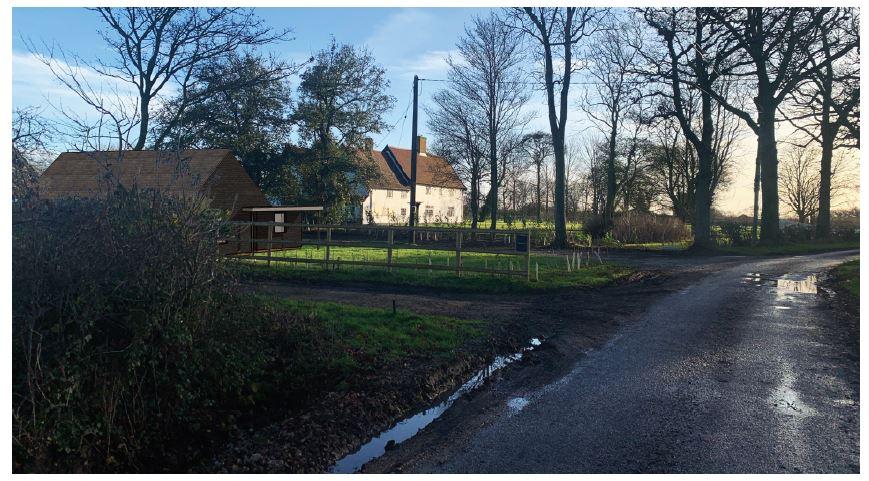
-
Thanks for the reply - I've contacted one guy on there but I suspect he's more 'real estate retouching'. We'll see. I forgot to ask - anyone know the right term for this - compositing / staging seem to be close but not quite there? Similarly 'property CGI' which seems to be high-end photo-realistic stuff.
-
Hi, Does anyone have any leads / recommendations for imaging editing services - I want to drop our CAD house design into photos of the existing scene. This is to appease some LPA requests. The quality of the render of the house design isn't crazy important - it's the visual relationship between the proposed building and a 'heritage' building nearly that's the thing. Ta, Alan
-
Hello and foundation type opinion and cost?
Alan Ambrose replied to greenqueen's topic in Foundations
Welcome to the forum. I don't know why there are not more self builders on BuildHub using oak frames - because there are maybe a dozen oak frame companies - and they're clearly building houses for someone. If oak frame is a possibility and will provide the main structural element, then one logical questions is 'what does it get clad with'? Well you clearly need some insulation and 'something to contain it', some air-tightness, some vapour barrier, some 'rain screen' (that is, the outside layer that sheds most of the rain off), and maybe something to help control racking. Larsen trusses and, say, cellulose fibre could be a part of that. I can see SIPs being a possibility also as they would provide some of the functions above. With sandstone rock and sandy soil (and therefore reasonably firm) and the frame distributing the load mostly around the floor plate / edge of the foundation by then you can probably use any of the foundation methods you have suggested. Maybe @Gus Potter (an SE) and @GaryChaplin (an oak frame guy) will have time to comment. -
>>> Do you really need that pit / stairwell that badly? My understanding is that if there's any thought of 'habitable space' (now or in the future) then there needs to be two means of egress. Seems sensible too. As an engineer (at least, of sorts ), the prospect of draining any rain out by sump and pump doesn't fill me with too much concern. I guess this could be mitigated, if desired with say a glass roof to keep most of the rain out. Also the ability to get stuff down there fairly easily for the plant room / workbench is appealing as I was only planning a spiral staircase otherwise.
-
>>> Don’t be to quick to cross off a log burner Yeah, agree, one of my must haves. And I know that cellulose is popular here but I have some of the same concerns as @saveasteading
-
>>> Now non of us can actually live at the CET location Well presumably at least one person can
-
One option is just to let it weather to a nice silver colour - as long as there are no significant areas that receive regular water splash and remain constantly damp. You then end up with a nearly no-paint / no-maintenance finish. If you look at Elizabethan houses you'll find that the old untreated oak has gone nearly black and crazy hard. That's the beauty of oak.
-
Softening the feel of a concrete slab floor
Alan Ambrose replied to Sparrowhawk's topic in Floor Structures
>>> Softening the feel of a concrete slab floor Out of curiosity, I visited the battersea power station building yesterday. I swear the concrete slabs they were used for 1st floor and above flooring had some give to them. Is there such a thing as concrete and rubber crumb mix? Ah, I see there is: https://www.theengineer.co.uk/content/news/crumb-rubber-from-end-of-life-tyres-recycled-into-concrete/ -
>>> Your basement will displace water the area of the basement plus outside staircase times the depth beneath that where water flows through the ground. This might be 3.3m to base of excavation less the top of the yellow clay shown at 6 feet deep on the second log. It could be 1.5m but it needs to be known. The concrete is likely to be 300mm thick floor slab plus 300mm thick around the perimeter 2.95m or thereabouts high. Add all that up and, at 3.5 tonnes per cubic metre, it needs to equal the mass of water displaced. You should have 10% spare mass but I haven't included the timber frame etc. If you are nearly there but not quite; make the floor slab bigger (adding a heel) and backfill with heavy stuff that will press down on the heel adding mass to resist uplift. <<< Thanks for outlining that calculation and solution - it makes a lot of sense. My concern atm is where the water level will be - the plot is 38m above sea level and as far as I can see (I need to study the contours a bit more) the top of a fairly flat 'peak'.
-
Raised bed from 2.4m 'sleepers'
Alan Ambrose replied to Radian's topic in Landscaping, Decking & Patios
@DarrenP I like the look of your T design - nice to be able to use them as seating too. I bought dowels for mine but the guys doing the work just wanted to use brackets. 5 years later - I need to put in a few dowels now. -
First Time Self Builder - Buckinghamshire
Alan Ambrose replied to RBran's topic in Introduce Yourself
You can also do a bunch of desk research without triggering any nosiness. Anything remotely similar in the area on your local planning portal? Is it in the village envelope? If not, near a cluster of other dwellings? -
Best smart doorbell?
Alan Ambrose replied to ashthekid's topic in Networks, AV, Security & Automation
>>> I can check for dogs and cats You just can't stop technology advancing - wait till they integrate advanced AI into everything: 'Hide event received - mother-in-law detected" -
Raised bed from 2.4m 'sleepers'
Alan Ambrose replied to Radian's topic in Landscaping, Decking & Patios
>>> Seems like such an obvious design, I wondered if anyone else here had already built something similar? Yeah, I built a bunch for our garden. Some 1 sleeper high, some 2, some 3. I got the supplier to cut them which made things easier. To reduce rot, I lined the sides with DPC and stapled it in and just screwed big screws through the ends to hold them together. For long thin beds I also used threaded rod between the sides to stop them bowing apart. I'll put up some photos. I'll probably use the same method again on our new build when the time comes. -
>>> Which is in part why I'm doing most myself! Agree, because you want it done right ... and preferably first time...
-
Well they may have a point of course. I don't know what parking is like in your area - but here it's hard and, over the years, 50% of the public parking spaces have been removed by the council and for at least 25% of the remaining, you will get a nail in your tire if you park there (nice area huh). So, work with highways to reduce the impact i.e. attempt to remove only one space rather than 2 or 3. If it comes to committee, point out that yes, you will be removing one space, but then again you will be taking one car off of the roadway by parking on your own land. You could make the same argument to your neighbours directly to attempt to reduce future friction. Did you free up a parking space when you made your garage residential, or are you still holding onto that?
-
>>> the installation which will be rather yikes. I suppose that would include paying for a transformer? Not sure which part of the install cost you were thinking of? No transformer charge if it's a 'Low Voltage' overhead line i.e. 230V per phase. Ask your DNO and they will give you cost / availability etc.
-
>>> What an utterly stupid and inflexible way to build houses. Yeah I agree. Proper services void, cavity etc with or without some European ducting is the way forward IMO.
-
>>> they should move to make them safe. The game the DNOs often play is 'yes we have to do it, we'll do it when we get round to it (expect 3 years)'. Usually you need it done quicker and you therefore end up paying for it. You may get a better result if you're lucky, but you might want to get some back-stop cost estimates. If you achieve a final result better than those estimates, consider it a win. Of course, if you have all the time in the world and a lawyer's mind you may eventually be able to get them to do it for free. For UKPN the two departments involved are 'Projects' who do the quotes and organise the work and 'Wayleaves' who deal with the legals. If you can convince Wayleaves that your case has merit and urgency you may be able to get them to 'make a contribution' to the project cost as decided by Projects. You can save a bit of cost, of course, by doing some of the 'contestable' work e.g. trenching yourself. The UKPN admin is BS and super-slow, but the engineers on the ground are usually friendly and reasonably sensible. Having said that, they did get a geezer to put safety barriers around the trenching work they were doing which was about 0.5m deep. This was in a field and only them (doing the work) and us (keeping an eye on it) were around. Anyone else there would have been trespassing. Be aware that they may bring up some last minute BS like road closures (yeah, UKPN you had about 6 months to think about that) and want to do a different cable route at the last minute. Again, they assume you want the work done pronto and are in no place to argue.
-
>>> The art in it is to always be shifting your tone words body language to match/mirror the other person, identify their primary concern, determine if it’s reasonable and come up with a mitigation. In your case I’d tell them to eff off. (my highlighting) Well that started my day with a smile.
-
>>> refused to chase the walls or work in the ceiling. And IMO they're generally not too good / careful / skilled at the things not involving wire / connections / testing. That was probably a 'I don't really want to do this job price'.
-
Pipe banging, don't want to have to lift floorboards.
Alan Ambrose replied to mickespite's topic in General Plumbing
You don't say whether you have a vented or unvented set-up. The latter will have a pressure vessel which will partly cushion the hammer when a hot tap is turned off. That's if it's pressures are set correctly and if the tank hasn't failed. If it's a new fault on a system that has been working fine (and it's an unvented system), then I would suspect the pressure vessel. -
I don't want to be a smarta55 - but 20 year economic calcs probably don't want to rely on today's grid conditions or supplier pricing schemes ...
-
Best silicone for uptaped glazing units?
Alan Ambrose replied to Alan Ambrose's topic in Windows & Glazing
Ah double glazed
.jpg.4a2be12182584e855afa031ed5515a93.jpg)
.jpg.80b3c43e295c3a0f098e769b2cc6ca2d.jpg)
.jpg.a5a979fb4b06eb8a7f2b4d4674e6879d.jpg)

