Alan Ambrose
-
Posts
3392 -
Joined
-
Last visited
-
Days Won
15
Everything posted by Alan Ambrose
-
I was just looking at the density of topsoil yesterday - a glamorous life eh? It's about 1.4T / m^3. Google says a sedum roof should have 70-200mm of topsoil - so 1.4 * 7% = 100 Kg / m^2 and 1.4 * 20% = 280 Kg / m^2. So, yeah - 100-280 Kg per m^2. Putting it another way, 120 Kg per m^2 is about 85mm of topsoil. My present roof (pitched tile) presents a load of ~1.6 Kn/m^2 i.e. ~160Kg/m^2. I appreciate yours is flat and probably more lightweight construction - tiles are heavy (I see they're about 1/3rd of the loading). So yeah, an extra 120Kg/m^2 sounds like it would make a sizeable difference.
-
https://www.engadget.com/scientists-strengthen-concrete-by-30-percent-with-used-coffee-grounds-221643441.html That should save some money then
-
Building a simple car park
Alan Ambrose replied to ToughButterCup's topic in General Construction Issues
>>> Tea, medals. Nice idea re the medals - you have campaign ribbons and all? I just finished 70 m^2 of ecogrid 30 for pedestrian use. Fairly pleased although it's not cheap. The company that sells it was dodgy over delivery though. Paid for 'next day' and it turned up on day 3/4 (I forget). Asked them to sort less than 7.5T truck as we live on a narrow lane. Arrived in a van after the truck decided he couldn't be bothered (we get 7.5s regularly). Had to unload an entire van full by hand rather than with a hiab. A kind of couldn't-be-ar5ed attitude.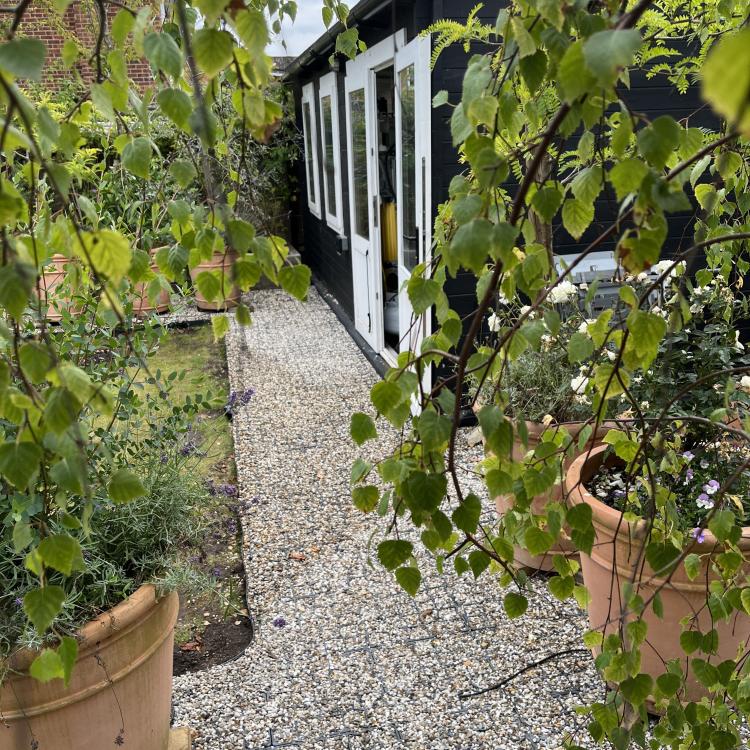
-
Double height void/ room thoughts
Alan Ambrose replied to Stonehouse's topic in New House & Self Build Design
>>> Does vaulted mean following the roof pitch (like a tent) right? Yeah. -
I wonder whether the XPS will go down exactly flat - I'm not sure I think it will. Maybe a thin layer of ply to bridge point loads and smooth? I have something like that in my workshop - actually 'horizontal timber framing' with insulation between and ply over. Can't remember how I came up with that - probably to support the edges of the ply sheets. I was expecting some fairly heavy localised loads for machine tools. Be aware that 'self-leveller' doesn't - it needs some skilled help. Apologies if you already know this.
-
P'Permission, Building Control, Freedom Of Information Requests
Alan Ambrose replied to PXR5's topic in Planning Permission
As if it wasn't hard enough to get all this stuff moving. You have our sympathies. Sometimes par for the course it seems. Maybe a polite round robin letter to the local neighbours informing them of progress etc but also mentioning the damage and asking them to contact you directly if they have any problems. There's nothing like bright light to make little buggy things crawl back under their stone. I have one neighbour who's already tried a couple of tricks and we have not even finished planning yet. -
Loxone switch vs alternatives
Alan Ambrose replied to BartW's topic in Networks, AV, Security & Automation
Wow: "Made of high-quality, satin-finish real glass" !!! I quite like the idea of the sensors and monitoring but I'm hoping to find a solution at a fraction of the cost. We stayed in a place recently with fancy light switches and lots of buttons. I'm a luddite, but I just found them annoying. -
Double height void/ room thoughts
Alan Ambrose replied to Stonehouse's topic in New House & Self Build Design
Yeah, our present barn conversion is naturally vaulted in the sitting room and a few other bits and I love escaping the tyranny of the 2.4m ceiling. Oversize is what makes the posh houses in Kensington look classy imho. -
>>> is there any point in engaging additional architectural input if all that is left is 'only practical detail' If you're happy with the plans you have, not much. If you have doubts, or harbour a nagging suspicion that something could be improved you could probably negotiate to pay a few hours work for one or more reviews by anybody that you think has the expertise. Perhaps something you've seen in a magazine and/or locally that you like - you may be able to track down the architects / interior designers. Not everyone will go for that approach, but some might - as it could lead to a bigger chunk of work. It's fairly painless for them - they get paid for a few hours to see some plans / talk to some potential new clients / give their thoughts / no commitment or liability either way.
-
Well firstly congrats - it sounds a lovely site. My theory is that the architect used to 'get planning' puts in the most conservative thing he or she can think of to obtain the landowner's 'planning valuation bounty' with minimum risk. Then often as not, the buyer needs to do the whole planning loop again with the design they want. However, the first loop has broken the ice with the planners regarding size, style etc, so that's a benefit. It's curious to have a structural guy who deals with planners - usually building control is their liaison point and they come in after the architect has obtained planning - which is effectively only 'look and feel'. Not to suggest that the structural person doesn't add great value by taking the architect's ideas and making a detailed building design from them. Occasionally (if the architect has been a bit fanciful) that might mean applying a dollop of common or engineering sense which might involve changing the look and feel a bit and thus some negotiation with the planners. e.g. 'it's great that one side of the building is 100% glass, but that won't really fly for these reasons...' You probably knew that. Maybe your structural guy is branching out or maybe the existing buildings effectively define the architectural style so much that what's left seems like 'only practical detail'. Perhaps ask your structural guy and a couple of local architects to take a look at their portfolios - see if there's some work you admire or that fits with the thing you have in mind?
-
Wow design without blowing budget
Alan Ambrose replied to Stonehouse's topic in New House & Self Build Design
I think you can do great things with a staircase regarding width, slope etc without spending a fortune. A couple of the 'statement staircases' I've seen cost a fortune and then look naff. -
This is not what you want to hear, so feel free to ignore >>> no roof overhang around the building Looks cool, but buildings have had overhangs for centuries for a reason - to keep the weather off the walls, so they're not regularly saturated. Similarly with the bottom of the wall, where upsplashes often rot the cladding eventually. >>> Is the EPDM roof covering that I'm using breathable. No, not at all. >>> 3. Do I need to lap the EPDM over the cladding and then drill vent holes in the cladding near the top (not preferred) I would definitely lap the EPDM over, preferably with some kind of overhang and/or kick to keep the water off the cladding. It also looks dead cool without gutters, but...
-
I've had a similar problem in the past - the LPA's pre-occupation with ridge height meant that our design was less than elegant. I think they shoot themselves in the foot sometimes. I had a similar problem with a cart lodge position one time - LPA's 'suggestion' was to move to other side of plot. I said I would investigate, produced a few sketch designs and was able to reasonably conclude that it would make access unrealistic. Officer accepted my logic. Maybe show willing, with a sketch for a lower roof line and reasons why it doesn't look good / has 'lower utility'? Push back a little to determine how important it is to the officer.
-
>>> They are located using a length of 20mm stainless round bar sticking up into a hole in the bottom of the post. Yeah, agree - I think I used 10mm last time. A4 rather than A2 SS would be good. This kind of relies on the structure being heavy-ish and stiff-ish in itself i.e. it is expecting to resist shear (crosswise, parallel to the ground) forces only. It looks to me like @machtucker 's structure is light-ish and not very stiff-ish, so maybe buried posts would be good after all. Being oak, they should last probably our lifetimes (making some BH assumptions here ) anyway. Whereas, I found recently that a treated softwood post with no other protection and in waterlogged soil gave up after 5 years.
-
Best underfloor water heating system brand
Alan Ambrose replied to KayleyH's topic in Underfloor Heating
I wonder whether the plumbing differences are marginal? The controller might be more important. I have Uponor plumbing and Heatmiser wired controller. Works fine. Also, half-a-dozen zones (some peeps have only one). This gives me full app control, but that does mean I'm dependant on the app supplier (Heatmiser in this case) (a) staying in business, and (b) keeping their server going. Having said that, it wouldn't be a big deal to swap the stats & controller, I swapped out from a Uponor non-app-based stats/controller to the Heatmiser one myself in a couple of hours. I forget the exact cost but it was around £400. Personally, I would stay away from the wireless stats/controllers - you'll see that some people on BH have had reliability problems with them. Wired also means you don't have to swap any batteries. -
That's clear then
-
FFTP/Openreach/new building regs
Alan Ambrose replied to Selfbuildnewbie's topic in Networks, AV, Security & Automation
@MikeSharp01 >>> We have all our services; Gas - not connected, Electricity, Water and the FTTP, to a services block at the front of the property Ah, I was thinking of using 3 glass fibre kiosks, but a single building/shed thing makes sense. Was there any problem having water & power etc into the same structure? Ta, Alan -
The traditional way to to do this and keep the post and dampness separate would be by using a padstone of course.
-
There's a kind of shrinkwrap thing you put on the bottom of softwood posts - meant to be good. As long as it's not waterlogged, being oak, it'll probably last forever anyway.
-
Foundation near tree line - raft? Systems available?
Alan Ambrose replied to Pabbles's topic in Foundations
@Big Jimbo- thanks for your very useful info, BH is great! >>> Have you dug any holes elsewhere? If so , describe in non technical terms. Only by hand to see the invert level of a culvert pipe to use for potential drainage. It was last year, I don't remember much about it except that it was xxxx hot and the ground was hard . We do have some services to run and a drive to dig though so I'll get some samples at a good depth while the digger man is on site. -
If I was fussed, I could see using cement board or stainless (or even standard) steel sheet, the former (plastered and?) painted the latter powder coated. FWIW I fired up the damn thing to max for a few hours after it was installed and measured the temperatures on all the nearest points - there's 'meets the regs' and there's 'should be safe' - not necessarily the same thing. That also, kept the BCO happy - don't think he had even seen an installer do that before. FYI we used a nest smoke/CO detector rather than one of the crappy battery operated things.
-
Combining 3 phase and 1 phase systems?
Alan Ambrose replied to Lemna gibba's topic in Photovoltaics (PV)
>>> Is it possible to have two systems in the same household with one on 3ph and the other a single phase? Assuming you don't have any actual 3-phase appliances (it is possible to get 3P heat pumps / inverters / EV chargers for instance) then 3P is usually actually just used as 3 separate phases for 220V circuits around the house. That could be 3P into a consumer unit which uses particular phases on each 220V circuits, usually with them vaguely balanced for current draw. That's what I have in my place, and I don't have any actual 3P devices to supply. In the common parts for this building the 'landlord's supply' has a 3P CU with a mixture of 3P devices (garage door opener, lift etc) and single phase circuits (lights etc). Alternatively, you can probably use your current single phase consumer unit and have say a 3P box for the 3P devices, or several single phase CUs on different phases - I don't have any experience of those last two set=ups though. A lot of domestic electricians don't have any experience of 3P though so expect some teeth sucking. -
Foundation near tree line - raft? Systems available?
Alan Ambrose replied to Pabbles's topic in Foundations
V. interesting thread....as I want to build within 9m of some fully grown Ash trees. I hope this moves the discussion along on the original poster's question rather than hijack the thread... Reading the NHBC guidance I see the calcs - which are completely new to me. On first blush, I'm getting about 1.4m foundation depth assuming I'm on a 'moderate' volume change clay. I'm looking at these charts: https://nhbc-standards.co.uk/4-foundations/4-2-building-near-trees/4-2-12-foundation-depth-charts/ Which begs the question - can I get a quick and dirty plasticity index reading by sending some soil in to, say, here: https://k4soils.com/ based in Watford. This is more for peace of mind than anything as I'll get a proper ground investigation done when we have a SE on board. If so, what depth should the sample(s) come from? -
Foundation near tree line - raft? Systems available?
Alan Ambrose replied to Pabbles's topic in Foundations
V. interesting thread... -
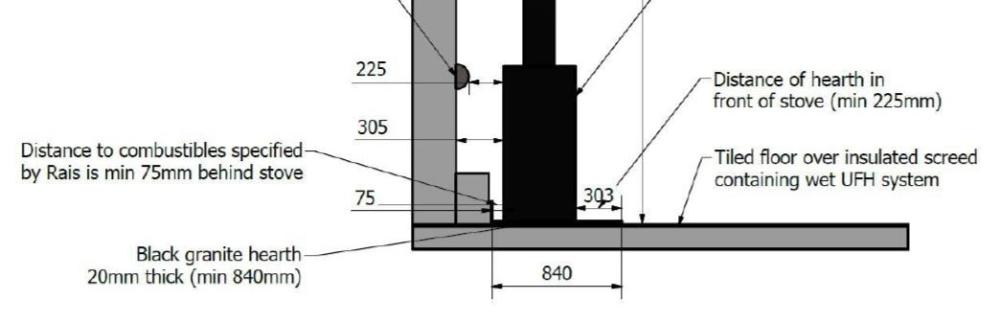
These are the sort of distances you're looking at, both for the 'rules' and for practical safety, but as others have said ... you need to check both the BC rules and those for the stove you're thinking of selecting. This drawing clip is for a Rais Viva 100L: p.s. plasterboard, in these calcs is not a 'combustible', wood for instance is.