


Alan Ambrose
-
Posts
3392 -
Joined
-
Last visited
-
Days Won
15
Everything posted by Alan Ambrose
-
Inverter behind inverter
Alan Ambrose replied to Pocster's topic in General Alternative Energy Issues
>>> Master inverter can output 3.6kwh I.e draw from grid That doesn't make much sense. An inverter takes power ('draws') from your PV panels and generates 230V power. You may use that to power your house and/or send power back to the grid. Now some inverters control battery modules too and can then 'draw from the grid' and 'charge a battery'. Is your objective to get round the DNO export limits? Nothing wrong with that, but maybe you can clarify? -
How to estimate self-build costs before starting
Alan Ambrose replied to selfbuilder91's topic in Costing & Estimating
>>> In reverse logic....what will your finished project be worth to sell? Add 200k to that to get an idea of budget required. Hilarious, but true often I suspect. >>> Get a detailed construction drawing pack from them, which will be full off errors like odd window/door sizes that don't work brick and add cost, then get it QS'd so you know ballpark what its going to cost. Depending on how hands off (costing you ££££££) you want to be tender and engage a builder, paid in arrears to a written contract. Pay a quantity surveyor to visit each month to determine what the builder is going to be paid against the contract QS schedule. The fees you save doing this method instead of buying the architect another BMW will sort at least a bathroom. <<< Nice, super-valuable advice I believe. thanks. -
Hi, I read through a bunch of recent appeal decisions yesterday for my local area, East Suffolk. I was slightly surprised that the inspectors seemed to be as non-fact-based, opinionated and capricious as my LPA - which suggests to me that appeals are a bit of a crap shoot. I had hoped that they would be more evidence-based than the LPA. I see stuff like: (1) I acknowledge that a brick wall abuts the back edge of part of the pavement along this side of the road, however the proposed development would have a greater scale and massing and therefore would be more visually prominent. i.e. Yeah, introducing a new garage is 'a greater scale and massing' - that's the nature of new buildings duh - but I am going to use that fact to turn down the proposal. In reference to the main issue, the proposed development would cause harm to the character and appearance of the surrounding area. i.e. That's just my opinion, of course, and I'm not going to explain why - but I am going to turn down the proposal. (2) I consider that the proposal would appear dominant in the streetscene and harmful to the setting of the locally listed Puddingmoor Place. i.e. That's just my opinion, of course, and I'm not going to explain why - but I am going to turn down the proposal. The imposing position is not matched by the design, which is neither modern nor reflective of the quality of the buildings that are typical of the conservation area. i.e. I like either modern or pastiche, and I won't allow anything else. (3) Although I note the willingness of the appellant to provide the Suffolk Coast RAMS payment, a financial contribution towards mitigating the effects of the proposal on the Protected Sites, I have no evidence before me to demonstrate that such a payment has been made. I am, therefore, unable to complete the AA favourably and, as such, I must conclude that, following Appropriate Assessment, the proposal would cause harm to the Protected Sites. i.e. The applicant has given an undertaking that they will make the RAMS payment, but I am going to ignore that. Any thoughts? I don't expect anyone will read through the appeal decisions, but they are attached if anyone is interested. Alan APPEAL DECISION 3284215.pdf 3306433 Appeal Decision.pdf 3306824 Appeal Decision .pdf
-
>>> Are there any downsides. Yes, they're very expensive.
-
>>> at the Warmstar ones from eBay that others have on here. Just a warning - these are, of course, a bug... nuisance if they fail. Buy the best quality ones. How do I know that?
-
30kW PV, All electric heating, is this mad?
Alan Ambrose replied to DevonBarn's topic in Photovoltaics (PV)
>>> actually with respect the aim isn't to use less energy, it's to generate as much as we use (in £) OK I see - so the grid power you use in the winter, you're planning to pay for with exported power in the summer. Makes a certain amount of sense. So you'll be 'net zero' electricity over the year. Probably not the most economic set-up though ... you can take a stab at calculating the benefit of each incremental panel - either as actual calculations/estimates or just in concept. The first panels get great payback, the last panels get fairly marginal payback. Panels are not that expensive though - so if that's want you want, there's no reason why not. -
30kW PV, All electric heating, is this mad?
Alan Ambrose replied to DevonBarn's topic in Photovoltaics (PV)
>>> I would definitely pursue having a 3 phase supply, even if it costs you a bit more, as it will future proof your supply. It's becoming the norm now to have 3 phase. Yeah, I respectfully disagree with that. The object of the exercise is to use less energy, no? 3-phase let's you use loads of energy (and pump loads back, but you're probably not making any money on that). It's a bit like having a 8L engine Bugatti Veyron - great fun I'm sure, but it won't help reduce your petrol consumption much . Yes, on 3-phase you'll be able to run 3 fast car chargers, 3 ovens and ASHP on full blast - all at the same time, and you won't be using any fossil fuels (at least directly), great! Just like doing 267mph in your Veyron - theoretically you can, but you never will. Add a bit of extra complexity for monitoring, PV feed-in etc, a bit of extra danger for having 400V around, and I don't get the hankering for 3-phase (and I do have 3-phase). -
30kW PV, All electric heating, is this mad?
Alan Ambrose replied to DevonBarn's topic in Photovoltaics (PV)
Here's a graph for our little 100m m^2 medium-insulated barn from when I was figuring PV numbers...consumption is total energy use and we have electrical heating (well backed by a log burner). This is 15 kWp limited by roof area. Generation in winter is about 20% of summer generation. Are you figuring that you want to run your full electrical needs including heating totally from PV in the winter?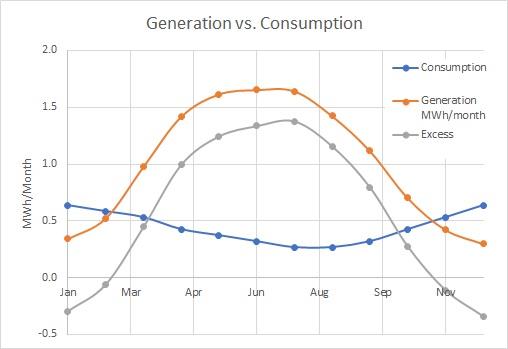
-
I think that inverters are generally of the 'fails fully or not at all' variety of equipment. I suggest a single panel could be damaged or something more subtle. Check connections carefully and see if anything is hot that shouldn't be. Scan the roof with binoculars etc. And yeah, you need to provide more information... Output slowly reduced over many months? Suddenly dropped one day? Multiple strings? How many panels? Any shaded? Graphs, pictures etc. We're not clairvoyant you know...you need to do some of the work too.
-
Yeah, I don't agree with the 50 year lifetime thing. We need building methods which are not just 'build once' - that is houses should be designed to be taken apart and re-built. Our barn conversion was built several hundred years ago for agricultural use and therefore not expensively. But because it had an OK oak frame structure, it was a fairly easy job to strip off the boarding, roofing etc and re-clad it using some proper insulation etc. So, build houses with good 'bones' that can be re-built on easily.
-
>>> when I’ve dealt with all my invisible animals i guess someone has to ask. Might as well be me.
-
If it helps any, Octopus were by far the most sensible company I've dealt with re smart meters. Time for a 3-phase meter smart meter swap (from a previous 3-phase dumb meter) was 3 months. Some other suppliers don't even know what 3-phase is (or at least the call centre staff don't).
-
My solution is to get proper fibre if you can (or 'fibre to the cabinet'' if you can't). Run it into a box next to the box on the edge of your plot ('kiosk)' that you're getting your 'temporary' builder's supply electricity to. Put your router/access point in there (with power from the box next door). Run wireless from the box and/or or CAT cable to your static. (Cable will be faster and more reliable.) You'll be doing a lot of online googling / looking at BH / placing orders etc Then run both your electricity and internet in ducting into the house when you're ready. Leave the 'temporary' boxes where they are. Same with water if you like.
-
OK for anyone in a similar position... After bu.......ing about with Eon for 6 months, who said it was possible but could never quite get round to it... It took 'a little reminding' but Octopus had a 3-phase smart meter installed for me (swapping out the old 3-phase dumb meter) yesterday - a little more than 3 months after I first asked. A successful conclusion (well Octopus say it can take up to 14 days to go live) to this 7 1/2 month project ...
-
>>> the force to pull a screw pile upward will be greater than the force to push it downwards. I appreciate your thinking - e.g. for say a steel bar the 'modulus of elasticity' means that's true over the initial linear region etc. But ... the pile has unlimited ground underneath for the pressure to be spread over, but limited ground above. Sometimes you see a theoretical diagram of how the pressure is distributed underneath a pile. I can't imagine it's that similar to the pressure distribution above - unless the pile is very deep maybe?
-
Is this a normal heat loss graph from an UVC?
Alan Ambrose replied to Thorfun's topic in Boilers & Hot Water Tanks
0.5C per hour? Assuming no one has used the hot water? I'm not sure that's great actually - I'm getting about that for a badly insulated thing from 30-years ago. Interesting data though. In a real-life case, I wonder how much is heat loss and how much is just mixing with the incoming cold water. Actually I'm interested if anyone else has data - as I had on my to do list to replace the cylinder here with something more modern with 'better insulation'. -
And another one: 5 Serviced Self-Build/Custom Build Plots, Old Stowmarket Road Location Woolpit, Bury St Edmunds, Suffolk https://www.plotbrowser.com/plot/132237 Maybe this is a positive new trend?
-
I like these Bosch sets for their quality and compactness. You'll need a separate driver handle or a battery-driven driver. The 'cased' sets take up too much room in my book. Quality is a good thing in itself but screwdrivers and bits are a bit of a consumable these days. https://www.screwfix.com/p/bosch-1-4-hex-shank-mixed-screwdriver-bit-set-32-pieces/6810t
-
I think that 'if it's worth doing, it's worth doing well'. There's so much low quality housing stock in the UK, I think we have a bit of a duty to do a good job. The extra cost will probably be minimal and at £1.5m you might get buyers who want something up-to-date. If the likely buyer is a well off 30-year old, then they'll want modern things that 30-year olds want. So I vote for insulation, air tightness and ASHP - not every 30-year old is a luddite.
-
Suggest you use the phrase 'consistent with safe access' liberally. Just noticed this text from someone's lighting statement fyi: "XXXX have completed lighting calculation to provide adequate emergency escape lighting from the building to comply with BS 5266. Wall lights mounted on the external walls of the building and above exit doors will provide emergency illumination along the escape routes. Their drawing below incorporates lighting level (Lux) isolines along with design standards and luminaire technical performance data. Two post top LED lanterns are proposed to provide adequate lighting for the car park, the exact position of these lights will be determined after trial holes are dug to confirm existing tree root positions but they have been shown indicatively on the plan below. All chosen luminaires will have a ULR (Upward lighting ratio) of 0% and will be ‘dark sky compliant’." A bunch of buzzwords there...
-
Congrats. Presumably several cold beers
-
It's hard to be let down by professionals - you assume that they're 'professional' after all and have a higher standard of work and ethics than the general population. Here's my 10 cents: Would it be feasible to find a new architect at this stage to take the project forward, or would it even be possible just to work with a builder if they can do the project management? If you're at the stage (or nearly) of house designed / planning approved / building warrants done - then you now need a builder and/or project manager. Some architects can and do project manage with varying degrees of success. Similarly, some SEs. And some builders also. It may depend of the complexity and innovation level of the design. If a builder has built a very similar house before, then they probably don't need a project manager. If there's a bunch of new stuff, materials, construction methods etc then you might need a dedicated person - probably an engineer type. I would say you need someone looking after quality. On a commercial job that might be called 'clerk-of-works'. Maybe that's a project manager, maybe that's you if you know what you're doing, maybe an SE if you can be sure they're going to be on site regularly. What are the architect's professional obligations in this context (looking at the RIBA guidance, these seem pretty vague)? If your agreement / contract doesn't commit you both for the build / project manager stage then feel free to use someone else. During this conversation, make sure you have access and rights to all the drawings etc you need - maybe in digital (i.e. cad) form. Read your contract if you have not done so already. Even if the contract commits you to the next phase, you have a get out if the architect doesn't make themselves available. Give the architect every chance, then call the contract 'frustrated' and therefore terminated by virtue of his unavailability. Same as if he had a long term illness or accident and was unable to fulfill the contract for that reason. From your experience, how long could it take to find a new builder? Maybe our expectations are simply mismatched with what's normal. However, at this stage we are simply trying to get a gauge of which builders would be available from when, rather than detailed costings. Long as a piece of string. Personally I would wait for the guy who you think will do the best job. If we were to ditch this architect and decide to get some of the work done independently, who could we turn to to help us plan the project, if not another architect? (see above) The key thing the architect brings is design. Once that's done (and I think, in this case, it is), an architect may not be the best project manager anyway. Yes, you'll need to give up your easy solution of 'architect gets his mate the builder to execute the job'. That may end up being for the better anyway.
-
That’s assuming you’re working the boards on a bench rather than already mounted in place.
-
Check out the little ‘trimmer’ routers. Much easier to use for simple chamfer / round over jibs imho. If you can work from each side with a round over bit with a bearing, that might be easiest than a full bullnose. Practice on some scrap, it’s a fairly easy job but e.g. important to get the direction right. Loads of YT videos on the subject. It’s possible, for the most blemish-free job, that you might want the adapter that runs the trimmer on plunge saw rails.
-
Holiday Horror(s)
Alan Ambrose replied to ToughButterCup's topic in General Self Build & DIY Discussion
Yeah, unless she reads BuildHub...


