


markharro
-
Posts
644 -
Joined
-
Last visited
Everything posted by markharro
-
I have very basic knowledge in this area - I know that normally shaver plug sockets only are allowed. However would there be any option to provide USB C power for this gadget and if so how? thanks
-
I am trying to plan for whether I need to instal an aerial for Freeview. Does anyone know if there is any likelihood that the full set of Freeview channels will be provided over a standard hard wired broadband connection at any point in the same way you can access eg iplayer? thanks
-
Thanks very much @AliG - it does look like its the radon area issue that has thrown this up. My argument as you say was that we will put a radon membrane but apparently that's not enough for BC as additional mitigation might be needed if the readings are too high! So that means the hundreds of existing houses in this area can bask in the radon but not us! More £ down the drain and more delay....at times I get so so fed up with this process.
-
Building control have now thrown a request for a "Geo Environmental" report at me focusing it seems on radon and more general potential contamination although the latter is a compete mystery. BC state "our records show that the property in in a radon zone and very close to an area where historically the land use may have been contaminated". As far as my own research goes the area was all farmland etc under housing was built. In any event I have just spoken to the BC officer and he says that I need to get this report and that its needed for all new build houses he seemed to say. I don't know why my architect didn't flag this up with my months ago as it is now going to hold up our warrant but anyway. @AliG did you need to get one of these reports? It seems like Aitkens can do them - I really wish I knew about this when I got them in for the soil capacity report,.
-
Concrete slab pour over winter months - recommended?
markharro replied to markharro's topic in Foundations
It is MBC - yes prefab timberframe but that SIPS is it not? -
Hi fi system and forums
markharro replied to SuperJohnG's topic in Networks, AV, Security & Automation
https://pinkfishmedia.net/forum/ is a good audio forum. I am trying to decide on my own audio requirements for our new house. I'm lucky that I already have a separate garden office hifi den but I would like to instal something half decent in the house. Like you, we will have a double height kitchen/dining/living room. Ideally I would like to plonk an amplifier in our plant room and then probably use my Innuos Zen as the main source as I can control it via its App on my phone. The only issue with this is how to control the volume as the Innuos Sense App doesnt let you do that I think. This may dictate having to bring the amp into the main living space so I can get line of sight with its remote control. For speakers I was thinking about floor standers but I think they will get in the way. I may get a decent pair of bookshelf speakers and wall mount them. The other option is to use flush mounted ceiling speakers but I am not sure the audio quality would satisfy me. I am also trying to decide about audio in the bathroom - this would be via ceiling speakers but here the issue is the source and volume control - I may have to look into raspberry pi media servers and work out if I can use that as a streaming source and control content and volume from a phone app. Something like an Apple homepod probably makes more sense for hands free but there is the issue of how you use that in a bathroom and being too miserly to pay for the Apple music content. -
Thanks - I had no idea these existed. So in summary if I just wanted to stream from eg iplayer or Netflix in up to 4k a CAT6 or 6A cable will do fine? If we were talking uncompressed 4 or 8k presumably that would need to come into the house via a fibre-optic cable using some sort of pay TV service/box. I don't use these so can the box be put in a central place and then multiple cable feeds be taken using HDMI to remote TVs? So this is where using the AOC cables would come in?
-
Concrete slab pour over winter months - recommended?
markharro replied to markharro's topic in Foundations
Thanks @George can you point me to any guidance on additives to use depending on conditions etc? -
I have a connected question. We will be laying an insulated slab intending to use the powerfloated concrete as our final floor finish. What is best practise on cutting expansion joints? We will have UFH 50mm under the slab so that is one issue and of course no rooms/doorways.
-
flush mounting sinks, hobs - pros cons?
markharro replied to puntloos's topic in Kitchen Units & Worktops
We also have bought a reduced Bora hob from a show-room and were hoping to flush mount it. We collected it and watched as it was removed from its flush mount in the showroom and saw something like a metal perimeter ledge somehow bonded or fixed into the worktop a few mm below the surface that the hob sat into. What I haven't yet investigated is whether something like this could be sourced and fitted as a DIY project? -
Likewise we used a Neff for over a year prior to the old house demo and no issues and that with me not being overly careful half the time. Now bought a ex-demo Bora for the new house - if that ever gets out of the ground - so Im hoping that Bora dont use some sort of inferior glass!
-
Concrete slab pour over winter months - recommended?
markharro replied to markharro's topic in Foundations
Its ok its the same company doing slab and the SIP instal! -
Concrete slab pour over winter months - recommended?
markharro replied to markharro's topic in Foundations
One of the issues is that the company laying the slab are based in England and won't be happy if they had to wait to do the pour until the temp relented. Yes we have thought about that but Its a SIP build and after the frame is up we will be doing a lot of the finishing ourselves so we will only have ourselves to blame if we damage the surface. Yes we are putting in UFH - it goes in 50mm below the concrete surface level. -
Annoyingly we are too late to pour our insulated slab now before probably January at the earliest and I face a dilemma. We intend to use the powerfloated surface as our final floor surface so any cracks etc during curing as going to be an issue. We are in Edinburgh so Jan and Feb are the worst months to be contemplating this but everything moves so so slowly in this game that's where we are. I know you can put in admixtures to be able to pour in colder weather but I understand that this can increase the risk of cracks etc. So what do we do? Take a big risk or delay any further progress yet again until the spring proper? thanks
-
Any chance you could post a link to that please?
-
I'm afraid this is beyond me technically. I expect this is to do with router capability? I'm only interested atm in the wiring infrastructure. I have no idea what the source of the 8K will be....I guess I am thinking that in the future it may be pure fibre into the house to a new router and then distributed from that or will a 5G modem router be enough? Thats not the point. I'm only interested in what to plan for for wiring from a central spot in the house to possible TV locations. thanks.
-
Ralph that's very helpful thanks. So assuming we had no runs above 55 metres in the house there is zero to be gained from installing CAT6A? On the 8k, is it worth putting in fibre? Can you do that DIY? What is CAT7 - would that not cope with 8K?
-
Just thinking ahead. If I am hard wiring to rooms where there will be TVs will CAT6 or CAT6A be ok for 8K TV? thanks
-
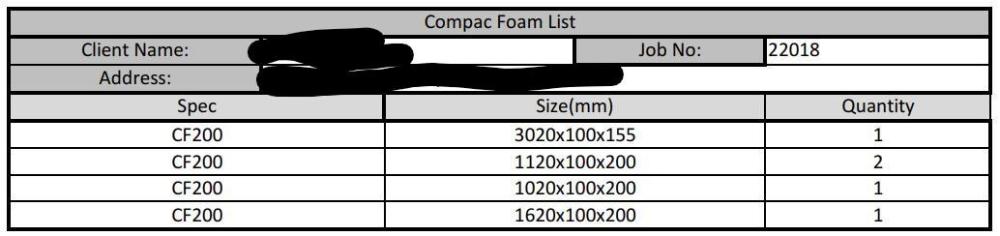
I am being quoted £1000 for Compacfoam 200 for our passive slab by the installer - quantities in the attached image. Can anyone advise whether its likely I would make much saving on the price by sourcing from GBS myself? Or would one of these other products be cheaper and the same spec? thanks
-
How to wire my renovation
markharro replied to FrankHouse's topic in Networks, AV, Security & Automation
Thanks...can I check though do you need a special PoE variant of CATx cable on does standard stuff work? I understand the toothbrush now I think but could you not just instal a socket with a USB outlet? -
How to wire my renovation
markharro replied to FrankHouse's topic in Networks, AV, Security & Automation
What type of toothbrush can charge this way? And presumably then building regs allow you to instal ethernet sockets in bathrooms? Another basic question. Do you need a special ethernet cable to use PoE or does standard CAT6 or 6A do the job? thanks -
How to wire my renovation
markharro replied to FrankHouse's topic in Networks, AV, Security & Automation
What type of toothbrush can charge this way? And presumably then building regs allow you to instal ethernet sockets in bathrooms? Another basic question. Do you need a special ethernet cable to use PoE or does standard CAT6 or 6A do the job? thanks -
How to wire my renovation
markharro replied to FrankHouse's topic in Networks, AV, Security & Automation
What type of toothbrush can charge this way? And presumably then building regs allow you to instal ethernet sockets in bathrooms? Another basic question. Do you need a special ethernet cable to use PoE or does standard CAT6 or 6A do the job? thanks -
Water pipe and electricity cable in duct to carport/garage
markharro replied to AliG's topic in General Plumbing
Hi @AliGmaybe you can help me on a related theme. I have two things I am wrestling with atm. I have scheduled a lead replacement new water instal from SW. The engineer said it would be 25mm bore. It looks like the supply pipe is on the opposite side of the road to us. My pal (a BP engineer) mentioned that he would normally expect a 28mm or 32mm bore for decent water pressure. That's the first issue. How do I know what to specify? The second thing is that I am deciding on ducting under our slab. We want an outdoor tap on the house wall (about 7/8 metres I guess away from where the water will enter the utility room). Options for this are to tee it from the supply outside at our boundary and take it completely outdoors to avoid any plumbing running through the house or tee off at the utility room. That would then need a hole through our external wall to the tap. We want to have another outdoor tap this time in the back garden. I had thought that the best thing for this was a tee from the utility room and down through the slab and then right across the width of the slab underneath to take us to the back garden. But another way would be to tee off where the supply comes in off the street in the front garden and then take the connection round a long loop right around the perimeter of the house to the back garden. I have asked our architect about what is best with all of this but he says these are services issues that he cant properly comment on! -
Thanks - all good points - we have been in a house with a power floated floor as the final finish and were quite happy with it but I do get that a lot will depend on the amount of care taken at the time.
