Carrerahill
-
Posts
2132 -
Joined
-
Last visited
-
Days Won
10
Everything posted by Carrerahill
-
In its simplest terms an EV charger is logic controller switching a contactor, that is is. Yes you get OCPP control stuff with GSM etc. however, as a home owner, paying your own bill you don't need any of this. Within the charge cable is a data pair and the mains. The car tells the logic controller it wants charged and it turns on the contactor, the cable goes live. Simple as that. A friend has a VW ID with a home made charger, he could have got a £350 grant towards it, and the installed cost was about £1100 - he built one for about £250 in a nice stainless steel enclosure. Google EVSE charge controller, they can be had on eBay, Amazon and more reputable EV equipment outlets like Stegen, some have LCD screens incorporated, some remote so you can panel mount it and some have nothing depends what you want. I just want something to switch a relay on and off.
-
Buy one, have friendly spark install it but use a 32A/65A Ceeform to connect it, when you need rid of it, unplug it and demount it. Or just have it wired in, kill the breaker, and unwire it yourself, have it reinstalled by spark who does your house. Simple. It is just an electrical appliance, nothing fancy. I wouldn't even buy an EV charger to be fair, I would buy the logic module, a big contactor and the charge cable and make it myself!
-
Cruel!
-
Ah yes, the old "salmonella strip"!
-
Electric Boiler with Underfloor heating costing a fortune
Carrerahill replied to Richvet's topic in Underfloor Heating
Welcome to the electric future. Can you offset with PV?- 38 replies
-
- 1
-

-
- electric bolier
- boiler
- (and 2 more)
-
Given the price of steel, and the added complexity of building with steel portals, I would still build in block. Block prices have stayed about the same, as has sand and cement so I think. 6" block with piers within the long walls will make for a solid garage. One piece of advice on the piers, plan their location! I didn't and now have some annoying splits in my racking where I need to end the racks, have wasted space, then a pier, then start the racking again. Also try and plan piers to align with things like roof trusses. I have 4 trusses and purlins to have a more open feeling garage with a big open roof area, it does look good and gives loads of height for moving big bits of wood and things about and the ability for me to suspend bikes etc.
-
Just to be clear, the silicone I refer to was not to seal the bead, that was the render product type I used from Enewall. It basically repels water but has breathability. So, from soffit to bellcast bead I covered the whole wall making the block water repellent, however, I would argue waterproof in normal circumstances, although I understand it will not truly be “waterproof”. Then a waterproofed sand/cement smooth render below which was worked in hard against the bellcast to form a continuous protective cover. You could build a steel portal frame and infill with block. I nearly did this for speed of getting a roof over so I could work on the build in the rain, but I was impatient and didn't want to wait for my steel kit to come. Usually the block is just dressed into the web of the steel so that it forms a solid locked in panel, although the mortar does not stick, it locks it in firmly. Also, I have seen the steels with a wall tie system bolted or Hiltigun nailed on. Works well. You need to dress up the plinth detail properly at the based of the steels and protect the steel so that it doesn't rot out in 30 odd years. The other design used frequently is for the steels to be kept within the weatherproofing envelope of the building to keep the steel dry.
-
This is not strictly correct. I have a block garage on a 10" slab and have had no issues with damp. I ensured that the ground levels around the slab are lower with no build up, and I took the render down to a bellcast bead just a smidge above the slab, I caught the DPC and pinned it up, just caught it and no more, I used a 2 coat silicone system which you can spray with a hose all day long and you never see damp coming through the mortar joints of the garage (which is always the first to let water migrate through). From ground level up to below the ballcast I used a smooth cement render with waterproof additive which I then painted with water-proofer a year on and after weeks of dry weather. FGL is about 6" lower than the slab, except at the front door. Garage is so dry that even when using my nailgun to build things the exhaust port air is enough to kick up all the floor dust even after the 2 weeks of solid rain we had up until the weekend. I also laid my slab on a DPC, which you said you have done too, so where is the damp issue?
-
Do I *have* to allow a planning officer access?
Carrerahill replied to harry_angel's topic in Planning Permission
My question is what are you trying to hide? Keep them on side. -
Spurs, mixed from junction and socket
Carrerahill replied to ash_scotland88's topic in Power Circuits
My honest opinion is that you should get an electrician in. -
Spurs, mixed from junction and socket
Carrerahill replied to ash_scotland88's topic in Power Circuits
I am struggling to work out what you are trying to do. When you say spur do you mean a spur leg of wiring or a fused spur? What you can do if you must create a spur with multiple sockets from a ring is fit a fused 13A spur then run a radial to as many sockets as you want, safe in the knowledge you cannot overload that cable. The reason you cannot spur off a spur is due to cable ratings, 32A ring main only works on 2.5mm cables because you have two of them, however if the circuit was a radial at 20A (which means the cable is then rated higher than the breaker) then you can actually create spurs from spurs because the whole thing is then only 20A. -
How does infrastructure get upgraded?
Carrerahill replied to Radian's topic in General Self Build & DIY Discussion
I can speak from the electrical aspect here, although I can also comment fairly accurately on other utilities because I am fully aware of them and the hurdles they pose to developments. So the question you might first ask is, "Who applies for the utilities" well that would be, in most cases the M&E consultants. I probably do an application a month and for me the application is based off my proposed load assessment, sometimes this can be tough because the first question is gas or electric heating, if they go gas it makes life easier, as soon as they go ASHP or other electric then the can of worms is open and its never simple in the early stages. I would then fill out an application form to the relevant DNO (i.e. UKPN or SPEN etc.) and sometimes I also send them to some IDNO's (Energetics) and ask for X number of supplies at X rating. So in a block of 10 gas heated flats, I would ask for 10 x 2.5kVA single phase supplies and 1 no. 50kVA three phase supply for the Landlord (less if no lift) all fed from a single cable head into a main service board. The next step is I then get an email from the local connections manager who will say, yes that is fine, give me your site drawings, which we would have from the developer, architect etc. and they go and do a drawing and quote. Or they come back and say you will need a substation in which case they will quote you from the local HV network. Other variables are forms for solar. See below, red is 11kV and brown is LV ready to go directly into a house or office etc. If they have capacity on the LV they give you it, if not you have to put in your own sub. Developer pays for it. We did a hotel last year the sub was for 1 hotel and 1 restaurant, £150K. Water and gas are very similar actually, gas there is high pressure and low pressure networks, so a local tap can be had from wherever needed. Water may need upgraded or new run in. Openreach or Virgin media, fairly easy to be honest. This of course all assumes the plot is not 2 miles from anything. As with everything there are variables and exceptions. I have known HV lines to be brought in over a mile to a new development, subs are also sometimes considered at master planning stage. You may have a plot and they will say, no capacity, but actually there is, they just have it earmarked for a 5-10 year master plan and it might never get used, but it was put there as part of a bigger plan. The above site is a commercial estate. They put in a sub and allotted x amount to each plot, this way every plot will be able to get a connection. Oddly on this site there is also an Energetics sub, must have stacked up for them financially.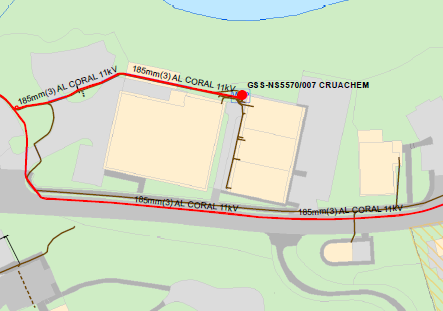
-
ASHP SCOP=3 in uninsulated 1960s house!
Carrerahill replied to richi's topic in Air Source Heat Pumps (ASHP)
I think the installer is trying to make an arbitrary point that ASHP will work just fine on an older building. It also appears that only about 3-4 rooms are actually being heated with the ASHP. It proves very little. Just that you can heat 4 rooms with 4/5kW. I think he is being a typical installer, "Look it works fine, here I will install 100's of them for all you gullible sorts" -
ASHP SCOP=3 in uninsulated 1960s house!
Carrerahill replied to richi's topic in Air Source Heat Pumps (ASHP)
I think you have misunderstood me. I said the installation seems flawed, and you replied, "Yes but a rule of thumb that makes it "seem" flawed might not reflect reality. I gather that they were of the opinion that those rules of thumb weren't helping the industry, in the light of newer, more efficient HPs and better weather comp. So they did some calculations and used their office as a test to verify." My reaction was based on you making the comment "rule of thumb", you have assumed that I am basing my response on rule of thumb heating requirement, as a building services consultant I spend my life calculating things, I don't do things by rule of thumb. So for clarity, no rule of thumb, calculated area heating based on calculated heat loss. My reference to SAP calcs and LA requirements etc. was to point out that rule of thumb heating installations are not done anymore on new builds. Yes, there was a time when a plumber would look at a space, apply some typical figures and work out the heating requirements for a building and that was fine, it was just the done thing, energy was cheap and no one cared about CO2. Now steering this back round to the point I am making, this installation seems flawed and I cannot see how it stacks up, here is a brand new flat in London, insulated to the hilt, it still needs PV on the roof to offset CO2 to achieve the required DER: This is based on maintaining a room temp of 20°. Note the heat input required for this PIR air tight box...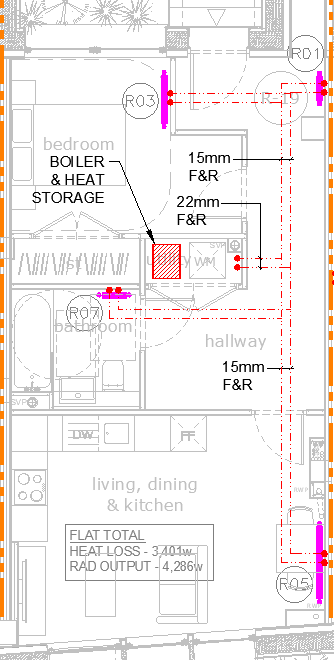
-
Irony here is that an MK Logic white socket is sometimes more expensive than some of the "decorative" sockets from cheap manufacturers. But I see the point.
-
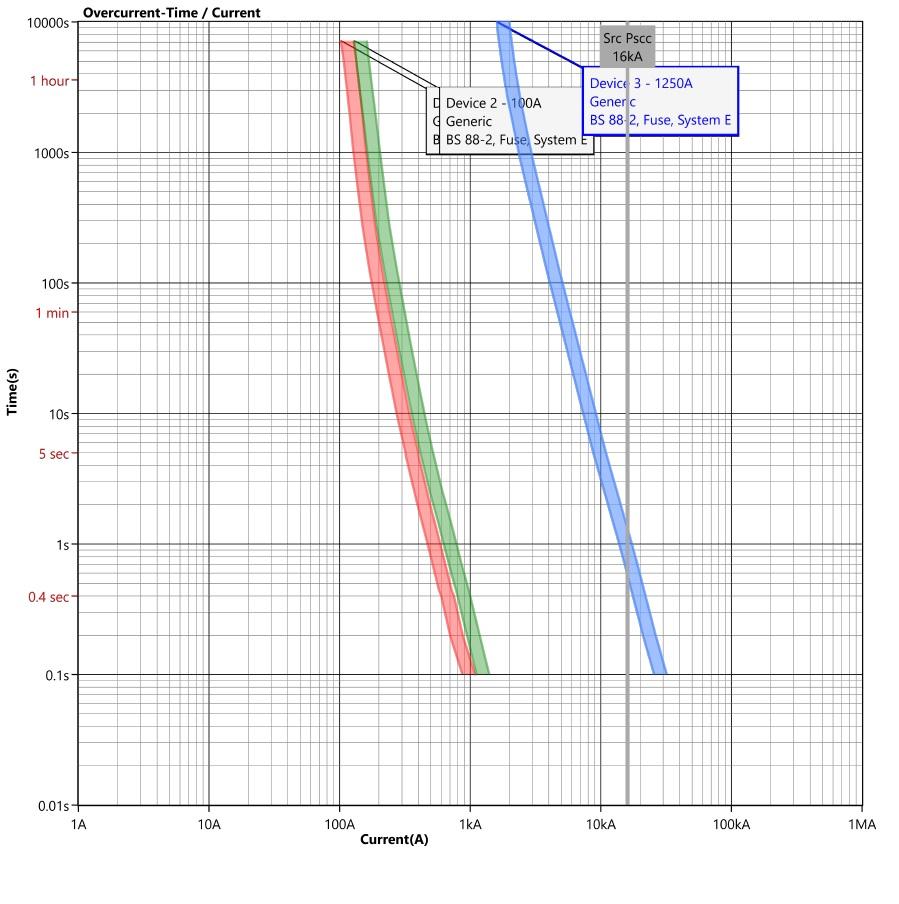
Indeed, see my graph posted above, that is the fusing curve of a BS88 (what they fit in the fuse carrier of just about every fused supply in the land) 80A and 100A. To get a 100A BS88 to fuse within 1 second (which is slow) you would need nearly 800A. They will of course fuse within 0.1s at about 1000A which is basically instantaneous short circuit protection.
-
ASHP SCOP=3 in uninsulated 1960s house!
Carrerahill replied to richi's topic in Air Source Heat Pumps (ASHP)
That isn't a rule of thumb, that is calculated room by room heat loss and a sized radiator, on new builds you cannot get by with rule of thumb anymore as you have SAP calcs and CO2 targets and council schemes and standards now. So this installation is systemically flawed. -
A diversified load which demonstrates sustained current draw well over the 100A mark. When I do a load assessment, usually for a commercial/industrial development (residential, until now has generally just been taken as a 100A fuse) I take all the main plant loads, lighting loads, small power, lifts, water pumps, EVC, etc. and add them all onto a table. Small power for an office for example is based on office type and W per meter sq. So that gives an estimate of "uncontrolled loads" i.e. plugged in items. In your house you could work this out, by working out how many of you there are and what do you all do. Laptops, TV's, do you run washes a lot, cook a lot etc. etc. Lighting can be much more accurate as you spec the lighting and know the connected loads and switching arrangement so you can work out burn time. Then we apply diversity to the other loads. Lighting might be 80% if you assume stores, WC's etc. and occasional use rooms are not always lit, general power I usually take at 100% because I have already worked out estimated loads and I don't like to reduce it more if I am sure the estimate is good. Lifts in a busy office maybe 70-75%. Vent 90% Water pumps, 60% and so on. At the bottom of the speadsheet it spits out a amps per phase figure, then I add 30% for expansion. On this office I am doing just now the figure was 215A per phase before the spare 30%. So clearly this will be a 3 phase supply, but had that figure rolled up at 16A per phase and I knew that we could get single phase kit, I would propose a 25kVA single phase supply which is about 100A. If you PM me your email address I will send you the spreadsheet and you could tinker with it. I will leave it populated so you can see how it works.
-
Do it if they offer it, but I think you would cope. Say you have ASHP and EVC and also electric cooking (which is meant to be green - ha!). I would think so.
-
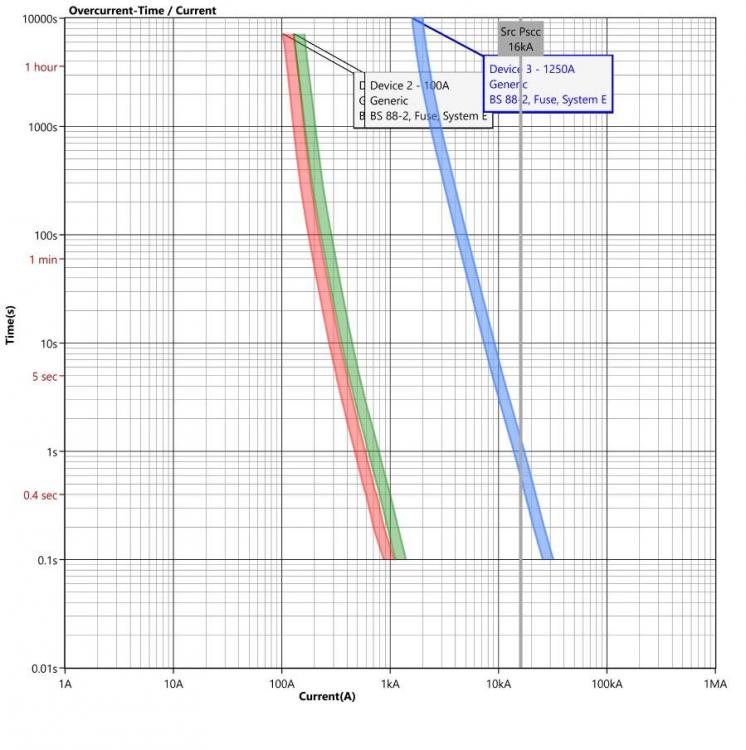
I am saying that the chances of all those electrical loads all simultaneously drawing full current is unlikely. Ovens and hobs modulate most of the time they are on, so they don't often pull that current for long periods of time. Even if you did go and load up your electrical system the chances are that the full load may only last 15minutes or so then start to fall off. You also need to consider normal use. In my house just now the WM is on a 40° wash, the oven is on too, this laptop and some lighting. Then there are the parasitic loads, so peak power draw right now is probably 25A. I could add an EV charger and ASHP and still only be at 80A, however, as said above, the oven and washer load will modulate, so might peak at 80A but realistically sit at 70A. For the record, a 100A fuse won't blow at 100A, see green curve below: Without going into the technical details of it all, basically even if you did pull 100A for say 10-15minutes it would be fine, not ideal but it would be fine, the actual BS88 fuse would take 100A for over 1 hour, seems odd you may think but incoming fuses are there to do multiple things, one is to protect downstream and upstream cabling. Yes, that fuse also protects the DNO's incoming cable before your fuse, because that cable will probably be jointed to a much bigger cable in the street which is on a 1250-5000A fuse at the other end, but that cable coming into your house sure isn't capable of carrying even 250A. Cable protection is based on time. A cable will not go 1A overcurrent then explode into flames, it will just warm up quicker than intended and may then tip over its maximum rated operating temp and at a point the cable will be damaged, twin and earth is rated at 70° - so if the cable goes overcurrent for say 30 minutes and got up to 50° it would be fine. It is quite common for submains distribution and switchgear to allow periods of time where the rating may exceed for example the cable rating, but it is controlled with MCCB's (big fancy, sometimes micrologic controlled breakers) or even a BS88 fuse like the DNO will fit. The weak point in your system might be the incoming isolation switch(s) therefore a board with a main isolator rated at 125A is a good idea. I personally always spec a higher mains isolator than the supply ought to deliver.
-
Doesn't work like that, you must apply diversity, if all supplies were calculated like this we would have colossal electrical networks and switchgear. Actual demand after maximum diversity, or ADMD is how the DNO's work out how many buildings they can actually supply, most class a 2 bed house with gas heating as 2.5kVA - which is basically 2500W at 230! They still fuse it at 60/80/100A depending on what/where etc. but they don't actually allow for all properties to use the max or the grid would fall over, which it will do soon enough with all the EV chargers.
-
I would use a 32A contactor, 25A would work too, but it's only just over 5A greater than max load, I like more spare as the contacts will be better sized. Second question depends on control hardware/software. Some heaters for PV work on a variable input, so if you have 500W it will take 500W, some however wasn't their full rated input all the time in which case you need to spare 4500W. I personally would have gone for a couple of smaller elements and banked them up as power was available, but you could use the variable input control perhaps and mitigate this issue.
-
ASHP SCOP=3 in uninsulated 1960s house!
Carrerahill replied to richi's topic in Air Source Heat Pumps (ASHP)
£156 a month on electricity for heat alone at my price as of 1st April (so I will be submitting some high meter reads for this month and next). It is not terrible I suppose, but it is not good. Installation seems flawed, uninsulated house with those little radiators? In new build developments with all their insulation we are seeing little 3500BTU rads and that includes a percentage of space for the calculated space heat loss and was based on a delta of 60°. I just can't see how that stacks up. -
Problems with Baumit.com thin coat render system - part 3.
Carrerahill replied to ProDave's topic in Plastering & Rendering
So was asbestos back in the day! -
Anyway to re-enforce roof tiles?
Carrerahill replied to TheMick's topic in Roofing, Tiling & Slating
It never ceased to amaze me that roofs were actually done like this down south. Being in Scotland I expect nothing less than sarking board, membrane then slate/tile. As for dancing tiles, there is not a lot you can do if they are already fully fixed.