IanR
-
Posts
1857 -
Joined
-
Days Won
6
Everything posted by IanR
-

My SE is recommending I do NOT embed the UFH in the insulated slab...
IanR replied to zzPaulzz's topic in Foundations
Can you clarify whether you are having a slab or a raft? Typically a slab is poured inside of strip foundations and isn't load bearing, where as for a raft there are no seperate strip foundations and your load bearing walls sit on the raft, passing the loads into it. My answers below assume you have an insualted raft foundation. What flow temp is he considering? Has yours been calculated? If you are at PH levels of energy loss then flow temps are likely to be <35°C. Typically the raft temp will only be 1°C or 2°C above your target air temp, ie. 21°C or 22°C. I see greater increase in raft temp from solar gain than I do from UFH. My raft is 465m² and I have no cut joints. Agreed with regards the repair, but not that high stresses may cause a burst. I did have to repair an UFH pipe, as I cut into it. My pipes were on top of the steel mesh and it was relatively easy to expose and repair. Why are you having a screed? Perhaps you should list your floor build up. Typically an Insulated raft only has floor finishes above it. -
Fabric and ventilation heat loss calculator
IanR replied to Jeremy Harris's topic in Heat Insulation
Having played a bit more I can see it's not doing either of those. But, while it's getting the Total Energy losses approx. correct, it's overstating the kWh.m².annum by around 200%. The extra is mostly in the shoulder months and summer, although December, Jan and Feb are a little high also. -
Fabric and ventilation heat loss calculator
IanR replied to Jeremy Harris's topic in Heat Insulation
I'm not sure if it's a good thing, but putting in my overall figures, it's pretty close to my "Total Heat Loss". But I'm pretty air tight, have mitigated most thermal bridges and benefit from plenty of solar gain, so I'd have expected your model to over state my thermal losses. But, costs are someway off. Either your Total Heat Loss value is dividing by COP of the HP (which I don't think it should be) or your costs are not considering the COP of the HP. It also assumes heating all year, where in reality I have around 90 heating days a year. Your ventilation value (ACH) - are you using that for the MVHR loses or for uncontrolled loses? It should be uncontrolled loses + MVHR loses in my view. I assume you've not accounted for thermal bridges ie. by setting some defaults values? Not all values are saved if you close and come back in. ie. location, manual house volume and energy source selection are not saved.- 204 replies
-
- 1
-

-
- heat loss
- ventilation
- (and 4 more)
-
Unfortunately not. HMRC makes no distinction between integrated or not. https://www.gov.uk/guidance/goods-and-services-you-can-claim-for-under-the-vat-diy-scheme
-
If it's on the Planning Approved Drawings, then it's zero rated. If not then HMRC could argue that it's not, but unlikely they would look in that detail. "white goods" are not covered.
-
Exercising Class R conversion to stable block
IanR replied to Mike Wynn's topic in Planning Permission
I believe it would, although "holiday let" may mean different things to different people. To me a holiday let (which may be let via AirBnB), would be a self-contained unit that provides facilities for day-to-day living for a single person of family, so falls within C3. C1 is intended for hotels, where rooms would be individually let to unconnected people and may not provide full facilities for day-to-day living. Ref. https://www.legislation.gov.uk/uksi/1987/764/schedule/part/C/made?view=plain -
Exercising Class R conversion to stable block
IanR replied to Mike Wynn's topic in Planning Permission
If your are renting out the unit as a "whole", where it may have a couple of bedrooms, a kitchen and a sitting area, then this would be a C3 Residential Use, rather than a C1. I believe for a C1 you'd have to rent out individual rooms, as per a hotel. But... there is a grey area between these two. The last Tory government had completed a consultation for a new C5 Use Class, specifically for AirBnB "2nd homes", I've not heard if Labour intend to bring this to fruition, but it's not on the statute books yet. -
Any chance of planning/ideas for use of ground
IanR replied to croboy's topic in Planning Permission
Hi & welcome. Assuming you are outside of an established settlement, now the buildings have been removed they can't help with a new planning, unfortunately. From what you've said they are likely to have been removed in a trade-off for the development that has occurred, making it even less likely that the site could be re-developed. That leaves the Para 84(e) option mentioned by your architect. This is a long and expensive route with no garuntees, costs overall will be much higher than £8K. Do some research into Architect's that specialise in this type of application. Some LPA's may not accept that the site is an "Isolated" position (that allows for Para84(e)), due to the neighbouring properties, but there is now some case law that has defined "isolated" as anything that is not within a built settlement. Ref. https://www.gov.uk/guidance/national-planning-policy-framework/5-delivering-a-sufficient-supply-of-homes If it were mine I'd canvas the adjacent properties so see what it is worth to them, someone may want to keep a horse and pay a premium for it. If no one offers an amount acceptable to you, then you could apply for Equestrian use + stables and tack room, with a high enough ridge that can be later converted. With water and electricity connected it could return a reasonable rent, while you wait it out for 5 - 10 years and then approach the council for a conversion/re-build. It's got a low chance of success, but stops being a chain around your neck and covers its costs. Caveat - hopefully you have access rights over the drive/track and it includes running utilities?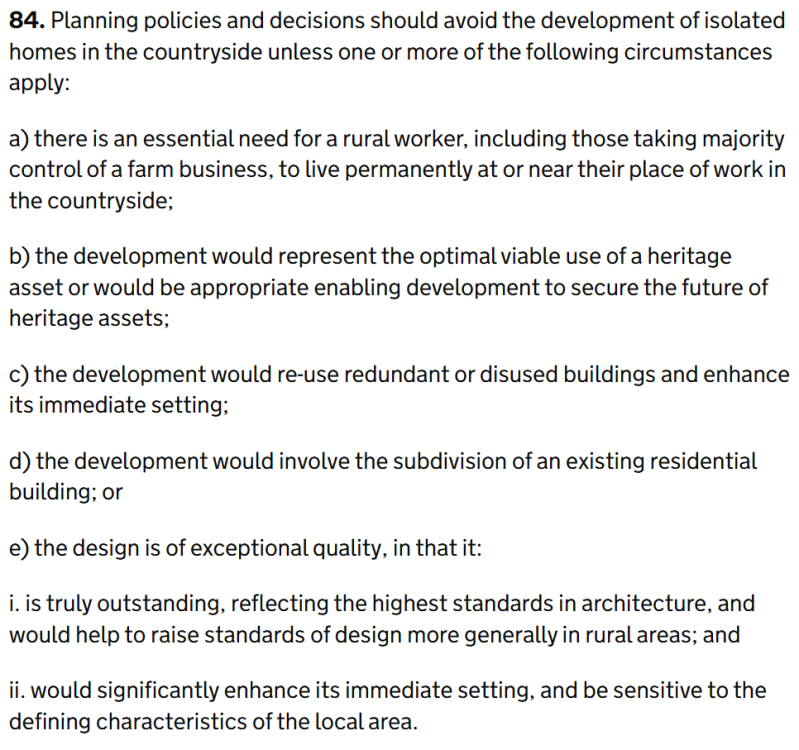
-
No, the insulated "slab" can't extend under and take the external wall loads (making it a raft) while sitting on PIR and without a suitable build up under the raft (see AFT examples at link I provided) What's missing in the AT's sketch is the pile capping/beam that joins the top of the piles for the dwarf wall to sit on. Giving the AT the benefit of the doubt, the rectangle they've drawn is intended to cover the piles and beams. What have you asked for with regards the floor/foundation. There appears an attempt to go above building regs regards insulation, but there are better ways of doing it.
-
That's not a raft foundation. Is the technician calling it a raft, or is that an assumption you have made. Yes, to be a raft, what is shown currently as a concrete slab needs to extend under the load bearing walls. If you are after an insulated raft and require it to be supported with piles due to ground conditions, that's quite niche. You'll need someone with proven experience. I'd recommend having a chat with Advanced Foundation Technology: https://www.advancedfoundationtechnologylimited.co.uk/our-products/timber-steel-icf-framed-building-foundation/
-
Evaluating a potential plot / Planning Consultants
IanR replied to -rick-'s topic in Planning Permission
What have you based your opinion on? Are you aware of the NPPF Rules for Green Belt? Does the LPA have a policy in the Local Plan that says how they deal with development in the green belt? From https://www.gov.uk/guidance/national-planning-policy-framework/13-protecting-green-belt-land You need to be able to argue one of the exceptions, otherwise the LPA will refuse. If you have deep pockets with regards obtaining the planning permission, it's worth looking at "Para 80 e)" development. While it's not explicitly a green belt exception (it's regard development in the open countryside), on occasion it does get an Approval within the green belt. -
I've got the KF410 Studio from 2017 in my Utility and Boot room, which looks to be halfway between the current KF520 and KF410 versions. For an opening sash, there's not enough frame on the inboard side to cover any more than around 5mm of the frame, before you'd be stopping the inward opening sash from being able to open. So, internally you'll be seeing nearly all the frame. Externally, you can cover the sides and top of the alu-clad frame with your cladding/render board, but not the bottom. On the sketch below the blue block at the bottom comes on the window and I've shown the internal cill level with the bottom of the frame, and the pink is a folded external cill. The hatched area is supposed to show cladding on the side of the rebate covering some of the frame. Edited to add: I have alu-clad timber across the rest of the house and while I'm very happy with them, if/when I do it again I'll think seriously about saving the money and going UPVC through out. The KF410 is a really solid, stable, well built window.


-
Ha - Not something I have direct experience of but I know of the "Probity in Planning" guidance document for councillors: https://www.local.gov.uk/sites/default/files/documents/34.2_Probity_in_Planning_04.pdf As per section 5 I believe the councillor in question would have to withdraw from the committee since if he's already given his view before committee he has a "closed mind" with regards the decision to be made.
-
I'm going to ignore your comments now, no idea why you choose to be argumentative, some of your input is of value. The ASHP will be on and off, the emitters are more constant. They are not balanced.
-
The gauge in the pocket 2/3 up looks close to me measuring at 35°C, although both the gauge and the laser temp gun will likely have a ±1°C tolerance so can't be relied on to compare between the two. You'll need to measure a few times to get a feel for what is going on, the temps are dynamic as the ASHP comes on and off and you're wanting 0.1° accuracy which isn't achievable with consumer devices. It would be nicer to see the temps across the top, and those at the bottom within 1° of each other. If after multiple readings, at different times, you are still seeing a similar result are you could try to slow the emitter pump down and are you able to limit the flow rate of the ASHP? Not sure if it's a setting available on all HPs, but I can turn mine down (on space heating only) to make it run slower for longer. I set mine up with a data logger and DS18B20 sensors and some times the traces would show the flow temp to the emitters higher than the flow from the ASHP, which isn't possible - the accuracy of the readings I need are not within the capability of the DS18B20's. After about 10 different sets of readings, each running for a couple of hours mine averaged out with the emitter side being within 0.5°C of the ASHP, except just as the ASHP stopped or started. Is it cold enough that the emitter circuit is running continuously (my own heating isn't on yet), are the measurements you have taken are at a reasonably steady state?
-
? The emitters are not on, the Buffer is at flow temp, possibly fully charged. You can't draw any conclusions, unless you have a biased view. A 4P buffer removes the inefficiencies and warranty concerns of short cycling, at the cost of minor standing losses and powering a second circulation pump that would not otherwise be required in most cases. ? The ASHP will switch off when the buffer is fully charged at flow temp.
-
That's not correct. A 4P buffer is to allow hydraulic separation, allowing the emitter circuit to take energy at a different/slower rate than the ASHP adds energy, reducing short cycling. Thermocline/stratification is a robust phenomena that does not require balanced flow rates - it occurs in HWCs that do not have balanced flow rates, and have no baffles or features to promote stratification.
-
You'll be losing a lot of temp from the uninsulated pipe work. Can you measure the temp on the pipe into the buffer from the ASHP, just at the joint to the tank.
-
Keep an eye on the temp gauge, there's no circumstance where it should stay at 30°C. At 2/3 up the tank then when the ASHP is on it should mostly be showing a temp around the flow temp, and when the ASHP switches off, if the UFH is still running it will, after a while, drop to return temp, shortly before the ASHP switches back on. Flow temp is water temp coming away from the ASHP. The flow rates either side of the buffer do not need to balance, a 4 port buffer is there to allow the exact opposite, ie, the UFH to take energy from the buffer at a different rate to what the ASHP supplies it, it's what protects the system from short cycling. The biggest improvement you could make is some insulation on those pipes.
-
It would mean 0.714m³/m².h, rather than ACH, natural ventilation. For total ventilation you'd then need to add the MVHR ventilation (converting your 0.5ACH to m³/h). Or you need to convert the air permeability target units to ACH and add to the 0.5 ACH of the MVHR. Apologies, I shouldn't have included the "@50PA" on the MVHR figure, it would be just the m³/h. The *10% is to account for the 90% heat recovery of a PH certified MVHR. If we're keeping everything in ACH, and the target is 2 ACH, then total house loses from air flow is the 0.2 ACH (from natural ventilation) + (0.5 ACH * 10% (from MVHR)). If the heating engineers don't consider MVHR then then I'd give them this value. [physical air permeability testing (blower door test) in the UK tends to provide results in the m³/m².h@50Pa units, as that's what building regs uses, so you need to work out how to convert between them and ACH for your property] I'd ignore natural ventilation for the MVHR figures. The building regs airflow requirements are a minimum, so base those on MVHR only. I'd only consider natural ventilation figure within the total house losses, when sizing the heating system.
-
Is it a 4 port buffer? What size is it? What height is the temp sensor? Assuming 4 port (or 3 port) I'd go with flow temp control running off a weather compensation curve.
-
It's actually 8m³/m².h@50Pa rather than ACH. Each house has a different relationship between the two so you'd need to calculate the ratio for your house. (PH is 0.6 ACH as you say) Supposedly, the Building Regs change due 2025 (if Labour continues with the plan) for the future homes standard will drop to 5m³/m².h@50Pa. 20 is used for an unexposed area, 14 tends to be used for an exposed area. I'd keep it, but use the "rule of 14". But, infiltration losses should be based upon: (air permeability (m³/m².h@50Pa) / 14) + (MVHR flow rate (m³/m².h@50Pa) * 10%) The higher insulation and air permeability you target the greater the proportion of losses due to thermal bridging. Have you attempted to account for thermal bridge losses for your construction type? Most heat loss calculators include a "standard" psi value for typical construction methods, if you are mitigating thermal bridges you should adjust for this.
-
Barn conversion on five acre plot in Northamptonshire
IanR replied to Owain1602's topic in Introduce Yourself
Hello and welcome, Sounds like your LPA is taking a pragmatic approach, which is as much as you can hope for. Look forward to seeing your plans once you are ready to share. Hopefully keeping the portal frame has not put you off the passive slab, depending on finished floor level versus the height of the pads under the columns there's a bit of extra detailing to do, but it is all "doable". I worked through mine with Advanced Foundation Technology Ltd and came up with a neat solution dove tailing the two together so they have some previous experience which may be useful to you if you've not already settled on a supplier. Have you thought of construction method for the timber frame? While the existing portal frame is quite an open structure, keeping the purlings in place (to keep teh LPA happy that it's a conversion) does make it awkward to crane a panelised system into place. I settled on a stick built solution but went with an I-Joist structure to allow lots of insulation. Good luck with your planning app. -
Experience with EA for PTP permission to drain to culvert
IanR replied to Alan Ambrose's topic in Planning Permission
pre-2015 discharges have to abide by the "Rules that apply to all discharges" section of the General Binding Rules. When you say "OK treatment plants", if you mean a (BS EN 12566) small sewage treatment plant or a package treatment plant then they are meeting the requirements of the rules, but if they are still on a septic tank as most "1940 to 1960s" properties would have originally been, then they must upgrade or get a permit (which they are unlikely to get without changes). Under the General Binding Rules the must have a plan to upgrade within 12 months. -
Experience with EA for PTP permission to drain to culvert
IanR replied to Alan Ambrose's topic in Planning Permission
Nope, they'll assume you've gone through the rules and worked out you can't discharge under them. Yes, but... pre-2015 still have to follow the rules, which likely means having a plan to upgrade within 12 months. If they don't have a permit, then they are under the rules, if they're not discharging within the pre-2015 rules they're at risk of a prosecution, but in the context of your connection, they are discharging "within the rules". If your discharge would be wihtin 50m of one of your neighbours (that doesn't have a permit) then you can't discharge within the rules. (but you could have done pre-2013) If you can position your discharge 50m away from the closest neighbour's discharge, then you can discharge under the rules.