IanR
-
Posts
1857 -
Joined
-
Days Won
6
Everything posted by IanR
-
Nope, line loads are used to calculate the loads the walls put into the foundation. ie. 10kN/m = just over 1 Tonne-force per meter length of wall. Edited to add: From the Drawing

-
The drawing Key helps you here: First figure is dead load, second is live, the units will be kN/m.

-

Community Infrastructure Levy (CIL) HELP PLEASE
IanR replied to Caroline's topic in General Self Build & DIY Discussion
It sounds like you were attempting to offset the new residential area with the existing agricultural area, for the purposes of CIL. Is that what you were attempting? Unfortunately you can not do that - for the CIL calculation the council wants to know how much additional residential area is being created by the proposed development. You can only offset an existing residential area that you are demolishing for the proposed development. Can I ask why you are not applying for self-build exemption? or are you and the council is confused? -
MVHR ? Who needs it? I don't.
IanR replied to ToughButterCup's topic in Mechanical Ventilation with Heat Recovery (MVHR)
Are you able to measure CO2 levels in your house? The BC requirement for mechanical ventilation when you are under 3m³/m².h@50Pa infiltration is a really rough proxy air quality. For your own benefit it would be better to know the CO2 levels without MVHR and if it goes above 1,000 ppm then you'd be better off having MVHR, and if above 2,000 ppm it would be a health risk not to have MVHR. I've tried running without the MVHR on between Spring and Autumn, and I don't like bathrooms not drying out as quick as I've got used to, even with a small window open... -
Private shared driveway being blocked by neighbour
IanR replied to qamar's topic in Party Wall & Property Legal Issues
Sounds like you should park in front of your garage, until you get hold of the Title to prove access rights. Assuming the Garage was there when you purchased the property, it would have been your Conveyancer's job to ensure you had Access Rights. -
CAD software recommendations?
IanR replied to Great_scot_selfbuild's topic in New House & Self Build Design
What is it you want to do with the CAD software? If you want visualise the staircase within it's environment, then a lighter-weight software such as Sketchup will be quicker to learn and it's polygon/tessellated database is sufficient for the task. If you wanted to create photo-realistic rendered images of the staircase then Blender is a good option, and completely free. If however you want to create an Engineering 3D model of the staircase, with accurate models ,thicknesses, fillets, holes with the ability to build associated assemblies, with a catalogue of stock hardware (bolts, nuts, screws, rivets etc.) and sub-assemblies where global changes to the staircase automatically update through to all parts in the assembly and the ability to develop blanks of folded brackets, cutting lists, weld details and associated 2D Engineering drawings that update when the 3D model changed, then you need a NURB/Bezier based CAD system, which will tend to have a steeper learning curve. If you are wanting to create something that was going to be manufactured from, at a fabricator, then I'd be looking at a mid-tier CAD system such as Solidworks, Creo, Solid Edge etc. most of which can now be leased monthly. Free for 6 months is OnShape, which gets close to these systems for the basics. However, if you're going to just do this once, it may not be worth the trip up the learning curve, there's a lot of content in a design like a bespoke spiral staircase if you want to fully define it "in CAD" and have a workshop manufacture it for you. In this case I'd suggest a seasoned professional. -
Insulated threshold detail for insulated rafts
IanR replied to WannabeBob's topic in General Construction Issues
I don't know of the Internorm "thermoplastic insulated threshold", but the image above shows it taking bolted/screwed fixing so I'd put the brackets on to the threshold and suspend the lower portion in air, where you are going to cast the raft. Put some threded bar through the holes in the (initially) unattached end, using a nut either side to hold the threaded bar in position, then cast the bracket into the raft. You'll have to temporarily, externally, back up the threshold so that it doesn't move during the pour.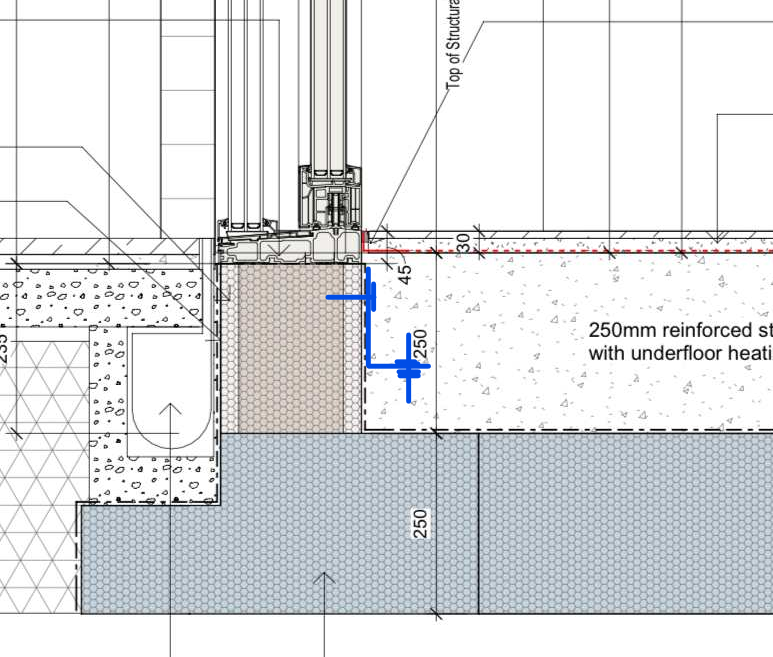
-
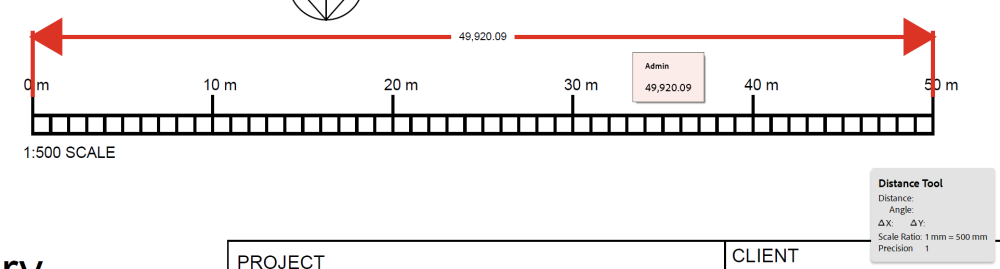
While the Plan you attached is "to scale", it's incorrectly called out as an A4 sheet size. Image below shows in the bottom right hand corner that I have set the scale in Acrobat as per drawing 1:500. Units are mm The 50m scale on the drawing measures 49,920.09mm However, the above is directly off the digital file. If you do as the drawing states and Print to A4 it won't be to that scale since the sheet size is actually 594 x 841 (A1) not 210 x 297 (A4), as defined in the file's properties: So, while your Architect has made a mistake, the Council are being a little picky. All dimensions they require are called out on the drawing. They don't need to "scale" anything.

-
Yep. I don't know Greenraft. The image on their website appears similar to Isoquick, but without the bespoke insulation pieces. I'd recommend Advanced Foundation Technology, and use them as a baseline to compare others to. He doesn't specialise in insulated rafts, he shouldn't be upset if you choose to use a specialist.
-
Yes. Isoquick is an option, but they are not optimised. You'll pay more than you need to for steel and concrete and you'll have more mass to heat up for the UFH.
-
Implication of not using MVHR
IanR replied to Indy's topic in Mechanical Ventilation with Heat Recovery (MVHR)
You'll need to be worse than 3m³/m².h@50Pa, with trickle vents closed, otherwise BC should require you to have a mechanical ventilation system. Without mechanical ventilation you will need trickle vents in windows. There's no payback directly on MVHR, but, MVHR enables a < 3m³/m².h@50Pa infiltration rate. It's the low infiltration rate that provides the payback on the MVHR. ie. the reduced energy loss from, say, having a 0.5m³/m².h@50Pa infiltration rate pays for the MVHR. -
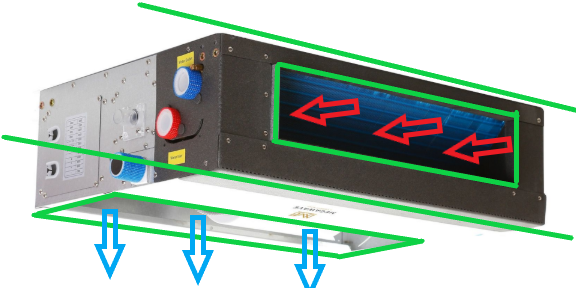
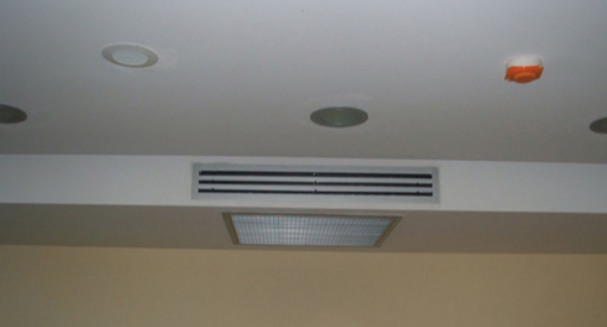
Have you got the install instructions for the FCU you have imaged? Does in not install 180º from the way it is pictured, inlet at the horizontal and outlet at the vertical? You mention keeping above dew point. What kW of cooling are you expecting from a 14°C water feed? They're really for single room recirc. My loft is the warmest place in the house, often around 26°C. I think you'll be warming the bedrooms below rather than cooling.
-
Thinking about it, but not done yet. Have you got a reason for wanting to take air from the loft and circulate it to the room below? Typically you'd recirculate the air within a closed off room, ie. inlet and return into the same volume. It's not going to be powerful enough to cool/heat the whole house with a single unit.
-
I'd assumed it was PV array area. Max height 4m and 5m distance from boundaries. Mines not going within the defined domestic curtilage, so I'm going to need planning anyhow.
-
Only "theory" not put into practice. Typical PV panels could be installed for the same or slightly less, using S5 bracketry and avoiding a full frame. https://www.s-5.com/products/solar-panels-on-metal-roof-pvkit-2-0/?_gl=1*e60zsa*_up*MQ..*_ga*NjE4NTUzMDA2LjE3NDExNzkwNzQ.*_ga_PCT1SK6CMV*MTc0MTE3OTA3My4xLjEuMTc0MTE3OTA4NS4wLjAuMA.. I agreed this wouldn't effect warranty with the roof installers before the standing seam was installed. I also looked at flexible bonded PV panels. You can get them preinstalled on steel trays, or retrofitted onto other standing seam materials. I looked at retro-fitting. Costs were higher, performance less efficient, and they had no rework plan should you want to replace the 25 year life PV on your 60 year life roof. https://bipvco.com/flextron/ This is the one job I have procrastinated most on and have now decided to go with a ground mount array.
-
It would be better to not think the negative response you received was due to corruption. That would leave you under the likely misapprehension that it will be easy to counter once others are considering the details. Mistakes do get made and maybe this is one of those occaisions. You would need to set out your application to counter the issues raised by the officer. The Consultant you used should explain to you why they feel the Planning Officer's argument cannot be challenged. Ask for a face-to-face meeting, and keep asking questions until you understand his/her new point of view, or until they have accepted yours. It's unlikely to be black-and-white, It may help you understand if there is a way around the Planning Officer's arguments against development. If you still can't understand the Planning Consultants view, then perhaps get a second opinion. Planning applications, and their appeals are long and drawn out, you need to be sure that you have understood why your opinion is different to the Professionals.
-
How to space two parallel reinforcement bars vertically?
IanR replied to AartWessels's topic in Foundations
Pretty sure everyone would agree the position of the rebar within the beam should be where the SE has shown it in his section, that's why the OP has opened this thread and I have contributed with a means of doing so. If you believe I have said something different you need to go back and re-read my post. -
How to space two parallel reinforcement bars vertically?
IanR replied to AartWessels's topic in Foundations
You're over thinking it. -
How to space two parallel reinforcement bars vertically?
IanR replied to AartWessels's topic in Foundations
Tie in some short rebar pieces horizontally and vertically. Push the pieces a little way into the EPS. Spacing sufficient to keep the longitudinals robust for the pour.
-
By thickness EPS gives 60% of the thermal insulation that PIR does, so to achieve the U Value that 300mm EPS provides, you need 180mm PIR. I said 200mm PIR as I'd personally be buying that in 2 x 100mm sheets. When I cost compared for bulk order, I could get 100mm EPS100 sheets for half the price of PIR sheets and I was comparing BBA Certified EPS100 (load bearing) with an equivalent, but not load bearing, PIR. Looking at what each are retailing for today it still seems to have the same price difference. At the time (2016), and apparently still the case today, EPS formwork are not priced publicly by the various suppliers, but are offered as part of an Engineering & Supply bundle. For me prices varied widely between the companies offering such bundles and if the bundles included installation the incremental cost for installation was far higher than you'd expect to pay with local resource. The price I ended up paying, after looking at all options available, was the equivalent to paying around 10% more for the same m³ that I could purchase directly in sheet form, once I'd allowed a reasonable Engineering fee, so felt it not unreasonable as it included the EPS300 formers. I can see the benefit of buying a full package: Engineering, supply and installation, especially if it also includes the house frame on top, as that totally de-risks that structural build, but, you have to expect that to come with a large premium attached, and you'll be paying that premium on everything, ie the insulation, steel, concrete, UFH and labour. The best "full bundle" price I could get, including installation, was over 100% more than the price I paid using a local ground works company, PM'd by me, to install the Engineered raft by AFT, who supplied me the insulation from Springvale EPS.
-
I don't believe BC would accept it. Why do you want the outside ground at FFL level? What's your plan for the outside finish?
-
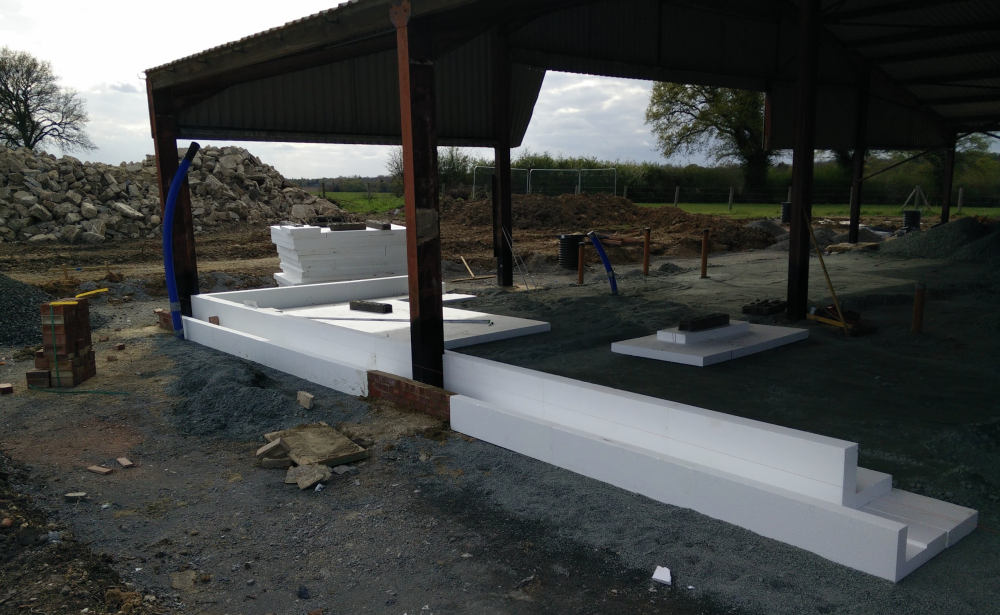
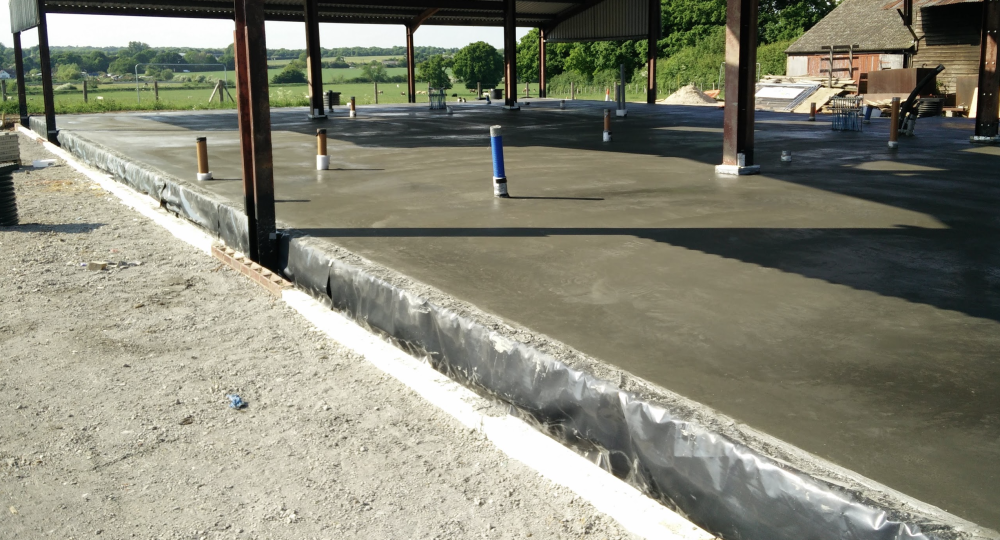
As per image posted on page 2 of this thread And in practice At the threshold locally bring the outside surface up to the FFL with linear drain against the threshold if exposed, or just tip the surface away from the door a degree or two if there's an overhang above. Level thresholds are no problem with a raft. Edited to add:

-
It's a BC erquirement for DPC above ground. DPC/DPM will be at the top of the poured concrete of the raft. (unless you are building a partial basement)
-
Planning Approved - Feedback on proposed layout
IanR replied to Owain1602's topic in New House & Self Build Design
Well done, you must have crossed a lot of hurdles to get to this point! Lovely project! Will that be a "thick" timber frame with lot's of insulation to go with that passive slab/raft? Ignore the Portal Frame? - Have you got permission to knock down and rebuild? Even better if so!!! Re. Plant Room, assuming warm roof can you make any space above the 1st floor to house MVHR, and maybe UVC, Buffer? etc. If you can, then centalise your coms up there as well. Yes you can (and should) duct your ASHP under the raft. (pre insualted twin pipe from someone like Rehau) MVHR to external should be on same wall or roof plane, ideally 5m apart, 3m Min. -
I'm also on clay and due to the nature of my build didn't even go down that deep, but as I was converting a cow shed the top soil was already gone, I just cleared away the old floor and hardcore that was underneath. I actually had to build up the outside around my raft. You need to clear away the top soil and any vegetation and as long as the clay you expose has > 100 kPa bearing capacity you can go from there. AFT can go lower than 100 kPa, but might need to change the build up. Top of the raft should be at least 150mm above ground level, but can be more. Under the insulation is typically 150mm Type 1 plus 50mm layer of uncompacted pea gravel or granite chipping with no fines.