IanR
-
Posts
1841 -
Joined
-
Days Won
6
Everything posted by IanR
-

Problems with glazing fitted into green oak frame
IanR replied to Robert Clark's topic in Windows & Glazing
I believe so. Part L1A, Page 25, New fabric elements in an existing dwelling https://assets.publishing.service.gov.uk/government/uploads/system/uploads/attachment_data/file/1057372/ADL1.pdf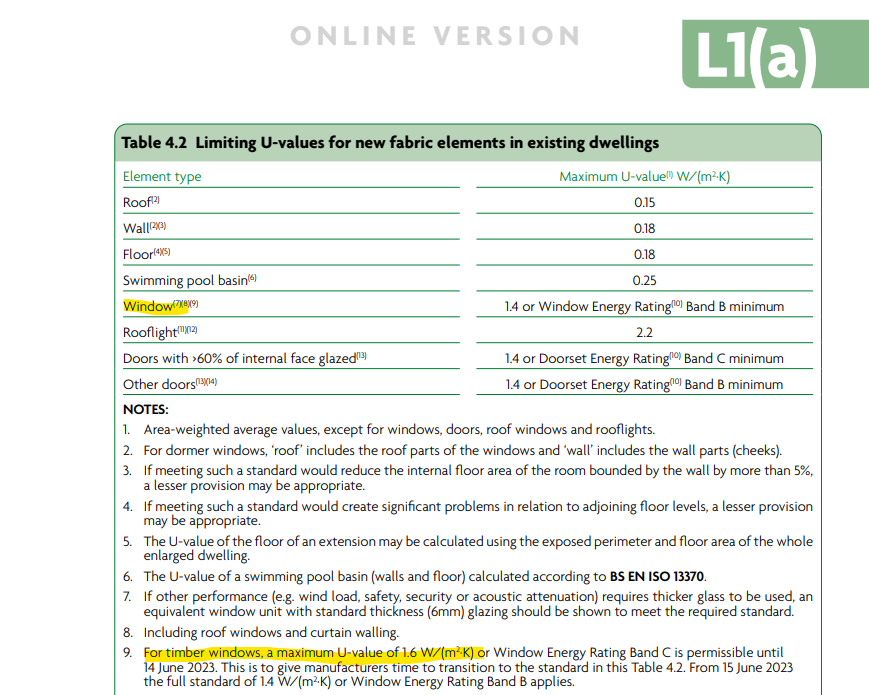
-
Problems with glazing fitted into green oak frame
IanR replied to Robert Clark's topic in Windows & Glazing
Surely he will have to for Building Control -
Problems with glazing fitted into green oak frame
IanR replied to Robert Clark's topic in Windows & Glazing
If you are not sure of the spec, then you will need to go to the manufacturer. However, Is it not the whole window value that needs to be under U 1.6, not just the glass? -
Your loads appear typical, so a typical connection should be sufficient. At the time I requested a connection I was told 20kVA was "typical". Because I was requesting something untypical, and they knew I was a home owner and not an electrician, they wanted me to prove the load size with a (I think it was called) diversification calculation. This was the total loads connected x a factor (ks factor?) that allowed for them not all being in use at the same time. Different connected items seem to have different ks factors. In the end I just got the electrician to speak to them and they accepted what he told them without the need for any proof. Edited to add. 3 phase may be an advantage though, allowing more than a 3700kw solar PV connection, without DNO approval and for EV charging at above 7kW.
-
The Quote from Network Power reads as if the £2,819.60 is the whole cost for the new 100kVA Transformer, rather than just my 45kVA portion of it. On top of this there was £3,300 to install 130m of 3 phase cable from the telegraph pole to my kiosk, in a trench that I dug, and make the connection, plus other amounts for reinforcing the local overhead lines from transformer to telegraph pole, +++ Total cost was £7,600.
-
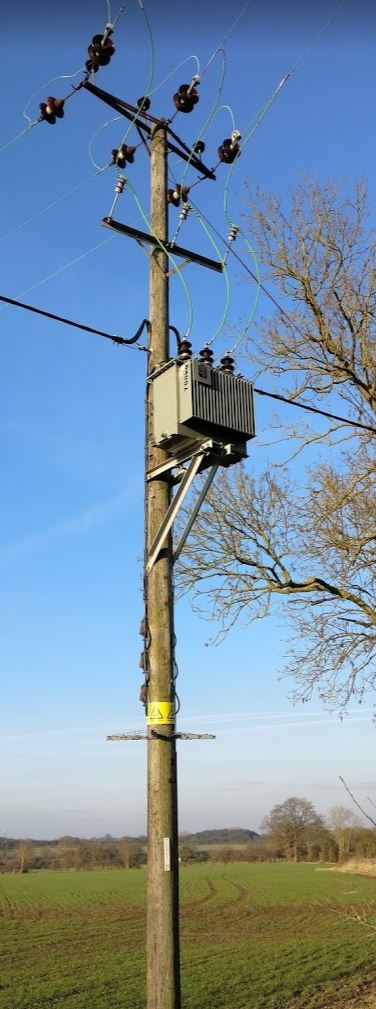
Are they charging you the whole cost of a new 200kVA transformer? For a new 3 phase, 45kVA connection, I was charged £2,819.60 to upgrade the pole transformer from 50kVA to 100kVA, back in 2016. Here's mine. I feel like putting my name on it! Lot's of other charges for the connection. Total bill was over £7K iirc.
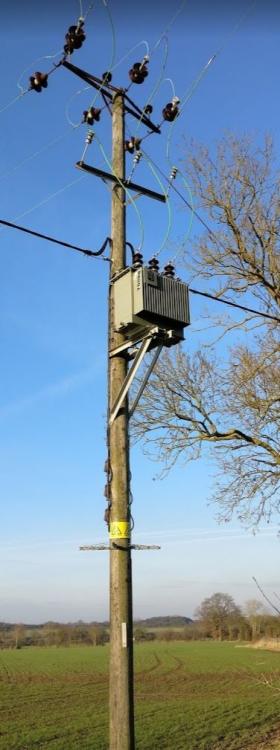
-
It's not about who is quoting you. It's about the property's space heating requirement being 57,225 kWh. On your property, with cost effective measures, you could get this down to around 8,500kWh. Whether it's heated by gas or electricity, the property needs the same amount of heat energy inputted to maintain the required temperature. A 90% efficient gas boiler(s) will meet that requirement with 63,583kWh of gas, or an 481% efficient GSHP will meet it with 11,897kWh of electricity.. @ 7.37p per kWh of Gas and 28.34p per kWh Electricity, the heat pump will be cheaper to run day-to-day, but if you design, engineer and build better and get the 57,225 kWh energy requirement down to 8,500kWh both options would be much cheaper to run and install. I believe there is around a £2,750 per year cost save by improving the energy efficiency of your house. The parts of the build that improve energy efficiency should have a 50-60 year life, but even if you only considered a 25 year life then that's a £68,750 budget for energy efficiency measures.
-
Simple, cost effective steps could vastly improve your proposed building's energy efficiency. My property is a modest ~450m². But, as a barn conversion, has a large volume, circa. 1650m³. That would be similar to yours if you had an average 2.8m ceiling height. My space heating and hot water could be comfortably met with an 8kW ASHP. I did oversize my heat pump to 12kW, wanting a faster re-heat on the hot water, but that has proved entirely unnecessary. My annual space heating requirement is around 6,400 kWh. Hot water is around 10,000kWh, which combined, needs around 4,000kWh of electricity at a SCOP of 4.
-
Is that space heating and water? For a GSHP they may have used a SCOP of 4.5, which would mean a roughly 60,000kWh annual energy requirement for heat and hot water. Unless you are providing hot water for 10, or have included a swimming pool, you could easily get that figure down to sub 20,000kWh annual energy requirement. GSHP install cost do not make the small efficiency increase over ASHP worth it. An ASHP install cost should be in the region of £5K to £10K more than the equivalent gas install, and you can get £5K back in a BUS grant.
-
But they're not. My local gas standard rate is 7.37p and Electricity is 28.34p Gas boilers are, say, 90% efficient. An ASHP needs a SCOP of 3.46 to be in parity. For me, ASHP is cheaper to run day-to-day, even without considering not having to pay the gas standing charge. Inflationary pressure will remain higher on gas than electricity going forward, for many reasons. Over time the swing will be more in favour of electricity.
-
With Gas prices now having gone up by a higher percentage than electricity prices, ASHP v. Gas boiler day-to-day running costs are now in parity, or slightly in ASHP's favour.
-
Hi and welcome. How about reducing the energy/heat losses of the building so that you don't need such a large (two boilers?) heating system. Are you saying you have calculated a heat pump to be 75% more day-to-day running costs than a fossil fuel boiler? or are you saying 25% less? Day-to-day running costs should be around the same.
-
Depends upon your energy efficiency (heat loss) aspirations, whether you need a masonry skin for planning, your feelings about timber-frame houses and whether you have access to any particular construction trade via you, family or friends that would make one or other construction type more cost effective. An I-Joist or twin-stud (Larsen Truss) timber structure, filled with blown cellulose fibre insulation, combined with an insulated, ground bearing raft (foundation) and timber or render board clad, I would say, is the simplest construction method to achieve a very energy efficient build. A light weight timber structure makes the insulated raft simpler (and cheaper) to design cold bridge free. If you have to have a masonry skin then it may make an I-Joist or twin-stud structure more expensive than alternatives I'm not so familiar with insulated concrete formwork, but there's a few members here that have built ICF houses that perform to a very high level, with some building the ICF structure themselves. If you are not up for getting trained and doing it yourself you may struggle to find experienced trades to do the ICF build for you.
-
SIPs don't really deliver their headline "quick build" for a bespoke self build. There may be less build-time on site compared to some build methods but that's balanced out with more frame design time and factory time constructing the panels. You may actually be committing money earlier in your program with a SIPs build, and may therefore need to be in rental accommodation earlier and for longer. With regards to being thermally efficient - there are better options. A SIPs structure won't deliver the advertised standard panel U value. With roofs especially, but also walls, additional timbers will need to go in to the panels to carry the loads, and these reduce the whole panel U Value and introduce cold bridges. Reasonable airtightness, compared to building regs, can be achieved with SIPs but it's a difficult build method to achieve excellent air tightness. If you look into the Potton case study of building a SIPs PassivHaus they comment on the extra work it took to achieve the air tightness targets. You don't say whether you are considering combing SIPs with a masonry skin. I'm personally not a fan of PIR/PUR insulation in general, but combined with a light weight rain screen (timber cladding, render board etc.) I'd definitely steer clear. The low decrement delay of PIR/PUR means it really should be combined with a "heavy" outer layer to avoid uncomfortable internal temp swings
-
"The Federation of Master Builders (FMB) says that the government needs to pull its finger out and tell small builders what it expects from them." As if the government has the contact details for all the small builders. I think it's really for the FMB's to keep their members informed. On this one, the Government has done a reasonable job on publicising the coming changes. It's a shame the industry is, in general, reluctant to any such changes.
-
As @jack says, with a small bit to add. For materials only, you pay 20% VAT and can reclaim it at the end of your build. For Supply and fit, or labour only, it must be charged at the reduced rate, which is either 0% for a new build, or 5% for a Conversion or a residential refit on a property that's been empty for +10 years. The 5% paid can then be reclaimed at the end of the build. Only VAT charged at the correct rate can be reclaimed.
-
VAT is claimable on materials and labour to install.
-
Recomended suppliers
IanR replied to hotnuts21's topic in Mechanical Ventilation with Heat Recovery (MVHR)
What do you hope to get from an MVHR? Are you taking steps to find and block all existing air leaks in the existing structure, and to build the new extension with measures to ensure a much higher air tightness than building regs allows. If you are not likely to achieve an infiltration rate of better than 5m³/m².h @50Pa then a whole house MVHR system will not bring any benefits, and will in fact increase the property's energy losses. Building Regs (in England) do not require mechanical ventilation unless you have a better than 3m³/m².h @50Pa infiltration rate. If you are not planning to significantly improve the property's air tightness, you could save the MVHR budget and focus on single room extractors (with heat recovery if you want) on those rooms that need it and adjustable trickle vents in windows. -
Newbie looking for inspiration and ideas for 7 acres of land
IanR replied to Doug82's topic in Introduce Yourself
What's surrounding the plot? Is it "open countryside", with adjoining agricultural fields? There may well be no formal classified use of the land. Sounds like it was likely once agricultural, which has then been used for equestrian. Previous owners may have formalised that equestrian use with a Change of Use application, but often it's not done. If it's not been formalised, then once the new Use has continued for 4 years, without interruption, it becomes immune from enforcement. If the new Use is later abandoned, it goes back to the original agricultural use. While the formal line is that agricultural Use is a Use for an ongoing business, you can generally get away with any agricultural-type uses as a hobbyist. The only Use on your list that may raise an eyebrow is the raised beds. Typically the LPA will want to retain the agricultural scene, and not have residential/domestic paraphernalia encroaching what was ounce agricultural land, however they will generally only act if neighbours complain. When fencing and planting hedgerows, keep it agricultural in nature, ie. post & rail, stock, estate etc. or hawthorn mix (native species) hedgerow. Be warned though, if you put in hedgerows, while they do significantly add to the bio-diversity, they will need regular maintenance. -
Another 'Cool Energy' heatpumps thread
IanR replied to HughF's topic in Air Source Heat Pumps (ASHP)
Then your comparison is more likely a self-install ASHP for £5k v. an MCS ASHP install for £?K with a £5K BUS grant and a 7 year warranty. (Unless ASHP manufacturers will now give full warranties on a DIY Install.) If you can find a friendly MCS firm, perhaps you can do the UVC, rads and most of the copper and brass and the MCS company do just the ASHP. -
Another 'Cool Energy' heatpumps thread
IanR replied to HughF's topic in Air Source Heat Pumps (ASHP)
I can't see anything fundamentally wrong with your working, but... Shouldn't you compare to a replacement condensing gas boiler at circa 90% efficient, rather than your existing non-condensing boiler? 75% efficient non-condensing gas boiler v. 350% efficient ASHP = 466.7% efficiency improvement 90% efficient condensing gas boiler v. 350% efficient ASHP = 388.9% efficiency improvement 7.9p per kWh Gas v. 28p per kWh electricity = 354% higher cost Condensing gas boiler is still higher day to day running costs, but closer. If you already plan to replace the rads and cylinder, I'd go with ASHP as I view electricity costs to be more stable in the future. But if you only have to replace the rads for an ASHP install, and they will last 10 years, then perhaps another gas boiler is the better cost option. -
ASHP vs Gas Boiler - crunching the numbers
IanR replied to Indy's topic in Boilers & Hot Water Tanks
If you design/engineer to PassivHaus levels your space heating requirement will be ≤ 15kWh/m2. yr Your space heating requirement should therefore be 280 x 15 = 4200kWh per year. This would require 4667 kWh of Gas, assuming 90% efficiency, or 1200kWh of electricity, assuming a SCOP of 3.5 In my approx PH level home, I find that my HW energy requirement is roughly twice my space heating requirement, for a family of 5. Gas can be installed in new builds until 2025 and you'll have no issue getting sign-off, but the system design has to be for a low flow temp. -
ASHP vs Gas Boiler - crunching the numbers
IanR replied to Indy's topic in Boilers & Hot Water Tanks
If you plan to build to PassivHaus levels of insulation and air tightness then it's a waste of your time using your current property's space heating figures. You need calculated data, based on real U Values and ACH (air changes per hour). Even with Gas prices going up faster than electricity, and the good reasons that electricity will stabilise and hopefully reduce before Gas does, it's still unlikely that an ASHP will achieve parity with Gas on day-to-day running costs, nor on capital costs now that RHI has been replaced by BUS and grants will be lower in most cases. But, that doesn't mean you shouldn't consider an ASHP, or maybe direct electric if you over-achieve on your PassivHaus aspiration, avoiding the capital costs of the boiller/ASHP installation. Firstly, forget Hydrogen. There is not currently a path to 100% grid/network Hydrogen for UK housing. The Max 20% blend of hydrogen into natural gas, currently being trialled is a red-herring. It's been discussed at length on this site, have a search and read those threads if you wish to know more. Gas boilers in private residence have a finite life. From 2025 they will not be able to be installed on new properties (legislation is not in place yet, but that is the government target with the future homes standard), and replacement fossil fuel boilers will be banned by 2035 (possibly sooner for some housing types). Building regs new for this year now require a low flow temp heating system. You can still specify gas, but it has to be designed around a low flow temp to ensure replacement with non-fossil fuel boilers in the future can be done without too much rework. Your 2.5K gas pricing suggests you are comparing to a combi gas boiler. The Regs are pushing new properties towards a system boiler with a a hot water tank so the Gas v. ASHP installation will now be very similar in all but the boiler itself. If HWC, buffer tank, valves and pumps are all equal, the price difference will just be the difference between a Gas system boiler and the ASHP itself. The 5K BUS grant should get close to closing that gap. If you do go with Gas, to future proof the house you should consider a UVC, maybe a buffer tank for UFH and a route to these from where an ASHP would be located for the pipework. -
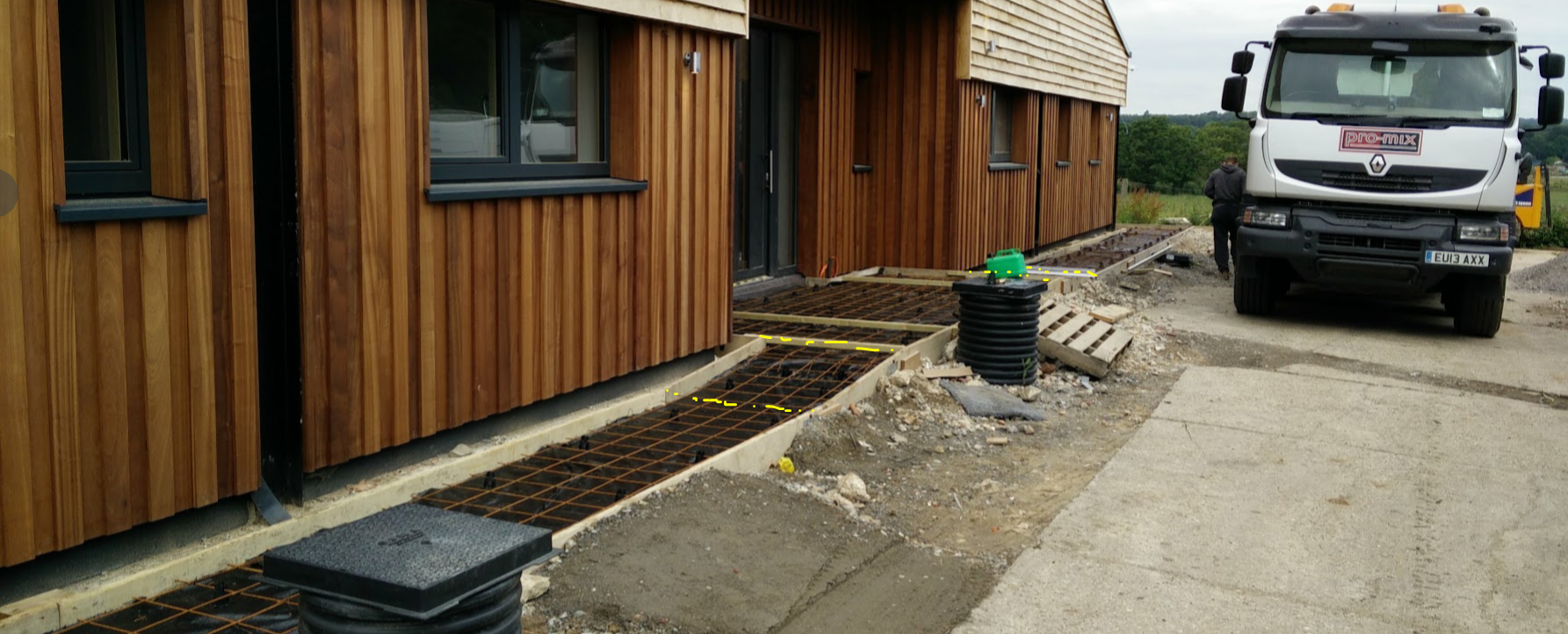
I've put in 1500 wide paths that will eventually have a 25mm resin bound topper. In the hope they will be good for +25 years without cracking, I have 100mm compacted, crushed hardcore with 25mm Type I compacted on top and 100mm concrete with A193 mesh at 50mm deep. I've got slopes up and down to a high area at the entrance and have only put joints in at the start and finish of each slope. The joints are concrete against concrete with no expansion medium. The path in the pic below is around 30m long, and I have no cracks after nearly 5 years. Edited to add: Elsewhere I do have an internal corner where the path goes from 1.5m to 3m wide, and I now have a hair-line crack starting at the corner and travelling diagonally away. I should have put a joint in where it went from 1.5m to 3m wide!
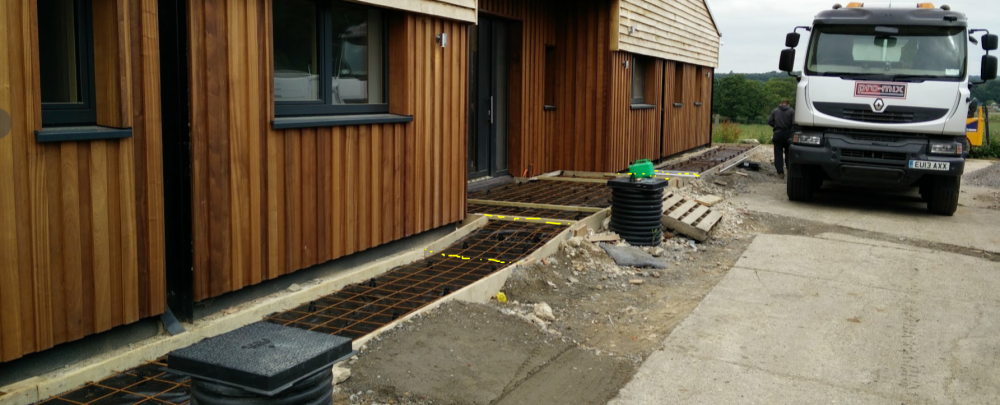
-
For me, solar gain is the bigger factor. We also went back down to sub-zero overnight, with frosty mornings and a bit of snow and sleet. There was however enough break in the cloud cover to warm the house up. In fact, on the recent cold, bright days we had to use the blinds to stop us overheating. Agreed though, if it had stayed overcast at the low temp for 2 or 3 days then the heating would have needed to come back on.