


IanR
-
Posts
1857 -
Joined
-
Days Won
6
Everything posted by IanR
-

MVHR insulated ductwork throughout??
IanR replied to matt-me's topic in Mechanical Ventilation with Heat Recovery (MVHR)
Hi @matt-me, and welcome. Are you using a PIR/PUR or an EPS SIP? and do you know the effective U value of your SIP Roof Panels, once the timber fraction is taken into consideration? I suspect once the timber fraction is taken into consideration, the U value of the roof panels will mean that your unheated loft area will be cooler than the rest of you house (except under sun loading on a sunny day). Since the hot moist air from a shower-room at say 24°C with 85% humidity has a dew point of 21.3°C it would be advisable to insulate the extract ducts. Unless you are considering adding cooling to the supply air, there's no reason to insulate the supply ducting. -
Hi @russellfeeed and welcome. Congrats on the planning. Photos are always encouraged....
-
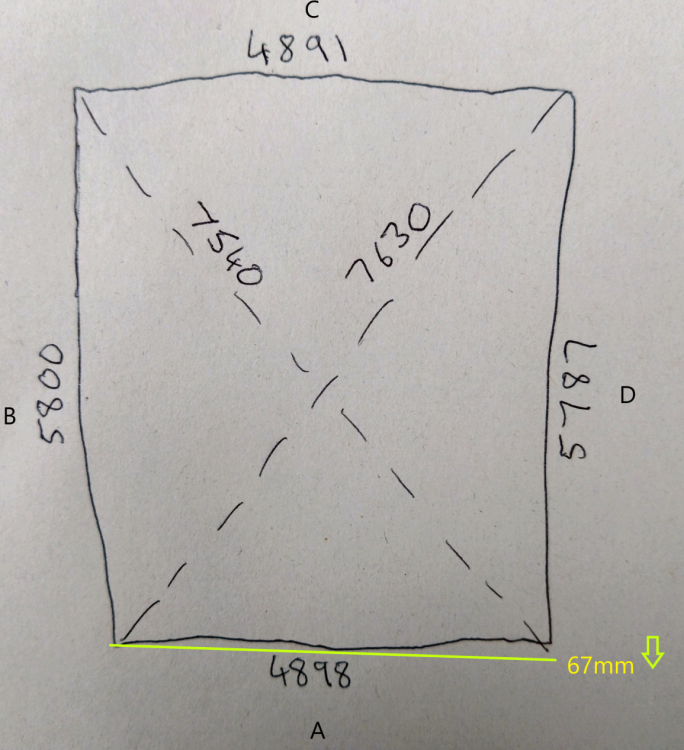
The bottom right corner (Between A & D) needs to drop 67 mm. If you are not extending the sides to the correct length, ie. side D to 5800, then perhaps only move the bottom right corner down 60mm, to half the error. Not aware of a specific App, but use a free piece of CAD software to draw it out.
-
Went to visit a self build, they had geothermal
IanR replied to CalvinHobbes's topic in General Self Build & DIY Discussion
There is often confusion, even within the industry, with regards geothermal and ground source. The terms are starting to become interchangeable, but I remember when Geothermal required at least a 500m borehole, and probably more, to get down to rock that was being heated by the earth's core, rather than solar energy. Unless you happen to have a hot spring emerging on your plot, when you could go without the borehole. Ground source is of course absorbing energy from the ground, or water that is heated by the sun. Typically GSHPs have lower day-to-day running costs, but are much more to install and a little more to maintain. With the demise of RHI, I can't see there ever being a cost benefit of GSHP over ASHP. Only if the ground arrays are incorrectly sized, which does seem to be the case with a reasonable number of early installs. -
The discharge to surface water rules have a contradiction. While there is a clear rule (19) stating you can't discharge to a water course "that does not contain flowing water throughout the year, unless there is a drought or an unusually long period of dry weather", in rule 20 it then allows a partial drainage field that permits waste water to soak into the ground, when the ground is dry. With this rule 20, the partial drainage field is still considered a discharge to surface water as long as the perforated pipe used between the treatment plant water course is no more than 10m from the water course. You previously described a "land drain" installed by a previous tenant of your plot. Is this a piped drain? Could you replace a section of this with perforated pipe, if it isn't already perforated, and then discharge directly into it. For my install BC made no checks on the discharge pipe. I supplied a drawing and stated the installation is covered by the GBR and that satisfied BC. The Environment Agency would only ever get involved if there was a pollution issue.
-
If you are only drilling a few holes then HSS should have been fine, but at Ø16 you should slow the drill down and take your time. Even a little fairy liquid under the drill may help. If you are drilling a lot of holes then you may want to go with a cobalt steel bit or black oxide bit.
-
Areas precluded from the GBR for discharge to a surface water are specifically listed as: biological sites of special scientific interest (SSSI) special protection areas special areas of conservation Ramsar wetland sites designated bathing water protected shellfish water freshwater pearl mussel population Are you believing ground water protection zone 1 is covered by one of the above list, or have you got a reference elsewhere that precludes it? I'm not saying it's allowed, just haven't found the rule you are likely referring to.
-
If there's not an "authority" that owns the drainage adjacent to the road, I doubt it's going to be part of a larger surface water drainage network. Sounds like previous land owners, or perhaps the council, have taken local measures to put underground what previously ran in ditches, but probably caused some occasional local flooding. We have similar in our road, where a neighbouring farm allowed a ditch to be diverted under a corner of their field to give surface water an easier exit to a larger ditch then into a river. If they were all still "ditches", there would be no issue discharging into them under the General Binding Rules as long as, at the point you were discharging, it remains "wet" for the majority of the year. Or are you saying the fact that you are in a "groundwater source protection zone 1" disallows this? I thought it stops the drainage field, but discharge directly to a water course was allowed. Just because surface water ditches have been re-routed underground, it doesn't change their function, so they should be able to be treated as a water course in General Binding Rules terms. It would be nice to know they won't get blocked though.
-
New Build - UFH Zones, Buffer and Active Cooling?
IanR replied to Shaun McD's topic in Underfloor Heating
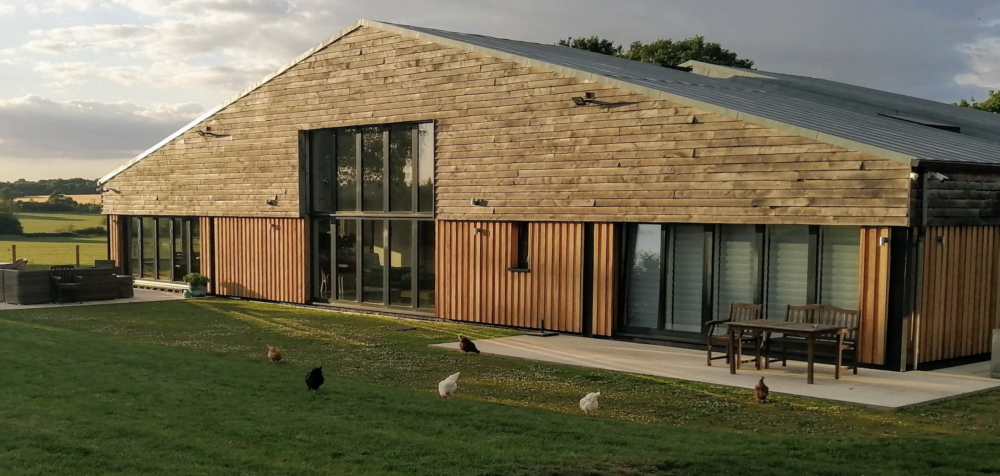
As long as I've explained well enough. A 4P buffer is a different use case, ie. if you want/need to run separate heat/cooling system (wet duct MVHR or fan coil heater/chiller) and you want to run that at ASHP Flow temp, for as long as possible when the ASHP is not running, then you need a 4P Buffer. If you "just" want to increase the volume of available fluid to the ASHP, then a 2P Buffer in the return line. Yes the Buffers are available pre-insulated, and there's no harm adding more. For my MVHR Wet Duct? Because I tee off the flow line before it gets to my UFH group manifold, which holds the UFH pump. So to get flow through the MVHR wet duct heater and back to the buffer, I need a pump on that loop. I had to do it like this as I wanted to be able to shut the buffer off from the UFH and just circulate the UFH water to re-distribute solar gain from the warm side of the house to the cool side. So this is rather specific to my installation and there may have been a better way of doing it. A condensate drain. So I use a wet duct chiller for mine which either heats or cools the MVHR based on what's in the buffer. Mine are Hunter Douglas external venetians and colour match very well to my Alu-clad Internorm windows. Good point regarding your location. And maybe your shading to the living area. I wouldn't take a risk on this though and I'd get it modelled. I'd recommend PHPP even if you don't plan to build to a PassivHaus level. Costs for me we're offset to some extent by not needing such expensive internal blinds/curtains. In my living areas I having nothing internal on the windows, and in bedrooms I have internal roller blinds. When my blinds are retracted they are entirely concealed behind the cladding In 2017 the 5m window blinds were £2K each and I have some 2m windows that were £1K each. Internorm wanted around £1K per sash, but they do add a 4th pane when they include integral blinds.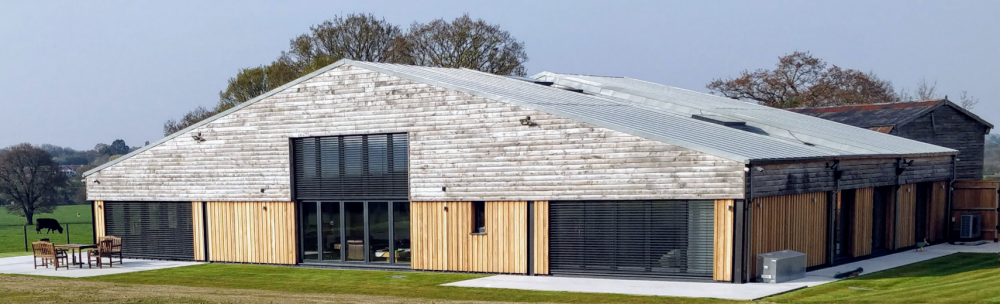
-
New Build - UFH Zones, Buffer and Active Cooling?
IanR replied to Shaun McD's topic in Underfloor Heating
Yes, buffer always in use. A 2 port buffer is less efficient due to standing losses of the buffer. A 4P buffer is less efficient due to standing losses + an extra pump that may not otherwise be required. Neither are huge inefficiencies. Standing losses at ASHP flow temps aren't huge, and even less at ASHP return temp (hence put the 2P buffer in the return line), plus you're only paying for one third of the standing losses since you have an ASHP heating the water. For a 4P buffer the extra pump that you may be able to avoid without it, may cost £20 - £60 a year to run. Your capital investment is also higher, of course. I have mine tee'd off the flow line, before the UFH group manifold, but I then need yet another pump, and use it for heating and cooling. But, energy transfer via MVHR is low, due to air-flow rates. I doubt it would make sufficient difference unless you have very low energy losses, ie. PassivHaus class. No, HP in cooling mode will definitely not be enough. Bris Soleil is a minimum, but more control allows you to make more use of the solar gain. What was the issue with shutters? I have external venetian blinds, that are not visible when retracted, and controlled by the HA so that the slat angle matches the suns positions to maximise visibility. -
New Build - UFH Zones, Buffer and Active Cooling?
IanR replied to Shaun McD's topic in Underfloor Heating
The Installer manual will hopefully state a minimum volume of water that must always be available to the HP for heating. My Nibe F2040-12 states 80l Min, although I have a 200l buffer. If you just want to increase the volume of available water to the HP, then a 2 port buffer in the return line is generally the most efficient route. There are situations though when a 4 port buffer may be appropriate, but it does require an additional pump that may be able to be avoided without one. While air flow rates can't deliver that much heating or cooling via the MVHR, in a well insulated home there are quite a few heating days that the 1-1.5kW an MVHR can deliver is enough. A correctly sized 4 port buffer allows for an MVHR wet duct heater/chiller to use water, at ASHP flow temp, to trim house temps. I have similar and didn't fully appreciate how powerful solar gain is within an well insulated home, even though PHPP analysis told me exactly this. Thankfully I fitted external blinds to all the larger windows on the South-East and South-West elevations as they are used regularly for 9 mounts of the year to stop over-heating. In Winter, on the coldest days, which are normally the sunny days, I'll need no heating at all. I'll just let the solar gain warm up the rooms that benefit from it, then circulate the UFH to distribute that energy to the rest of the house. It does mean allowing the "sunny" rooms to get to 23°C or 24°C, but it seems nobody complains when the house is a bit warmer in winter. -
2.5 ACH seems an odd target to me. Depending on building proportions, 2.5 ACH is in the region of 3m³/m².h @50 PA infiltration rate, which is the threshold at which whole house mechanical ventilation is deemed required as there is insufficient natural ventilation for reasonable internal air quality. At that target, you have to install mechanical ventilation, but receive no benefit and therefore no pay-back for the cost on the install. There's a lot to save from better air-tightness, but if you are to go better than 3m³/m².h @50 PA, then shoot for 1m³/m².h @50 PA (approx. 0.6ACH), in order to get a return on the MVHR investment.
-
Insurance for agri building being converted to resi
IanR replied to seano's topic in Barn Conversions
I'm surprised the NFU wouldn't continue to insure you until the build started, but they don't cover self-build insurance. I used www.tradedirectinsurance.co.uk for self-build, NFU before and https://www.frontierinsurance.co.uk , now it's a home. Frontier should insure before the build starts, they're very flexible with outbuildings etc. I've actually moved all our buildings insurance over to them, from the NFU. -
Minimum height of insulation build up on concrete slab
IanR replied to seano's topic in Barn Conversions
I'm in agreement with you and made the same point myself. But, you are being called in to repair corroded columns, so that's what you are seeing. While I made the same point, I didn't have this issue with my own frame, but have seen it in others. I did "square up" a number of columns that were 2" - 4" out of plumb though. It needs to be checked, preferably before purchase, or needs to be budgeted for if it can't be checked. ...but it can be the ticket to a residential property in a location that there is no other route to gaining permission. Such a shame that there is not a legislated route to a knock-down and rebuild development if there is no architectural/heritage/historic merit in the existing structure. -
Just to reinforce what others are saying, I have 421m² of UFH for which I paid £5,500 for in 2017 including help for 1st fix install. I paid a premium at the time as it was added on to my insulated raft package and came from ThermoTech in Sweden who aren't the cheapest. It included system design, a group manifold and mixer + 2 further distribution manifolds, 1800m of Ø17 pipe and x20 electronic proportional actuators That makes just over £13/m², although didn't include commissioning or controls. As for Infrared v. ASHP. ASHP, no question. 300% more efficiency, DHW included and cooling if you want it.
-
Minimum height of insulation build up on concrete slab
IanR replied to seano's topic in Barn Conversions
Why is PassivHaus levels excessive? 150mm PIR doesn't even meet the proposed 2025 Building Regs. With a 2,600 ft² footprint, I'd be concentrating my insulation on the floor and roof. -
That's sounds the same as my external Egger DHF layer. I do have a "breather" membrane on this, trapped under the cladding batons, which protects the sheathing from weather in the short-term, until the cladding and roof finishes are on, and continues to protect in the long term in case any water breeches the rain-screen.
-
I don't have a distinct VCL membrane in my build-up. I have foil-backed plasterboard that restricts moisture entering the wall/roof. Unlike your air-tightness layer, the VCL can have small gaps and breaks, as long as each layer towards the exterior has a higher vapour permeability than the one before. Just for good measure, I also don't have a distinct air tightness membrane. My frame is externally sheathed with T&G Egger DHF board that has a non-curing butyl adhesive in all joints, which is the air-tight layer.
-
What can you do with a drainage field, long-term?
IanR replied to Drellingore's topic in Waste & Sewerage
I believe the advice is not to plant a vegetable patch or fruit trees over, but as long as you are not consuming anything grown over the area you can plant what you like, incl. lawn. Assuming you haven't got a very high water table, where a drainage field would not be appropriate, it won't be boggy. I don't believe you could install in such a way that it would be OK to drive over. -
Minimum height of insulation build up on concrete slab
IanR replied to seano's topic in Barn Conversions
For me, the visible fixings are a compromise, on a residential building, but would be less noticeable within a strong industrial/agricultural aesthetic. Acoustically, they are poor, for both blocking external noise coming into the building as well as rain noise. Difficult to incorporate roof lights. While they have OK airtightness across the continuous roof and there are solutions for continuity to walls that are clad with the same product, some careful detailing is required to the walls if you plan different wall construction. You may wish to mitigate some of those compromises with internal ceiling/wall studwork, plasterboard and perhaps acoustic insulation, but this needs to be balanced with what additional weight the SE can accommodate through the portal frame. If the SE starts wanting any new structure to take the loads down to ground floor level via load bearing walls then you may as well build that structure to carry the thermal insulation that doesn't carry the compromises. The SE would also need to satisfy themselves that the existing slab was capable of taking the loads. Is there a ring beam, for instance, already incorporated into the existing slab and are the reinforcing steels of known size? If there are existing heavy (masonry) external walls to the barn/shed, that aren't showing any movement, then that should give the SE some confidence. -
Plot with outline PP and fictitious final drawings.
IanR replied to flanagaj's topic in Planning Permission
You need to go though all the "Application for approval of details reserved by condition" and check all the conditions of the outline planning are resolved. There's lots of planning history including a couple of Appeals (one lost, one won) It does look like it could be all in order, but some reading is required. https://publicaccess.westberks.gov.uk/online-applications/propertyDetails.do?activeTab=relatedCases&keyVal=000QKS00LI000 -
Minimum height of insulation build up on concrete slab
IanR replied to seano's topic in Barn Conversions
I'm not suggesting the pads will need under-pinning, just that the condition of the uprights is checked where they join their pads. As long as there are no signs of movement, the pads should be capable of continuing to hold the frame up, as long as you don't plan to increase the loads through the uprights with a new mezzanine or substantially heavier roof. Your conundrum is how to support the insulation for the roof without overloading the existing structure. There are insulated profile sheeting panels from Kingspan that are light weight and maybe able to go straight on to the existing (or replacement) purlins, but they do come with compromises. When I did mine I tried to avoid the compromises and built a new timber structure inside the existing portal frame that was filled with blown cellulose fibre insulation. The timber frame structure took the new loads straight down to the new insulated raft foundation and not through the portal frame. The portal frame remains in place holding up a light weight rain screen (standing seam aluminium roof in my case). It would have been cheaper to have removed the portal frame, but 8 years ago the LPA would not entertain a knock down and rebuild, so I had to retain the superfluous steel portal frame. Surprisingly cheap, although I wouldn't be sure how much a today's prices. Two people with a 5T excavator, pecker and a dumper will have it out and levelled in under two weeks. If you've got some hardstanding to do then crush the concrete on site to use later. There will still be perhaps 100T to muck-away (or loose in a corner of a field if you have land) as you won't be able to reuse the hardcore that the existing slab is sitting on. Taking the existing slab out then allows you to put in an engineered insulated raft that can be spec'd to take whatever loads you want to put through it, drop the finished floor level if need be (accepting that you may need to detail the raft around the existing pad foundations) and putting the new drainage in will be an easier task. -
Minimum height of insulation build up on concrete slab
IanR replied to seano's topic in Barn Conversions
Assuming the permission is for a Change of Use Conversion, then no. But some LPA's will allow a CoU to be used as a fall-back for a New Build application, and that has to be the better option for all concerned if the primary frame of the existing building has no architectural or historic merit. -
Minimum height of insulation build up on concrete slab
IanR replied to seano's topic in Barn Conversions
Welcome @seano Ideally you'll want 200mm of PIR insulation so that the UFH is efficient. Regs will allow you to drop lower, but I'll let others say by how much as I've not looked at this since the U Values were recently changed. But, a few questions first. Do you own the barn? have you had a good look at the levels of the floor and the condition of the bottoms of the portal frame? Agricultural barns/sheds will typically have a fall on their slabs. If it was built for animals then it could be quite significant for draining slurry. My own had a 200mm fall from one end to the other. Often the base of the portal uprights, which are likely bolted to a foundation pad, are then concreted over when the slab gets poured. It can trap water, or worse, slurry, that can corrode steel columns, or the reinforcement of concrete columns. It may be worth considering taking the existing slab out, and digging a bit lower to install an new insulated raft foundation. -
I don't personally believe Kingspan or any PIR/PUR insulation is a particularly good option with a TF either, especially with with a light-weight rain screen. For a timber-frame construction I'd only consider either as a larsen truss (twin-stud) or an I-Joist structure filled up with an insulation that gives a better decrement delay than PIR/PUR/EPS, such as a blown cellulose fibre. They offer better performance at similar costs, and less potential downsides. What are you perceiving as "simplicity" with regards to a SIPs structure? Is it being able to package up the build as a kit for a 3rd party to have responsibility to erect? The same is available for a twin-stud build, or for an I-Joist structure it can be built on site with traditional carpentry skills and no need for any cranes etc.





