


IanR
-
Posts
1857 -
Joined
-
Days Won
6
Everything posted by IanR
-

Insulated Concrete Slab Garden Office - Questions
IanR replied to Ticky's topic in Garages & Workshops
We've gone full circle. -
Ah, ok, you're not saying the water flow is stopped, just that it continues in the same direction. But that still puts water that's at least 5°C below what was the retuned temp, back into the emitters, or top of a 4P buffer. Hopefully mine doesn't do that, I had assumed not, and haven't seen/noticed that sort of temp drop off. Something for me to investigate, since it if does, I need some additional control to stop the emitter circuit circulating when the ASHP is defrosting.
-
Now I'd assumed the water flow reverses, pulling heat out the emitter circuit or buffer (or UVC when on DHW heating cycle) I can't see there'd be sufficient energy in the "water" in the condenser, to defrost the ASHP, without pulling warm water back out of the house.
-
Unfortunately it has no material effect on a planning application. If the site is within the settlement boundary (should be available within the local plan) then infill would be a strong argument. If it's outside the settlement boundary, then it would be considered rural or a "ribbon" development (development that has historically occurred along a road, leading away from a settlement) where the infill argument is unlikely to carry any weight. Get a copy of the relevant OS map, sketch out the foot print of what you are thinking and walk it into the Planning department. They should make someone available for a 10 min chat (although some LPA's will make it as difficult as possible), and see whether it's a definite "no", or a "may be". If it's a "may be" then it's worth a punt and offering a little over it's value without planning. What is odd though is why the current owner hasn't already tried to get Outline Planning and made their plots worth a lot more money.
-
Yes, there are buffers that make provision for an immersion and I believe that was an option on the Nibe. Standing losses will increase significantly if you hold the buffer at 70°, rather than flow temp, circa 35°C, only when it's running and you'll need to supply the extra plumbing to blend it down before going into your UFH. The Cool Energy buffer in the first post of this thread shows a tapping for an immersion. Nibe sell through an Approved dealer Network and appear to actively discourage others from using their products. It seemed their Approved dealers can only install the Nibe products in an agreed configuration. When I asked to do something slightly different it needed a discussion with the Nibe UK service manager to get approval. The backup support to the dealers was first class and they were very open to doing things differently, as long as they felt it wouldn't impact the core performance of their systems. My buffer is a Nibe UKV 200, and does not match the buffer on their website, under that name. There's at least 20 different configurations available for 2, 3 and 4 port versions, with different temp sensor and immersion pockets etc. None of this is advertised to the public as it's only available to the Approved installers. The left hand ports are the feed and return from the ASHP and the right hand ports are the feed and return to the emitters. I know nothing about the CoolEnergy product, but it struck me how low the external hot ports appear, but perhaps the cylinder doesn't go all the way to the top of the enclosure or they have some trick porting to speed up the time it takes to get hot water to the emitters. With respect, I won't be taking that as evidence of correctly designed and matched 4P buffers having no stratification.
-
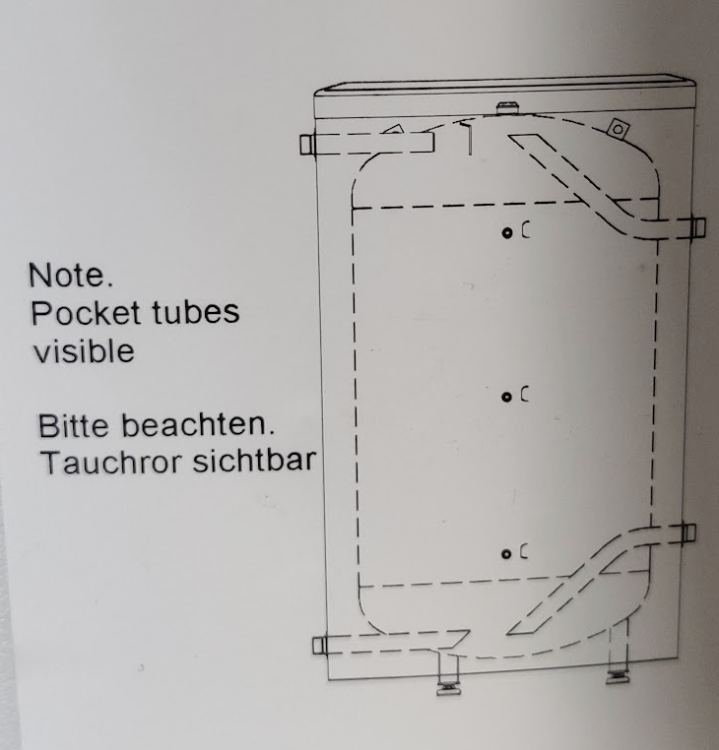
To hand, I have the labelling on the tank itself, which this is a photo of: In the paper work, somewhere, there is the same image but with a little more detail. It's only used in a schematic showing the plumbing options, so isn't intended to be a set of engineering drawings of the internal details, but if I find it I will post it.
-
Equal, within a degree, at the times they should be. Unfortunately the thermocouples I have are +/-0.5° accuracy. But that's close enough for me. How about yours? I hadn't appreciated you had a 4P buffer installed. Is it designed for stratification? What's the model number? what ASHP have you got attached to it? and how are you controlling it?
-
A heating system that is working as designed. It's normal to assume things work as they are designed unless there is evidence that they do not.
-
My ASHP requires at least a 90l buffer. I can't imagine there are many people that have room for a 100l buffer, but not a 200l buffer. And what works for me heating 420m² of UFH and +1650m³ of thermal envelope, with a 200l buffer, will likely scale up or down to suit different requirements. And your evidence is?
-
Stratification is a fairly robust phenomena. A cold 4P Buffer, that is designed for stratification, will go straight into stratification when the ASHP switches on and warmer water is pushed into the top. That less dense water will sit on top of the more dense colder water in the tank. In a short time, once there is sufficient volume of warm water for the port taking water to the emitters to be fully enveloped in that warmer water, it will start to make its way to the emitters. There is a small delay of warm water getting to the emitters compared to a non-buffer, Parallel 2P, or Series 2P in Return line setup, but it's negligible. It does not however require the buffer to fill completely with warm water before that warm water is fed to the emitters. Once the stratification is running, the incoming hot water "slides" across the cold water below and out of the flow port to the emitters. Since the ASHP will not be under-sized for the load, the buffer will then fill with flow-temp water. All that happens as the buffer "charges" is the thermocline plane travels down the buffer, increasing the volume of flow temp water, and reducing the volume of cold water. Once the thermocline plane breaks the return port to the ASHP the return water temp will increase to what was the ASHP flow temp. The ASHP flow temp will then increase accordingly, trying to maintain its 5° delta and if the target flow temp has not been met the process will repeat stepping the flow temp up circa 5°C. If that new flow temp exceeds the target, because the ASHP can't modulate any lower, the ASHP switches off. If the ASHP switches off, the heating load is lower than the ASHP can modulate down to, so flow rates are quite small. I can't explain why the Idronics article doesn't consider this and only considers flow rates at their Max for the given heat pump, but with no heat demand - it doesn't appear the author has understood the logic. On my Nibe F2040-12 heat pump I seldom see flow rates above 5l/min during a space heating cycle, once it has stabilised after initial warmup, and it reduces to around 1 to 2 l/min before switching off. To me that means the heat load at that point is requiring less than the 2l/min flow rate at that point. With a fully charged 200l buffer, that will last over an hour without needing the ASHP to restart. There are loads of opportunities for poorly designed buffers to be specified, or incorrectly sized buffers to be specified, or poorly matched buffer port/pipe sizing to ASHP flow rate to be specified, so I'm sure there are lots of examples where levels of stratification are less than ideal. It's why I said: I can't speak for other manufacture's buffers, but I can see from my own Nibe buffer (and the diagrams of the internal porting that came in the paperwork) that there has been a lot of development work done on the internal porting to ensure minimum disturbance to the stratification.
-
I've never found a single site that will walk you through the design process, but this is a good place to ask questions and gauge opinions. If you were to use "cost of install" to order the different options, then I'd suggest the following order, and suggest you shouldn't go up the order unless you have a reason to do so. The pros and cons are a brain dump, certainly not exhaustive and more judgement that evidenced: 1. No Buffer, ASHP plumbed directly to heat emitters Reduced options for zoning A zone with minimum volume stipulated by ASHP manufacturer must always be open to ASHP Emitters will "switch" on and off with cycling of ASHP. ie. load demand satisfied intermittently, requiring a higher flow temp, stopping system from taking full benefit of weather compensation. Hot water for defrosting taken from emitter circuit during space heating cycle. Colder return water from defrost pushed into emitters. ***My assumption that system does not switch over to take heat from UVC Small flow temp hysteresis required Requires high confidence in heat loss calcs and ASHP sizing. Space heating and DHW demand, incl. expected DHW re-heat times, need to reasonably complement each other. 2. 2P Buffer plumbed in Series Flexible zoning options to react to transient load demand due to dynamic external factors, ie. solar gain. Correctly sized buffer allows for proportionate actuators for all zones Emitters will "switch" on and off with cycling of ASHP. ie. load demand satisfied intermittently, requiring a higher flow temp, stopping system from taking full benefit of weather compensation. Hot water for defrosting taken from emitter circuit during space heating cycle. Colder return water from defrost pushed into emitters. ***My assumption that system does not switch over to take heat from UVC Small flow temp hysteresis required Additional standing losses which can be reduced as far as possible by locating within the return line. Higher output ASHP can be selected than required for Space Heating demand to support better DHW performance 3. 2P Buffer in Parallel Same advantages/disadvantages as 4P Buffer, may be less efficient than 4P due to potential disturbance of stratification? 4. 3P Buffer Same advantages/disadvantages as 4P Buffer, may be less efficient than 4P due to potential disturbance of stratification? 5. 4P Buffer Flexible Zoning options to react to transient load demand due to dynamic external factors, ie. solar gain. Emitter circuit hydraulically separated from ASHP circuit requiring an additional pump for emitter circuit. Hydraulic separation allows emitter circuit to remain circulating, when ASHP has cycled off, allowing load to be satisfied continually with a lower flow temp, allowing full benefit of weather compensation. With a store of warm water that can supply the emitter circuit at ASHP flow temp until tank is almost fully depleted, much longer ASHP cycles can be achieved. Additional lower energy emitter options can be included simply, and provided with ASHP flow temp water when ASHP has cycled off ie. Wet duct heater/cooler in MVHR, fan coil heater/chiller. Hot water for defrosting during space heating cycle taken from Buffer. Warm water can continue to be pushed to emitter circuit, although buffer will deplete quicker during defrost cycle. Larger flow temp hysteresis can be used to further increase ASHP cycle times. Additional standing losses. Although on average, while operating, the tank will be 50% depleted so the ΔT used to calculate the standing losses should use the mean temp of the flow and return range. For a low flow temp system, standing losses are quite small, only cost 33% of the loss to power the ASHP due to SCoP, and are leaked within the thermal envelope. Higher output ASHP can be selected, than that required for Space Heating demand, to support better DHW performance. For me, a 4P Buffer needs to be well designed and correctly matched to the ASHP to get the best out of it. I personally relied on a manufacturer approved configuration from a big brand manufacturer that made both the ASHP and buffer, in the hope that their R&D budget developed a buffer that was well designed and correctly matched.
-
Insulated Concrete Slab Garden Office - Questions
IanR replied to Ticky's topic in Garages & Workshops
On the proviso the floor is unheated, I'll hold my nose and say "Yes". If you plan an electric heat mat, then you really should double it, at least. I would include a 50mm thick perimeter upstand, chamfered at the top, as I detailed in my original sketch. -
Insulated Concrete Slab Garden Office - Questions
IanR replied to Ticky's topic in Garages & Workshops
None of those show it as load bearing, ie. they show a "floating" concrete slab that stops short of (and insulated from) the perimeter wall. The loads of the perimeter are taken down to a strip foundation. The BBA Certificate for Celotex GA4000 shows the same. You are showing it used for an insulated raft, where the raft supports the perimeter wall. Typically EPS/XPS would be used for this due to it's better long-term compressive strength and that it does not absorb moisture. It is less insulating, so a greater thickness of EPS is required to achieve the same U Value as PIR. Edited to add: A link from one of your links quote: Ref. https://insulation-uk.com/floor-insulation/ground-floors/concrete-slab-floors -
Insulated Concrete Slab Garden Office - Questions
IanR replied to Ticky's topic in Garages & Workshops
Taking a step back, before considering a finished floor, level with outside ground, what Insulation are you considering under the slab? 75mm is low for any insulation product, but my concern is that you are thinking of using a PIR/PUR insulation. If so, have you found a product that has the compressive strength to be load bearing as you have it shown? It would be typical to use EPS/XPS for a loadbearing requirement and EPS100 or above can do what you are showing, but 75mm of EPS is a really poor level of insulation, even on an unheated floor. With regards the Finished Floor Level, I feel you'd need to build it like a basement, up to 150mm above FFL, and you've still got some work to do to detail the threshold of any doors. For the basement option, I'd look at how an insulated raft with ICF basement is detailed. You'd "just" need one course of ICF formers around the perimeter. -
No, thankfully mine stopped at the Phase 2 when nothing else was found. They do appear to be pushing for a few conditions on your planning approval that requires them to book some labour hours and lab time at your site. You should try and take control of the outcome and when you submit the report also provide you own summary of the pro-active actions you intend to take. Have you got a Statement of Work from an Asbestos removal company for your site, I'd repeat that verbatim so it's clear you are taking it seriously, and then suggest the ground works team will be tasked with visually checking for and reporting any further unearthed contamination, for which you will bring in the necessary Geo-tech team to analyse and identify the contamination plus recommend remedial work. My report did include a couple of pages of "recommendations" that was just general advice to the builders etc. If you have similar I'd be rewording that and saying how your going to do it all, with bells on, in the hope you don't get a condition requiring further ongoing assessment.
-
3 and 4 port buffers allow the heat emitters to run independently from the ASHP circuit. If well designed and correctly sized for ASHP requirements and system flow velocity, they allow the emitter circuit to continue to run at close to ASHP flow temp for as long as possible while the ASHP is off (due to it cycling when the heat demand is lower than the ASHP can continuously deliver). Poorly designed and sized 3P/4P buffers could induce mixing of flow and return water and lower the flow temp to the emitters. It's only through stratification in the 3P/4P Buffer that flow temp to the emitters will stay at close to the ASHP flow temp, while the ASHP is off. A 4P buffer allows for the design of flow and return ports in the buffer to be optimised for their specific function (flow or return) for minimal disruption of the stratification within the tank. A 3P buffer has 2 ports that always perform the same task (flow or return) so can be optimised as such, but 1 port that acts as both flow and return at different times, so can be optimised for neither. They will therefore tend to be a just a direct horizontal tapping in the side of the tank, which is OK for flow out of the tank but less good for flow into the tank, so more likely to cause disturbance to the stratification in the lower area of the tank. I have no idea if that means a 0.1% loss of efficiency over a 4P Buffer or a 5% loss of efficiency. It may well be that the lower flow velocity, when the pump is running, mitigates the lack of optimisation of the porting. 2P Buffers can be plumbed to effectively work just like a 4P Buffer, where they are plumbed in parallel to the emitter circuit. They do however have 2 ports that cannot be optimised for their function so may induce more turbulence within the tank, disturbing the stratification, leading to more mixing, but again this may be mitigated by lower flow velocities when the ASHP is running. A 2P Buffer can also be plumbed in series with the heat emitter in either the flow or return line but when the ASHP cycles off, then the emitter circuit is also off. With the 2P buffer plumbed in series the extra pump required for the other options may be able to be avoided, and with the 2P buffer in the return line, the buffer-to-ambient ΔT is lower than all the other options, so standing losses are reduced as much as possible. But, you don't get a store of water at ASHP flow temp to continue to circulate to the heat emitters when the ASHP is off. If you wish to run additional heating circuits, such as wet duct heater/cooler in your MVHR or fan coil heating/cooling units, which may have very low heat loads in a Passive-type house in the shoulder months, having a store of water at or near ASHP flow temp can be quite handy and mean the ASHP only runs for 30 mins every few hours. Which is the best option, who knows, but there's lots of opinions out there...
-
How does that meet your x4 simultaneous 20l/min showers for 20 mins + apparently hot feed to washing machines and dishwashers? If 300l @ 65°C with a 3 hour reheat time meets your requirement, then just have a 500l UVC heated to 50°C by a 12kW ASHP and have a 60 min reheat time. Pretty standard, if a little on the larger side, but able to store plenty of excess PV when the sun is shinning.
-
The big phone switch over/off in 2025
IanR replied to Temp's topic in Networks, AV, Security & Automation
Sound quality is no worse than an analogue phone, supposedly better if both ends are VOIP. I've found the Service reliable, apart from the handset occasionally not ringing, but that's likely my own fault for trying to route a single user account to multiple devices. The options and configuration available (if Service provider makes provision) far exceed an analogue phone service. For instance, Voicemails are held on providers cloud, available from anywhere and I receive a reasonable voice-to-text translation, via email, directly after any message is left. -
A 50kW gas combi could perhaps get to 18l/min of 50°C water, so blended down to 38°C could get you to perhaps 25l/min. With just 2 you'd still be +30l/min below your target. I'd suggest it's not reasonably practical to meet your unusual requirement with an ASHP, so go with Gas.
-
Is this for a domestic install? +80l/min of 40° water must have taken some setup if that's what you are used to. What boiler did you previously have? How frequently would x4 showers be running simultaneously? It's an unusual requirement.
-
The big phone switch over/off in 2025
IanR replied to Temp's topic in Networks, AV, Security & Automation
The codes are staying, but they're already becoming less meaningful. I moved to VOIP a couple of years ago and ported my landline number, which rings on my mobile phone wherever I have a signal. I did look at an analogue adapter (~£50) for the house when I moved over to VOIP, which could be a solution for alarms dialling out and keeping your existing phones. Needs to be on a UPS, along with the router, to keep it working in a power cut. Some VOIP Services will set up the adapter box and/or new VOIP phones, if you purchase the items through them. In the end I went with a 3rd Party VOIP Service (Yay.com) and now pay £6 / month for a "landline" with 100 mins of inclusive UK calls, incl. mobiles, and cheaper call rates than standard BT. I bought a new Grandstream WiFi VOIP phone that works off the existing house WiFi, so no extra base station. It was easy to set-up and does generally work well. I've not yet worked out why, but occasionally the handset won't ring for an incoming call, so I now make sure I power off and on every week to keep it connected. It may be that I've also routed the line to a couple of mobile phones, but I've never got it to work robustly and have all phones ringing on an incoming call. It does make me wonder if an adapter box would just sit there and work, or whether regular reboots would be required. -
While the external materials and finishes are very strongly "Suffolk Barn", I don't see that from the form. Roof Pitch on both main roof and mid-stay porch, need to be steeper, in the 45°-50° range, and for a traditional timber structure it appears too wide. Max width of the main structure would be 6m. To get to 10m wide would need a lean-too. I imagine you have a height restriction to combine the current width, 2 full stories and 50° roof pitch. For me the form would appear more in keeping with a modern, portal frame style barn, but that would mean walking away from the Suffolk tile, black cladding and red brick plinth.
-
Insulated Concrete Slab Garden Office - Questions
IanR replied to Ticky's topic in Garages & Workshops
Correct there is no DPM, or any membrane under the upstand or the lowest layer of EPS. It is OK for the EPS to sit directly on the Pea Shingle. The Pea shingle (no fines) is free draining, so combined with the perimeter drain, removes any water from under the raft. Yes, 100mm is all you need with Mesh included. A deeper ring-beam under the external wall is unlikely to be needed with the loadings for a garden office. The setup I've shown is for EPS not PIR. I don't believe there's a PIR/PUR approved for ground bearing (happy to be corrected), so for this the concrete has to go under the insulation as per @Moonshine's option, and is no longer an "insulated" slab/raft.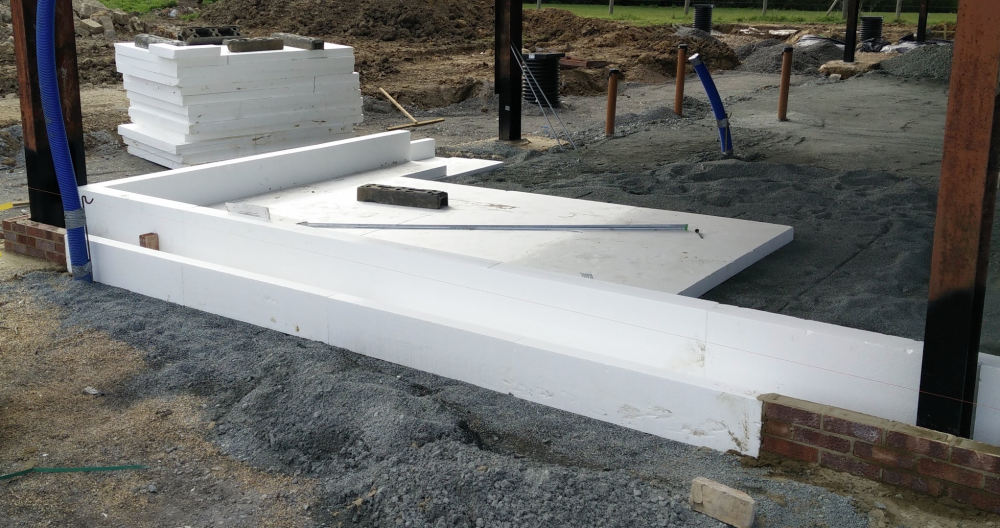
-
Insulated Concrete Slab Garden Office - Questions
IanR replied to Ticky's topic in Garages & Workshops
Here's my go at an over-engineered insulated raft, for a Garden Office. As per @Iceverge, ground should be around 150mm below the finished floor level. No separation layer needed for EPS. To do the chamfer detail on the upstand you'd need to make up a hot wire cutter. If not then a thinner upstand (25mm) will do. Upstand can be stuck and screwed to the base layer. You could, almost definitely, do it all in EPS100, rather the the EPS200 I've shown under the ring beam, as you won't be having a heavy roof finish on that 5° pitch.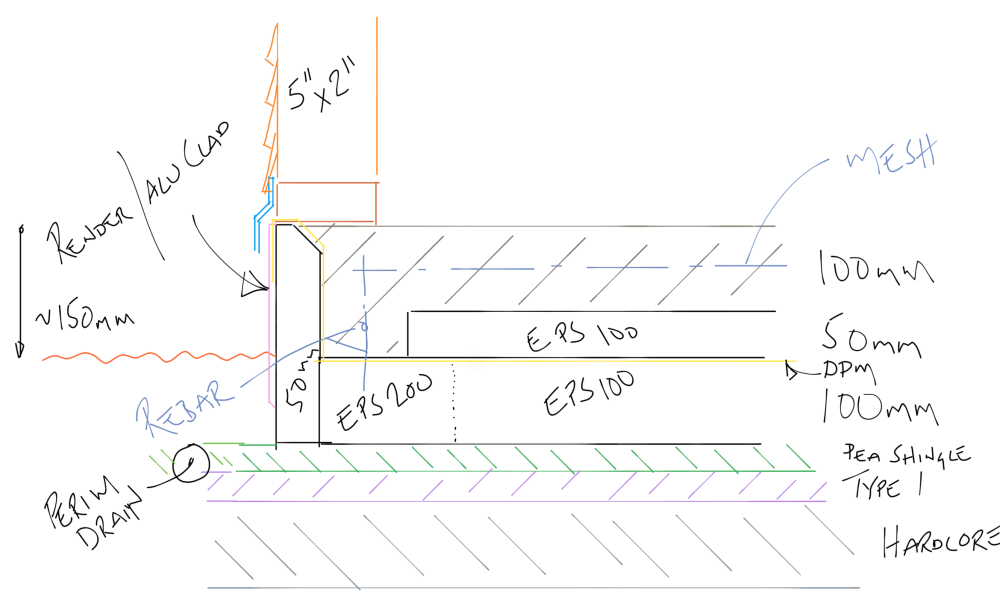
-
Hi @fatgus, and welcome. I really like the simple form, the contrasting graphic and material choice, it gives it an agricultural aesthetic that should fit well it what I assume is a rural setting. Working against that though, imo, is the fenestrations. Windows and doors are a little too busy for me, especially as it contradicts the agricultural aesthetic. In part this has come from an equally busy interior layout. What's the overall sizes? It does appear that a little too much has been fitted into the available space. The 7 different sitting areas (outside of bedrooms) for instance, the additional laundry room on the 1st floor, the Shower in the Utility (for the dog(s)?) as well as the WC & Shower on the utility, the narrow passage to the Cinema room etc. It's a shame this has then left only a small space for a compromised office and only one bedroom with en suite bath/shower room.






