


JohnMo
-
Posts
13296 -
Joined
-
Last visited
-
Days Won
200
Everything posted by JohnMo
-
 The mitsubishi unit seems to have a very large flow rate, assume you will be just 20m3/h, this unit delivers a min flow of 61m3/h, which is about 3x what you need. Europlast one looks ok size wise but looks like the cost is too low, so may be questionable quality. Prana seems smart enough to only ventilate when you need it, and can turn down far enough, with a min speed of 12m3/h
 -
Only thing to careful of, is, do the units give the required flow rate to comply with building regs. When I started sizing for the house I needed so many units, the cost was stupid high.
-
Your reference docs state, "smaller hot water systems, BRE Information Paper 8/07 indicates that discharges can be made to PVCu stacks, provided that: relief discharge is from domestic unvented hot water storage systems only – not combi boilers or sealed system boilers. storage volumes do not exceed about 210 litres. stacks are fully ventilated (ie. no stack cap or air admittance valve). pipework complies with BS EN 1329-1:2000 or BS 4514:2001. It clearly states stacks are to fully ventilated, no cap or aav. So surely you don't comply. Assume you are below 210L also.
-
Hot and cold pipes routing wall or suspended floor
JohnMo replied to severnside's topic in General Plumbing
What ever you use will need insulation so not sure it matters that much what you use. If you are insulating makes sense to have the pipes above or in the insulation. -
As above it will be either oil or heat pump based on outside temperature. Not both together. If you want to run both all the time see below. The other way is heat pump on central heating/cooling duty, oil system on DHW only. If running the heating system only on a low temp a CoP of 4-5 should be easily achievable even at low outside temps.
-
I would up to about 1.5, see what happens
-
Here is a simple graph. Oil has a lower condensing temp compared to gas
- 1 reply
-
- 2
-

-
Heat up time is a combination of kW of heat input, and then how much concrete/screed you have to heat up, plus heat loss downwards. Not sure I would get to hung up on the DT until the floor is up to temp, even then not bother that much. The basic of floor heating system are The greater the mean flow temperature, the higher the heat output of the floor. The mean temp is set with a combination of flow temp and delta T. For a given flow temperature the lower the DT the higher the kW rate the floor will give out. As you have realised lowering the flow rate increases the DT. Your issue at the moment is the energy transfer from the water is too low to heat the room at an acceptable rate (its too slow). Increase flow rate, ignore the delta T. Get the room up to temp, your balancing act should be not overshooting room temp too much (flow temp not to high and/or DT to low) and not taking a couple of days to reheat (flow temp to low and/or DT to high). How much insulation do you have under the floor?
-
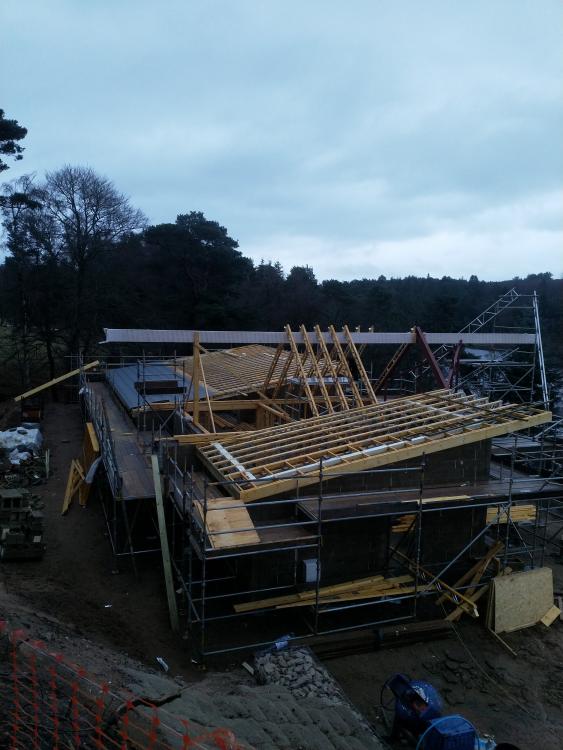
Our ridge beam is huge, something like 450x180mm if I remember correctly.
-
Our kitchen ceiling, 12 degrees has a 7m span with no steel. Our 45 degree roof has a span of 4.2m, without steel, except where the window opening is formed. Look at posi posi rafters
-
From what I heard a month or so ago, they have been taken over, not certain if they are back trading yet
-
MVHR flow rates are way to low to move heat from A-B, it will move some but the don't count on it. The air you supply to a room, will wash though that room, out an open door or under it and make its way to an extract point, so supply air moves the air anyway. You UFH manifold will be at a low temp so not much warm air to move about. Study I would make that extract only in your case. You can do the kitchen either way. But watch for grease mist entering the extract terminal, I have mine about 4m away from the hob, so grease is filter by the recirculation extractor first and have a foam pad in the extract terminal to capture anything missed by the recirc extractor.
-
Photos of your manifold, pump and mixer, would be helpful. When you say close the mixer - do you mean reduce temperature or increase temp? Are they the same mixer valves? Do you have a pump on each manifold?
-
Same with me for Durisol approx. 190m2 plus 3m tall, less than half that price delivered to NE Scotland.
-
Ours is in an insulated airtight roof section, walls and ceiling are nice a shiny airtightness vapor control layer - heavy items are mounted on off cuts of 18mm ply. Floor waterproof 22mm chip board. Under that is 200mm of Rockwool Flexi. Access through airtight insulated loft hatch with integrated stairs - all help keep noise away from the living space.
-
Lots of contradictions everywhere you look. In the end that's why I looked at Scottish Building Regs, the last thing I want is the inspector say no it has to move.
-
We used ubbink 90mm, if you look on their website and datasheets they have all the details on pressure drop and bend radius.
-
ASHP, shouldn't require anymore gubbins than a gas boiler. A monobloc heat pump will live outside - the gas boiler inside. You can use the same cylinder for either gas or heat pump, as long as you get one with a heating coil sized for a heat pump. Ideally you should operate the gas boiler exactly the same way as a heat pump this will ensure you are always condensing. Allow for a buffer cylinder, 50L to 100L should be fine as long as you don't oversize the heat pump. A buffer is worth specifying even with a gas boiler, to stop that cycling. So plant room will have a cylinder, buffer and possibly a manifold, if the MVHR is being located elsewhere. Your door sounds huge, mine all went in through a loft hatch.
-
Heat pump+PIV: enough? Or are fan coil units necessary?
JohnMo replied to Garald's topic in Air Source Heat Pumps (ASHP)
There not cheap, just looked at the price of the 1.1kW £842 each -
New build heating / energy choices
JohnMo replied to RedRhino's topic in New House & Self Build Design
I was looking at, which is pretty much a standard air to water https://argoclima.com/en/prodotti/im/ -
New build heating / energy choices
JohnMo replied to RedRhino's topic in New House & Self Build Design
Air to water heat pump ASHP. Not water to water, uses refrigerant to refrigerant. Instead of routing the hot refrigerant gas to an air cooler, when in cooling mode, they route it to a cylinder with a refrigerant coil. Disposing the heat to water. Once heating cycle complete it goes the normal route to the outside air. Argo clima is the make I have seen. -
New build heating / energy choices
JohnMo replied to RedRhino's topic in New House & Self Build Design
Some heat pumps (with the correct cylinder) will cool the house while heating DHW at the same time. DHW is heated free from the waste heat extracted from the house. If you have PV, cooling and DHW could be provided free in the summer. -
You increase pump output/ speed. Or Increase flow temperature and decrease flow in the other rooms.
-
That's about the same flow as I have on my 100m loops. Are trying to achieve more heat in the room with those loops? Or something else?
-
New build heating / energy choices
JohnMo replied to RedRhino's topic in New House & Self Build Design
Hello and welcome. Always a bit suspicious when they we don't need heating and the house is huge. So from the link the heat load is 11 W/m2, the floor area is 550m2, so on a cold design day that's 6kW. Where is that heat coming from, a couple of hours of sun in mid winter may heat a couple of rooms, but a few overcast days it's going to get cool, so I doubt the fire will be cosmetic for long. Small house 100m2, that heat demand is 1.1kW, small panel heater would do it on the coldest days. A2A heat pump, for heating and cooling? Cheapish to install, cheap to run. UFH, or fan coil units, small heat pump and UVC for hot water. Needn't be that expensive.

