


JohnMo
-
Posts
13294 -
Joined
-
Last visited
-
Days Won
200
Everything posted by JohnMo
-

UFH manifold pump and radiators on first floor
JohnMo replied to Joshua Graham's topic in Underfloor Heating
Have you designed the radiators to work at the same temperature as the UFH? Generally the flow temp for UFH is well below that required for a radiator. Whether an issue for the pump would depend on the what pump you are using. Would you be better plumbing for the radiators and using two close coupled tees from the radiator circuit to supply the UFH manifold? -
External air ventilation for log burner
JohnMo replied to SBMS's topic in Energy Efficient & Sustainable Design Concepts
My air pipe comes up through the floor connected to a socket on the stove. All air for the stove goes through this pipe. Not true for all stoves, some take primary air via the outside air connection and secondary air via the room. So check before you buy. Our stove has a primary and secondary air controlled via a rotary dial, this can be turned off fully. You can also get a butterfly valve that goes in to the air supply pipe, but was not really required for our stove - some do need it. I considered heat loss, but concluded if I was stopping continuous airflow though the stove in the grand scheme of things the heat loss was insignificant. The air pipe is required if you want a stove. So stove need air pipe, don't want air pipe - no stove. But to be frank - well insulated house - do you really need a stove? - NO. As mentioned a day or so without heat make a small difference, so put your jumper on. My wife wanted one - different story, different argument. -
External air ventilation for log burner
JohnMo replied to SBMS's topic in Energy Efficient & Sustainable Design Concepts
@Gus PotterDo you CO detector in the room - if you don't you should be looking to install -
My boiler is currently kicking out out about 26 - 29 on weather compensation, but at the end of a firing the supply temperature does rise until the return temperature increase to a max about 5 degrees over the set point. So at an extreme example you have a set temp of 45, you easily be supplying circa 50 deg to the floor. Secondly you need a over temp protection devise to protect the floor. The mixer valve supplies both these services, it limits supply temp and provides a layer of protection. Plus it will cost to remove. With that much insulation in the floor I would be surprised if you need 35-40 flow temps. I had ours set to 30 for a day and the house got up about 26 degrees.
-
External air ventilation for log burner
JohnMo replied to SBMS's topic in Energy Efficient & Sustainable Design Concepts
We have balanced MVHR, WBS with an external air vent connected to to the stove. Would have thought a disconnected air supply, is just an air leak in to house, not really understanding why you want it in an airtight house, with MVHR. But everyone to there own thoughts on that. Never experienced anything stuffy in the house (with or without stove on), have baked myself when we first tried the stove with room temperatures at over 27. Buts its just a matter of getting the stove burning, very little air and not much wood, to controls heat output. Don't select a stove with a high output. A house that requires circa 3kW to heat at -5, doesn't need a stove that puts out 16kW for example. When stove is off, just select air supply off, so no un-necessary air movements. Simple -
If you no idea of the basics and the equipment needed, should you being the install? Basic parts Panels plus mounts, optimisers (option) Connectors Suitable DC rated cable, suitable crimper for making up connectors DC isolation switch, even if inverter has one Inverter AC isolation switch Meter
-
Sorry I missed typed. Electrician doesn't need to install, but as you say declare it's compliment.
-
Just point of note even without mcs approval, in case you hadn't realised, your electric install has to be by a registered electrician. Their certificate number is required for the G98 form.
-
LG Therma V mono block Air Source Heat Pump
JohnMo replied to ProDave's topic in Air Source Heat Pumps (ASHP)
@ReedRichardsYou could have few issues - Looks like you are short cycling - heat on for a short period, forced outage for 10 mins. Issues that cause short cycling are Your buffer could be too small. Lots of zones combined with no buffer or buffer that is not big enough to compensate for the smallest zone open. Do you have lots of zones or just one? Open zones doesn't meet or exceed the min flow rate for the heat pump. Or is the flow temp to high and room temp keeps hitting a thermostat set point - switching the HP on/off. Either way somethings not right. The ideal of WC is you don't have a constant set temperature, but you have a couple degrees reduction in temperature during the night. -
LG Therma V mono block Air Source Heat Pump
JohnMo replied to ProDave's topic in Air Source Heat Pumps (ASHP)
Just use a Salus SQ series thermostat, hysteresis can be set to 0.25. it can also be set to to learn your heating response time make adjustments to how it reacts. Good for radiators not so good for very low temp thick screed UFH. Or just change over to weather compensation and don't use thermostats. -
I've use made2measure. Not installed yet.
-
Mixing large amounts of Concrete on site...
JohnMo replied to Mulberry View's topic in General Self Build & DIY Discussion
We did a couple of small walls in our ICF and used a mix on demand lorry, more expensive than ready mix. But we did a couple cubes, by barrow and buckets, we also did a few other concrete jobs at the same time, all different grades and slumps, all from one lorry. -
Mixing large amounts of Concrete on site...
JohnMo replied to Mulberry View's topic in General Self Build & DIY Discussion
Ours was £580, good job it wasn't £1200 as we had him 4 times -
15kW is the correct units, before @SteamyTea comes back
-
Concrete slab pour over winter months - recommended?
JohnMo replied to markharro's topic in Foundations
The sip build may bolt supports to the floor, so would be worth checking with contractor. Holes in floor, or UFH pipe? -
Heat Pump vs Gas Boiler: Lifecycle Cost Comparison (UK)
JohnMo replied to Green Power's topic in Air Source Heat Pumps (ASHP)
So are you using 2 hours x 11kW or 22kWh per day for hot water? That doesn't sound right? -
Prices of building materials moving forwards
JohnMo replied to James Frome's topic in Costing & Estimating
At that price is worth installing? Rough estimate is 3.5kW installed is 3000kWh year. So about £1000 per year offset if you use it all. If you export a fair bit at a couple pence a unit, much lower yield cost wise. A 345w panel is about £200 delivered, do the maths. So £2000 for panels, £600 for an inverter, plus mounts and a couple of switches. Sounds like an installer taking advantage. -
Heat Pump vs Gas Boiler: Lifecycle Cost Comparison (UK)
JohnMo replied to Green Power's topic in Air Source Heat Pumps (ASHP)
No, but seems to be performing well. Last winter was a disaster for gas consumption, underestimated what low temp heating needs to support it. Lots of short cycling, house way too hot, then too cold most of the time, didn't appreciate how to manage a thick (100mm) concrete slab, hoped smart thermostats would help, but they just messed things up even more, the floor response time was outside there logic. So operate as a single zone, with loops balanced to set room temperature -
Heat Pump vs Gas Boiler: Lifecycle Cost Comparison (UK)
JohnMo replied to Green Power's topic in Air Source Heat Pumps (ASHP)
Only had the system running in this configuration during Oct (off at moment due to warm temperature). But have consistently delivered an average of 0.5kW (based on actual gas consumption) heat into the floor over a 27 day time period. House is 192m2, UFH pipes at 300mm centres big buffer. In NE Scotland. In the depth of winter hoping for a 2-3kW gas input, but time will tell. -
Heat Pump vs Gas Boiler: Lifecycle Cost Comparison (UK)
JohnMo replied to Green Power's topic in Air Source Heat Pumps (ASHP)
Sorry you really need to read up on condensing boilers theory. What you have been told is just wrong and applies to non-condensing boilers. Not sure where your getting my boiler is running at 54+ degs from, last time I looked while the boiler was firing it had a supply temp circa 28 and return 23/24. If it gets to 35 it is forced to cut out, by the settings. Only time it goes above that is for DMW as its a combi. -
Never really seen why people fuss over PV efficiency if you have room to install them. PV efficiency is w per m2, nothing more or less. BUT - Getting them at a good price, that is the important thing. They should be cheaper than high efficiency panels, because they are using an older technology. Another thing to ask, are new - old stock, as some of their 20 year life may have expired. In that case I would be wanting factory fresh, not something that has been hanging about for a number of years.
-
Heat Pump vs Gas Boiler: Lifecycle Cost Comparison (UK)
JohnMo replied to Green Power's topic in Air Source Heat Pumps (ASHP)
Yes running a buffer, but the buffer has no thermostat, so just floats at supply temperature, so is never hotter than target flow temp. Plumbed as a 2 port buffer. Boiler fires up when it sees the return temperature drop to a level where its happy to fire up, keeps firing until it's no longer happy. On an average 10 degree day, fires for 10 mins, off for 2 hours. -5 day, on for 30 mins off for 30mins. -
Heat Pump vs Gas Boiler: Lifecycle Cost Comparison (UK)
JohnMo replied to Green Power's topic in Air Source Heat Pumps (ASHP)
The idea is the flue gas passes through a heat exchanger, it condenses, gets drained away. The process has a phase change from steam to water, the latent heat is captured by the heat exchanger and passed to water increasing efficiency. The acidic water goes direct to drain after that and does not go through the flue. A condensing boiler working correctly has no steam coming out the end of the flue. My boiler is running at target flow temp of 26 to 29 degrees depending on outside temperature. So they do go below 35 degrees. -
Heat Pump vs Gas Boiler: Lifecycle Cost Comparison (UK)
JohnMo replied to Green Power's topic in Air Source Heat Pumps (ASHP)
Take a look at the efficiency and recorded flue gas temps at low flow temps. Screenshot from the same manual.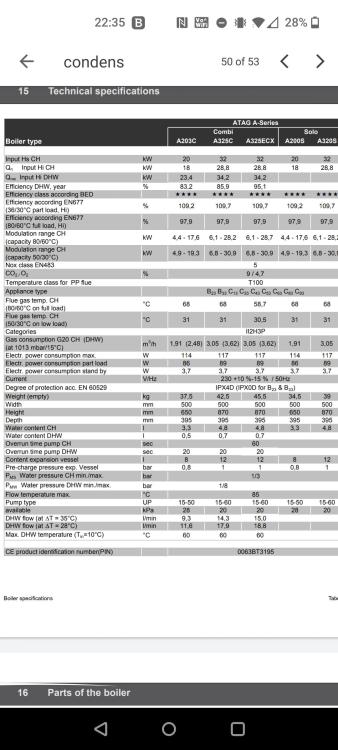
-
Heat Pump vs Gas Boiler: Lifecycle Cost Comparison (UK)
JohnMo replied to Green Power's topic in Air Source Heat Pumps (ASHP)
Direct cut and paste from a condensing boiler manual. "The boiler is equipped with a compact stainless steel heat exchanger with smooth pipes. It is a well thought-out principle using sustainable materials. The boiler burns (natural) gas to supply heat. This heat is transferred in the heat exchanger to the water in the CH installation. The rapid cooling off of the flue gases causes condensation. This results in a very high efficiency. The condensate that is formed, has no negative impact on the heat exchanger and it's operation, and is removed through the internal syphon."




