
JohnMo
-
Posts
12467 -
Joined
-
Last visited
-
Days Won
179
Everything posted by JohnMo
-
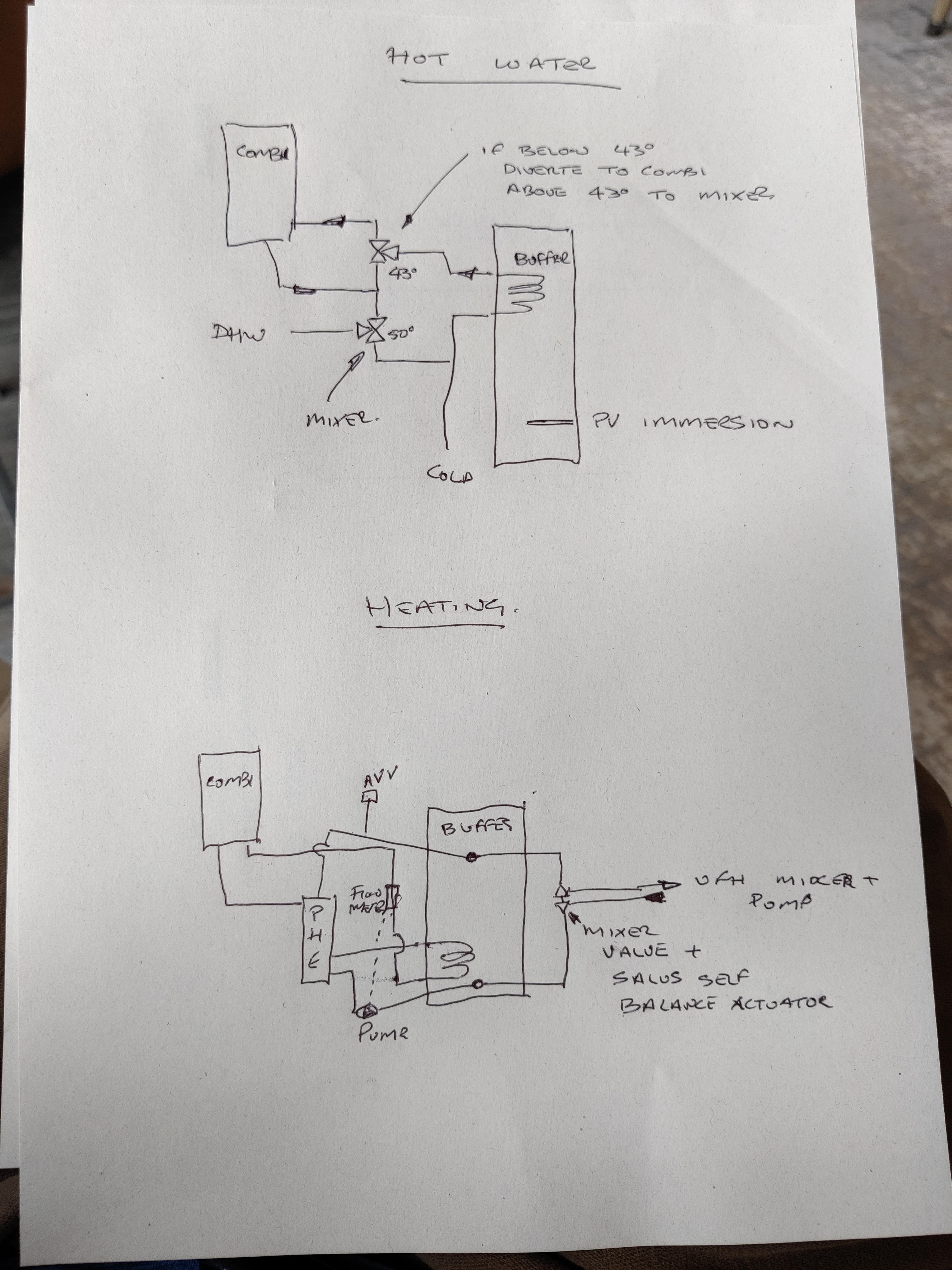
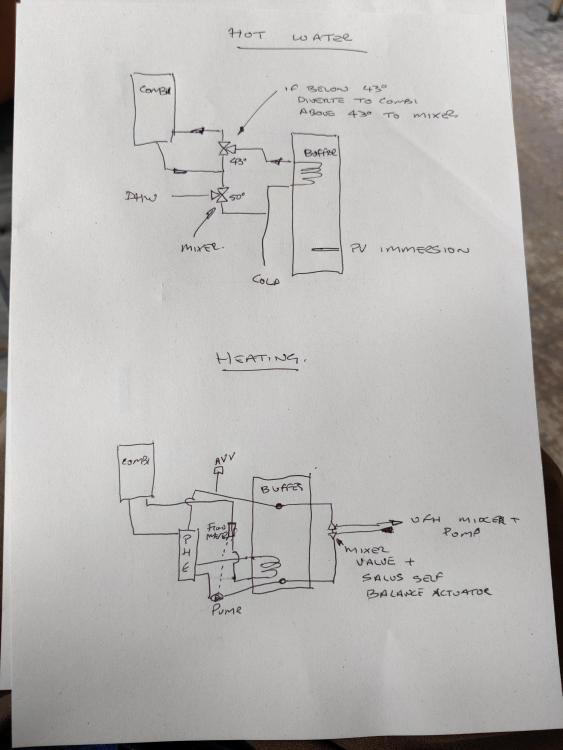
AVV - automatic vent valve Dot connectors are the connections on the thermal store - these tap in the inhibited fluid in the cylinder. Its just a 160L vented thermal store, with a indirect heating coil (supplemented with a large plate heat exchanger) and DHW coil. DHW water does not enter cylinder directly goes through a coil.
-

Immersion heater automation
JohnMo replied to Andrea C's topic in Networks, AV, Security & Automation
I would keep it simple either A simple immersion timer or an immersion diverter. The advantage of the diverter is if you have 0.1kW it goes to the immersion, nothing more or less - not the full 3kW demand you would get from a simple sunlight sensor. -
A schematic of my system. Have a simple combi thermal store (160L) upstream of the combi (with additional insulation to limit heat loss). Immersion heater connected to PV diverter. You need a diverting valve and thermostatic limiting valve on the output of the thermal store DHW coil. This will reduce gas usage and stop un-necessary boiler firing when the cylinder is above about 45 degrees. The cylinder is also being used as the central heating buffer.
-
Sizing a combi boiler to avoid on-off cycling
JohnMo replied to LnP's topic in Boilers & Hot Water Tanks
Basically you need a buffer. The larger the minimum output of the boiler the bigger the buffer requires to be. But operating as a single zone would help without the buffer. The more zones you have the more likely short cycling will be, if you have TRVs on rads they need to modulate down not be on/off. -
Yep, filling my car in litres, calculate consumption in mpg, and distance travelled in miles, while monitoring temperature in degrees C and building a house in millimetres. And paying for things in pounds and pence instead of shilling and Grote's etc.
-
No I think they have their own network or sits on another similar to a mobile phone.
-
Oops should of been 1.5 miles. 5' is way to close for comfort.
-
I tried to get a smart meter, but they failed to get it to connect to the data collection centre. So I now have a dumb smart meter. I am the vast total of 1.5m away from a large village, and they couldn't get it to work, so no hope in a remote area.
-
Think of a storage heater, but with an air to water heat exchanger instead of and air to air exchange. Idea is pretty simple, would suspect its very heavy, filled with bricks similar to a storage heater. So its really a high density thermal store. Key advantage over water is installed space required is way less. 40kWh sounds great, BUT, if you take away 5kWh for DHW it only leaves 35kWh hours for heating (1.45kW per hour based on 24h) and also depends on the threshold of where in the 40kWh the heat becomes unusable from the store, due the heat exchanger performance and the delta T required. Also if a top up is required during the day - not cheap. According to the manual it looses 15-20% of its charge over 24hrs, which is huge. So 6-8 kWh, which is the equivently of about 3-4 300L cylinders. But 2x300L cylinders would hold about the same energy at 60 degs, with half the heat losses. So if you had space would be better and possibly cheaper run on the same E7 tariff or similar. Also when its cold outside you could charge to higher temperature (to store more energy), in the summer just charge one cylinder for DHW to save money. Something borrowed from another website, the Octopus refers to a heat pump run on the night time tariff.
-
My flaps work automatically, I cannot select manually (Titon MVHR), but they should only be open when the outside air is warmer than the inside (i.e. summer hot day). Various other thresholds are set like minimum temperatures, the summer by-pass is installed so as not to heat the house when it not needed or would make things uncomfortable.
-
Go on to sites like the one for FRESH-R and see how they implement MVHR. Very few inlets/outlets. Same thing can be done with MVHR with a little thought. Also look at condition based dMEV. only venting when required by internal humidity levels.
-
Remember MVHR is ventilation only, it does not provide enough flow to cool the house in summer. You have windows that open to allow cross flow ventilation to provide cooling as much as anything else.
-
CO2 level in passive house according to British standards
JohnMo replied to irnbru's topic in Ventilation
I came from the military with the same definition. However this defined understanding does not exist in many walks of life - building regs included -
You want summer by pass off. If it's on the incoming air does not go through the heat exchanger and will just come into the house without being warned by outgoing air. You need both fans on, one is for extract the other for supply air. Hope this helps
-
CO2 level in passive house according to British standards
JohnMo replied to irnbru's topic in Ventilation
No not speaking about CO. Sorry it is a monitor not a sensor, but it is for CO2, also it is not an alarm. The monitor requirement pre dates COVID by 5 years. https://www.gov.scot/publications/carbon-dioxide-monitors-standard-3-14-letter-to-local-authority-verifiers/ -
CO2 level in passive house according to British standards
JohnMo replied to irnbru's topic in Ventilation
If you look in Scottish building regs, they mandate CO2 sensor in the main bedroom, the regs also dictate the functions of the sensor. Other than that, there is nothing that says you must be below an upper threshold. That I am aware of for domestic properties. -
I think the problem is although only 1345W that's 32kWh per day. E7 would be 4.5kWh per hour for 7 hours. PV is pretty rubbish in the winter, so I wouldn't bank on anything spare for heating in the winter. But in the summer most of your DHW would be PV heated. Think I would seperate DHW and UFH. Exhaust air heat pump cylinder for DHW, route the air from outside and back outside. Then a Willis x2, most of time only one required. Then batch charge the floor on E7. Or joules do a slightly bigger exhaust air heat pump that can do central heating also.
-
If your using 5.8kW on a cold day, that is 5.8x24=139kWh per day. So £70 per day at £0.50 per kWh. An electric boiler will give you 1kWh out for each kWh in. Never any better than that. An electric boiler is really just an immersion heater with some control. A heat pump on UFH should get a CoP of 3 or better on the coldest day, so would cost £23 per day instead of £70. A typical heat pump 3kWh out for each kWh in.
-
You even have to careful about which Freeview box you get, as some don't do all the channel apps, or don't allow you go back in time at all.
-
They leak air not water, your topic is ventilation, not water leaks. They will be water tight. The T&G, the joints between panel all leak air.
-
Mine came with a slot below the roof line that could be either filled in or left open, so just left the strips of wood out. But its a bit of a cop out, there should be no humidity being generated, unless you sleep in it, plus they do leak like a sieve generally.
-
What is your current heating demand? Have you looked at Exhaust Air Heat pump cylinders (heat pump and cylinder in one, such as the Dimplex edel for example. They would be a standalone hot water solution which can also be heated with PV or solar solar thermal.
-
Gas boiler vs ASHP & short cycling in low heat loss property
JohnMo replied to ruggers's topic in Other Heating Systems
Heat loss on a -5 day is about 3kW. The issue with short cycling, having to heat up the metal and any water that has cooled while the boiler is off. That all takes energy. In the heat pump most that metal is outside, on boiler I think a lot of heat gets wasted out the exhaust. By getting on top of short cycling and boiler control I have halved my gas consumption. Lots of cycles also mean additional wear and component life reduction. -
It just a pressure drop (head loss) calculations, you can use to size the pump in big systems, but not really needed in domestic installs as the pump in most cases will be variable speed or automatically adjust to the pressure and flow required.
-
Gas boiler vs ASHP & short cycling in low heat loss property
JohnMo replied to ruggers's topic in Other Heating Systems
A, there weren't many low energy homes. B, gas was cheap and no one knew any better. C, People that knew better installed a buffer, I assume as they are not new. May even start short cycling before that at very low flow temps. You either need a big capacity system or a buffer. Most heat pump manufacturers mandate you have a buffer, or a minimum volume, and have a min flow rate all the time. I can still get it with a gas boiler and 160L buffer at very low flow temps. Have just increased buffer temp to compensate. Think when all heat pumps were non modulating the issue was seen and installs had to have a buffer. With inverter drives, there is more modulation but not as much as a gas boiler. Both will short cycle at low flow temps and low heat loading, unless you design around it.