


JohnMo
-
Posts
13296 -
Joined
-
Last visited
-
Days Won
200
Everything posted by JohnMo
-

Has anyone had any experience with Chelmer Heating?
JohnMo replied to sharpener's topic in Air Source Heat Pumps (ASHP)
The discussion was bathroom rads not bedroom. -
Has anyone had any experience with Chelmer Heating?
JohnMo replied to sharpener's topic in Air Source Heat Pumps (ASHP)
That's a bonkers price for supply only How big is your house going to be to need that size of heat pump. I could run 600m2 with that size of heat pump, and have room to spare. -
Has anyone had any experience with Chelmer Heating?
JohnMo replied to sharpener's topic in Air Source Heat Pumps (ASHP)
Just put an electric element in the bathroom rads. Why heat a huge volume of water, pump it around when you can heat the bathroom rads which contain a few litres of water. They work all year round if you want, with the heating off. -
Mad idea for DHW retrofit based on Mixergy?
JohnMo replied to JamesPa's topic in Air Source Heat Pumps (ASHP)
I would put the pump on the cold side instead of hot, it will always be flooded and less chance of air and get the head available to the fluid level in the header tank. You will need a DHW pump not CH pump. If I get time I will get my set up running at a boiler flow of 50 deg and let you know the temps across the PHE. I need to know for when I get my ASHP fully connected anyway. -
I would set up WC (Weather Compensation - Ed) curve and have a thermostat that can switch off the heat pump. Test 1 optimise WC curve, so HP runs 24/7, without tripping thermostat (set thermostat a couple of deg hotter than target house temp) record energy usage daily. Test 2, increase WC curve up a couple of degrees, set thermostat 0.5 below target house temp. The HP will now batch charge the floor over an 8 to 10 hour period, the temp in the house is likely to overshoot the thermostat 0.5 to 1 degree. Record your finding compare with test 1. Publish results. As a note, although on a gas boiler, I am finding test 2 results in about 10 to 30% reduction in gas consumption - it changes with outside temp. With a thick floor, on off scheduling doesn't work that well, due to the huge heating time.
-
It called compressive strength. It holds an incredible weight when spread across a large area. We have 56T of concrete on top of ours, but it is spread over 192m2. The screed then acts to spread any point loads out across the floor.
-
Has anyone had any experience with Chelmer Heating?
JohnMo replied to sharpener's topic in Air Source Heat Pumps (ASHP)
Hot side of PHE. Water from boiler, to PHE, out of PHE in to coil and out back to boiler. Other side of PHE, water is pumped from the bottom of cylinder through PHE to top of cylinder. The cylinder is connected as a two port buffer with oversized tees at the cylinder. The other side of the oversized tee goes to the UFH. The cylinder also has a DHW coil not shown on this drawing. In my case it's a thermal store, but could work with an UVC or any cylinder. Prior to PHE install at 30 degrees flow temps, boiler run for about 1 to 2 mins and shutdown on high temp. Following PHE install boiler runs for about 10 to 20 minutes. The increased area allowing much more heat to be transferred to cylinder. The approach temperature of PHE is about 2 to 3 degrees depending on flow temp. -
Has anyone had any experience with Chelmer Heating?
JohnMo replied to sharpener's topic in Air Source Heat Pumps (ASHP)
A simple drawing of the circuit diagram with PHE.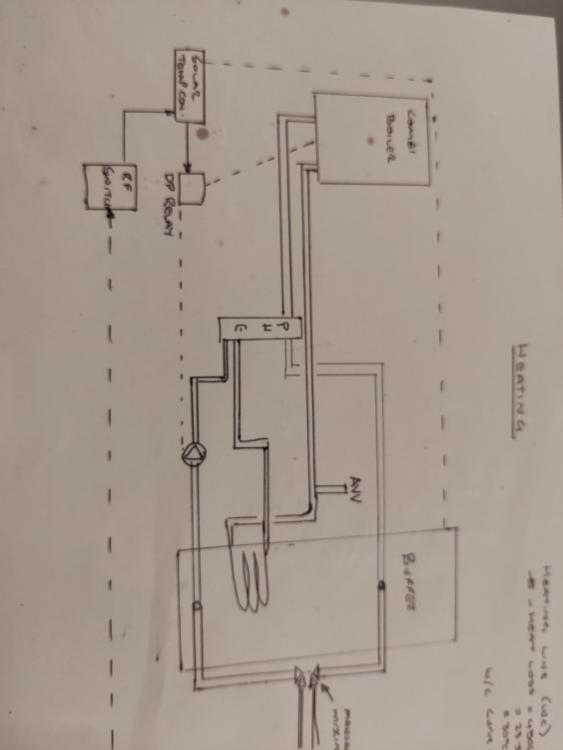
-
Has anyone had any experience with Chelmer Heating?
JohnMo replied to sharpener's topic in Air Source Heat Pumps (ASHP)
Bi zone package - Operation principal › serves to distribute and regulate two zones in which the water temperatures are different. › The heat pump produces water at the temperature of the zone where the control requires a higher water temperature (radiators or fan coil units). The bi-zone kit will adjust that temperature to the one set for the underfloor heating. › That water temperature is constantly adjusted based on the exterior temperature. › The ambient temperature thermostats in each zone simultaneously communicate with the receiver, located near the heat pump, and with the bi-zone kit controller. The controller, by means of the signals received, communicates with the exterior probe to provide the ideal temperature based on the parameters selected. So a 3 way mixer valve pump and weather compensation - which the ASHP provides anyway. Nothing different to a UFH mixer pump assembly. Funny how it does work with thermal store Flow path is boiler PHE, cylinder coil then back to boiler. Other of side PHE is bottom or cylinder to top of cylinder via a pump.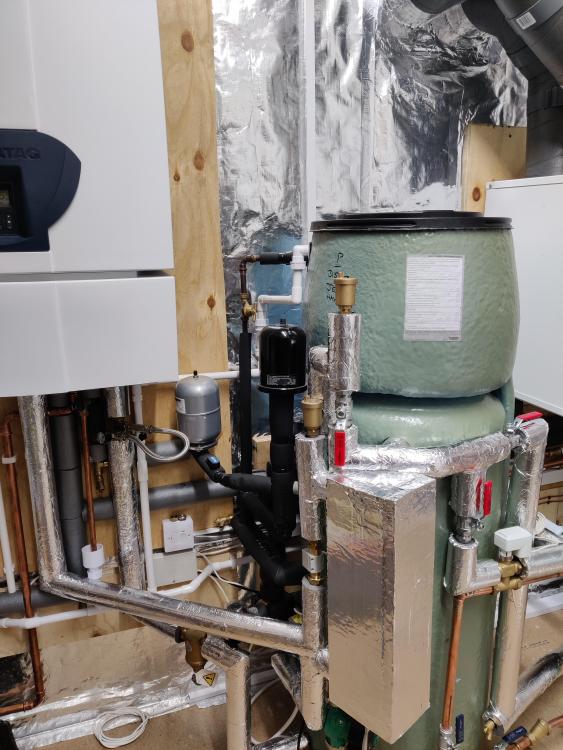
-
Has anyone had any experience with Chelmer Heating?
JohnMo replied to sharpener's topic in Air Source Heat Pumps (ASHP)
Or in simple terms a mixing valve. UFH mixer valves do this anyway. If you want to keep an existing cylinder with a small coil you can always add a plate exchanger and pump (similar to mixergy cylinders). This would effectively increase heat transfer area and let the cylinder be heated by the heat pump. Trying to keep the radiators may be an expensive missed opportunity, as running cost will always be more expensive than needed. -
1. yes, but the heat pump would not be able to complete the legionnaire cycle, so would see push back from the installer. Do you need a legionnaire cycle if you are using DHW daily is questionable. 2. No idea The buffer with immersion, will be there to make up any short falls in heat pump performance on a colder day than design conditions. It would kick in short the ASHP not be able to cope. May be waste connecting iboost, as PV performance in the heating system is rubbish
-
Don't go MCS route, do it yourself. Or specify and get electrician to hook up and plumber to plumb.
-
Decking without footings - bad idea?
JohnMo replied to MarkH's topic in Landscaping, Decking & Patios
With the planning requirements and the need for a ballastrade due to the drop, you may need a structural engineer input. Do it right once or why bother, my 25m X 3m (bigger but not much) deck cost me £2500 in wood alone for the support structure, plus ballastrade, plus decking boards. It's a big cost to mess up, because you don't fancy digging a few holes (a day's work) and pouring some postcrete. -
For a gas boiler I would simply design it to run exactly the same as a heat pump, big radiators, big coil in cylinder. Install buffer if required. For rads design around a delta T of about 5. Run then at 30 to 40 degs, let the boiler condense as much as possible and have the efficiency uplift. Our UFH is running on a delta T of about 4 fed via a buffer. Average boiler efficiency in this mode is around 110%. For radiators I would engage load compensation, but not for UFH, as system response time messes things up.
-
A well installed and designed heat pump system should cost less to run than gas. If you go heat pump route find the CoP tables for your chosen heat pump, you will see the dramatic effect flow temp has on running costs. For our heat pump at -2 deg, I get the following A flow temp of 30 will give a CoP of 3.6, while at 45 deg, you get a CoP of 2.6. So if you used a 100 units of heat, your energy usage would be either 27kWh for the low flow temp or 38kWh for the higher temperature. An increase of around 30% in running costs. So do what is required to have low flow temps, huge radiators and / or well insulated floor with UFH. Run the system on Weather compensation long and low.
-
So back to your comment You the user on a modern modulating boiler or ASHP cannot choose the delta T, that is predefined within operating software. The in-built circulation pump will change speed to maintain the delta T it wants. The only way to change it is add hydraulic sepereration between heat source and heating circuit, such as a buffer or LLH.
-
Mini split instead of a heat pump?
JohnMo replied to anonymous's topic in Air Source Heat Pumps (ASHP)
Mini split could work, you ideally would use a multi split, so you have one outdoor unit and multiple indoor units. You would need to route small bore refrigerant piping from the outdoor unit to the rooms with an indoor units. So a faff as well doing that. Depending on how you are plumbed and the individual room heat loads there is a possibility that micro-bore could work. Have a read here https://www.heatgeek.com/does-my-pipework-need-upgrading-for-a-heat-pump-with-cheat-sheet/ -
B&Q or Wicks they normally under cut just about everyone. Or do an internet search, prices vary almost daily.
-
Why - don't follow your logic. Please expand. If you are flowing a set temperature, the amount of work being done by the radiators is reflected in delta T. As room gets closer to the radiator temperature the radiator has less work to do. So delta T decreases, as less energy is transferred to the room. The boiler then cuts back flow to manage delta T. Test your own system if you are sure, I have. If you choose to run the radiators at 70 degs flow temp the delta T will stay at about 20. If you run the temps lower than 70 very rarely will you see a delta T of 20.
-
Why do you need such a kit? You are not touching refrigerant gas - or shouldn't be?
-
Decking without footings - bad idea?
JohnMo replied to MarkH's topic in Landscaping, Decking & Patios
Just jumped into the planning portal Planning Permission Putting up decking, or other raised platforms, in your garden is permitted development, not needing an application for planning permission, providing: The decking is no more than 30cm above the ground Together with other extensions, outbuildings etc, the decking or platforms cover no more than 50 per cent of the garden area. None of the decking or platform is on land forward of a wall forming the principal elevation. Trouble with raised deck they may/likely require designing and structural engineering input. Ours did and the amount of timber involved was huge. We needed to go below ground and form pads out of concrete. -
No real difference to a system boiler. Just need to make sure ASHP isn't oversized to much and flow temps are low. Oversize the cylinder as it stores at a lower temp.
-
How to deal with house overheating/sun in face when dining?
JohnMo replied to rh2205's topic in Windows & Glazing
Internal blnds? -
as said monbloc is pre gassed. You really would only use a monbloc ASHP, that keeps all the noisy stuff outside. You need the ASHP Flexible hoses 3 way diverter valve cylinder with 3m2 or bigger coil Heating system - this needs to be designed to run as low a temperature practical, so ideal is UFH. But big rads can work. If you have loads of zones you need a buffer or volumiser.
-
Yes the lower the return the higher the efficiency. But you do not control the delta T of a modern modulating boiler the boiler controller does. It changes pump speed to have the delta T it wants to see for a given temperature.


