


JohnMo
-
Posts
13296 -
Joined
-
Last visited
-
Days Won
200
Everything posted by JohnMo
-
True. They have been doing very expensive studies for the last decade, drawing up the engineering schemes. Park it and do it again. Good job I didn't believe him also. I would have wasted £2k otherwise installing one. Just says don't go to than man for an ASHP, as he has no idea.
-
Cheaper and way quicker. Make all farm land have vertical PV panels spaced to suit the tractor and it's equipment, so no land use is lost. Just like they have started doing in Japan. It could just be at he perimeter of a field. https://www.pv-magazine.com/2022/04/26/japans-first-vertical-agrivoltaic-project/ But all the NIMBYs in the UK would have field day.
-
Nothing really that complex with carbon capture. Most is based on flue gas capture from power generation. As @joe90 says countries have been doing it decades. Basics are a spent oil/ gas well, pipeline, gas compression train and some membrane sepereration, and possibly a booster compressor upstream of process plant and downstream of source. The projects I have seen in the UK, add on many bells and whistles like hydrogen generation which make it complex and super expensive.
-
DHW heating summer is not working too well so far. If the sun's out the PV heats the cylinder by the time the ASHP is ready to heat. Or it's been raining, so solar is pretty rubbish. Need to do some thinking about summer use.
-
Hot water cylinder is a different control to the house heating. If you are running a single zone you may be able to run the whole lot from the ASHP circulation pump (I do). Then you don't need a wiring centre at all, or any actuators, no pump or mixer on the manifold. Depending on the control for your ASHP you may be able to just use the thermostat to control when the ASHP gets a start permissive. I use a wireless thermostat (with time and temperature), the output of the thermostat says ASHP start or stop, the weather compensation curve says what temperature to flow at. Cylinder heating, a temperature probe in the cylinder tells the ASHP if it needs heating. The ASHP, will stop UFH, move the 3 port valve towards the cylinder, once the cylinder is satisfied the 3 port valve moves back to UFH.
-
Mainly because they aren't categorised for emmisions within the UK. Basically in the difficult basket for the law makers.
-
My VW based buggy is exempt anyway, without electric drive, it's my only vehicle allowed in ULEZ with charges. But it's 60 next year.
-

Joining flexible ducting
JohnMo replied to richo106's topic in Mechanical Ventilation with Heat Recovery (MVHR)
Why bodge, do it right, you may never be able to get to the joint easily once the house is built. The right solution costs nothing, compared to another 50m of duct. -
Log burner review if any one has one.
JohnMo replied to fiaraziqbal's topic in Stoves, Fires & Fireplaces
Not exactly comparing like for like. One is a remote boiler, the other a fire you have to have on to get anything out of the back boiler. The remote boiler will give heat whenever you need without melting everyone in front of it, the other will not get started in in the summer, because it will melt everyone in front of it. But as @SteamyTea say... Tech is old hat, and not environmentally responsible anymore. -
It doesn't look like you need to supply a 240v live as it already has it. The jumper just becomes a switch in the wiring centre. So the two wires just go from boiler to wiring centre not in to the isolation switch. If it wrong someone will be along to say I'm wrong
-
I would double check your boiler takes a live demand for heat. Ours needed a volt free demand for heat.
-
Apart from rubbish weather, my first trial was not successful. Main issue is timing things to occur together, biggest issue is shading and timing hot water heating. Have moved everything to 2pm. And will try again tomorrow. The other issue was the legionella program working slightly different from what I expected, so that required a little fine tuning. Which I have done. See what tomorrow brings
-
York Heatpumps - any experience?
JohnMo replied to Beelbeebub's topic in Air Source Heat Pumps (ASHP)
I have 2 acres, and getting one small unit in a place I and wife was happy with was not easy, can't imagine anyone agreeing to 4 units. -
York Heatpumps - any experience?
JohnMo replied to Beelbeebub's topic in Air Source Heat Pumps (ASHP)
Why do you need multiple units just stop people splitting their heating system into a zone for each room. Just have enough water engaged all the time then no issue. -
Do you really need a buffer? I think the rectangular shaped room looks fine, you may need to move some things around. Not sure how close the consumer unit is to the sink? Is it too close. I would be tempted to move all the wet stuff in one area and the electric stuff in another to keep them away from each other. MVHR will be wall mounted so most likely so could be above other stuff.
-
York Heatpumps - any experience?
JohnMo replied to Beelbeebub's topic in Air Source Heat Pumps (ASHP)
Do you need your heating on when it's 16 degs outside? That's when the heat pump struggles to get rid of the heat. -
York Heatpumps - any experience?
JohnMo replied to Beelbeebub's topic in Air Source Heat Pumps (ASHP)
Makes sense, adding system volume with a large water capacity radiator -
York Heatpumps - any experience?
JohnMo replied to Beelbeebub's topic in Air Source Heat Pumps (ASHP)
Doesn't it do that already, mine has a min flow temp for heating of 25 deg. A lot of the time I would need less temp than this so for some of the year I am on a fixed flow temp. If you heat pump runs for less than 10.minutes you do not have enough water engaged, you either have too many zones or one that too small. Or if you want lots of zones you need a buffer if you already have one a bigger one. -
York Heatpumps - any experience?
JohnMo replied to Beelbeebub's topic in Air Source Heat Pumps (ASHP)
Why - what's the theory that makes you think that? -
York Heatpumps - any experience?
JohnMo replied to Beelbeebub's topic in Air Source Heat Pumps (ASHP)
But as @JamesPapoints most installer install and walk away. Only if you have a large volume of water engaged. The floor absorbs heat slowly a small circuit will not stop short cycling. If you design for poor CoP, otherwise it's a bad idea. First heat cycle will be good as a ready source to a sorb heat, but once heated, it just a radiator what goes in comes out -
York Heatpumps - any experience?
JohnMo replied to Beelbeebub's topic in Air Source Heat Pumps (ASHP)
I think it would have to amendable in all cases. Certainly on mine I can change every control point and the curve. -
York Heatpumps - any experience?
JohnMo replied to Beelbeebub's topic in Air Source Heat Pumps (ASHP)
Heating cycle of my ASHP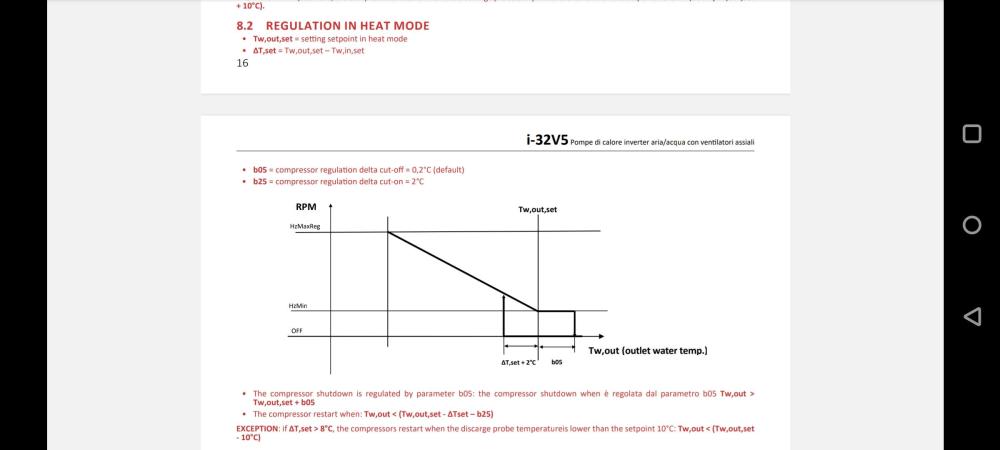
-
York Heatpumps - any experience?
JohnMo replied to Beelbeebub's topic in Air Source Heat Pumps (ASHP)
A little worse than a normal internal boiler, no worse than an external oil boiler, possible a lot better due to the lower flow temps. -
York Heatpumps - any experience?
JohnMo replied to Beelbeebub's topic in Air Source Heat Pumps (ASHP)
Heat pumps stop and start heating just like boilers do, but the circulation pump continues to run. Controlled stop starts of the heating cycle are fine so a run time of circa 10 mins or more is fine. Anything shorter is short cycling and wastes energy. The working volume of water is the prime reason for ok cycling or short cycling. Various formula are available to calculate the min working volume and cycle times. So if you are heating rate is fixed, the more water you have to heat the longer it takes. So can either install a buffer or keep system volume engaged by have a single or a couple of large zones. -
Yep no issue. We did our finished floor before the walls got built. A few low spots were sorted with a few bags of self leveling screed.


