


JohnMo
-
Posts
13296 -
Joined
-
Last visited
-
Days Won
200
Everything posted by JohnMo
-
Hopefully a quick question. Background installing an unvented cylinder. Location is remote from the cold water manifold, preventing connection of the balanced port to the cold supply. House already has a PRV just after the stop cock set at 2.5 bar. Cylinder comes with a combined inlet set, set at 3 bar. Can I just blank the balanced line off? Do I need the second PRV to comply with regs?
-

Timber framed VS SIP build.
JohnMo replied to gustyturbine's topic in Structural Insulated Panels (SIPs)
It may be the difference between a breathable insulation and not breathable (PIR in this category) -
But I did search their website and only found one CO2 unit, which doesn't have a screen.
-
Timber framed VS SIP build.
JohnMo replied to gustyturbine's topic in Structural Insulated Panels (SIPs)
Read up on passivhaus builds with block work, see how they do it. Also many on here have used blocks with wide cavity and say to steer clear of PIR; good in theory but in practice not easy to install with good results. -
A did see a video the other day where the guy was recording flow temps and CoP. In theory a flow temp of 30 would have been good, but the reality was 35 gave him a better CoP over the period, due to how the heat pump cycling occured. Difference in CoP was 4.0 compared to about 4.5. So not always that straight forward.
-
Mild cycling is fine, with run time 10 mins or over. Its all to do with the amount of energy expended to heat things up, like compressor, heat exchanger and piping, all of which are not useful heat and get lost to the outside, between cycles. Think of opening a tap, the water will heat the piping and displace a load of cold water before you get hot water on your hands. Do the same 30 mins later it's almost a repeated process. In that case heat is lost to house, so who cares. The heat pump does the same but a big chunk of heat is lost to outside. Any machine has micro wear during a start or stop cycle, that doesn't occur during steady state running, this happens on bearings and any surface that doesn't normally touch during running, due things like hydrodynamic lift that support a shaft from a bearing surface... Equipment life is normally rated in number of cycles not running hours.
-
Don't think that would comply with Scottish regs, has to display the following - CO2 now, average over 8 and 24hrs and peak in last 24 hrs
-
Horizontal cylinder in a 'cold' loft. Bad idea?
JohnMo replied to Post and beam's topic in Boilers & Hot Water Tanks
Have a look at this size guide and go from there.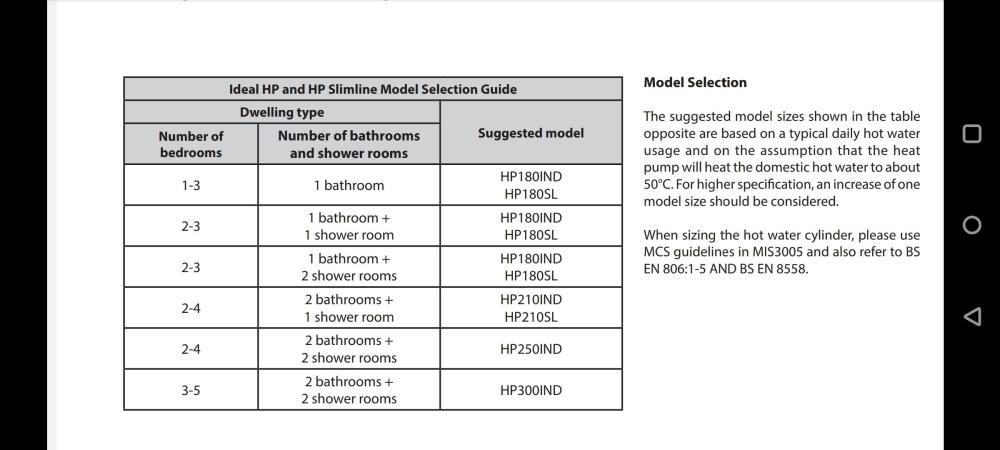
-
Read the regs they are very explicit on what type of meter you need and placement. Look for CO2 meter Scottish building regs on Google.
-
Horizontal cylinder in a 'cold' loft. Bad idea?
JohnMo replied to Post and beam's topic in Boilers & Hot Water Tanks
A 210L slimline is 450x1950mm ish depending on make. My thoughts are there are generally 2 of us in the house, so 210L will be more than enough for us. The cylinder has an immersion, so if we need more capacity I will flick on the immersion heat the cylinder to higher temp and leave on while people are showering. -
Be realistic with you air changes 0.3 isn't, even with passive the notes say use 0.6. Even using 1 you total heat required is circa 3kW. So you need a dinky ASHP, 5 to 6 kW gives plenty of room for DHW. Just watch the volume of water engaged in the system or add a volumiser to the return leg.
-
Timber framed VS SIP build.
JohnMo replied to gustyturbine's topic in Structural Insulated Panels (SIPs)
If you are actually doing the build, build with what ever method you want and are comfortable with. Any build method can get excellent results, as far as u value is concerned. Not sure PIR in cavity would be my number one choice. You would be better with a wider cavity and blown insulation. If you are not actually building, but paying someone else to it, choice a method the used in the local area, so builders are easy to get and you can get competition to quote. Unless you are building circa 500m2 plus, there should be no reason why a good self build will need 10kW ASHP? Specifying the size before you actually know how you are building putting the cart before the horse. -
Plate loading or coil UVC for heat pump
JohnMo replied to JohnMo's topic in Boilers & Hot Water Tanks
Spoke with Warmflow their heat pump cylinder will only work with their heat pump, as the pump speed is controlled by the ASHP. Mixergy cylinder requires internet to function in the most part, so both are none starters for me. Have decided to go slimline (easy access through loft hatch) 210L UV cylinder with 3m2 coil. -
Backyard doors - all glass double or triple glazed?
JohnMo replied to JohnBishop's topic in Doors & Door Frames
Various ways to skin the cat. Double glaze can vary in U value hugely, depending on the frame build up and double glazed units used. We have triple glazed windows and 4 double glazed outside door sets -mainly due to weight. UPVc/aluminium U values came in at between 1.4 and 2. something, which is rubbish. We went for wooden (and all windows) with krypton gas between the double glazed pains, total U value for the door is either 1.0 or 1.1, a while since a looked. Unless the rest of your house is well insulated and draft proof, triple glazed is long way down the list of things to spend your money on. -
Horizontal cylinder in a 'cold' loft. Bad idea?
JohnMo replied to Post and beam's topic in Boilers & Hot Water Tanks
I utilise a loft section as my plant room. The room is all within the thermal envelope so insulation is at roof level. Have an MVHR Extract in there, so any heat loss from the cylinder is recovered. -
Seen a couple of plate loading UVC's on offer for heat pumps, as opposed to a coil. So PHE and small pump taking cold water from bottom and deposits at top of cylinder after heating. One from Warmflow and the other from Mixergy. Advantages disadvantages?
-
'Packaged' UVC, larger than 200l?
JohnMo replied to Post and beam's topic in Boilers & Hot Water Tanks
How about a slimline cylinder actually build in to a tall unit. Like a fridge? -
'Packaged' UVC, larger than 200l?
JohnMo replied to Post and beam's topic in Boilers & Hot Water Tanks
Viessmann do them I believe, need deep pockets for some, others don't look to bad. You can get Erp A+ ones from there also. Vaillant may also. Ignore the above they are round -
Long studs and nuts with a chemical anchor.
-
They are part of efficiency measures brought in about 10 years ago. 93% isn't really that good. There are much better out there, 93% eff is the minimum allowed I believe.
-
The main I would question should you have DHW within the cylinder? Or a small body of heating system water? The issue may be legionella if you have the body DHW floating on heating temperature via WC. This could be at the least ideal temp for period of time. For it to work all year you need it to heated in the summer also. So you really need 3 way valve and thermostat, if you intend taking any heat from the heat pump. Then the volume you are taking will mean short cycling if not managed well with a 8 to 10kW heat pump. Also don't assume all flue come out through the wall, mine is in the roof for example.
-
Not really seeing anything different from the link provided to that drawn above. Except the expansion tank is very small. Although similar to my previous link, this is smaller could be positioned where a combi boiler came from (900x400mm), on a simple shelf. It has a heating coil, and everything after that is customisation friendly, maybe even get a bigger coil if you asked and if there enough space for it. https://newarkcylinders.co.uk/product/newark-indirect-combination-cylinder/
-
Some comments in bold above
-
Stubbled across this MCS cylinder sizing guide Domestic_HW_cyl_selection_guide.pdf
-
You need room by room for radiator sizing, but you are good enough with the whole house calculation to get the total heat KW required. Jeremy spreadsheet in boffins corner is quite accurate. Show a slight over demand above 5 degs, but below pretty good.



