


JohnMo
-
Posts
13296 -
Joined
-
Last visited
-
Days Won
200
Everything posted by JohnMo
-
Is coil size is a bit small?
-
It's a closed shop, no opening for entry by any third-party person or organisation. Isn't that against the law?
-
Why bother? just balance the flow rate to get the heat output you want and have it so the bathroom comes on when ever there is a heat demand else where in the house. One less thermostat especially on a small zone can only be good, to help keep whatever boiler you have happy. Also no need for the thermostat, wiring or actuator on the manifold.
-
Mean that the grants are going to people that already have plenty of money and don't really need it. But you are also correct its all about self preservation of the MCS and finding its self.
-
The current grant system is just funding the rich, as to take up an MCS heat pump installation, you need to rich or daft or both. Normal person just cannot justify (and why would they) a boiler for £10k+ after grant.
-

Connecting radiators to UFH Manifold?
JohnMo replied to Smarty67's topic in Central Heating (Radiators)
There was a similar post not so long ago. So it may come up in a search. Be careful with lots of thermostats and boiler being pushed into short cycling. Also look at weather compensation. If a system boiler make sure it's plumbed as X plan or priority hot water, so you can run two different temperatures one for CH the other for DHW. Your pressure drop the pump sees is equivalent to the longest loop -
Doesn't that just add more expense for little or no benefit. Staple UFH pipes to the PIR, then fibre reinforced concrete, tile to concrete So hardcore compacted, sand binding, DPM 200mm PIR, Polythene separating layer UFH stapled to PIR, 100mm fibre reinforced concrete slab.
-
Saw a YouTube vid a while ago, some did similar, but the cylinder was open vented so he took the top off and replicated the coil. From the day he published it worked a treat. That all the ventilation air HP do.
-
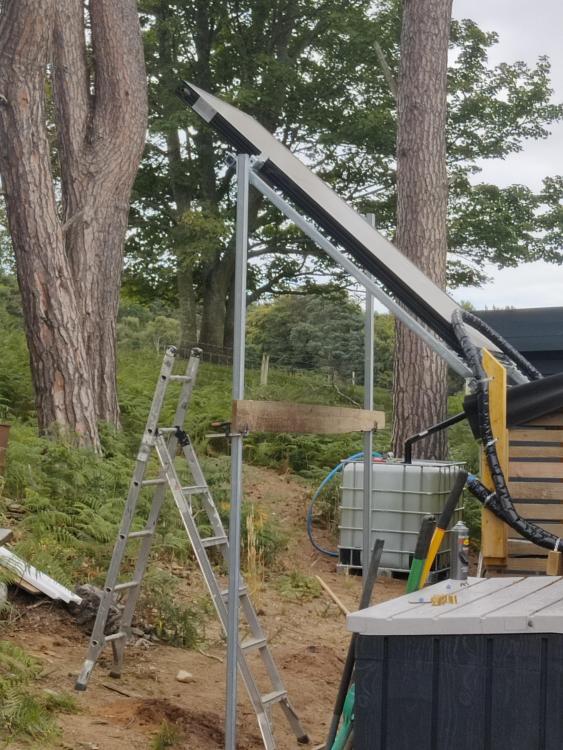
Panel now in place - piping and temperature probe next.
-
Gas boiler lobby obstructing heatpumps
JohnMo replied to Beelbeebub's topic in Air Source Heat Pumps (ASHP)
But as per relevant legislation and guidance - so as per BR.... If so I believe it's just the first metre to insulate of piping connected to the cylinder. I am sure someone will correct this if I am wrong. -
You need them on flow and return or an air bubble will just sit there. These seem quite good Inta 15mm Automatic Air Vent AAVB15 I got mine from here www.Heatingspares247.com
- 1 reply
-
- 1
-

-
Gas boiler lobby obstructing heatpumps
JohnMo replied to Beelbeebub's topic in Air Source Heat Pumps (ASHP)
If you read the press more people would be wanting rid of them due to the high running cost, fly tipping on your front garden would be more of an issue, than low life's taking them from you. -
SNP plans to ban sales of house with gas boilers
JohnMo replied to Temp's topic in General Self Build & DIY Discussion
Gas will be given a worse CO2 score than electric. That's been floating about for ages. "Forcing some owners" - doesn't mean all. Typical headline grabbing. -
You still don't seem to grasp that there are millions of ASHP made each year and many millions of A2A worldwide. The inverter driven heat pump has been about for well over a decade, maybe 2. The first heat pumps were in people's homes a century ago. Nothing new, nothing rocket science about a heat pump. It's a simple refrigerator cycle with a heat exchange to water.
-
Tolerance in ASHP sizing? Drawbacks of oversizing?
JohnMo replied to embra's topic in Air Source Heat Pumps (ASHP)
A 10 deg swing between inside and outside temp halves or doubles the heat loss depending which way you look. So in my case the calculated heat loss is 1.3kW at 10 while at 0 it is 2.6kW. However the generated heat from people and appliances is a bigger proportion the warmer it gets outside, so the actual heat required at 10 degs is less than calculated. A heat pump with 50% turndown is therefore massive at 10 degs if it's been designed already bigger than it needs to be at -5. The key is having enough system capacity so the on off cycles allow a run time of at least 10 minutes. The run cycle at warm temps could be 10 mins on 40 mins off or longer. -
Some comments The last curve it was circa 20 degs outside compared to the others circa 15, so CoP should be better. The last one is also heating to a lower temp not going above 55 before cutting out, while the others are hitting close to 60. The first HP is heating cylinder in 35, second one 40, third one 90, the last 70 mins. Way to many variables to pin anything statistical against. You could say the coil size in the cylinder or set point it is being heated is also something that needs to be compared. None of that data is represented. Rubbish in rubbish statistics at its best. Makes good headlines though
-
Reason I thought to go AC coupled was I have 2 PV inverters at remote locations from each other. One is routed to a consumer unit in an outbuilding the other in the house attached to the main CU. If I put a hybrid inverter on the outbuilding it would be good location for the battery, but I would need something like a wireless CT clamp - not seen anything that solves that issue - anyone any ideas. The other solution is leave the outbuilding as it is and replace the inverter in the house with hybrid and locate the batteries there, CT clamp will be an easy route. So if I go hybrid any suggestions on make or models? 3.7kW would be right for the solar array.
-
You need to work out your pressure drop, the install manual should tell you the max allowable.
-
A do you have a flow rate issue? Or are you assuming? What is the pressure drop allowed for the heat pump circulation pump? 8m pipe run to where? Is that 4m each way or 8m each way, is that to a cylinder UFH manifold etc?
-
Tolerance in ASHP sizing? Drawbacks of oversizing?
JohnMo replied to embra's topic in Air Source Heat Pumps (ASHP)
Drawbacks are Not enough modulation on the shoulder months, so could short cycle during these months. Which will impact CoP. May need a buffer to compensate, which if not really careful will impact CoP. -
Gas boiler lobby obstructing heatpumps
JohnMo replied to Beelbeebub's topic in Air Source Heat Pumps (ASHP)
the next question would be, will the MCS installer or person quoting accept that you can do space heat only and would get a better price,knowing you cannot get the grant. -
Gas boiler lobby obstructing heatpumps
JohnMo replied to Beelbeebub's topic in Air Source Heat Pumps (ASHP)
Source document attachedHeat-Pump-Guide.pdf It may get you out of asking for for planning permission, grants are another question. -
I believe the Riello are rebadged Midea units, so you could look there to compare pricing. They have the same controller, same casing, same manual rebadged. Also check the outputs as the name plate kW seems to be the min output rather than max. Good modulation, but could be Freedom Heat Pump quoted me £2.3k plus VAT for 4kW one. But also sure both Riello and Midea units on eBay for less than £2k, but they were too big for me. Was high on my contender list, modulation looks as good as most other heat pumps.
-
Gas boiler lobby obstructing heatpumps
JohnMo replied to Beelbeebub's topic in Air Source Heat Pumps (ASHP)
Just had a look at the heat pump guide by MCS. And found this (third option was for a combined system). 5.2. Heat Pump System Type Options • Space Heating Only The heat pump provides heat only to heat the space. Domestic hot water for sanitary purposes (if required) is provided by a separate system which may or may not be another heat pump. • Domestic Hot Water Only This heat pump is dedicated to heat up domestic hot water. Any space heating requirement is supplied by alternative means. This can be a popular solution on large projects such as multi residential apartments when services are centralised e.g. heat network systems. So using this available configuration may be away around not changing your existing cylinder. Say you heat on E7 and don't want to change - ask them to add a 3 way valve (and wiring) just in case you change your cylinder at a later date. Get your MCS ticket, get a plumber in and pipe up the cylinder how you want. -
Gas boiler lobby obstructing heatpumps
JohnMo replied to Beelbeebub's topic in Air Source Heat Pumps (ASHP)
The controller always had it. Although it looks like an S or Y plan it's actually X plan, because they run to different flow temps, CH can be WC and DHW has up to 60 deg. A small Grant ASHP can be bought for around £2k, has its own controller, comes with flex hoses. Grant add a seperate interface to replicate S plan and a timer for DHW. All of which is added to make it feel like an oil or gas boiler install. Grant corporate have the MCS certificate, they do the design, any Grant certified boiler installer can then install, unit commissioning is done by Grant corporate I believe.


