
JohnMo
-
Posts
12469 -
Joined
-
Last visited
-
Days Won
179
Everything posted by JohnMo
-
 Basically as you reduce leakage, CO2 and mould become an issue. I am a fan of MEV, but only when it's done via humidity control, so the extract points open and close based on the local humidity and so do the inlets either trickle vents or wall vents. The MEV fan speed automatically changes based on system resistance. So it only ventilates when needed. You inlet to dry rooms and extract from wet. If ducting to wet rooms is an issue dMEV, with humidity boost, but with humidity controlled inlets in dry rooms, not manual.
 -
Not sure aerogel would be suitable for the floor, as it's quite fibrous so would compress. Infrared heating, is still trying to heat the room, is basically 100% efficient, same as any electric heater. Maybe in your shed for a quick hit of heat, but convinced for the house. Basically the more insulation, the better the outcome, but also spend as much or more on draft proofing and then think about your ventilation strategy while your at it.
-
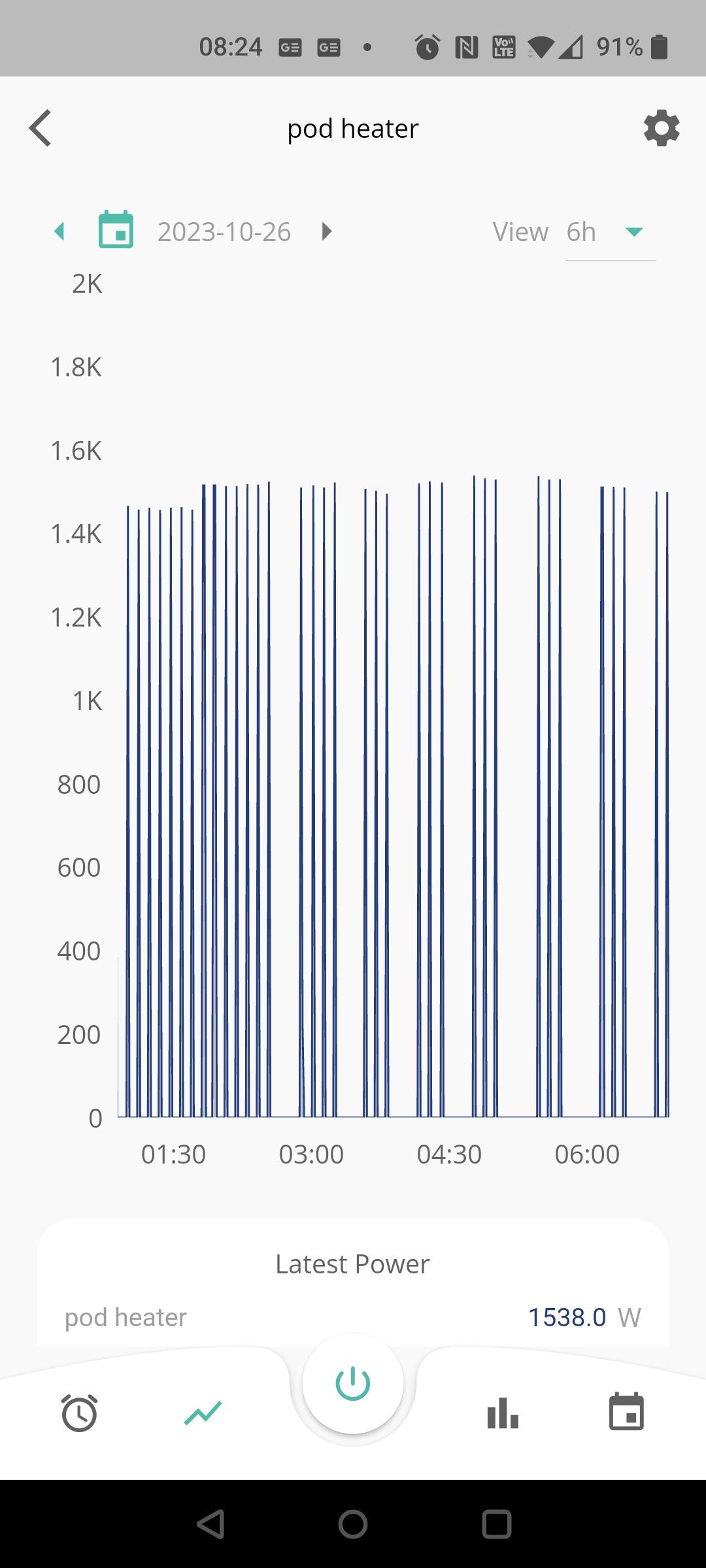
Yes running everything from the ASHP circulation pump, no buffer. During the test flow temp was around 35, the house flow rate was 12.4L/min and average dT 4.7. The summer house has 2x 50m loops, again driven by the same circulation pump within the ASHP. During the test, I had the flow date quite high in the summer house each loop getting 2.5L/min. The dT in the SH was 2 Interesting looking at my house power flows this morning, the ASHP was online from about 1am to 4am, and the there is a corresponding reduction in the start stops of SH heater. With an approximate lag of 1.5 hrs. The heater input dropping from an average of 300W/h to about 160W/h. After I stopped the test, I also reduced the SH UFH loop flow rate to about 1L/min and increased the house flow rates back to around pretest levels, while at the same time reduced the temperature output from the ASHP.
-
No, they are part of the habitable space and within the heated envelope.
-
Hi, house floor 192m2 has 200mm PIR with 100mm concrete floor, with 7 loops at 300mm centres stapled to the insulation. Walls are Durisol, with 50mm service space and plasterboard. Roof is 350mm of spray foam, behind vapour barrier, 50mm service void and plasterboard. All room have high ceilings, so quite a big volume. As you say high thermal inertia house, low inertia summer house. But even running the summer house UFH at 35 for 24+ hrs did very little in the way of heating.
-
Can anyone help with my MVHR saga?
JohnMo replied to Deniance's topic in Mechanical Ventilation with Heat Recovery (MVHR)
You really need to start with all the terminals open an equal amount. Then start at furthest away terminal and set fan speed to get the room target about right. Now don't touch the fan speed or that room, but adjust the rooms getting closer to the MVHR unit and adjust the terminal to room to target flow rate. Then go back to the start again and use the same method, furthest room fan speed adjustment to tweak flow rate, all other rooms the terminal. You may need to do 3 or 4 times to get it right. -
Can anyone help with my MVHR saga?
JohnMo replied to Deniance's topic in Mechanical Ventilation with Heat Recovery (MVHR)
Your pots being different positions it just indicative of the difference resistance (pressure drop) in the supply and extract. My extract will just hold a bit of toilet roll up. So not much flow. Remember you are only extracting the whole house air every 2 to 3 hours, so flow rates are aren't huge I set my boost to 25% above the trickle flow rate. -
Switching on off like you are proposing may not be the best way to do it. All you will be doing is getting just enough heat into the system and then loosing it repeatedly. You may be better running a pipe stat, set to a warm temperature and let that control the stop starts, not sure if you would need an external timer. All are pretty cheap to pickup. There are other ways around it and other things to sort out, but it depends on the exact plumbing of the cylinder, do you have a mixing valve on the hot water outlet, it limit outlet temperature?
-
Aren't you using a proper backwash filter then small 10 and 5 micron filters after? Our well when it first started up to the first year point, I had to change the 10 and 5 micron filters every 3 months, now it's nearer once a year.
-
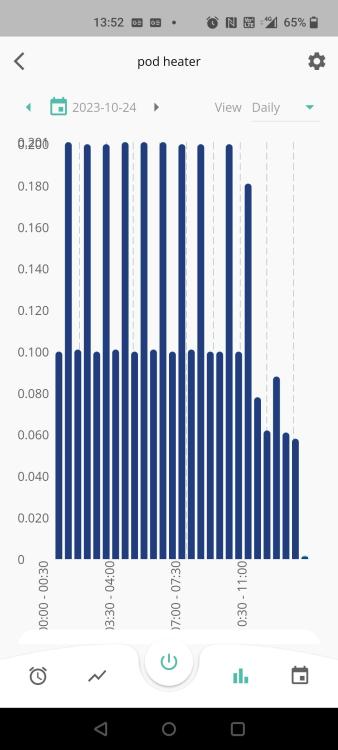
Doing it again, I think a screed finish above the pipes, with pipes in full contact with the screed and a bonded down floor covering not floating. Think that would fix the transfer issue. Certainly the sales model with the moulded polystyrene with aluminium spreader plated and 125mm pipe centres sound convincing, but in reality a bag of ..... But I think my electric heater and its modified thermostat, will do for now. Wife is happy! Basically now set on 16 degs 24/7, if the wife needs to use the room, she just turns up the thermostat an hour before, she needs to be in there. It was 4 to 5 degrees overnight and is currently 11 degrees. Have used about 3kWh in the last 14 hrs. Below is the 30min output from the smart plug. Once I get E7 tariff sorted, all the electric will be cheap rate either from the battery or in the E7 window. So today would have about 50p so far. Since my experiment with running higher flow temps for 24 hrs, the house heating hasn't needed to come on yet. So quite a big mismatch in demand rates.
-
All Nissan Leaf models support it, and always have, but getting a charger in the UK that supports it, is different story.
-
As far as I tell it's the same thing.
-
If the hysterisis is 0.5 the switch off, is 22.5 not 22. The control point is 22 the hysterisis on the thermostat is actually +/-0.5. A 0.1 deg hysterisis thermostat works at +/-0.1 from the control point.
-
Documents required for building control sign off
JohnMo replied to Moonshine's topic in Building Regulations
They will have listed them all when your plans were approved. UVC commissioning certificate Structural sign off certificate, if you have balustrades or stairs, you may need all the design approvals for that. If in Scotland (not sure about England), sustainability certificate, As built EPC. Home owner manual -
Couple of things worth noting Panel angle, near horizontal great summer production and rubbish winter, near vertical lower summer production (but you will have loads anyway), but pretty good winter. Several small arrays spanning east to west will give more production than a single large array pointing in one direction.
-
The normal point you add probes to are sealed so water doesn't leak. So you would have to find a thermal pocket to insert first. But remember you have to be deemed competent (i.e. Certified) to work on an UVC.
-
Well have given up on that idea, had a flow temp of 37 overnight and dT across the floor loops of 3 to maximise the heat output. Heat pump ran for 12 hours straight slowing only to defrost every hour, as it was zero overnight here. Floor in garden room got to a massive 18 degs and the room only managed to stay at 16 deg room temp, because I set the thermostat for the electric heater at 16 deg. Think I would need a flow temp of 40+ to keep the garden room floor happy, and that's not going to happen. The house UFH flow rates were reduced to prevent overheating managed to keep house down to around 21. So about to wind everything back again and reset the WC curve.
-
So back to square one. Realised I am actually putting more electric into the garden room than the house, with direct heating. Garden room direct electric and house via heat pump. So have decided to sacrifice a little CoP and increase flow temp. To make this achievable, the house output needs to be reduced quite a bit, so flow rates have been set with a much bigger dT to compensate. Have programmed a different WC curve into ASHP and will monitor and adjust as required. Tonight we are getting down to zero degrees, so a decent test.
-
Foam gun lost propellant?
JohnMo replied to Sparrowhawk's topic in General Self Build & DIY Discussion
They all do that, after a while of being connected the can is useless. -
3.5m2 is a very small area to get pipes in, by the time you have stepped in from any outside walls there isn't much floor to gets pipes into. Small areas and underfloor heating are difficult. Anyway why would you need a porch area at the same temperature as the rest of the house? It's just a transition space.
-
Here's one piv system for a flat, I've seen in the past when researching something else https://www.permagard.co.uk/nuaire-flatmaster-piv?___store=default&utm_source=google&utm_medium=cpc&utm_campaign=performance-max&gclid=CjwKCAjw7c2pBhAZEiwA88pOFwDMhgNYiyQJd6Apasm9CyQTq9b_UaBExI87yiJ3jD4-HhyK4-SCdhoCqnoQAvD_BwE
-
So did you check the pin heights?
-
I would get something like a Greenwood CV2GIP dMEV Extractor Fan, cheap as chips on eBay, almost silent, leave at a low rate all the time, with boost at needed, with its built in humidity sensor. Three wires and your done.
-
They are called flow meters. I would remove the Salus actuators, to see if the pin is stuck in a position, compare it to one of the other circuits that seems to be closing.
-
Sounds like a lot of waste, they should be providing 300m+ length rolls! Not seeing why you would to go though walls? There should be no reason? A buffer provide a reservoir of working fluid for the heat pump. But depending on the plumbing it can result in a drop in CoP. You can plumb them as a two port either in the supply OR return lines or across the supply AND return - these methods give no hydraulic sepereration between the heat pump and heating system. The more normal way is 4 port, basically the flow and return all go into a single cylinder, the heat pump and heating systems are hydraulically seperate, so both need their own pump - this config nearly always results in a fall in CoP. If you are going buffer a 2 port would be best. https://www.kensaheatpumps.com/installer/buff-up-your-knowledge-of-buffer-tanks/