


JohnMo
-
Posts
13307 -
Joined
-
Last visited
-
Days Won
200
Everything posted by JohnMo
-

Improving an "ok at best" ASHP installation
JohnMo replied to pstunt's topic in Air Source Heat Pumps (ASHP)
Couple questions buffer yes/no Weather compensation yes/no When you measured the dT of 2 was the heat pump on an on cycle, just starting or just stopping? You don't normally have any control dT, as it's managed by the heat pump. Why would you need it? -
Scottish Water have testing facilities in most bigger towns. Our was tested in Elgin. Your local council web site should have details.
-
Should we attach plywood to large west-facing windows in storm?
JohnMo replied to LinearPancakes's topic in Windows & Glazing
Just been back through the email trail and the data came directly from the glass supplier -
Bathroom extractor: self install?
JohnMo replied to Post and beam's topic in Electrics - Kitchen & Bathroom
If it's a building regs job and council is checking, then yes, otherwise all depends, are you competent? -
Agree it lets you add ACH figure, but not a direct airtightness figure. If you were ventilating at 0.5ACH with MVHR, you add that figure and the efficiency of the MVHR. The spreadsheet assumes you are pretty much airtight and well insulated. If you know a target airtightness you can say add 10% of your airtight figure to the ach and drop the MVHR efficiency slightly. But if your airtightness is 3 or below, and you are using MVHR it's good enough as is - nothings exactly correct, but better than a ballpark away.
-
Should we attach plywood to large west-facing windows in storm?
JohnMo replied to LinearPancakes's topic in Windows & Glazing
Sorry no clue, the window supplies provided the information to our structural engineer and I was copied on the email. -
Should we attach plywood to large west-facing windows in storm?
JohnMo replied to LinearPancakes's topic in Windows & Glazing
We are in a high wind area and all our windows were subject to structural approval. Take a look at the allowable deflection - quite surprising
-
What Boiler to prevent short cycling?
JohnMo replied to windsor-tg's topic in Central Heating (Radiators)
Looks like a system flush/chemical clean and some corrosion inhibitor wouldn't go amiss. Wonder the system worked at all. -
Tell the wife that, she complains every time she uses the hob - its induction. She misses the gas hob, I don't and I do most the cooking.
-
Self Build Insurance Required?
JohnMo replied to NRMartin's topic in General Self Build & DIY Discussion
If you are currently insured, talk to your supplier of insurance and they will do a temporary change of insurance during the work period. Then if the worst happens you are covered -
Me also, but make sure you pin it down to the insulation, as it will start floating upwards if you don't - been there, done it. You are likely need 6mm2 (or bigger if on a long run) for your cooker and a separate feed for you sockets, (so not small conduit) and UFH pipes possibly in the same space so make sure you have enough screed depth to cover everything. Also if the run of conduit is long or has bends in it makes sure you pre install a draw string to make life easier later.
-
I have one sold with an Ideal badge on it. No issues, charges quickly, has a 3m2 coil, but it is split into several smaller ones in parallel to limit pressure drop. The immersion is silent in operation, unlike a thermal store I had. Run at a low temperature cylinder heat loss is almost zero. Most cylinder losses are down piss poor pipe insulation normally anyway. Do secondary circulation if you have long runs, with thermostat and timer and small bore from a plumbing manifold for hot and cold.water distribution.
-
Also have to concider location and building form factor, also some people live in colder locations, so payback is different. If you are doing UFH get yourself down to 0.1, to mitigate downwards heat loss. And the roof is generally quite cheap to get down to 0.1 also. All things house related are not about pay back period. If you built all houses based on payback we would all live in tents. You mean 0.14/0.15
-
Basics are Heat pump generates heat for central heating at one temp or a temperature based on weather compensation. When there is a demand to heat DHW the heat pump moves a diverter valve from central heating to DHW cylinder heating. The heat slowly increase output temperature until your cylinder is hot enough. It then reverts to central heating. You are better to have a heat pump cylinder and no buffer. But you need to understand the size of heat pump required etc. if you are going for a grant you have to heat DHW via the heat pump!
-
You need to use the heating season average not the whole year. So will be nearer 13 to 14 I would think. That again would be just for the heating season say 180 days If a heat pump, your CoP of 3 to 4, so nearer 10p. I assume U values are 0.14 or 0.11? About £40 per year difference based on a heat pump.
-
Two reasons, short cycling and defrost. Both require a minimum volume of water available. If you zone the UFH your volume will reduce very quickly. Volume is smallest zone capacity plus piping to that zone. You need to design for no more than about 40 at your lowest temperature to good efficiency. Then a lot of the time you will flow closer to 30. There are buffers and volumisers. Generally a buffer will provide hydraulic seperation between heat pump and central heating. If done well can be ok, but most times it isn't and you end having to run the heat pump hotter than it needs to be due to mixing. A volumiser does not provide hydraulic seperation, it adds volume and is more likely to an ok addition to the system.
-
We can get -9 here, but I made the decision to add about 10 to 15% anti freeze to the system. Accept I maybe getting an efficiency hit. Mitigation were, need all to coincide together, 1. you need a power cut to coincide with the coldest day, 2. I need to away at the same time, to ensure 4 is implemented 3. we have a battery it needs to be flat, but we always keep 5% in reserve 4. and we have a generator that needs to be connected - it may not start. 5. Also cool down time to the water getting to freeze point will be reasonably long. So you need a long power outage.
-
If you can't or won't fit an UVC - there is it's an open vented cylinder as pointed out by @SteamyTea this could be direct or indirect or a thermal store like a Harlequin, or point of use direct heaters. Plenty of options for DHW heating. Nothing mandatory about installing an UVC. There will be plenty of properties where installing a unvented cylinder is wholly inappropriate, due to water pressure and flow issues.
-
Yes. Big coil is the only difference in the actual cylinder. Two options are run at low temps when your house is empty of kids etc in a few years. Run at normal gas boiler temps to get the max storage of hot water. But with the huge coil your recovery time will be really quick.
-
Or just heat the SA on E7 or similar tariff.
-
If you are doing UVC, cold ideally wants to come from the UVC pressure reducing valve, so everything hits the tap mixers at the same pressure. Combi boilers only take a 15mm supply in, so no point running 28mm. 15mm, would do in Hep2O so internal dia is slightly smaller. Issues I see. Doing everything from the combi heating output misses out on different flow temp. A decent boiler would allow different temps for CH and DHW heating. If it was me Decent system boiler, that does weather compensation and is plumbed in X plan (not S or Y plan). Run heating at lowest temperature you can, to get around 100% efficiency or better from boiler. Install a heat pump cylinder with 3m2 coil. Again can run boiler at low temperature to get good efficiency or at a higher temp to super quick recovery. If insistent on a combi. Dump the idea of a huge UVC as well. Get a combi that takes preheated water, Intergas, Atag etc. install a preheat cylinder circa 150L. The preheat cylinder takes the cold water normally fed direct to the combi and heats it. This should be a heat pump UVC, heat as a zone from the central heating to around 30 to 40 degrees. Output from the combi will be huge - I had this set up for a while, don't notice any difference in flow with an UVC.
-
Think if you want zones or you don't have enough system capacity the Gant volumiser or the attached Kensa scheme are better. Hydraulic seperation just add inefficiency, as it's too easy to have a heat imbalance
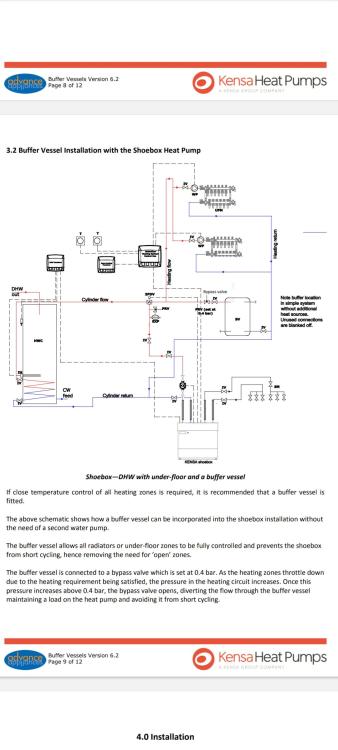
-
Must agree, great until you get a power cut and they actually activate, then you have no heating until you repressurise the system. OK if your handy, but not so good if you are not, or you are away. Glycol system just picks where it left off prior to power cut.
-
Keep turning it down until the flow rates start to drop from their set point on the manifold flow meters. If it's a big drop one speed up. I have same number of loops, same pump on speed one - no issues with flow rate.
-
But only for 3 to 4 hrs. Our garden room floor was similar buildup but with laminate flooring, was just rubbish at heat transfer. Probably better just switching the bedroom UFH off and opening the bedroom doors. Run the downstairs longer to compensate.




