JohnMo
-
Posts
13308 -
Joined
-
Last visited
-
Days Won
200
Everything posted by JohnMo
-

2 x 100m or 1 x 200m borehole
JohnMo replied to ronaldgibbons's topic in Ground Source Heat Pumps (GSHP)
I started in the same place a few years ago, then realised I really wasn't getting what I expected. After that I learnt and started to drive what my expectation were. I actively reviewed and commented on every document, as would as a client within an engineering project. Learn and fully understand things like kW is and the difference to a kWh - sounds easy, but you would be surprised how many mix up the units. Also understand U values and R values and the difference. -
All I will say is get ready for lots of wasp nests. Ours has lap joints and wire mesh everywhere and they still find their way in behind.
-
2 x 100m or 1 x 200m borehole
JohnMo replied to ronaldgibbons's topic in Ground Source Heat Pumps (GSHP)
New build house, with decent insulation and airtightness. UFH pipes on 200mm centres generally, do 150mm centres in bathrooms. No buffer or plate exchanges 3 way valve to divert between UFH and cylinder. 3m2 coil cylinder around 250 - 300L Most likely a 6kW heat pump would be fine, based on heat loss calc. Our build was completed with gas boiler, but added an ASHP last summer. Heating this year NE Scotland, has a couple of weeks at or around -7, with zero issues. Heating costs during the really cold period is more expensive than gas, but during less cold cheaper than gas. My self install cost around £2k as a retrofit. UFH materials were around £1k and it took me alone 2 days to install. A cylinder is £1k ISH. -
2 x 100m or 1 x 200m borehole
JohnMo replied to ronaldgibbons's topic in Ground Source Heat Pumps (GSHP)
Gee you have deep pockets, and at those costs you should be doing a mansion. Your house is slightly bigger than ours. I am running a 6kW heat pump which is oversized. Full retail price is around £2.5k to £3.5k depending on brand, you need a plinth to stand it on and a couple flex pipes, power and coms cable and that's the external work done. -
You need to add to this how and when you heat the cylinder, and how your house reacts to the heating being switched off on a cold day. Also if you are using standard rate electric a time if use tariff. Taking 90 mins off heating could be fine, in some cases in many you could get 3 to 4 degree temp drop in the house, which takes all day to recover on WC. In that case big coil and a few small tops would be better spread over the day. My 210L cylinder with a 3m2 coil, takes 35 mins to reheat to 50 deg based on a standard thermostat differential, from a 6kW heat pump. It generally does this twice a day. With a coil half the size, you could spend a lot of time not heating the house.
-
They seem to work, OSO use a similar sized coil also. I get one with a 3m2 coil, a Gledhill one badged by Ideal, comes with a 3 port valve etc. and was about £400 cheaper than the Gledhill one, although exactly the same.
-
Basic silly question
JohnMo replied to Nic's topic in Mechanical Ventilation with Heat Recovery (MVHR)
You haven't said how big you service void is? you need about 50mm to get lights in, but if you just want cables you only need about 25mm -
Main thing for me is would it run the house or just a couple of circuits if mains suffers a power cut. Does this?
-
Looking for ICF Case Studies for my Dissertation
JohnMo replied to schalm203's topic in Insulated Concrete Formwork (ICF)
Doesn't that end up giving a very biased outcome, you miss the 100's with zero issue, but you get the ones with issues, whether caused by poor workmanship, poor selection of product and or project. Then you need to differentiate the two routes of a self build a 'self build', and the custom build. One is the actual person doing the build, the other paying a professional to do it them, with no real participation in the hands on stuff. All the above with have a different thought processes, maybe similar outcomes maybe not. You also need to include bankruptcy and people's money being taken - real issue. -
How to measure the remaining HW in an unvented cylinder
JohnMo replied to Adsibob's topic in Boilers & Hot Water Tanks
Pressure safety group and an expansion vessel. Inhibit the water with a corrosion inhibitor and Y type strainer. Take out any flow restrictors in the normal cold feed. -
How to measure the remaining HW in an unvented cylinder
JohnMo replied to Adsibob's topic in Boilers & Hot Water Tanks
Back to the boiler, where the cold water would go in. So a closed loop with an external pump, into the boiler where cold water normally goes in and out where hot water comes out, pumped through a cylinder coil. Almost the same as a 4 pipe system boiler? -
How to measure the remaining HW in an unvented cylinder
JohnMo replied to Adsibob's topic in Boilers & Hot Water Tanks
Makes you wonder if you could simply strap an external pump on the DHW pipes and charge a cylinder. Use a heat pump cylinder at 14 to 16l/min - same as 6kW heat pump. Then leave the CH on WC. -
Heat loss over time (Vented Cylinder)
JohnMo replied to marshian's topic in Boilers & Hot Water Tanks
That's the idea.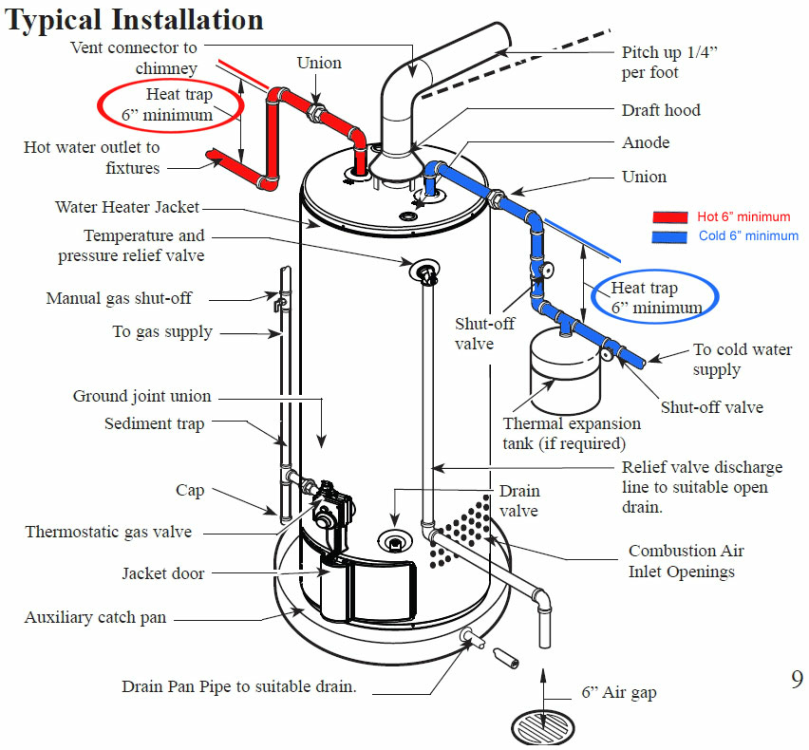
-
How to measure the remaining HW in an unvented cylinder
JohnMo replied to Adsibob's topic in Boilers & Hot Water Tanks
@SimonD so maybe a daft question, and out of interest - is a 4 pipe boiler such as the Viessmann, basically a combi boiler with a pump on the DHW side? So instead of taking in fresh water, uses system water to heat the cylinder? -
Looking for ICF Case Studies for my Dissertation
JohnMo replied to schalm203's topic in Insulated Concrete Formwork (ICF)
Can I ask, why just Polystyrene ICF, wouldn't your output be more rounded if you also looked at woodcrete ICF also? -
Heating / hotwater systems -self build
JohnMo replied to cairstiona's topic in Central Heating (Radiators)
Storage heaters on E7 in main areas and panel heater in bedrooms? E7 Cylinder. But why? I would do self install of a heat pump - and UFH and heat pump cylinder. UFH on 200mm centres generally, 100mm centres in bathrooms, single zone, no buffer, flow direct from heat pump or electronic mixer. Overall could be cheaper to install and run. All out of sight. 4 to 6kW heat pump - £2k Cylinder - £800 UFH manifold - £100 Pert-al-Pert pipe for UFH £400-500 with clips and unions Another £500 for general stuff All VAT free Bungalows cost more to heat than houses as the form factor is rubbish, direct electric heating will cost huge amounts. Don't be fooled by advertising that is there to mislead. Do the heat loss calculation, if your house looses 3kW, that's 72kWh per day or £20 per day or £600 per month, plus DHW heating. Even a poor install of the heat pump will give a CoP of 2.5 to 3, so now your monthly cost is £200. -
How to measure the remaining HW in an unvented cylinder
JohnMo replied to Adsibob's topic in Boilers & Hot Water Tanks
Would suggest you are overthinking something here. You system is what it is, low loss header no point, but you have one, unless really well designed specifically for your system they reduce efficiency. But you have what you have. If you are concerned with running out of hot water allow more time slots for heating. I heat once in the morning and again in the afternoon (but it will only add heat if needed by the thermostat), you could just as easily allow it to heat anytime based on thermostat thermostat. If you aren't consuming the thermostat will get to temperature and stop the heat cycle. Unless you are willing to pay a huge amount of money out, to get a plumber in and pull your house apart, just use your thermostat, the timer you have - done -
Anyone had first hand experience of Shower Power Boosters?
JohnMo replied to Del-inquent's topic in General Plumbing
Looking at the datasheet you are likely going to need one on the cold and the other on the hot pipe, so twice the cost. Only really useful for combi or unvented cylinder. What have you got? -
Heat loss over time (Vented Cylinder)
JohnMo replied to marshian's topic in Boilers & Hot Water Tanks
Just looking at the photo, your issue could be the vertical section of pipe from the cylinder coil to the 3 port valve. Very likely you have a nice internal current in that pipe. Ideal would be to take the pipe down 150mm then up to the valve. That would eliminate any likelihood of a thermosyphon. -
To allow me to run the summer house temperature at the most economical temperatures and be at the right temperature at the right time, I have added a thermostat. The thermostat sets two different flow temperatures on the heat pump rather than switching off the water flow. The first is ok for a set back temperature, but also more suitable for house heating, the second temperature is 2 degs hotter (may need to adjust) and is more suited to the garden room. Now have a simulator for a DHW probe installed and this has freed up a set of contacts to allow the double set point on the heat pump to be used. So when make contacts (via the thermostat NC contacts) the lower set point is set, when break contacts (thermostat demand on) another temp set point is set.
-
PT100 cylinder probe wireless connection
JohnMo replied to JohnMo's topic in Boilers & Hot Water Tanks
So took the time to install my simulator for a cylinder DHW probe and it works a treat. 5.6kΏ resistor across two terminals of the wiring centre and a 15kΏ resistor connected to normally closed side of a relay. A call for heat opens the relay contacts and the heat pump thinks the water in the cylinder is 42 degs, so starts a heat cycle. Once the thermostat on the cylinder is happy the relay contact closes and the heat pump thinks the cylinder is at 51 degs. The cylinder and heat pump are not connected to each other a wireless MainsLink switch. This has released a set of contacts that now allows a double set into be used and two WC curves. 62c460aeda4aa444DS-MAINSLINK-9.pdf -
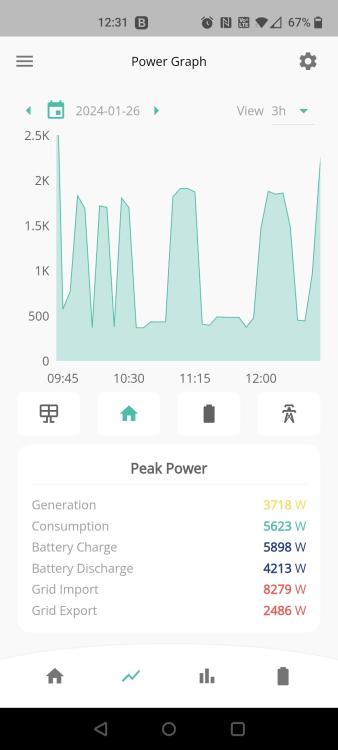
I found from my install of an ASHP, little changes can make a dig difference to how much electricity you use. There are several ways to have the circulation pump run, for example. Recently changed mine from continuous to intermittent as decided by the internal temperature controller. Thought it may save some energy - but just the opposite An image of the electric consumption but shows the ASHP starting and stopping. The left three peaks are letting the heat pump control the circulation pump, the other wider spaced peaks are circulation pump on all the time. First three peaks is the ASHP short cycling, plenty of electric going in not much heat coming out. The other two peaks show longer run times, but also long off times. It was 8 degs at the time and heat pump running very low loads. The main take away from the above, is you need to take the time to understand how your heat pump is running to get the best out of it. (Most heat from least electricity). Have also found leaving to run all the time let's you lower flow temperatures so you use less electricity.
-
How to measure the remaining HW in an unvented cylinder
JohnMo replied to Adsibob's topic in Boilers & Hot Water Tanks
The cylinder consists of 1. An outer metal jacket/casing - decorative cover. 2. Then insulation 3. Then the cylinder. I drilled in item 1. Then with a drill bit in fingers removed the insulation until I touched the cylinder 3. You don't drill into item 3. The probe butts but against the cylinder wall and you get a slight under read. -
How to measure the remaining HW in an unvented cylinder
JohnMo replied to Adsibob's topic in Boilers & Hot Water Tanks
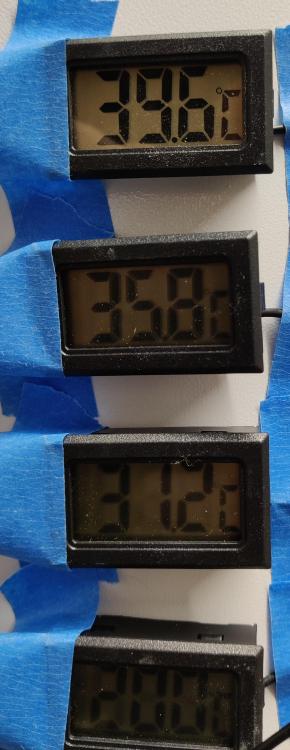
My attempt. Cheap eBay sensor with a 6mm probe. Drilled 4x 6mm holes in casing of the UVC down to 50% height. The 3rd one down coincides with the height of the secondary returns. There is about 4 deg under read compared to the thermostat pocket. But all good enough to get an idea of the hot water left in the cylinder. Especially good for a slim line cylinder. Night before temporary mounts with tape. Showing level of hot water (bottom gauge reads 20 degs)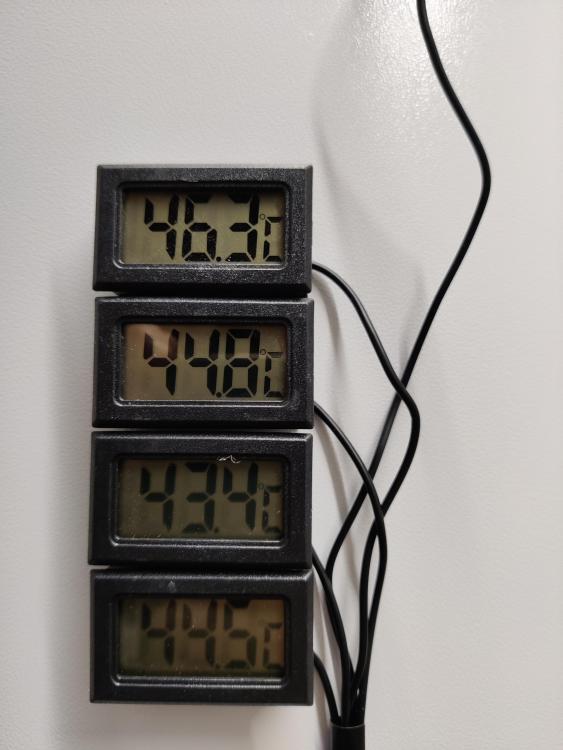
-
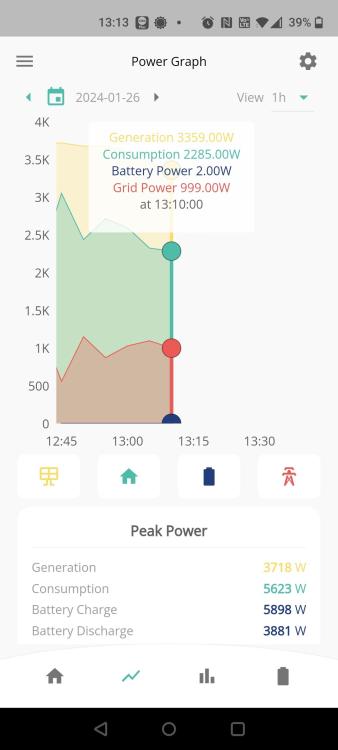
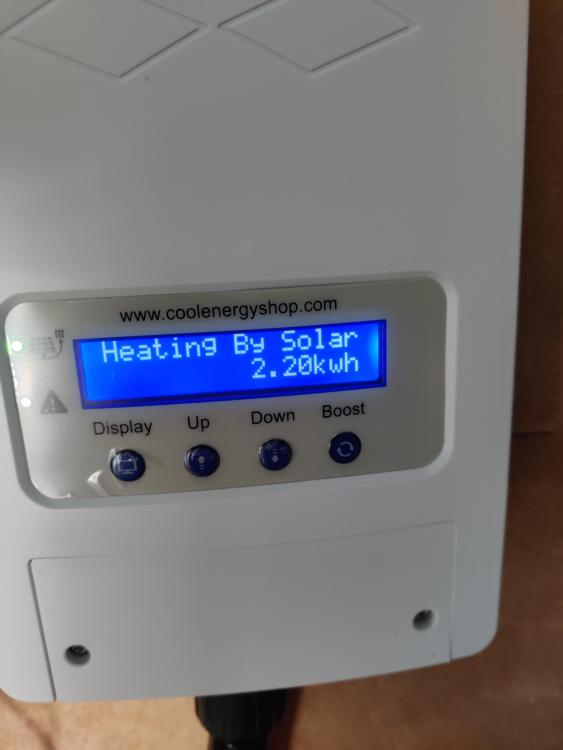
Good sun day today. Battery fully recharged by lunchtime, left heat pump running and 2kW going into hot water via immersion at one point. Grid power is excess going back to the grid on the battery software, but really it goes direct to hot water via a diverter. It's plotted every 5 mins so peaks are missed. Wife just put the washing machine on, to use more electric.