


JohnMo
-
Posts
13308 -
Joined
-
Last visited
-
Days Won
200
Everything posted by JohnMo
-

Passivhaus Under Floor Heating & Water Supply
JohnMo replied to Carpe Diem's topic in Underfloor Heating
What is your floor make up? How are you operating your DHW heating - always on on, one or two heating periods per day and what temperature do you heat too? Was that a new build, first heat period? Do you mean 300L DHW cylinder? If so that is nothing to do with the UFH as that is a separate system. The Two tanks are DHW and a buffer, you will not need a buffer, unless you have a out 10 zones (thermostats) You heat one or the other not both at the same time that is normal. You have a priority hot water system. Your shower water will come from the cylinder not your UFH system - confused? What do you have automated and why? -
Intake and Exhaust Ducts
JohnMo replied to Mr Blobby's topic in Mechanical Ventilation with Heat Recovery (MVHR)
I quite like it, but you can also get slightly thicker version from other manufacturers. I got it from EpicAir, they are quite good to deal with and if not not their site they seem to be able to get hold of it. Easy to use and cut, not cheap but gives a nice finish. better than trying to make a bendy floppy duct straight. -
Intake and Exhaust Ducts
JohnMo replied to Mr Blobby's topic in Mechanical Ventilation with Heat Recovery (MVHR)
I used polystyrene duct - UBBINK AERFOAM INSULATED DUCT -
How to measure the remaining HW in an unvented cylinder
JohnMo replied to Adsibob's topic in Boilers & Hot Water Tanks
Putting a lump of energy into floor over a continuous period, anything from 3 to 10 hrs, then switching off the heating until the next heating period and using the floor to give back the heat to the house - bit like a big storage heater. Example On a day where you need 60kWh of heating to keep house at the temperature you need. You can slowly heat the floor at a rate of 2.5kW for 24hrs or you can put 6kW into the floor for 6 hrs. I do the charge based on some manipulation of thermostat settings and elevated (3 degs hotter than normally needed) weather compensation curve. Today we had 5 degs outside most the day and wet so not much solar gain. Heating went off after 8 hrs when the house hit 20.6 degs, the next hour house temp increased to 21.1, then the next 4 hrs drops to 20.9, then slowly decreases, currently 20.7, the recharge will start again at about 1.30. You need good floor insulation and thick screed. -
How to measure the remaining HW in an unvented cylinder
JohnMo replied to Adsibob's topic in Boilers & Hot Water Tanks
Yes it's sized correctly for my kW, flow and delta T. 22mm VRG133, ARA600 actuator, driven by ESBE CUA111 Controller. I used Kvs 6.3. Couldn't find a Kvs of 4 at the time. But I use mostly fully open as I am batch charging at the moment. Flow will start at about 28 at the start of the charge period and slowly increase 3 to 4 degrees as the floor warms up over the next hours. Max temp could go up to 33 on a cold day, so is set to 33 all the time, except at the end of the batch charge and it closes down to fully shut. Currently have it set I get a continuous run of the heat pump for about 8 hrs. When I did a fixed flow of 28 it would sit middle of dial and move about from there depending on flow temp.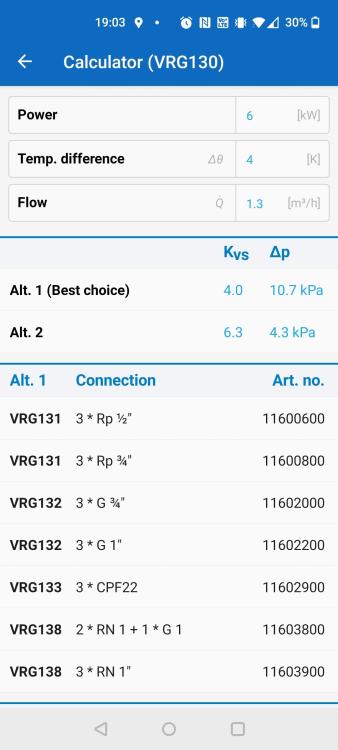
-
How to measure the remaining HW in an unvented cylinder
JohnMo replied to Adsibob's topic in Boilers & Hot Water Tanks
Would agree, I just set mine to max likely temp (33), so it generally fully open with no mixed flow, unlike a normal mixer that generally mixes down 10 degs like it or not. The heat pump really has no idea it's there as far as flow temps are concerned. They can be controlled at two set points - have second setting (22) set, so it closes the valve when the pump is switched off. -
Because we specified a slight positive pressure in the main room of the house, so as to be able to open the wood burning stove without sucking the smoke out of it. But that is quite a large difference, so i'm not sure that is right. Are they usually configured to be equal? Fan speed is set based on the pressure drop you have to make up, if your extracts are shorter runs, or have less bends generally you will run at a lower speed, for the same flow rates
-
That sounds better.
-
Vaillant 7kw % efficiency rating for BREL Part L
JohnMo replied to Post and beam's topic in Air Source Heat Pumps (ASHP)
Just got to read the number of issues people have in a ASHP section of this forum, with rubbish CoP. Bit like car manufacturer MPG claims, real world isn't the same a laboratory conditions. You can get great CoP figures, until the owner or installer, starts adding lots of zones, controlling temperature via thermostats, buffers (of poor design) to compensate, immersion heaters, etc. An arbitrary figure of efficiency saying your heat pump has about 2.6 better than a gas boiler (during the heating season) is probably good enough to cover the good and bad install. -
Vaillant 7kw % efficiency rating for BREL Part L
JohnMo replied to Post and beam's topic in Air Source Heat Pumps (ASHP)
Mine gave the following for a named gas boiler in my as built - Efficiency: 89.7%, Even though I was running at 35 degs max flow temp, against a declared heating efficiency from the manufacturer of 109.7% for the same running condition. Checked against certified heat meter and actual gas consumption, I was getting very close to that figure. There just numbers to enable a comparison of one building to another on similar basis, at the end of the day. Move on to the next battle. -
Not sure you are looking at that correctly, the difference to compare is extract temp from the rooms (internal house temp), and that being resupplied to the rooms. You need the room supply air temperature, to be as close to the extraction from room temperature as possible, otherwise you are pumping in cold air - this should be a small dT into the points of degree difference. Supply temp to rooms / extract from the rooms.
-
Well, multi foil only functions with an air gap, so not really that thin. Aerogel is major expensive and only performs about 25% better than PIR. So 10mm Aerogel is about the same performance 13mm PIR. Cost ratio is about 10 to 1 comparatively. I would just use PIR, readily available and way cheaper. Or battens and mineral wool, attach plasterboard to the battens.
-
Vaillant 7kw % efficiency rating for BREL Part L
JohnMo replied to Post and beam's topic in Air Source Heat Pumps (ASHP)
Everything you need if you can be bothered reading STP11-HP-01_Heat_Pumps.pdf -
Best thermostat hysteresis for ASHP
JohnMo replied to smart51's topic in Air Source Heat Pumps (ASHP)
If your running lots of zones on thermostats why bother with WC, you may as well simplify and run a set temperature. Or do WC properly and set the thermostat as limit stops, not temp controllers. I would, and did, dump all the zones and use a single 0.1 hysterisis thermostat for the UFH as a single zone. I can still get a 0.5 Deg swing in temperature, which you can feel. -
Perhaps cheaper to add more insulation so your overnight demand reduces
-
That's good to know, looks like I have made a nice cosy spot for them. No wonder they love it.
-
Have you tried batch charging the floor. Run heat at a higher temperature so it buffers heat in to the floor and then releases like a storage heater when you switch off the heat pump. You can do this the following way
-
Hi, do you have concrete in the floor, or is it just wood above the heating pipes?
-
If you go into the trade section there is a full spec. U valve for the window appears to be 1.4, which is, standard building regs.
-
+1
-
Some success after reading @Bramco reply on another thread. Sort of using what he does to batch charge, but have a longer run time to keep the fan coil happy so have batch charge curve based on outside temperature, the batch charge lasts for nearer 10 to 12 hrs depending on outside temp. So now have the heat pump set up to run and chase a slightly elevated temperature, with floor acting as huge buffer, so getting long run times, which in turn keeps the fan coil happy and charges the floor in a single run, heat pump is not having to modulate much. Leave it run a few days then assess if I should dump WC all together. The flow temp today got to 31 and the house thermostat tripped the UFH off at 20.5.
-
How to measure the remaining HW in an unvented cylinder
JohnMo replied to Adsibob's topic in Boilers & Hot Water Tanks
UFH pump pulls through the mixer valve. Doesn't need a buffer in the system but can if you want. The low loss header installed has a pump on the central heating side, so different to elimination of LLH and just using the boiler pump. I run with zero hydraulic seperation and mixer valve and pump on UFH without issue. Have also run direct from heat pump and boiler without mixer and pump, again no issues. If you have all circuits of the UFH running with actuators, you need a bypass, or simply make some circuits always open whenever there is a call for heat, such as bathrooms which can never be too warm. -
Question, do the dips coincide with the unit being on boost? If it does the boost flow rates could be slightly out of balance. Or do your filters need to be cleaned or replaced
-
How to measure the remaining HW in an unvented cylinder
JohnMo replied to Adsibob's topic in Boilers & Hot Water Tanks
How can you have 20 dT requirement when you are only flowing at low temps, the boiler would be expecting a return temp lower than room temp - that cannot happen. Example flow of 30 degrees how can you have a return of 10 when the room is at 20? A boiler capable of low flow temperature isn't designed like that. 20dT is old hat for high temp boilers only. Example - My Atag never looked for 20dT would just modulate the pump the get the dT it wanted to see. At low flow temps would modulate the pump to around 7dT, that was the dT you had from the boiler. Again not sure where you get one pump, there is one pump in boiler and one on each manifold. 4 manifolds and boiler pump. Get rid LLH, no mixing going on there, flow around 32 into the floor, 42 from the boiler to allow for mixing manifold mixers. If you wanted to get dT20 you just run at dT 10 across the floor, boiler return is 22, efficiency about as good as it gets. -
First self build - SIP Vs ICF or other
JohnMo replied to FLF's topic in General Self Build & DIY Discussion
A sip sounds good, but, you still need a block work outer skin and additional insulation. How much of the work do you want to do yourself? I did 195m² for not much than your quoting, finished. Very much a hands on ICF self build. I would be tempted to drop both the sip and ICF idea. I assume your in Scotland as it mentions warrant. 2 options I would look at Larson strut, stick build on site, cellulose filled. Block work build with external insulation. Use local labour for both options



