

JohnMo
-
Posts
12470 -
Joined
-
Last visited
-
Days Won
179
Everything posted by JohnMo
-
The two grey pipes one will be supply hot water from boiler, the other cool reject water from the UFH mixer, back to boiler. One pipe should be quite warm the other quite cool. A. and B. are correct. If you have the same temperature in both sections you are just circulating floor water
-
If you are flowing 35 after the mixer the temperature before the mixer should be warm to touch possibly hot - is it? Flowing 25 downstream of the mixer looks more like cool water within the floor loops circulating.
-
 Are we talking unvented cylinder or something else? Has the prv got a filter upstream that is blocked? Has you expansion vessel lost it's charge pressure, should be at 3 bar? Is it external issue not related to the house?
 -
Disabling Weather Comp during mid winter?
JohnMo replied to Andeh's topic in Air Source Heat Pumps (ASHP)
Some do it, some don't. Found the instructions are generally way more complex than they need to be. With way to many options that are not easy to plumb in or understand h way to easy to get wrong. Could be made really simple with a relay, this would be seamless (ish) - down to temperature say 2 deg, you have permission for heat pump to run, the relay switching at the preset temperature would make gas boiler come online and switch off the heat pump. Heat pumps normally have a remote on/off contact that could be used, the boiler has a call for heat contacts. You would need a few check valves to make sure the flow directions are correct and you don't get back flow through boiler or HP. -
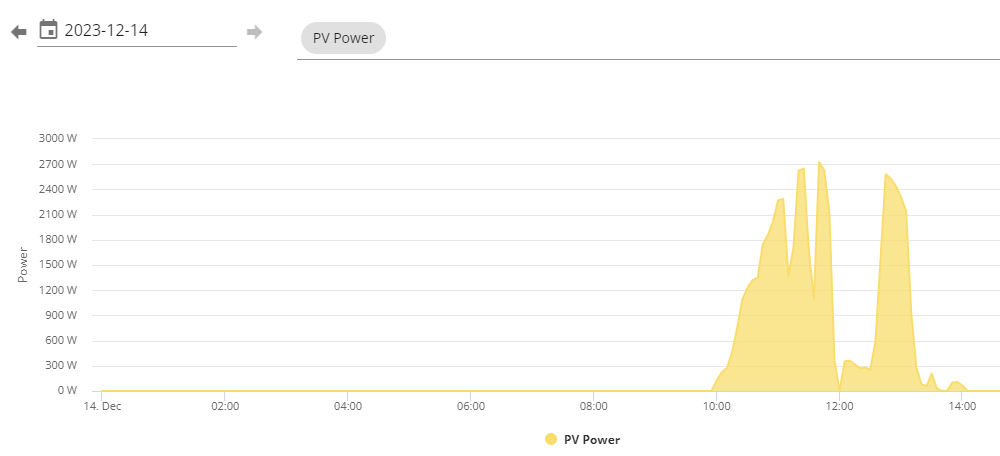
So just as an update, no issues experienced so far, even in the high winds we have had. Was comparing the house output and the vertical array today. Both a similar kW rating, house at 45 degrees, this array vertical. Vertical array was generating 1.5kW while house was generating 1kW at the same time, this was at 11am, when sun direction suited the house array (SE) better than the vertical array (SW). So circa 50% (or more) uplift in winter performance. So fulfils the design brief I gave myself, generation between both arrays was 4.5kWh between 10am and 2pm and a sun/cloud day. Attached is a composite of the total output of house and hill top array, from the battery software.
-
Disabling Weather Comp during mid winter?
JohnMo replied to Andeh's topic in Air Source Heat Pumps (ASHP)
Mine did this fine until it starts to get colder. The problem I found with this plan was the amount of defrosts the heat pump did, but great until you hit about 3 or 4 degrees and lower. Have reverted to 24/7 low and slow with hardly any defrosts, last night between -1 and 4 degrees and did only 3 defrosts. -
May be some useful info on these threads. I have had zero issues since installed.
-
Mineral wool is not combustible, not so certain of glass wool. Rockwool is certainly not combustible and is used in twin wall flues. I would be less concerned about not how much heat is trapped, but more concerned about how much heat escapes as it's a huge thermal bridge if uninsulated. We used a twin wall flue, but used rockwool around it in the roof to keep the insulation at the same value as the rest of the roof.
-
lowest energy would be a loop of UFH pipe from ASHP, just flow it out via an electric mixer at super low temp
-
looked at this when i did my remote panels, you need the inverter by the house. The inverter is trying to push electric to the house and compensating by supplying a higher and higher voltage to overcome the voltage drop. It basically inverter trips on over voltage with long cable lengths. As @ProDave says take the voltage drop on the DC side. Use a DC isolator by the panels, then run SWA from there to inverter.
-
Basic component and setup Q's
JohnMo replied to MarkyG82's topic in Mechanical Ventilation with Heat Recovery (MVHR)
Downstairs I would do a simple cascade system. Supply air only to lounge (around 50 to 70m3/h depending on floor area downstairs), use a fan in the internal wall between snug and utility. Supply air will be moved by the two MVHR extracts and via the fan in the wall of the snug, the airflow will be the blue lines on the drawing. The fan could be a simple dMEV fan, like a Greenwood, they are almost silent and would run at min speed. You also need an extract in the toilet, or you could cascade the utility into the toilet (another fan in the internal wall), as you wouldn't want smell from the toilet being pulled into the utility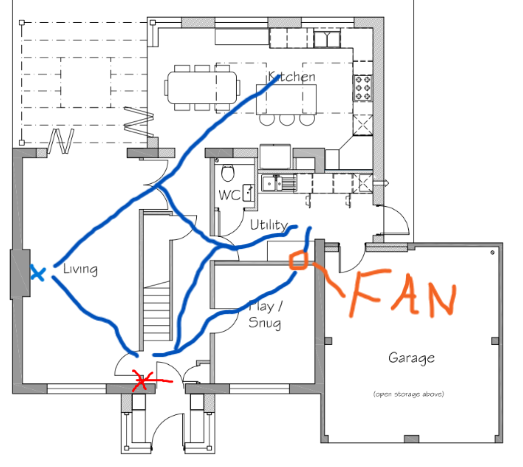
-
To melt the ice you may need more than 1 deg, I suspect. Your maths seems to output a very low input required are sure you are correct? Have you accounted for downwards and sideways heating. In the States they say allow 50W per ft2, so you are about 10 ft2, that would need 500W. It would be on from about 4 or 5am until you stopped moving about say 6pm, so 12hrs. So 6kWh a day, or £1.60ish a day. As @Mr Punter says get rick salt - stop wasting good energy on heating the environment.
-
If it's too big for your screw then, no. This advert on eBay would suggest plenty of sizes are used https://www.ebay.co.uk/itm/325546089152
-
If it's not catching is it the correct size?
-
I would go for best sun, would also consider going for vertical panels or close too, for best winter output. Summer output is going to big anyway no matter what the angle. I have two arrays, one at 45 degs the other vertical, both a similar size in kW terms. The vertical ones are producing 1.5kW, the 45 degrees ones 1kW, at the moment. So 50% extra output in December.
-
The 100A is made by Maxa, not sure about the other models.
-
VAT on stand alone battery storage to be scrapped.
JohnMo replied to Russdl's topic in Energy Storage
Mine was by a GivEnergy approved installer, as you cannot commission or register for the warranty without being approved installer. The installed cost was the same as online would sell to me on a pallet and not be installed, so a bargain anyway. -
Nothing wrong with that size, head loss over 100m is around 12m (for 22mm Hep2O which is smaller again), so over 8m (16m total), would loose less than 1.2m head against 6 to 8m pump. So he/she was correct and plenty of room to loads of other thing and for the circulation pump to modulate.
-
If you go 32/150 Rauvitherm pre-insulated twin duct, your bend radius is around 1m plus, super stiff, so not really practical to install later. You can add bends but not sure how in concrete casting. I would go over ground, holes are easy enough through wall, pipe easy to insulate etc.
-
And how far are you running the pipe, a metre or many metres all make a difference. Insulation is important depending on where the heat may be escaping too. 60 Deg water going to heat your cylinder needs insulation. Is under the floor the only way from A to B?
-
VAT on stand alone battery storage to be scrapped.
JohnMo replied to Russdl's topic in Energy Storage
Certainly have, I missed out on the VAT and on the extended warranty also - by 1 day -
Sooner they are out of power the better - or at least I hope so.
-
UFH balancing and understanding how it works
JohnMo replied to peredelkin's topic in Underfloor Heating
Weather compensation is when a boiler modulates its flow temp based on outside temp. You are obviously running a set flow temperature so ignore my ramblings about weather compensation (WC) Salus self balancing actuators function by reading flow and return temperature from the floor loops. They have a temperature detector on either end of each pipe loop by the manifold. Below a flow temperature of 30 deg, they (Salus actuators) manage the flow to achieve a set point point 4 deg dT (Delta between flow and return), and over 30 degs they manage this as a 7 deg dT. As more or less energy is taken from the floor (room temp change, solar gain etc) the dT will naturally fluctuate, the actuator will open and close to maintain it's internal dT set point. -
I would be more interested in the install, a well installed system and mediocre heat pump, will always out perform a mediocre install and fantastic heat pump. Both are good makes, what else has been quoted. Are you an open single zone system or zones everywhere? Buffer or no buffer? UFH, radiators or a mix? Viessmann tend to take the whole system approach and it's done the German way, so will come weather compensation out the box, usually well set setup. You never here them mentioned on here, maybe for a good reason.
-
UFH balancing and understanding how it works
JohnMo replied to peredelkin's topic in Underfloor Heating
A normal UFH mixer will always mix a proportion of the return water in with supply hot water. So the WC curve never works correctly. An electronic mixer can be operated on WC or if you set to 36 degs and water based on a WC curve is only 30bit will go fully open and flow 30 no more no less. It becomes to degree self balancing. Salus actuator is trying to manage dT at a set point. If the room gets warmer the dT between floor and room reduces, so less heat is transferred to room, and therefore less energy taken from UFH water within the pipes. This is seemingly working at the moment. As a backstop, have set a second set point on the mixer so if house temp drops to 19.9 degs it then controls at 32 degs.

