


JohnMo
-
Posts
13308 -
Joined
-
Last visited
-
Days Won
200
Everything posted by JohnMo
-

boiler behaviour,please let me know your thoughts.
JohnMo replied to Post and beam's topic in Boilers & Hot Water Tanks
From what he says below, I don't think there is an issue with DHW only. The DHW issue is related to the boiler being in a safety lockout, due to an uncontrolled over temperature experienced during central heating duty - short cycling. The simple fix is make a larger engaged radiator circuit volume. Remove more than two trv's for example. Basically in central heating heat has a huge boiler trying to heat a cup full of water, it can't do it in a controlled way. Don't believe there is a software issue, it's a system setup issue. -
boiler behaviour,please let me know your thoughts.
JohnMo replied to Post and beam's topic in Boilers & Hot Water Tanks
Do you have trv's on every radiator? -
boiler behaviour,please let me know your thoughts.
JohnMo replied to Post and beam's topic in Boilers & Hot Water Tanks
So your heating system is locking the boiler due to short cycling, in plain English A symptom of too many zones then. Reducing the zones would therefore decrease your energy consumption also. -
I would have thought the accumulator would be on the mains side. You are in effect trying to reverse flow the balance side of the system. You basically have a big accumulator attached to a small expansion vessel via the combination valve.
-
VAT on stand alone battery storage to be scrapped.
JohnMo replied to Russdl's topic in Energy Storage
I use the home assistant GivEnergy API, and uses Solcast API. Once you get set up, seems in the general be quite good. But last night it was predicting 10+kWh for today, just now it's predicting 2kWh. So the charge automation is rubbish. GivEnergy API is a bit hit and miss, maybe it's just the time of year is a bit too varied. -
Possibly don't qualify with when it got switched off. I only switch my heating on once a year, the same with cooling, then a thermostat does the rest. That's about the same as my non-passivhaus. I found heating our summer house with an 800W heat load expensive via a panel heater. So tied into the heat pump.
-
VAT on stand alone battery storage to be scrapped.
JohnMo replied to Russdl's topic in Energy Storage
We have had a rubbish day also, solar forecast said 10+kWh generation today, so far 2kWh. Battery only charged to 70% overnight (based on forecast), so likely to use full grid cost at some point today, unless the sun pops it's head out. -
I have two shelly H&T's for monitoring, one in the hall the other in the garden room. So comparison to the above post Different type of building, summer house (200mm polystyrene floor and roof insulation, plus multifoil, with air gaps, 70mm thick wood walls with 140mm mineral wool insulation). Inside temperature profile, very different. Fan coil, thermally light weight building, heating goes off at midday. All driven from the same heat pump as the house, this is yesterday and this morning, the big peak is solar gain. 3am fan coil starts up, with a flow temp that slowly ramps up to about 32/33 degs, takes 5 hrs to increase room temp from 12 to 20 degs., then maintains it till midday. Once solar gain stops the heat drops around a degree per hour. Outside temp at 5pm was about 5 degs and 10pm zero. Yesterday house temps Big dip in the blue was windows and doors open, we closed the door at 5pm and temp recovers quickly. But lounge window stays open for a further couple of hours. Bedroom was warm and we kept the window open all night (zero overnight outside).
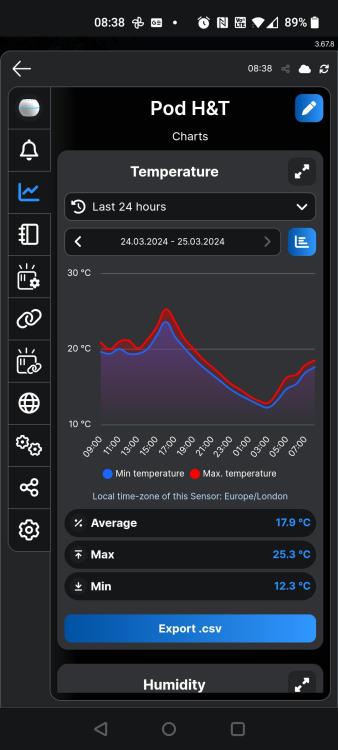
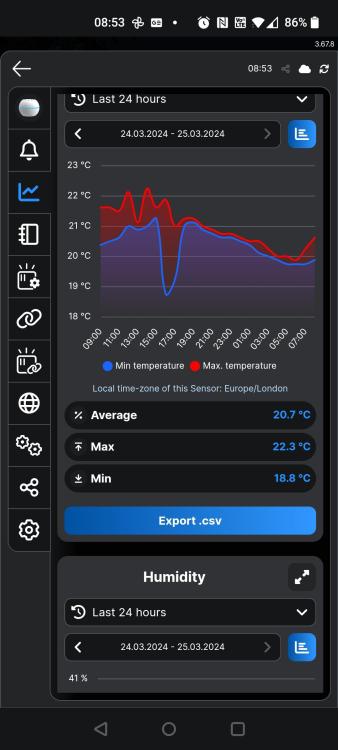
-
The way mine seems to work is Target temperature and dT Starts up maintains dT first, as dT decreases over time, it add more heat to increase flow temp to maintain dT. Once target flow temp is reached, it reduces load (modulates down) to keep flow temp and dT within limits.
-
This is a sensor in the hall, had to go back in time to find a day not affected by solar gain. So get about 0.5 Deg fluctuation over a 24 hr period.
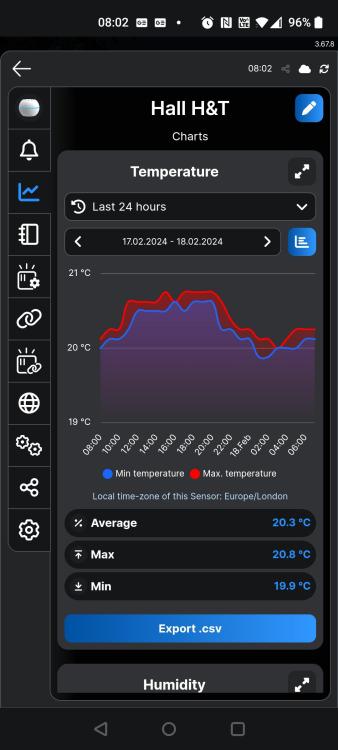
-
Sack him and get a proper plumber. If he can't do it now why will it get better - Why put up with it? As @FuerteStu says.
-
Ask him for the pressure drop calc, get the facts, instead of assuming the world going end.
-
The idea is there are are very few joints, the small diameter for a very short distance, although a pressure loss area in the grand scheme is very small. You would need to get the pressure table for the fitting and pipe and work it all out.
-
Omnie Lowboard 2 insulate on non insulated ground floor
JohnMo replied to Griffithsg83's topic in Heat Insulation
I have a similar system in my garden room on 125mm centres, with a total 200mm insulation in the floor, similar amount in room and 140mm of insulation in the walls. Even at 40 deg flow temp and about 5 degs outside I could not get the room above 16. Dumped the UFH and went fan coil, everything fine. Just keep your money in your pocket. Omnie and many other systems are all the same, if they say they aren't they are playing silly games. -
Manifold system versus hot return system
JohnMo replied to Russell griffiths's topic in General Plumbing
Mine, the smallest one copes with 15mm tube for 20m each way, so should have no problem stirring a tank. -
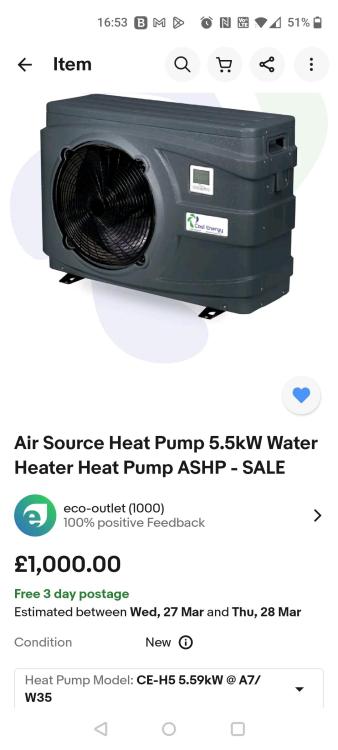
I have come across these heat pumps. The first is rated a 3kW, it has a single outlet temperature set point. Not sure about modulation, its £1500. https://eco-outlet.co.uk/products/activair-3kw-indoor-air-source-heat-pump It sits indoors, so could be manipulated with air ducts to do cooling in summer and possibly take discharge air from the MVHR in winter, so zero defrosts. You may need to do a buffer, but no different from Jeremy and @joe90 did. Or if heating a thick slab, you could flow at the same set temperature as for DHW heating. Sounds daft, but a heat pump will manage dT first and dT is generally 5 to 6 degrees. So batch heating a floor would be as follows Water exits floor at around 23 degs at start of batch charging, dT 6 applied so flow temp is pegged at 29 until floor takes some heat, temp would very slowly ramp up, floor taking 3kW. By the time it gets to 30 degs outlet a passivhaus thermostat would trip the unit off and it would move to DHW heating. I operate my UFH in a similar way (but set point is 35) and it never goes past 33. The second unit is Cool Energy basic heat pump on eBay is 6kW unit, but control is similar to above but sits outside.
-
Depends how you define breathability, water vapour or air. Cement is a water vapour open structure the same as lime. Air breathable why would you want it? Flexibility lime yes, cement and lime mix yes, cement only no.
-
Omnie Lowboard 2 insulate on non insulated ground floor
JohnMo replied to Griffithsg83's topic in Heat Insulation
And make sure someone doesn't put a hole in it. Would you trust a contractor - I wouldn't. You would need to protect with plenty of concrete, if it can take the weight? Just to make sure someone didn't come along later with the nail gun and fill it with holes. -
Not sure you need to pay that Samsung 5kW £1500 plus £350 for controller. All options need a basic cylinder. So now you are at 2 year payback
-
PV is connected to consumer unit after inverter (normal system), consumer unit provides electric to where ever or whatever wants it. Not directly coupled to HP. Just that the HP is another user from CU. Our HP (like many others) slowly ramps up when doing DHW, so with start flowing in the late 20s and over the next hour get to 55 degs. So the early part of DHW is actually pretty good CoP, the later part is a dreadful CoP. So not straight forward. It could be putting 2kW or more out for 400W off the grid. The 400W provided by PV the rest of the time would have powered the background loads to the house. Not easy to make the electric go to just the immersion though, unless directly wired. Add battery it makes things smooth out, currently paying 13p per kWh for 7 hours, utilisation over winter has averaged at 83% of night rate, so 17% at expensive day rate. Very patchy day for solar today, lots of clouds etc. Charged battery 70% last night, heat pump been ticking away most the morning, will be off at 12pm. Battery currently at 68%, and generated 5kWh from PV, with peaks (5kW) and troughs (0kWh), would have been useless for PV directly driving the heat pump and wasteful driving an immersion.
-
Leaking distribution boxes
JohnMo replied to jayc89's topic in Mechanical Ventilation with Heat Recovery (MVHR)
I am using similar, used ubbink 90mm sealing rings, no issues. Are you sure you inserted deep enough? -
Just to add a couple more lines to the spreadsheet - I would say there are advantages with PV with an ASHP also, a marginal PV day may not give enough PV to fire up the immersion via a diverter to any degree that will provide usable heat. ASHP, would amplify that PV out by 2.5. Then the maths gets way to difficult.
-
Really depends how you source your equipment. Plenty on here have paid less than £1k for a heat pump, currently there are ones on eBay for £1k new, not the most sophisticated, but can work well.
-
That's good, but if you didn't have an ASHP, your heating would be 4x that and your DHW 2.5x that, which gets back to the OP question. So comparing direct and ASHP - £700 for ASHP and £2400 for direct heating. I paid £1300 for an ASHP, my pay back in your house is less than one year.
-
Omnie Lowboard 2 insulate on non insulated ground floor
JohnMo replied to Griffithsg83's topic in Heat Insulation
Read some of the other UFH threads. Neither is adequate insulation for UFH, irrespective of what the company selling these products claim. 40mm insulation is also inadequate. Insulated floor with 40mm insulation, ok if you stick with radiators. But more would be better.




