


JohnMo
-
Posts
13299 -
Joined
-
Last visited
-
Days Won
200
Everything posted by JohnMo
-
Atag A325ECX, rated modulation is about 7 to 31kW, at lower flow temperatures.
-
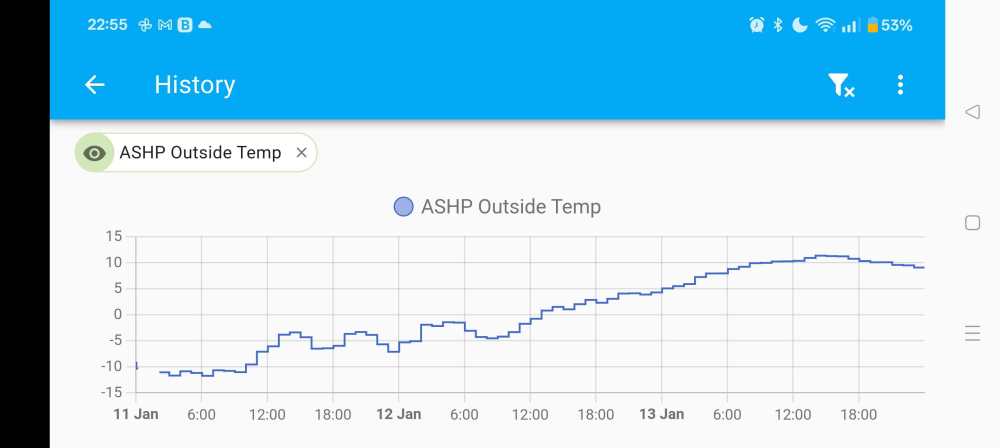
Pretty good swings going on 2.5 days of data.
-
Think you may have answered that question yourself? Sounds like sh!te in sh!te out. Without a real flow meter, real energy consumption meter, flow and return temps, all captured at the same time, it's all make believe.
-
Just having the UFH on only maybe the issue. Your boiler just has so little to work with to absorb the energy. Think you have two options Run everything on including all rads. This will give the boiler more surface area to work with, it will also up the flow rate. It will be a compromise to get flow temp low as you can so you don't overheat. That's where WC would be handy. The other way is just on/off control. This utilises the floor as a buffer also. Basics are you allow the room temp to drop, floor core drops also, so your boiler has plenty of stuff to absorb energy. Then it's a matter of matching energy take by floor with delivery. This is done by slowly reducing flow temp until its cycling then increase temperature a bit. Your thermostats are maybe a little smart to do something as primitive as hysterisis mode.
-
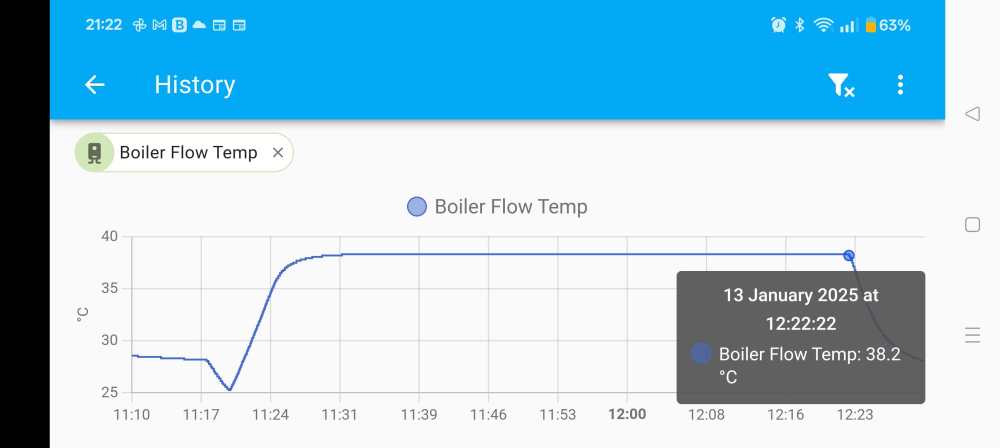
My boiler currently thinks it's running WC (fixed resistor) gives a solid flow temp. My thermostat just tells the boiler normal flow or setback. This a run the other day, after reducing flow temp a little. It was manually started and stopped when I got fed up. The boiler is putting out about (min modulation) 6-7kW against a demand of about 1-2kW, but floor is buffering the energy. Running the same mode at 32 flow runs 6 mins on 6 mins off. Will be moving to WC via Opentherm in a few days (driven by a new UFH wiring centre), if it doesn't do as good a job I will move back to simulated WC via on/off control.
-
 Are A2A vat except? Once registered everything the company does is subject to VAT. You have to manditory vat returns. PAYE returns, P11D etc. Limited company needs to do annual returns, generally they can be self completed - but it generally rises a flag for audit. Any profits are subject to taxes etc. plus when you fold the company you have to do final return. Any directors have to do self assessment also. Is it really worth the hassle to save a few pounds? I ran various limited companies (contracting and consulting), now just pay all the tax, as it's too much like hard work.
 -
Other thing to try is, let the thermostat(s) start controlling and see if things are better or worse
-
Other things I found with my boiler. A thing called gradient, manual had a default and just said nothing about it, had to read a few other manuals to find out what it meant. It is basically the acceleration rate, so how many degrees it adds to the flow temp per minute. The default was 5 Deg/min. Moved to 3, and ramp up was way slower and boiler was able to balance the flow and modulation better. Not sure if you have this feature? The other thing, is the bypass rad open to much and allowing too much hot water back to the boiler.
-
What house thermostat are you using. If it runs on TPI (time proportional integral) that maybe driving the cycle. So basis of that type of thermostat is up to a couple of degrees of target runs boiler flat out, then it cycles to blip heat in to house in short bursts. What UFH mixer did you use?
-
Are we targeting ASHP's at the wrong market?
JohnMo replied to ProDave's topic in Air Source Heat Pumps (ASHP)
You need an electric vehicle for go prices But then gas is 5p, running the same flow temp, same plumbing is very high 90s efficiency. So running costs are another 8% lower. But no grants, could be installed way easier as no outside space needed. Hook up gas PDHW with WC. Gas and direct electric have very similar CO2 -
You need to careful looking at English references as the roof build is completely different. England doesn't use sarking boards, instead the membrane is drooped to form valleys for water run off, so they need to provide a free space between insulation top of rafter. Your sarking boards provide a natural airspace, as long as the membrane is breathable.
-
Our is insulation between rafter, sarking boards, these dry to leave small ventilation gaps. Breather membrane, then natural slate nailed to sarking boards. No ventilation spaces, other than between sarking boards. We have GSE integrated solar, again this is breather membrane (same as rest of roof) and GSE panel mount trays directly attached to sarking. Why? Use as membrane that needs no ventilation gaps. Due to the natural slate not being flat you have thousands of small gaps to breathe through. Fixing - do what is local to you. If man made slates/tiles none of the above applies, they have to be treated the same way a tiles with battens etc.
-
Should Loxone control my UFH and ASHP
JohnMo replied to mattgibbs's topic in Networks, AV, Security & Automation
You should just be putting enough energy into floor to keep house stable. You will have to do some loop balancing during commissioning. Or you just use thermostats as limit stops set a Deg or more above target temp only room that may get effected by solar gain. You don't want zones calling for heat just closing a few loops off. But UFH is pretty much self regulated. Floor temp is generally only a Deg or two above room temp. So if room gets two degs warmer than target (same temp as floor) floor output reduces to zero. -
Should Loxone control my UFH and ASHP
JohnMo replied to mattgibbs's topic in Networks, AV, Security & Automation
One of the issues with many zones will be very little engaged water volume, but more importantly nowhere for the flow to go. You could do either of the below. Run everything on weather compensation - no thermostat needed. Have a manifold with no actuators or just a couple (ones likely to get loads of solar gain only). Run a slightly elevated WC curve or fixed flow temp. Have various thermostats, say bedrooms, living space, any cold area will start HP, heat all zones, all zones warm enough HP stopped. Basic thoughts are if one zone is getting cold others will follow, some time soon. Depending on screed thickness reheat time be huge, especially at low flow temps. So it's better to drip feed heat into the floor. Waiting for a thermostat to call for heat could end up with yo-yo temps especially if the thermostat is quite large hysterisis. Other way depending on electric tariff is to batch charge floor. This takes a little trial and error, not hugely successful unless your heat pump is too big. When cold will need to run in more expensive periods. So if you have a 10kW HP you run for circa 6 hrs to get 60kWh of heat into the floor. You can do this with a 0.1 Deg hysterisis thermostat, just a matter of trial and error to fine times and set temperature. You don't want a thermostat that run TPI mode with a heat pump, so make it's not operating in that mode. -
Did the calculations, pipe spacing was on 125mm centres, (house is on 300mm centres) the panels holding the pipe were aluminium lined also, so in theory had enough output. Output should have been about 50W/m². Testing against an electric panel heater only, the energy usage pretty matched the design heat loss, which is closer to 30W/m². So as mentioned possibly would have been fine at much higher flow temperature but not at lower flow temperature.
-
Can you not use gravity. Connect the two outlets and let them self balance level wise. Put a tee in as an outlet to tap or what ever. All the bits you need are on here https://ibcadapters.co.uk/index.asp
-
Are we targeting ASHP's at the wrong market?
JohnMo replied to ProDave's topic in Air Source Heat Pumps (ASHP)
My heating is - but get a short power cut or internet outage, you may wake to a cool house. Been there done that. Working my way from anything connected to internet for heating. -
Are we targeting ASHP's at the wrong market?
JohnMo replied to ProDave's topic in Air Source Heat Pumps (ASHP)
Sorry going to be a bit blunt - BUS scheme is really targeted at people with disposable income or more money than sense. No sane person would pay, the stupid prices you see on here often quoted. Exceptions are those that end up paying next to nothing, quite rare from what you read, and they have to do quite a bit of work themselves or be through an umbrella scheme, which is milking a flawed system h and why not. -
We have thick concrete screed in our house and we did have an overlay system in our summerhouse. The overlay system had 200mm of insulation under it. Overlay system just wouldn't work at house flow temps (from either gas boiler or ASHP) so was capped off. I got up to 38 Deg flow temps and at 5 degs outside summer house was about 16. House was overheating by this point. If your floor isn't designed for UFH, from the start, I am not sure I would add it.
-
Your trouble is the noise is bouncing about. The noise is in principle projected forwards, there is a hard surfaces in front, that deflects the noise towards the house. You may find getting rid of all the mess may help, allowing the noise escape easier. Then some soft planting, shrubs and bushes to absorb noise.
-
I did an oil and gas project 10 years ago, topsides costs were around 1 billion USD, subsea development another 1 billion USD. So 2 billion USD spent to get ready for production. Payback time 6 months, based on oil production. It's only money.
-
Distance isn't the issue, carpet and underlay is. Our bedrooms are the same. We just open the bedroom doors which fixes the issue. We have a dog bed on the carpet and when you move it the is super hot underneath, but overall the floor temp stays low so less radiated heat. Long term fix is replacing carpet and underlay for better UFH stuff. But will not happen. Alternatives are Switch UFH off replace with wall panel heater, or a combination of the two. Flow at a higher temp - CoP hit, rest of house gets too hot. Open doors when you need it warmer, bigger output towel rail electric or dual fuel.
-
Help in raising the COP on my Samsung 5kw ASHP
JohnMo replied to Suffolk peasant's topic in Air Source Heat Pumps (ASHP)
Do you need to do that, do your own risk assessment. Plenty of information on here and heat geek website If you have a cheap mixer they are generally pretty rubbish is you don't deliver 70 Deg water to them. I ended up deleting the mixer and pump. Open it up fully and see what happens. You really need to assess if you need 40 Deg flow? You either need weather compensation mode or a lower fixed flow temp. The lower the output flow temp from the heat pump the better the CoP. Switch all immersion heaters off and see what happens. -
Is the grant valid if you buy a preowned ASHP?
JohnMo replied to miike's topic in Air Source Heat Pumps (ASHP)
Then no way do you need 15kW even at 510m². I'm close to 200m² and about 3.5kW at -9. If you have done min building regs and min airtightness (leaks like a seize), you may getting close. But YOU need to do proper heat loss calculation, so you know for sure. Use this spreadsheet -
Is the grant valid if you buy a preowned ASHP?
JohnMo replied to miike's topic in Air Source Heat Pumps (ASHP)
Obvious next question are you sure you need 15kW? Can any units actually do 15kW at your design outside temperature? If you need that big, first do some on the building fabric to reduce heat loads first. Second really looks at hybrid. Then you need an 6-8kW ASHP and boiler pick up the big loads. You leave existing heating system as it is. Maybe replace some K1 rads for K2/3. No grants but plenty of heat pumps readily available




