


JohnMo
-
Posts
13299 -
Joined
-
Last visited
-
Days Won
200
Everything posted by JohnMo
-
It does, so does the controller any thing in the system relating to heat pump. Each electric item should be metered. We take a big dent in SCoP because batch charge. The main circulation pump runs 24/7, as I use it to borrow heat from house to keep a summer house warmish. CoP of 5 doing heating and daily CoP about 3.0. but heated mostly via cheap electric. Our heat pump has only one pump, and a diverter, diverter is powered only when doing DHW.
-

Hot water system design - have I got it wrong?
JohnMo replied to knobblycats's topic in General Plumbing
Why bother and have a bucket load of wasted heat with heat loss, will be ok in winter but overheating house in summer. That makes no sense, so get in morning to wash and brush teeth and run the shower for no reason? Are you sure about that. Even if they do the slightest of cold they receive first is what will be heated by the machine. My general comments are UVC at 300L and store at around 50 degrees, heat twice if you need to. Always install a heat pump cylinder with a 3m² plus coil. Fast recovery main reason. Future proofing if you are not installing a heat pump now. Don't bother with thermal store unless oil heating. Thermal battery don't bother, cost to purchase daft. Cold water manifold that also, good for easy isolation. All tap water is taken from the combined valve on the UVC no where else. I would install a secondary return loop on the furthest room, the have a timer thermostat pump, or link a simple smart plug to Alexa and tell it to start pump when you want. I would simplify the manifold to one port and pie run to each wet room and branch in the wet room. Do the long runs in 15mm. What the heck is a power pipe? -
Sorry this is just a load of waffle, stop trying so hard to save a few pence a day. To do what you want with a 6kW heat pump is a non starter. Flows sub 25 are a waste of time planning for because ashp don't go that low, min flow temperature is generally 25. I will not be responding again to this thread as it's just making hard work of a simple problem. But my thoughts are. 3kW max heat required, install 6 to 8kW heat pump. Thick screed floor to buffer heat, charge floor with heat on a cheap tariff over night, charge batteries on same tariff. If required run ASHP on battery in evening. Ideally if you had around 25kW of battery you would never run out of cheap electric. Problems you will have is defrosting of ASHP at 3-4 Deg and below, limiting power input. Different temps in different room, you embed more or less pipe.
-
I use these for my DHW switching. ASHP remote from cylinder. Not internet connected. https://www.rfsolutions.co.uk/remote-control-systems/mainslink-the-5km-original-switched-live-cable-replacement-solution/
-
So if you have normally zoned to death, set way to high. Octopus heat loss calculation will most likely over egg the cake anyway. So possibly a mile out on curve. Not quite followed that do you have a link?
-
Reduce the overall temperature, steady heating allows cooler house temp, while still being comfortable. Normally able to set temperature a good couple of degrees cooler. If your curve is correct radiator valves if installed shou6dtay fully open. Anything else means flow temp is set too high.
-
Convert Viessmann combi to PDHW with unvented cylinder
JohnMo replied to sonicboom's topic in Boilers & Hot Water Tanks
Various way to do it. My Atag combi is configured like this. Switching WC on and off no plumbing needed Cannot run Opentherm, cannot run on off control via simple thermostat (can but a few fudges needed and has to think it's in WC mode). If you are already running WC you could try this by disconnecting the WC outside sensor to see what the boiler actually does. Set boiler to weather compensation mode and max flow temp set to 60 to 70 degs. So cylinder heating control. Cylinder thermostat controls diverter valve kor 2x 2 ports) and a relay. The relay has the WC sensor wires going though it. When you power the relay the Weather Sensor is circuit is broken. Boiler now thinks it's no longer WC compensation mode, so ramps to 60 degs (could anything you set it too). Once DHW cycle is complete, relay makes WC sensor circuit and boiler goes back to WC mode. Convert to 4 port boiler. Plumbing needed Another way, is use the DHW circuit that is there. Add a pump, expansion vessel filter, relief valve etc. make a loop direct to cylinder coil. DHW call for heat, starts pump. Boiler assumes tap is open and sets to DHW temp. This maybe the easier route? -
That sounds very well controlled. You have your cold spell starting today if the weather forecast is correct. We have a 10 deg drop from midnight last night to midnight tonight
-
All sounds good. I found very similar at low flow temp WC (on warmer days) was really high consumption due to cycling. Actually found running slightly higher temps and bouncing of a thermostat was better, from a consumption perspective. Through experimenting found at 36 and below, boiler would cycle on off every 6 mins (or worse), but at 39-40 would run non stop for many hours if I wanted it too. First 20 mins would result in responsible consumption, but let it run way longer and the consumption drops really well. So nice long runs win for me, but I can charge my floor as a good buffer. So you may be better finding the magic flow temp for very long running and use the thermostat to stop the boiler, so you don't overshoot room temp. I replaced my outside sensor with a fixed resistor, boiler thinks it 15 degs outside all year round. So runs in WC mode. Thermostat used to drop boiler in and out of set back mode
-
Pipe insulation recommendation?
JohnMo replied to saveasteading's topic in Central Heating (Radiators)
I have a mix of armaflex but you need to shop about as prices vary hugely and lots of Climaflex. If it's exposed where a mouse will get, wrap in aluminium tape. If it's exposed to low temps do 25mm wall thickness, minimum 19mm. -
So you need an oversized HP first. Needs to generate the heat demand for 24 hrs in maybe 14 hrs to have leeway. Sunny day or not sunny days. Storage of energy floor is cheap it's also at a low temperature. Once house internal temp and floor temp match, zero heat is out into house. I would try to find a single thermostat that you can link to a price cap API. Or already had it built in. You place the thermostat in an average temp area say hall. Ideally you want thick screed, and a 0.1 hysterisis thermostat. In cheap periods you up the thermostat demand temp say to 21, and more expensive times at 20.5 and super expensive set to 16. No need to manage return temps, just keep it simple and understandable. I would also assign an elevated temperature WC curve to heat pump running, this has two advantages less likely to overheat house, when running you get a slightly better CoP. If your not very well insulated you plan wouldn't work full stop. I found a well insulated you don't need anywhere near those temps. Comfort levels vary in the 0.1 degs scale. We find 20 is fine in the day, upto 20.2, then it's getting too warm. In the evening 20.5 to 21 is comfortable any hotter is just too hot. If you have a battery and smart meter, just get a simple time based tariff. Something like Cosy gives 3 cheap time periods, run house and HP on that. Simple very little cost difference and your wife/husband will not divorce you, when they have been cold all winter, because you wanted to save 50p a day on heating.
-
What are you asking? You have lost me. You seem to be trying hard to do something, but no idea what?
-
And at the time they trained 100s of thousands of installer about condensing boiles - must have been in one ear out the other. Legislation is the only way things change. But the defaulte settings on most boilers is a flow temp of 70 or 75, which is the manufacturers also playing dumb.
-
I hammered my earth spike for the battery (in sand) got to about 20m deep before it passed the test.
-
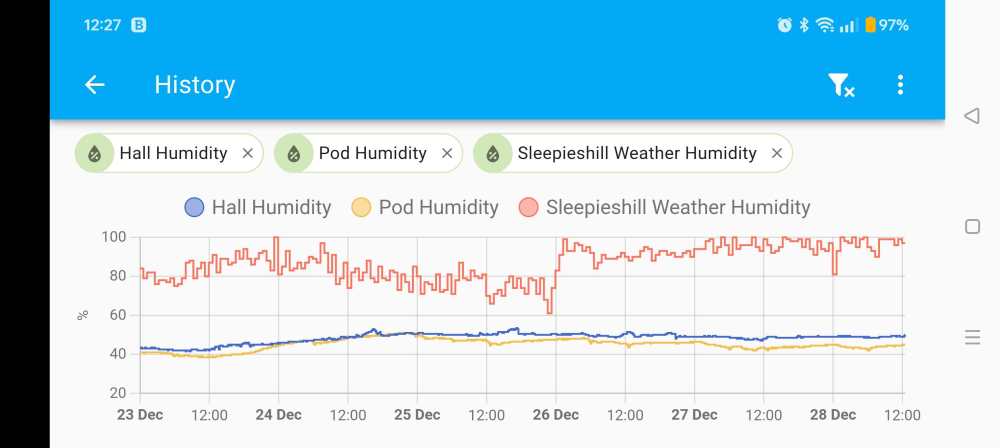
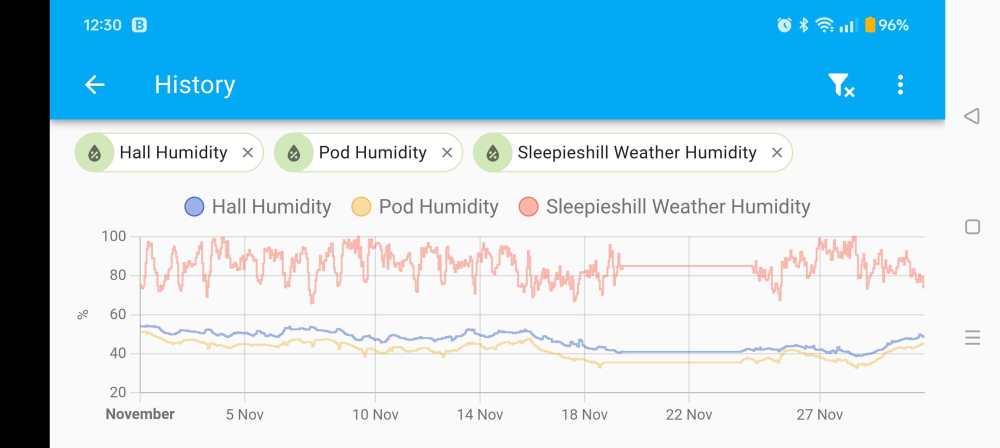
Screen shot, shows outside humidity, house humidity with MVHR and summer house (pod) with dMEV. The days below were above freezing. This shot it was colder, with days well below zero, so house and pod humidity drop. dMEV has no different humidity than MVHR, within a couple of percent. I would spend time/money resolving cold bridging. You want decent install, and decent frames. If you have argon filled double glazed with a good frame Uw should be about 1.2.
-
Are trickle vents open? Do you have door under cuts to allow cross ventilation? Have you checked you don't just have an open void around the window frame, causing a huge cold bridge? That is the normal cause of that issue, bodge window installation, not filled the gap with a good expanding foam, just some cheap filler pieces hiding a hole. You NEED to find the route cause. MVHR isn't the magic fix. If so what's the point of all the work and upheaval?
-
Must say looked good, but a lot of work, but all by hand - not a digger in sight.
-
When you take into consideration the cost difference between an unvented direct (immersion cylinder) and the heat pump on cylinder version to buy. So like for like materials. 210L UVC direct heated £500 Dimplex Edel £2400. Advantage is CoP of 3 compared to CoP of 1 for immersion. Daily cost is 1/3 for the heat pump cylinder. But you have a few years to make up the cost difference overall. Around 5 years to break even point cost wise based on buying and heating costs. Plus you have to route ducts in and out of house. An extra cost adder, 2x 160mm holes through wall plus duct. If using house warm air from house, this is likely to need to be replenished via the A2A for the heat pump cylinder. Other consideration Time to reheat is very long for HP cylinder, so check that out. As you mentioned noise? Service and parts, you are going to a glazed over look, from the plumber for HP cylinder.
-
Good point Then this could be an option https://www.ebay.co.uk/itm/185631610657?mkcid=16&mkevt=1&mkrid=711-127632-2357-0&ssspo=yawjptzcrle&sssrc=4429486&ssuid=8KgwDlAbTJS&var=&widget_ver=artemis&media=COPY
-
PIV yes agree. dMEV or MEV that is setup to only do minimal airflow, unless humidity levels demand otherwise, coupled with demand response trickle vents, not so sure there is that much in it. Only a local fan boosts, not the whole system, for example. Filter replacement time/cost zero. One set of air movement fans - half the running cost. Install in wet rooms, utilise the holes that most likely exist in those room already (core drill if needed). No ducts to retrofit for dMEV, extract only for MEV. Retrofit an MVHR correctly - rip house apart, make air tight or install in house not really suited to MVHR because it leaks like a sieve, loads of cost negative heat loss benefit (heating costs you more because of the additional ventilation provided by MVHR). OP is retrofit because he doesn't like PIV.
-
That cylinder is carbon steel and epoxy paint lined. So needs an anode to protect from pin hole leaks - You need to replace this every so often. Dimplex do the same thing but with stainless steel cylinder, so do Mixergy. Makes expensive hot water, if you are adding a heat pump anyway. Just get and unvented cylinder for a heat pump, for about the 1/3 the cost. The heat pump will heat the cylinder via a diverter valve. Keep the additional cost of the Tesy or other similar in you pocket.
-
Just been thinking and in it's simplest form, you would run both the boiler and heat pump on the same WC curve. All could be hard wired. Time based switching (cost) - £60 Then use a simple single channel time switch to deliver a run permission to either the HP or boiler. HP connected to the NC connection and boiler NO connection, with the other zero volt switching wire to common. Temperature based switching (heat pump capacity limited) - £100 Same as above but replace time switch for external thermostat. Time and temperature switching (combination of cost and capacity limit) - £160. combine the two above.
-
Plus - Having to defrost in humid areas. Takes a hit on CoP and heat delivery.
-
Just done some simplification to mine - touched nothing more than a keyboard and the existing thermostat for the heat pump. The only thermostat in the house - this connected to ASHP, timings changed slightly to batch charge during E7. Outside E7 times thermostat simply set to 20. Home Assistant thermostat - this is connected to boiler (may wire a spare normal thermostat in at some point) allows boiler to fire if E7 is in peak period and house drops below 20.6. If internet goes down, heat pump kicks back in at 20 degs as a backstop. So no one is going to freeze. Due to hydraulic separation via a PHE, boiler could be removed tomorrow and have zero effect on the heat pump running. Could even be removed while heat pump is online. So you don't need anything complex really, mine is in fact just two thermostats operating at different times. Ideal is one thermostat with two outputs that can be operated independently of each other. With no one looking after HA, worst case is the thermostat times are set continuous on the heat pump. Boiler never starts. House would be warm.
-
Got to agree with everything above. Mine is a pure tinker because I still have the boiler. Doing things in home assistant is pretty nuts, 99% of the population no clue. You can buy just about any good Honeywell thermostat (in the States) that does this stuff out the box. But they just don't work in the UK because everyone drummed down to S and Y plan compatibility.




