
JohnMo
-
Posts
12465 -
Joined
-
Last visited
-
Days Won
179
Everything posted by JohnMo
-

Why did you choose an air source heat pump?
JohnMo replied to SimonD's topic in Air Source Heat Pumps (ASHP)
Once a heat pumps heating a heating system, the system stays as is, you are only removing the old heat pump, basically power, communication cable and two flexible pipes. So new heat pump is just a simple reconnect everything to new heat pump. But cost of a Vaillant heat pump can be stupid expensive. As said I did it myself (had assistance moving the new heat pump only) in 5 hours to be exact, from switch off old to switch on new. So a company is likely to charge half a day for plumber, plus electrician or maybe a day each. But who knows. -
Why did you choose an air source heat pump?
JohnMo replied to SimonD's topic in Air Source Heat Pumps (ASHP)
I just replace one - the old one is being used for hot tub. The new one was a mornings work to install - I did install the wiring centre that came with new one, and pre-invest a cable the old unit didn't have. Cost £2100, plus some new insulation near heat pump. If you install a Vaillant you could be 3x that. In 7 years time, grants will not be available, so suspect like solar PV prices, will drop like a stone -
If you are doing a new build and it's not signed off, permitted development doesn't exist. You're legal obligation is to follow the agreed plans or do a variation. If you have a need for visibility splays, your into planning and highways approval. There is highways documentation that has full details of visibility delays (they change with speed limit and gate placements and how much of the driveway has to comply with highways road spec - that part only certified people can install the tar and sub surface.
-
You can do that, you basically connect to ASHP as two zones. Get the ASHP to control an electronic mixer to the UFH. Set the two flow temps in the controller and it will control fan coil and UFH flow temperature independently - note your heat pump generates the higher heating temp and lowest cooling flow temps of the two zones so you take a slight cop hit. Although set up as two zones, you operate as a single zone, so no buffer or additional pumps needed.
-
Have one fan coil in summer house and it runs same temperature as UFH. In cooling mode 16-17 degs, so have no condensation drains installed.
-
Week 15 - UFH, screed, and render base coat
JohnMo commented on Benpointer's blog entry in Contemporary build in north Dorset
Depending on heat pump it could be a screened pair cable or multiple cables. And ideally doesn't want to be in power cable duct. -
Not all dMEV fans are equal, some are quite noisy, I installed one in the summer house, next day removed it as it made racket and installed Greenwood CV2, totally silent.
-
Passive house Shepards hut ?
JohnMo replied to Waterworks's topic in Energy Efficient & Sustainable Design Concepts
Our summer house, is insulated, floor, roof and walls, double glazed wall with plenty of air leakage (rubbish design) and a dMEV fan. Insulation a country mile away from passivhaus, airtightness even further away. Heating is by fan coil as an extension to the house UFH system (all run as single zone), ASHP flow temp set at 28.5 degs. Heating consumption for summer house is the best part of nothing much, as it piggy backed on to house and summer house is sitting at 19.5 degs most of the time. If we need additional heat we flick on an electric heater and it bumps it up to 21 in 30 to 40 mins. Going passivhaus on a small building isn't worth the effort as with some insulation heat costs are tiny. Not even sure a diesel heater is worth the effort, small storage heater, electric panel heater or a room through wall heat pump heater, sized at about 1+kW. -
Interesting couple of days with the new heat pump.
JohnMo replied to MikeSharp01's topic in Air Source Heat Pumps (ASHP)
Your seeing pretty normal behaviour amplified with a thick screed. Your set point is 28, heat pump runs until it gets X degs above set point, then trips off. Will not restart until it gets to X degs below target. So your adding heat to slab it's is very slowly released, leave it long enough heat pump will restart. If your not running WC, outside sensor has no input to ASHP running. -
Why did you choose an air source heat pump?
JohnMo replied to SimonD's topic in Air Source Heat Pumps (ASHP)
If you get that it's just piss poor design from installer not the boiler. Mine was pretty much silent, directly connected to UFH manifold no mixer and pump. Just ran a steady 32 degs, and was managed by a low hysterisis thermostat. When it did DHW it just ramped up slowly to 60 degs, by the time it got the cylinder was at 52 degs. -
Stone Slip Window Head Finish?
JohnMo replied to WiltshireLink's topic in Insulated Concrete Formwork (ICF)
Where does your window sit, how far back, that may decide how you do it. My windows are flush with the wall so it was easy. -
Interesting couple of days with the new heat pump.
JohnMo replied to MikeSharp01's topic in Air Source Heat Pumps (ASHP)
To add to the above, if set the circulation pump to automatic modulation, the heat pump will change flow rate to help give a full range of modulating output, so for a fixed flow temperature you get a full range of kW outputs. So the flow meters on the UFH manifold need to be wide open. So low heat required, circulation pump runs slowly and ASHP compressor needs to do less work, high demand, circulation pump runs faster and compressor works harder. So in effect floor becomes self regulated. -
Should be able to do everything yourself. Why can't you install the ASHP? Most installer will look blankly at when you mention cooling, especially when you utter UFH as cooling. Condensation drains are only needed if you run below dew point, one real reason to do so, is if you don't size the fan coils correctly. If you size for a flow temp at around 16-17 then condensation isn't an issue.
-
Why did you choose an air source heat pump?
JohnMo replied to SimonD's topic in Air Source Heat Pumps (ASHP)
Swopped from gas in stages, but ASHP motivation was cooling via UFH. The boiler basically ended having to go it couldn't pay it's way, with gas standing charges and preferentially better ToU tariffs for electric, once I got the smart meter sorted -
Interesting couple of days with the new heat pump.
JohnMo replied to MikeSharp01's topic in Air Source Heat Pumps (ASHP)
I have been tuning my system over the last couple of weeks and kept hitting a lot of instability. I think what is occurring, is outside temp increases, heat pump tries to change flow temperature per compensation curve, but return temperature stubbornly stays where it is, due to the big slab of concrete not changing temperature readily (in like a radio system). So it backs off some more, then some more, and nearly trips itself up, so loads on more power to protect itself and move operating parameters out of trouble zone - this keeps repeating. The old ASHP cycled, so just stopped and waited as temperature outside changed to get a new return temp to it's liking and started up again. The new one doesn't it's determined to keep running, so isn't playing ball with WC. So I have reverted to a fixed flow temperature, mild temps I cover off with a thermostat as a high stop. I chose 28.5 degs flow temp as that should be ok for my house most of the time, thermostat will stop over heating when mild if heat pump doesn't modulate enough. Suspect your 200mm thick slab (mine 100mm), will cause more issues. -
Sand & Cement vs Liquid screed - which is best? (70mm)
JohnMo replied to Great_scot_selfbuild's topic in General Flooring
I did concrete over UFH and insulation, it was all done before the walls went up - the external ones. -
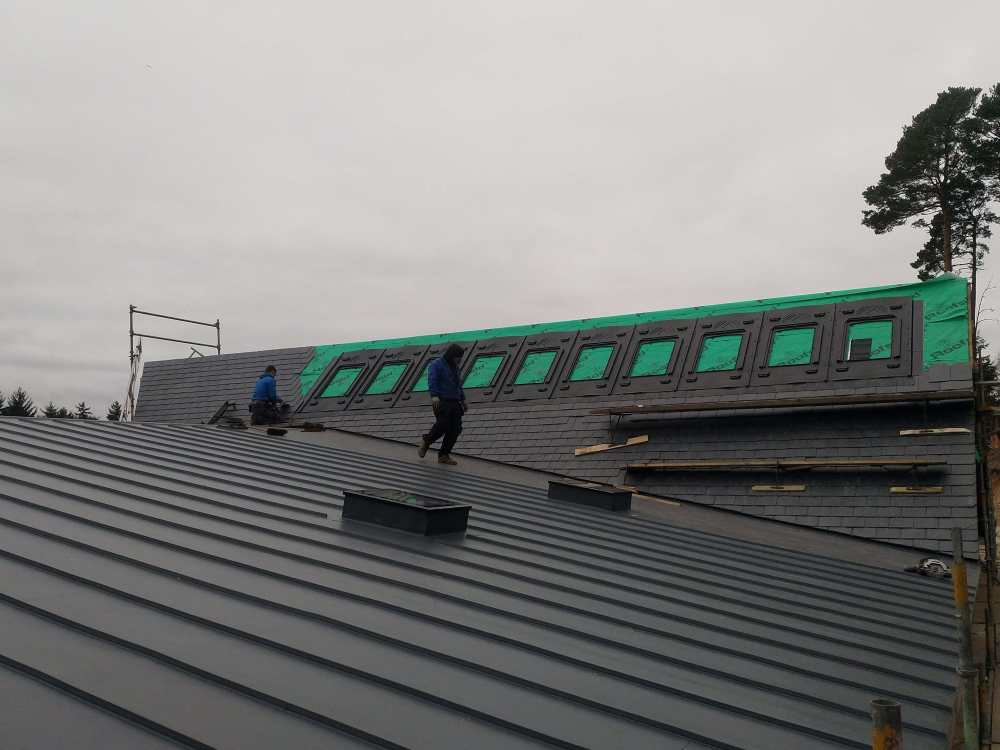
When I was pricing up, zinc was an option soon dismissed, when I got the prices. In the end I did a Sarnafil pvc roof with decor profiles at 450mm centres. But we did about 200m².
-
Target U-values… Cost/benefit sense check… What am I missing? 🤷🏻♂️
JohnMo replied to fatgus's topic in Heat Insulation
What this says if you are comparing 3G windows with 3G is the frames on 1.1 are truly rubbish thermally. You may as well install good double glazed with Krypton gas and get same performance. So you need to look a bit deeper it's not just about cost and just back its also about quality of materials being offered as well. It also depends what you want out of the house. Actually building a house is utter nonsense based on payback period, just get a tent! You heat a tent for several life times compared to just the basic windows for a house let alone the whole house. I improved stuff based on not having to fork out much for utility bills when I retire. I can afford stuff now, on a pension I may not. Lower heat loss also drives other costs down, simpler heating system, smaller heat pump, done correctly less noise, better house feel, air quality etc -
Target U-values… Cost/benefit sense check… What am I missing? 🤷🏻♂️
JohnMo replied to fatgus's topic in Heat Insulation
UFH in cooling mode (during summer) summed up in 7 words. -
Stainless Steels in warm, damp and chlorine environments.
JohnMo replied to SteamyTea's topic in Boffin's Corner
Similar tensile, A4 has a lower yield than 8.8. Stainless is also very susceptible to galling. But 8.8 is the minimum standard for anything structural, depending on exact application. -
Very minimum would be 100mm of PIR, then screed. But ideally 150mm+
-
UFH either do lots of insulation or none, thin is the worst of all worlds. But - If you do none, you really need the heating on 24/7 otherwise the floor heat just moves into the ground and dispersed, each time you start stop you waste huge amounts of energy. Simple, do low temp radiators. Get a decent boiler that will do priory domestic hot water (PDHW), this will allow boiler to run high temperature for DHW and low temperature for heating to get optimum efficiency. If you are getting a new cylinder, get one with heat pump heating coil, this will reduce heating time of cylinder and again also get efficiency from boiler. Or get a heat pump connected to max 35 deg flow temp system.
-
Stainless Steels in warm, damp and chlorine environments.
JohnMo replied to SteamyTea's topic in Boffin's Corner
Stainless steel screws in aluminium is another corrosion issue waiting to happen. The stainless steel is using the aluminium as a sacrificial anode. -
I do have a legacy UFH manifold controller with room sensors. It's connected to heat pump, a simple standalone timer to immersion, and standalone PIR sensors to various outside lights. The other automation I have is related to battery, but that is via the GivEnergy portal to control charge times. Home assistant is used but as simple monitoring tool, it has 2 automations, one to collect solar forecast, the other to tell me if PV generated is behind forecast, so I can check to make sure nothing has tripped off or panels aren't dirty. Nothing that actually matters if they don't work.
-
Stainless Steels in warm, damp and chlorine environments.
JohnMo replied to SteamyTea's topic in Boffin's Corner
Are you using stainless steel fasteners or structural elements? Are you in a high chlorine area (directly next to or on the sea)? Are these elements exposed to a salt spray or chlorinated air atmosphere? Do you have these fasteners or structural elements exposed to above ambient temperature conditions? If you answer no to all the above - no issues. If you answer yes to all of the above, you have issues to address. Stainless steel has zero place for structural elements or fasteners in almost all situations.