


Olf
-
Posts
315 -
Joined
-
Last visited
Everything posted by Olf
-
As this is a separate building, they can start drawings right now, as nothing (not a lot) will affect the final outcome. The same with planning, you don't have to own the property, with owner permission application can be done in advance of exchanging contracts. Make planning 3 months: my drawings waited for 4 weeks before being looked at (a day before deadline), then the response another 4 weeks (yep, day before deadline) with request for changes, then another 4 weeks... Start gathering materials as soon as possible, so there are no hiccups on the way
-
If you have to go the surveyour route, such party wall award is valid from the moment it is issued (unless specified otherwise in the document itself), so you might be still on schedule or even ahead of - but surely out of pocket.
-
Looking for 100mm and 25mm sheets of insulation
Olf replied to NewToAllOfThis's topic in Heat Insulation
I used them recently, waited only for a week for delivery, but this is because half of the wagon was mine: they send it only when fully loaded. Quality was ok, considering it will end up in the floor and was nearly 20% cheaper than the next best (though brand new: insulationhub), I won't complain. -
Following @Nickfromwales advice I started with 50mm pipes for shower and sink, but what advantage (in performance) will they give me for manifold drain and UVC? Being at UVC, will I be able to drain into common stack (made of uPVC), or do I relly have to think about a separate through the wall discharge point? Here is the schematic, the spaghetti junction under the toilet is just boss pipe linking all the 50mm branches, one of those with 2 x knees to adjust angle to suit. Edit: do I need a trap for washing machine, or a sealed connection will do? Edit 2: AAV is missing! Will it be happy in UVC cupboard?
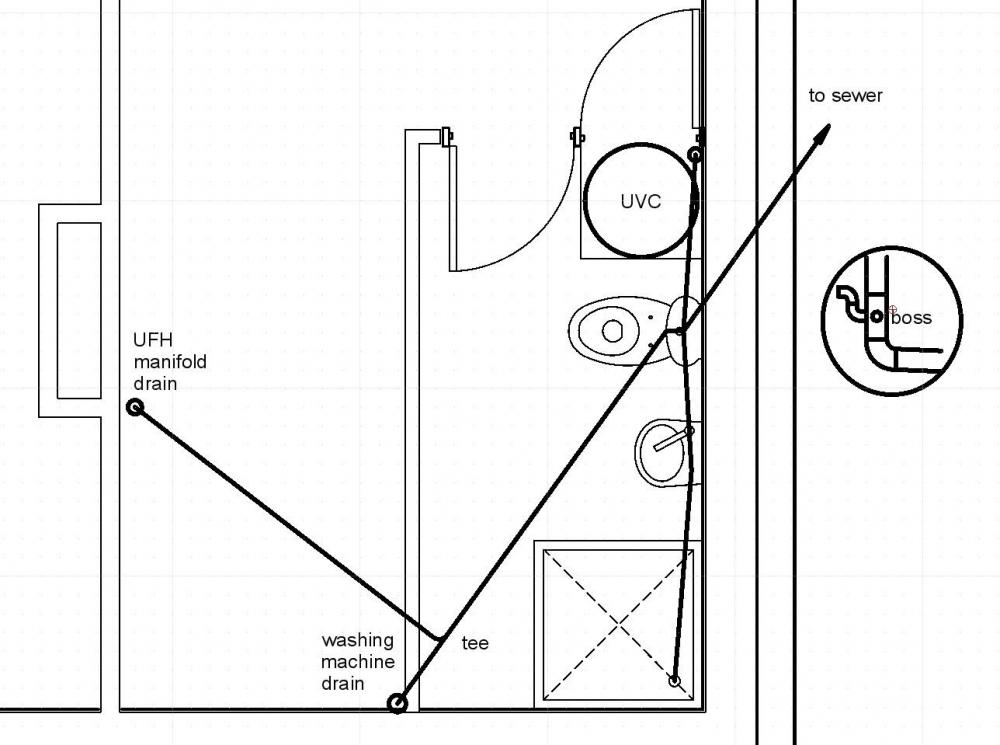
-
I'm in search of Catnic alternatives (as parent Tata Steel haven't been able to make sheets to roll it for the last 10 weeks) and think it is catch 22 situation: there are few glulam suppliers, so you can't pick up single beams easily like with steel merchants. That leaves them focusing on whole building projects (especially when fancy shapes are involved), those driven directly by architects studios - so self builder with few sticks is not really a partner. I kind of understand that: with £100k frame it makes sense to educate an architect with technicalities of glulam, to do that with self builder trying to mate with blockwork on a £1k project (so few hundreds in profit) may not seem sensible - though nothing is in the way to just publish that, rather than keep that secret. Or simply speaking imho glulam folks are cosy enough in the niche they cater for and don't see the need to reach out for extra business.
-
With some much glass and DG only, are you sure you're going to meet the building regulations for thermals?
-
I checked lintel alternatives, all seem to quote '4 weeks delivery' which I believe was realistic in good old times, but I know it too well now is a wishful thinking at best (due to raw materials, labour and delivery shortages to start with). I was originally thinking about 2 separate steel beams, but now are leaning towards glulams - any recommendations for suppliers for those, preferably close to Oxfordshire?
-
So it will reduce hassle and cost with BC application, but will not remove the need for more insulation than planned 50mm. Unless of course you find a 'competent builder' happy to issue a certificate stating that the job is ok, even if it isn't.
- 8 replies
-
- 1
-

-
- building control
- flat roof
- (and 1 more)
-
May not help too much - I did that as included porch in planning application for all the changes, had to scale it back to 1400mm protrusion from the front wall to comply with local planning guidelines. Check your council's website for something like that to see how big can you get either way.
-
Including the porch in thermal enevelope of the builiding will likely trigger need for building control
-
Get that in writing to avoid any poroblems in the future. I'd say that because you're affecting thermal properties of the roof, that would need to be done to current standards, though the workaround can be using extra wool in the attic.
-
Single room MVHR
Olf replied to James Newport's topic in Mechanical Ventilation with Heat Recovery (MVHR)
Do you have enough space in the soffits to extend the runs so they finish the recommended 1.5m apart? If not, check the 'combined grille' idea. -
I was after the same, though it appeared that high water table prevents from building any soakaway and so war with Thames Water to connect to existing rain sewer is on. I'd recommend you dig a control hole, that answers many of your questions. Using it for percolation test will give rough idea of volume ( and so cost) of soakaway to start with. Or - like in my case - possibility of having one at all. To answer the question it is yes and no. Yes, as there are companies doing just that, but not sure what methodology they use. I suspect it is based on HR Wallingford tools, so something not publicly available and requiring some skills to do the calculations. I'd believe there are consultancies using the same method without selling any product, but still the effort may be more costly than building 'standard' soakaway capable of capturing all the rainwater, and adding water harvesting system as a bonus
-
Exactly, and that what angers me. They just lough in the face: they prefer to supply large developers with standard stock and/or with increased price of raw material try to encourage to cancel an order than would be now at small markup or even loss. I've had these problems throughout the build, with noticable similar case when Tarmac called 3h before sheduled delivery to fill foundations to say that they 'ran of cement' - which was just smoking pile of bs. My biggest problem is lack of communication: if they said it is another 8-10 weeks, I would put all the resources in a backup plan. But if it may show up any day, but they just don't have an idea what is happening on their own backyard, then I'm not so happy to pay SE £££ and risk having 2 sets of lintels, in case Catnic shows up.
-
Make sure that you can actually order that. When I was searching few suppliers were interested in a small private project, and when it came to order no one was, all their output being sucked by major developers. Ended up with standard beam and block with PIR on top and worse U than wanted and planned.
-
Catnic thermally broken heavy duty lintel for 150mm cavity spanning 3600mm wide French door ordered at beginning of May, as the very fist thing. Was quoted 4 weeks delivery, which was comfortable. End of June (already past the scheduled date), checking for update, answer: not made yet, shortage of steel. Couple of more updates, one pointing to the week beginning 19th of July (as in now). Fresh update: not made, no steel to roll it. I'm not going to speculate what really is going on, but need to start with plan B, as the walls are now erected and only the section over the doors is missing, builders were pi$$ed and left for another job, making me *&^%$£. Because of cavity width (not 100mm, so building merchants don't have anything available), span (more than 2m, so building merchants don't have anything available) and my desire to have it possibly not thermally bridged, I'm thinking about 2 separate lintels for each leaf, using RSJs (as these need 'only' cutting to length). Any other ideas? Do I need to involve SE, or will it be enough to get steel merchant to provide figures just to demonstrate that load capacities are equal or better than the limits already calculated for Catnic lintel?
-
That's what I'm planning to use, if that helps
-
I used Iko Bitument paint. K Kaps look cool, but could not find any stock and probably they make sense when dealing with 10s or 100s of beams and time saving is measureable.
- 1 reply
-
- 1
-
-
Multifinish, concrete blocks, insulation boards please We may find the prices possibly dropping: few weeks ago I had to buy OSB urgently (collapsing foundation trenches), rented a van, sprinted to B&Q and paid £29 a board. 3 days later doing order for roof boards I was hit with £39 price - 1/3 hike! But now it stays. I suspect some materials got 'future increases' included on the wave of panic buying, with all the desperate ones served and shortage of labour, stock will have to be shifted so the price adjust. Though OSB doesn't have best before date, otherwise there would be soon pallets given away, like with plaster...
-
On one end of the extension (at the existing building wall) the roof joists are suspended from an RSJ, that creates a new challange: junction of the beam and the wall. With the load imposed by the beam I'm worried that any membrane I'd try to use to form 'Tony tray' would be thinned to the point of becoming permeable, defeating the whole point. The other issue comes from the small size of section of the wall requiring this treatment - that effectively makes it a 3D 'cup' around the RSJ end to be formed. That got me thinking about using joist seals, has anybody tried that route? Actually '3D' aspect should also show at the ends of standard 'Tony tray' - would you fold & wrap the membrane at the end of the wall, or for simplicity just leave this one junction potentially leaking?

-
I'd exercise an option to have 1st floor addition full width, by rotating the 1st floor bathroom 90 deg and extending slightly the bedroom, so it still have access to light (maybe even incease the size of the window).That will allow to blend with the roof better (less flat roof)and possibly address the issue they have with the form of it (with imho is ugly too). You mentioned future dormer roof, that would give you an option to go beyond existing rear wall with its depth (subject to planning and headroom available, maybe do some sketches now?) Do you need both bath and shower? Not concerning planning I'd also ditch the bifold idea - I assume flat roof joists sit on the walls, for 3 panel bifolds you would still need and extra steel above. For negligible effect of bifolds in 3m wide opening you'll spend a lot to make it work and more than 95% of time open one panel only. It doesn't seem that you have some lovely views there neither.
-
In normal times I'd just go for stock OSB/3 T&G boards, but with current problems with sourcing anything I'm considering all possible options. I put to sleep idea of using P5 chipboards (for now...), but trying to find what is wrong with square edge OSB: with joists at 400 mm centres, 1200 mm wide boards of the bottom layer should always meet over the joist (75 wide, so at least 34 mm support each) and any buckling that could still try to happen will never be visible, and should be reduced once the sandwich is sqeezed with the fixings. With top it should be even easier, with rigid insulation boards providing flat surface, OSB boards will only be providing extra lateral stifness (and load distribution of anything pressing from above), so lack of interconnection should not matter much. Should it? Additional question: going square edge, what gap between the boards is sensible to allow for any expansion? EDPM on top, so quite forgiving.
-
House is overheating
Olf replied to Savage87's topic in Mechanical Ventilation with Heat Recovery (MVHR)
Why not? As temperatures inside and outside get equal, heat recovery part gets less and less significant and the ventilation can be achieved by simply opening windows. If the intake is above sunlit surface of the roof, locally the air can get pretty hot so if you sick this in using MVHR is against you. Plus any gains through the attic (which does get very hot). As mentioned before, your best strategy is to reduce unwanted gains first and then fight the rest with aircon. -
Well there is a rainwater sewer right under the extension the builders 'found it' and have fun repairing, but in BC's words we can only connect there when all the other options fail. Possibly again, if I can show calculations that green roof and rainwater harvesting limit the output massively, may be a good bargaining chip.
-
When visiting to sign off footings trenches, the BC was a bit shocked how much clay was there and requested percolation test rather than stock hole for soakaway. On top of that all the new roofs served will be total of 120 m2, so with insufficient absorbing rate the hole could get bigger than the area available. However, we're planning a green roof on the extension (40 m2) and the remaining 80 m2 will be going through a surface rainwater harvesting system (2 or 3 IBCs). As much as plain soakaway calculation process is covered in BRE Digest 365, is there a similar source showing how to calculate either reduction of necessary capacity when slowing/delaying rainwater runoff, or adjustments to the parameters taken for BRE soakaway calculations (effectively achieving the same)? I can see some companies selling products that promise exactly this (eg https://suds-solutions.co.uk/rain-activ/), so there must be a way of either convincing or dazzling BC to approve reduced soakaway volume.

