


Olf
-
Posts
315 -
Joined
-
Last visited
Everything posted by Olf
-
Fair point. But imho of little use if disconnected from reality. PIR boards manufacturers are silent on that aspect, so not easy to find reliable sources, but there is a nice picture on the website of a supplier of wood fibre boards: for a roof structure of U=0.13 W/m²K (minimum required by Building Regs) PIR based solution gives 8.1h phase shift, woodfibre 16 hours. So let's say there is a very sunny day (radiation heating roof surface is dominant factor of total heat trying to enter the building) so already at 10am the roof is warmer than inside. For PIR roof that heat will get in 8 hours later, so 6pm - if the air temperature will be pleasant enough by then then this can be counteracted with natural ventilation, but on some days this will not be the case. Woodfibre is a clear winner, as the same sun generated heat from 10am will only arrive to the inside at 2am. However to get the same U value, one needs 50% thicker insulation layer and much stronger roof structure - so the question is how many days will benefit from this longer phase shift achieved at extra cost? Another case: U values better than 0.13. For both materials phase shift will extend, but PIR will actually benefit more, as will move the peak heat ingress towards the night hours. I'm not sure if there is any limit for what delay wood fibre structure could achieve, but I wouldn't want it to get close to 24h - meaning to receive heat from the day before...
-
Example? And what happens when you put it wrong way round? But seriously, insulation does not 'recognise' direction of heat transfer, acts identically either way.
-
If you served it more than 14 days ago, then you are already 'in dispute' and appointment of a party wall surveyor is necessary. The only issue now is whether the other party (whomever it could be, as the surveyor is supposed to be independent) would be happy to use him/her as a jointly appoined one, or have their own surveyor. Also as the surveyour will be doing schedule of condition, access to the property would be necessary. Also as you're building an extension I assume it's got some foundations that require excavation - in this case I don't think form 4 is/was sufficient. It is a tricky situation - have you talked to some party wall surveyors what's their advice in case of being appointed for such job?
-
Start with checking if your roof will manage weight of all the new additions - wood fibre is heavy. If using reflective type, not only protection but also reduction of emissivity (reducing heat loss when outside colder) / reflection of the heat coming from the roof surface (reducing heat gain when sunny)
-
I've been looking for answers regarding the same solution here Drawing you showed is conveniently missing wall tie at ground level DPC (14) which itself is against the rules, but even if placed there, it may invalidte BA certification of wall ties, DPM or both.
-
This on its own is a premium product. Also go through the forum, there is a similar discussion and as good as rigid boards are, they require extra care/patience - adding cost if that is taken care of or losing performance if not.
-
Where to start! (Planning permission, conveyancing, architects etc)
Olf replied to Pete77's topic in Introduce Yourself
+1 Educate yourself (read, read, watch youtube) so you can start asking many questions. My experience is that any trade will not tell you anything extra than a bare minimum - because they don't know any better, because they're not bothered, because they're paid only for what they do, not 'consultancy', because they could be accountable for something stupid they said. And at the end of the day you as a homeowner will bear responsibility for what is build (and you can insure only some aspects of it). -
Welcome @Mikeouk, Set the layout of the extension that works for you functional wise, check your budget, then worry about planning. The difference between obtaining Certificate of Lawful Development (what you need under permitted development rules) and full planning permission is £100, all the rest (drawings and cost associated with them) being equal. Do read https://www.planningportal.co.uk/, and your Council's website - they should have some guidance specific to your area, it may help to see what is their preference and give some ideas. So make a sketch, show it for the Forum scrutiny and you'll get there.
-
Really good idea! Saves me the whole water circuit
-
Mancave 30 m2 2 m from the main building and 7m (ok 10, with elevation) from planned location of ASHP unit. Is it better to connect it that way, or to have a separate small ASHP unit for the mancave only - I know it will need planning permission (but I'm working on one anyway, so can throw in just in case), and will cost slightly more, but running well insulated pipes may be a challenge and expense too.
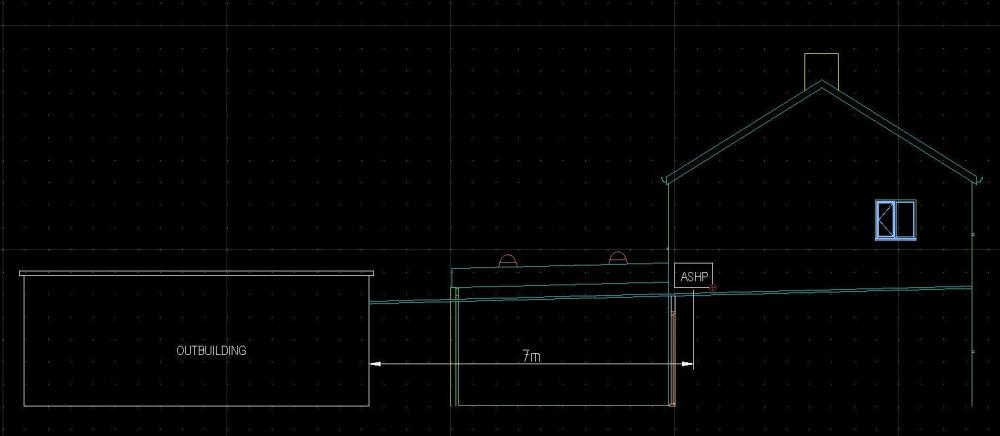
-
Because a washing machine/tumble drier becomes a killer the moment it walks into a British bathroom, we'll better keep it out. Kind of. I carved out a 'closet' so the access is from the outside. Question: what constitutes a 'wall' the idea does work? Is a single layer of plasterboard enough? It would be hard to join it at the corner, so I might slot in some batten and make the partition at the toilet side a double layer, but still no more than 50mm total thickness - is that any better?
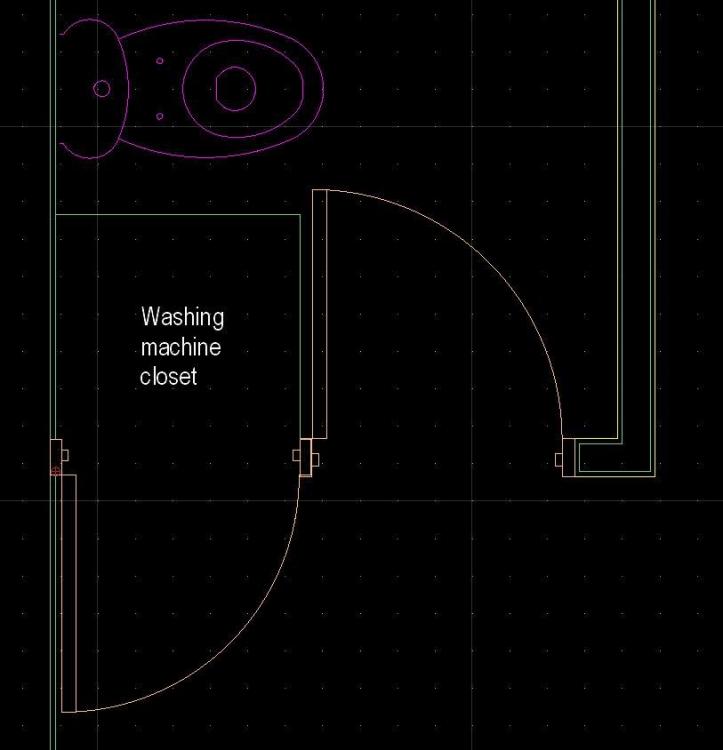
-
https://www.planningportal.co.uk/info/200130/common_projects/43/outbuildings Outbuildings are considered to be permitted development, not needing planning permission, subject to the following limits and conditions: Maximum height of 2.5 metres in the case of a building, enclosure or container within two metres of a boundary of the curtilage of the dwellinghouse This is UK wide law, you are at breach of it I'm afraid. Check if you can apply for a retrospective planning permission - even if positive, due to proximity to the boundary (< 1 m) you'll be limited as to what roof materials can be used to comply with ' constructed substantially of non-combustible materials ' rule.
- 10 replies
-
- 1
-

-
- planning
- permission
- (and 8 more)
-
MVHR BPC Standard or Premium Ducting
Olf replied to Haylingbilly's topic in Mechanical Ventilation with Heat Recovery (MVHR)
Get itemised list and check which 'premium' items really benefit you, not BPC. The problem with recommending either way is that most of people ordered a kit, so there is no comparison what could be better or worse. I've seen recently on the forum report that 'premium' tubing is easier to handle. Myself, for a peace of mind that it might be antistactic and antibacterial as advertised, for 80 quid buried behind the walls I went for the dearer tubing. Although at the same time I saved on extra roll, as BPC was happy to sell me whole 50m where I needed 10 only... -
Ok, so with the floor finish taking another about 20 mm the gap becomes manageable - happy nights
-
No such thing as dumb question so I'll try: 11 courses of blocks = 2465 mm 1 standard plasterboard = 2400 mm 65 mm gap staring at me in the worst nightmares. Is the plasterboard aligned with the ceiling, with the gap at the bottom covered later by the skirting?
-
MVHR to replace trickle vents
Olf replied to Fred D's topic in Mechanical Ventilation with Heat Recovery (MVHR)
Knowing what I know now I'd probably go radial, but branch worked ok and was way cheaper. A lot depends on the layout/joists directions etc - mind I routed everything through the loft, downstairs loo was a straight run down, so all relatively easy. -
I used a cowboy for the first phase (extension only) and it still passed. Knowing what I know now I'd save time and money then, so I'm sitting on the 2nd phase (EWI, porch, mancave, carport etc) myself. Yes, any drawings that show general dimensions and materials used should work, although I find it easier and useful for other purposes when doing in a CAD (Qcad - free 2D in my case) You can even make a 3D model out of card (or any other material you can shape easily), it may help you or planners to visualise. Add few inches here and there to have some freedom to make little changes. Past applications (including drawings) must be available on council website, go through what was build/modified around recently around you
-
If your site and house concept are easy, you could knock the planning drawings yourself.
-
MVHR to replace trickle vents
Olf replied to Fred D's topic in Mechanical Ventilation with Heat Recovery (MVHR)
It sounds like the layout may force you to go MVHR - maybe check the kitchen unit options? This is what I used last time: VTC Low-E - it is so-so, but the price was attractive. I had it hanged in upstairs airing cupboard so it could serve the bathrooms and deliver to the bedrooms - it definitely helped with the bathrooms, misus tested the boost every time and it would clear the sauna quickly. Even in the bedrooms with leaky windows it made noticable difference, with no stale smells in the morning and much reduced condensation. For intake/outlet I just used the roof vents on the opposite sides of the roof All branched, no silencer (but pipes laid to not to cause crosstalk) etc. Of course you can fit it in the kitchen, you will gain extraction point and maybe ever replace the hood as they are intended to do. -
I can see some influence here, but I'd do the same. As for the actual insulation thickness, more is better but why specifically 175mm ? Check cost vs benefit, it might be that 2x100 boards are only pennies more than 2x90 or 100+75 (and vice versa, maybe 160 will save you more upfront than you would be getting back slowly over the years) Thermoblocks are in 65 mm or 100 mm flavours only, so you would have to cut the blocks anyway. If you're really commited and have too much time, grab a saw and trim the first course. Win-win: builder happy that not all knocked, you happy with improving the junction detail. Improving psi of all the junctions may bring you more benefit than improving U of the floor. No, you must be relaxed. It was 2 am for me - planning drawings due to be sent on Monday and I've just had a genius idea to move some buildings around And then sort the rainwater collection. And ASHP unit location. And reroute connection to solar panels. And so on
-
Give us some idea of what are you planning to build. If it is a small extension then you can build it for this price. If it is a palace on the cliff edge, including multiple levels carved in the rock (popular nowadays) - you found a bargain.
-
MVHR to replace trickle vents
Olf replied to Fred D's topic in Mechanical Ventilation with Heat Recovery (MVHR)
The conventional wisdom is that MVHR works the best in building of decent airtightness - and for that reason is necessary to begin with. But even in leaky places it will extract/supply where and when YOU want, not where and when draughts choose to be. However, as you are really after extracting only from 3 areas, it may be that extract fans will do the job just fine - either with a common flue or individually through the wall (or with some run of ducting before they can reach the wall, as it sounds is case of the loo). That will save you on MVHR unit purchase, space it takes and installation complexity (4 pipes + condensate drain). If you can go directly through the wall you could (especially in the case of the kitchen, due to large volume of air) look at a unit with heat recovery and you might get the best of both. -
A drain seems like the most sensible solution, that will simplify the outer leaf DPC (leaving only the 'standard' layer at 225mm in my case) and will protect the wall from any surface water - the slope of the garden, however shaped, will still be towards the house in the end I've found some ideas here https://www.pavingexpert.com/threshold01#doorway-drainage (there is a patio door to consider as well, will just extend it all around the wall). One question still unanswered though: can inner leaf DPC be also positioned at 225mm (1 block course up), rather than at the floor level? That would make my life so much easier to have that floor level joint available for wall ties.
-
As the original house is barely above the ground and the garden is sloping towards it, so the finish floor level of the extension will be at ground level. That maybe makes stepless patio door and Part M happy, but causes issues elsewhere. There aren't too many details available for this case (all the stock drawings cover typical case where FFL is well above the ground and the life is easy), but I found something and translated into this: So it uses a 'secondary DPC', although as I look at it, what is marked as 'secondary' is actually primary >150mm from the ground DPC. The other layer right at the ground level doesn't seem to make much sense, but I believe it is there to restrict travel of moisture at least internally, as if it somehow crossed the cavity, there is nothing else to protect the inner skin. Is my thinking right here? Is the original idea sensible? Does the inner DPC need to end at FFL, could it not go one course up ?
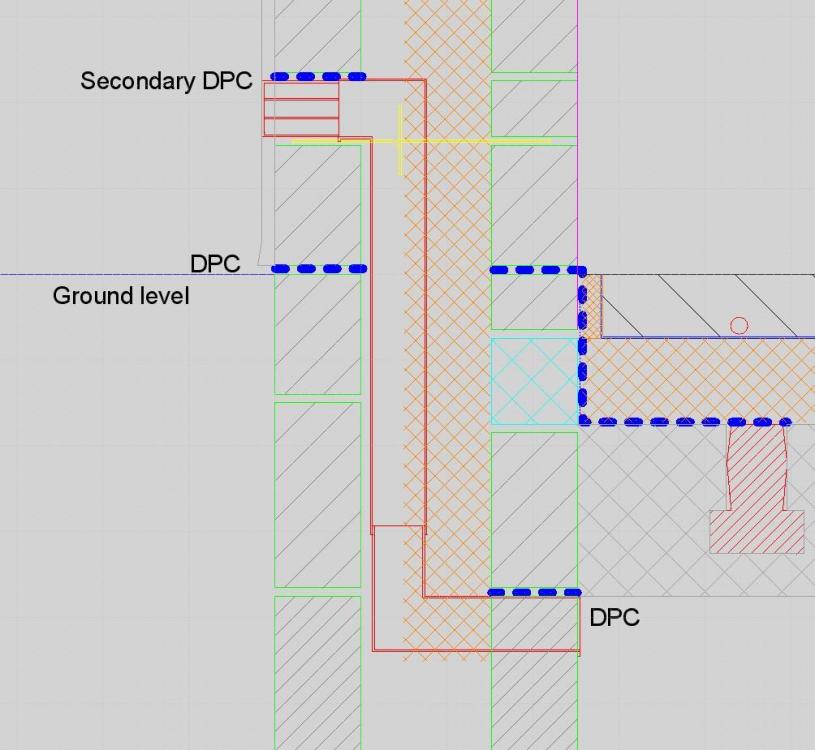
-
Here's his elaboration of the issue and answer to the OP


