


PeterW
-
Posts
18480 -
Joined
-
Days Won
207
Everything posted by PeterW
-
How do you mean...?
-
I noticed that new installs by WP have a neatly sloping incomer with the fuse in it that means there is no odd bend in the cable - also means the meter is much less cramped towards the top of the box. We had the supply listed as the final supply point so I've also had to fit the isolator and a Henley in there so it's looking tight but hopefully they will be ok as the whole of the left side of the cabinet is free....
-

connecting a boss onto a horizontal soil pipe
PeterW replied to joe90's topic in Bathrooms, Ensuites & Wetrooms
Wirquin have brought out a waterless shower trap that has a removable filter and can all be serviced from the top - worth a look as it's the best of both worlds. -
Its an inverter ASHP with a max current of 15.7A according to the plate. A 10m run of SWA clipped to a wall is fine under 17th at 1.5mm. So going up to 2.5mm would work fine, but not quite sure it's a C-curve as that's 5-10i from my reading and an inverter starts slow anyway so I would expect the 3-5i of a B-curve will be adequate ..?
-
Ta max load is 3.7kw so on a 7.5m run a 1.5mm would be fine hence the step up to 2.5mm for safety. @Nickfromwales 4mm seems overkill ..? Do you have shares in Doncaster Cables ..??!
-
Quick one then.... ASHP outside unit requires a 25A breaker but a max 3.6kw supply. Indoor controls to external unit is 4 core 0.75mm2 control cable which will be SY Multiflex direct to the ASHP Current plan for power is RCBO > 2,5mm SWA > 32A TP&N Isolator > ???? > ASHP. Question is, what is the best solution for the last metre from the isolator to the ASHP..? 2.5mm2 SY-Multi seems the best approach for flexibility but does it need to be SWA..? @JSHarris what did you use..??
-
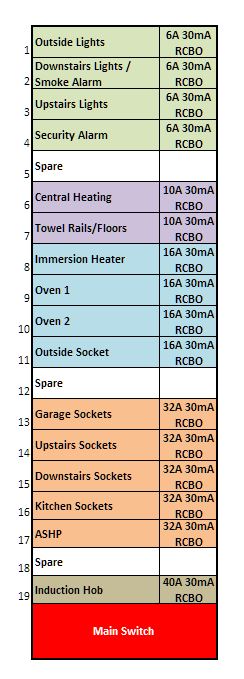
Right... had a quick rework and based on a 21 way unit I've ended up here.. Just so we are aware, that boiler run is about 4 ft in the same room btw as this is all in the plant "cupboard"...
-
So I had an outside socket and typed over it by the looks of it - wondered what was missing !! Gates are from a separate supply as the main meter box is at the gates along with a modified meter box (including a lock...) containing a new IP65 consumer unit with a gate and a driveway light supply.
-
You can use a caravan for up to 28 days in a year on a piece of land without planning (unless it has been the subject of enforcement ..!) so I'm assuming you are only "staying" for that many days @joe90..???
-
Why.........?? Not that I'm doubting you, it's just the only thing going on it is a time clock and a pump for the ASHP...
-
Roof Lights: glass or polycarbonate
PeterW replied to ToughButterCup's topic in Roofing, Tiling & Slating
Classic old greenhouse thing - beaver tail glass from one pane to the next and then the water runs down the middle of the panes and doesn't rot the glazing bars. Lower glass rests on a mullion and the upper straight on the glass below. In a modern set up if you have anything stopping water flowing down freely then it will find a way through the joint or you need some way of making a gutter to go round the lower pane. -
Right... plenty of food for thought ..!! @ProDave I had looked at a pair of 12/10 way units side by side which would give me spares. @Steptoe taking that point you made on smokes, I will include them on a light circuit and use the spare 6a for the alarm spur (as @Declan52 spotted I missed it..) Interested in the spur vs ring comment - doesn't that give issues on overloading ..??
-
Hmm... just checked and it needs a 16A fixed connection - so thats interesting..! I know its not 10mm2 (that is on the hob circuit, or at least 6mm2 is from memory) but need a quick rethink..!
-
Plugs in via kitchen socket..?
-
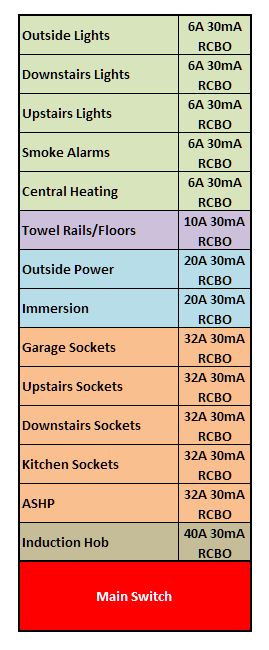
Chatting to the sparky about getting the layout of the circuits sorted and we've decided as previously it will be all RCBO. For an extra £30, is it worth splitting all of the circuits as below..? Bear in mind this is an all electric house which may in the future have solar installed (non-MCS) but only on a south westerly facing roof. Its a 3 bed house, all LED or low energy lighting. Induction hob in the kitchen and electric towel rails in 2 bathrooms along with upstairs electric tile warming (all centrally controlled) and ASHP for DHW and ground floor UFH. Immersion is for boost/legionella cycle.
-
Roof Lights: glass or polycarbonate
PeterW replied to ToughButterCup's topic in Roofing, Tiling & Slating
Do you mean hit and miss..?? So the wind will be able to blow through them..?? If so, then a single 6.4mm laminated sheet would be fine - either in 2 parallel panels (so you don't need to sort out how water runs over the mullion) or use 4 and overlap the top to the bottom by 75mm with a gap over the mullion bar. If its an unheated space then seems pointless having DG or TG. Other thing to consider is cleaning as I'm sure @MrsRA will want it on your weekly list of things to clean so you may want to get self cleaning glass or use something like Rain-X on both sides to stop it getting too mucky -
connecting a boss onto a horizontal soil pipe
PeterW replied to joe90's topic in Bathrooms, Ensuites & Wetrooms
Loving the bits of string on the wastes there @Onoff -
Yes as long as you can create a negative pressure in the cistern. That may need careful sealing of a standard porcelain cistern lid to the top of the cistern and the addition of an overflow looking pipe - some have this but a lot of modern cisterns only have one entry point.
-
connecting a boss onto a horizontal soil pipe
PeterW replied to joe90's topic in Bathrooms, Ensuites & Wetrooms
Yep its fine - think @ProDave had a similar issue and @Nickfromwales did some expert doodles on the thread.. -
I think that's the point we've all made though - coax or concentric cables (same cable structure, different terminology) is used by the DNO up to the incomer fuse at which point it is then a domestic installation onward from the meter. Post the incomer fuse you are then into a domestic set of rules on cable which are more about do as I say not as I do ..! Like all things, it's the detail in the connections that is key and earthing of SWA is one of those areas it's recognized there are issues hence the use of products such as the Piranha earth connectors.
-
Funny that as I was watching them do the install last week - and live jointing the new breach joint - and it seemed quite "thin" compared to the 25mm2 stuff I will end up using to do the rest of the run from the gate to the house. And SWA is lovely - especially when the glands have nice sharp edges....
-
Diamond disk in a Stihl saw and cut a rectangle the size you want. Then do parallel lines across the cut out area an inch apart and a couple of inches deep (assuming you don't have UFH..??) One or two cross cuts then use a cold chisel straight into the cuts to snap the pieces out. Will leave a rough surface but half a bag of leveling compo and you will think it was meant to be there.
-
Anyone mix their own Epoxy Mortar? (for concrete repairs/levelling)
PeterW replied to IanR's topic in Floor Structures
If it is not high strength structural concrete you are looking for then using a 1:6 volume ratio of activated resin to kiln dried sand will work fine. Any GP resin will do and you can get it from CFS or East Coast Fibreglass. The sand has to be dry or it will clump and also cause the resin to set badly. -
Two ways to fix this - first is a very shallow slope and live with the tables etc sloping. Second is to lay a slab or something similar on top of the sloping and sealed roof but with gaps between the slabs and lay on packers - you can get them for the job and it then allows the top surface to be level but any water goes between the slabs and drains away. The whacky alternative is lay membrane and gravel/ sand and use artificial turf or even the real thing ..!
-
Cheap, Thermally Efficient Non-Structural Wall Detail
PeterW replied to Nick's topic in General Construction Issues
If you search the UK Timber Engineering Association (I think..) they have a load of stuff on glulam beams and their use. From memory, @JSHarris has a glulam beam in his MPC build - I've gone for traditional steel as its easier to get the calcs on a single element.
