


A_L
-
Posts
652 -
Joined
-
Last visited
-
Days Won
1
Everything posted by A_L
-
The thermostat which operates the flap is the metal strip, it is purely mechanical, it does not switch electricity. There is no room thermostat on a storage radiator. If you turn the output control while looking through the upper air grill you should see the damper open/close (or hear it) Leave the damper in an open position and wait for the next off peak period to see if it closes automatically.(have the input control set to a small value). The storage rads are on a circuit which is only energised during an off-peak period, there will either be a electricity meter capable of controlling this or a on very old systems a separate time clock near the meter. The off-peak rate is more expensive w.r.t. to on-peak now than it used to be and I expect it to decline in advantage over time.
-
The flap should close automatically at the start of a charge period. If it did not you would simply be trying to fill a 'bucket with a hole in it'. The core would either never reach the temperature corresponding to the setting on the input control or it would take much more energy to do so and it would discharge continuously at a high rate. So the core would be cooler than expected at the end of the charge period.
-
12kW seems a lot for a newbuild. What floor area/insulation/air leakage? Nibe is at the expensive end of things so price for heat pump seems O.K. What sort of floor for the UFH and who is laying it? You will be paying for an 'RHI premium'. Most people on here get heat pump etc from ebay etc for a fraction of NIBE prices and forego the small RHI income on a well insulated house.
-
@Ferdinand , you would be better using 6 rather than 5 as the correct value is 5.678.
-
@steve77r, 'Fastwall' a slightly different approach which can be used on lightweight frames and done by you https://www.ibstockbrick.co.uk/wp-content/uploads/2015/08/04-06-Fastwall.pdf
-
@gwebstech , for floors you cannot just invert the R value to obtain the U value, you must also have the exposed perimeter and the total areas as thermal resistance of a uniform floor varies with distance to the edge because you have to add in the thermal resistance of the soil
-
Source for EPC 100 = Zero Energy
A_L replied to Ferdinand's topic in General Self Build & DIY Discussion
Currently on BRE website https://www.bregroup.com/sap/sap10 -
Source for EPC 100 = Zero Energy
A_L replied to Ferdinand's topic in General Self Build & DIY Discussion
@Ferdinand , section 13, page 35 here - https://www.bre.co.uk/filelibrary/SAP/2012/SAP-2012_9-92.pdf -
@SteamyTea & @Ed Davies, afraid not. https://inews.co.uk/news/environment/renewable-energy-vat-increase-solar-panels-battery-storage/
-
Given that the massive glazed façade over two storeys faces NNE and the default ventilation 15m3 /m2.hr applies, the 40000kWh/yr is possible.
-
Heating load of 10.6W/m2 x 226 sqm = a heat demand of 2395.6Watts at -10°C so a few 'micro' oil filled radiators would do ?. More important is your intended heating regime, a 24/7 one only requires to meet the heat demand but if you want an on/off regime you will need to allow for more to have a quick 'warm-up' but probably not to much (say 50%) as PH level houses (and yours just misses the requirements) do not lose much temperature of periods of a few hours. The 15.1kWh/annum just means you will need 15.1 x 226 = 3412.6kWh per year, not particularly useful. The overheating % is acceptable.
-
FWIW my ideal approach is to use a wall construction that actually does not need a vapour barrier then add one if you want! e.g. from the inside - ordinary OSB/any insulation you want between studs/more vapour permeable insulation outside studs/breather membrane/well ventilated rainscreen cavity/cladding vapour barriers are really only 'vapour checks', batten nail holes should be partly sealed by the batten itself, you could silicone the back of the batten to increase effect, but if vapour check free construction O.K. anyway..........
-
Yes, but you must have a low infiltration rate (i.e. draughts/air change). Probably not more than 3m3/m2 /hr@50Pa (i.e. air change volume per unit of external envelope at a small pressure difference between outside and inside). This would be a significant achievement in a 1939 house. Yes, or chimneys or trickle vents or other deliberate means of ventilation. Save plan as any common picture format e.g. .jpg and go to 'choose files' at bottom of 'write post' window and it should be automatic.
-
Since you are probably tripling the heat load can you manage with a single phase heat pump? Usually have to go three phase electricity at about 14kW thermal output. UFH in the garage/workshop by running insulated pipework is easy enough but hot water for washing etc will be the problem. Have you considered Non-Domestic RHI, 20 years instead of 7? So single heat pump doable, just a few extra wrinkles to sort out.
-
FWIW SAP says the difference in central England is about 4.4kWh per m2 per year
-
Internal wall insulation 600mm masonry wall - condensation risk
A_L replied to Robbie's topic in Heat Insulation
We have to distinguish between liquid water (moisture?) and water vapour. If liquid water is getting to the vapour barrier/breather membrane layer from across the cavity this needs to be sorted by fixing the wall away from the water vapour/breather membrane layer. Correctly chosen breather membranes have considerable resistance to liquid water penetrating them. They are 'non-tenting' (tenting is where touching the inside of a tent allows liquid water to come through the tent from the outside). In substantially warmer climates than ours in summer it is possible for external water vapour to condense within the wall structure, this is known as interstitial condensation. This is highly unlikely to occur, particularly given the breathable nature of your insulation/lime plaster. In our climate the problem is likely to be interstitial condensation occurring from water vapour moving from inside the building during the heating season. Your breathable construction allows the water vapour to transfer through to the vapour barrier where due to the cold environment it is likely to condense to liquid water. I strongly recommend that you get a condensation risk analysis done for your proposed wall build up, perhaps the insulation manufacturer will do one for free. do you not think using a non-breathable layer (i.e. vapour barrier) in an otherwise breathable build-up odd? -
Internal wall insulation 600mm masonry wall - condensation risk
A_L replied to Robbie's topic in Heat Insulation
It is, all you need is one which is essentially airtight, e.g. https://novia.co.uk/uploads/components/variation/ReflexXLDatasheetSep18-5ba3b4f2e768f.pdf you do not need a reflective one, I picked it because it comes in a 2.7m wide roll which makes air-tightness easier. As @jake, do not use a VCL on the cold side of 100% of the insulation. -
Hello and welcome, I attached a little light reading which you may/may not find informative. ? (4) Do you have a damp problem? Given your property you are not likely to need a PIV simply for air change. (5) To save energy a reflective surface requires an air space next to itself. It could reduce draughts and act as a vapour check but as alluded to elsewhere there are other/better/cheaper ways to achieve this. (6) Personally I would forget the Sun Tunnels. They will most likely cost more in lost heat than they save in electricity for light even without considering the additional cost/complexity of installation. Just fit a good LED lights instead. Is the a listed property? thermal-windows.pdf
-
No fossil fuels for heating in newbuilds from 2025?
A_L replied to A_L's topic in Environmental Building Politics
As well as the electricity/CO2 question I was wondering about backup for new off grid development. Are they going to have to burn renewable biomass (wood) for heating backup? -
In his Spring Statement the Chancellor has proposed that fossil fuel heating in new builds will be banned from 2025. As usual the devil will be in the details.
-
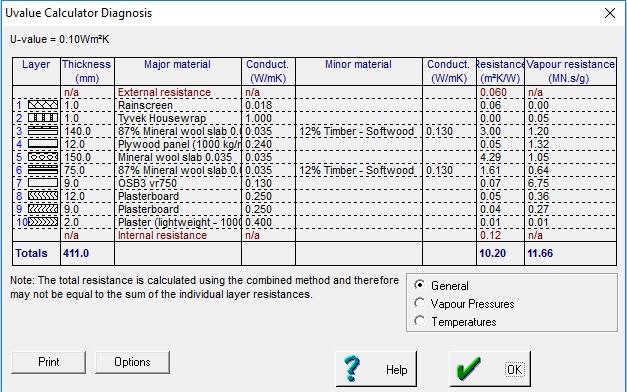
@Ed Davies has just beat me to it, layers 3 & 6 in the first attachment have 12% timber and thus average to a lower value of thermal resistance per unit thickness than layer 5 similarly the vapour resistance per unit thickness is higher for the 12% timber layers
-
-
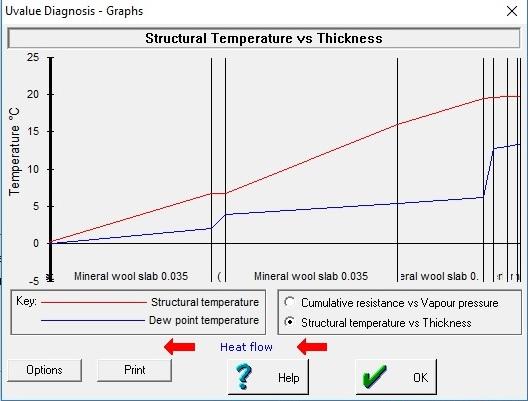
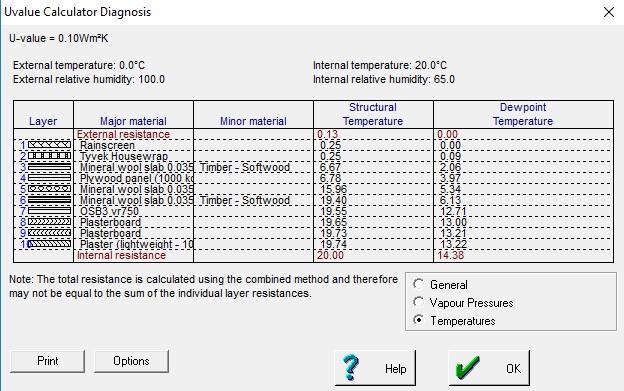
I am not so sure. If we take air at 20°C and 65%RH then the dew point as I understand it is at about 13.2°C. Yes a temperature of 13.2°C will occur in a profile with an internal temperature of 20°C and an external temperature of say 0°C. However by the time we reach the point in the profile where the structural temperature has fallen to 13.2°C vapour resistance has lowered the vapour pressure and thus the temperature at which dew will form. Can we use this example? The first image gives the construction details, the second tabulates the structural temperature and dewpoint temperature through the profile, the third shows this graphically.
-
@TerryE 'the heat equation'?, my instinct would be to design a wall profile where this did not occur or only occurred at an insensitive part. you said is your air tightness membrane also to any degree a VCL? Bulk air movement is not a prerequisite for water molecule movement through a wall profile. Vapour diffusion unless inhibited by a VCL, can transport H2O molecules without bulk air movement. Interstitial condensation will potentially occur anywhere the vapour pressure exceeds the saturated vapour pressure.
-
Capillary action will allow water to transfer inwards and affect the timber studs and depending on its type the insulation. Although OSB3 is designed for humid conditions this does not mean it is unaffected by liquid water, it will be. As Ed Davies please post the analysis or at least a detailed description of the wall build up.

