Thorfun
-
Posts
4891 -
Joined
-
Last visited
-
Days Won
36
Everything posted by Thorfun
-
well, the basement was designed by the structural engineer (from the architect's plans) and the drainage by the civil engineers but their drawings just say 'pump station by others'. there is no way to get the water from 3m down from ground level off the plot without a pump so I'm stuck with a pump solution and so will have to make it work.
-
cheers. think that's something I can handle on my own. will pop down to City Plumbing next week and see what they have to save paying postage from JTM
-
one of these on to the end of the manifold? https://www.screwfix.com/p/flomasta-female-socket-3-4-x/52588 and then screw one of these in to the end of that socket? https://www.jtmplumbing.co.uk/pipe-fittings-c433/compression-valves-15mm-28mm-c41/jtm-compression-valves-drain-off-type-a-p898 ps. I have to say I was a bit worried about doing a Google search for a 'female hex nipple'. thought I was heading into @pocster territory there for a second.
-
so now I have @pocster's permission to carry on with the 50mm pipe solution 😉 anyone able to answer my questions regarding the step down from the basement to the courtyard ending up at 150mm? or minimum rebar cover for reinforced concrete if I need more than a 150mm step down? I've answered the pipe question myself by finding this stuff https://www.sumpsandpumpsdirect.co.uk/acatalog/2-inch-Rigid-Pipe.html#SID=36
-
at that cost I'm tempted to get the heating engineers to solder something on when they're back connecting the manifolds up.
-
so I've just found! 🙂 https://www.bes.co.uk/22-mm-x-3-4in-tectite-sprint-push-fit-straight-female-connector-push-fit-x-bsp-parallel-f-19183/ quite expensive though.
-
but I'd still need to get a 3/4 to 22mm fitting, right? and then push fit from there
-
the sump is external to the basement in a courtyard. the slope of the land is quite shallow and so the only way to remove the water from the land drain is via a pump as I'd probably have to go 500yds down the road to get to the level of the bottom of our basement!
-
ok. but if I didn't want to solder I could do a 3/4 to 22mm compression and then use a threaded drain valve? I guess I could ask my heating engineers to solder a drain valve on for me. and is this a drain off valve? https://www.jtmplumbing.co.uk/pipe-fittings-c433/compression-valves-15mm-28mm-c41/jtm-compression-valves-drain-off-type-a-p898
-
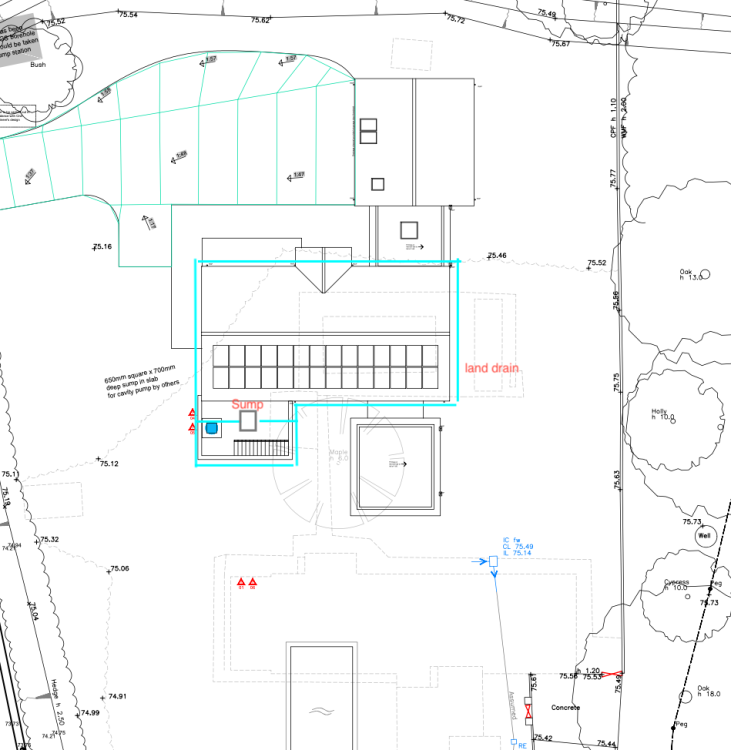
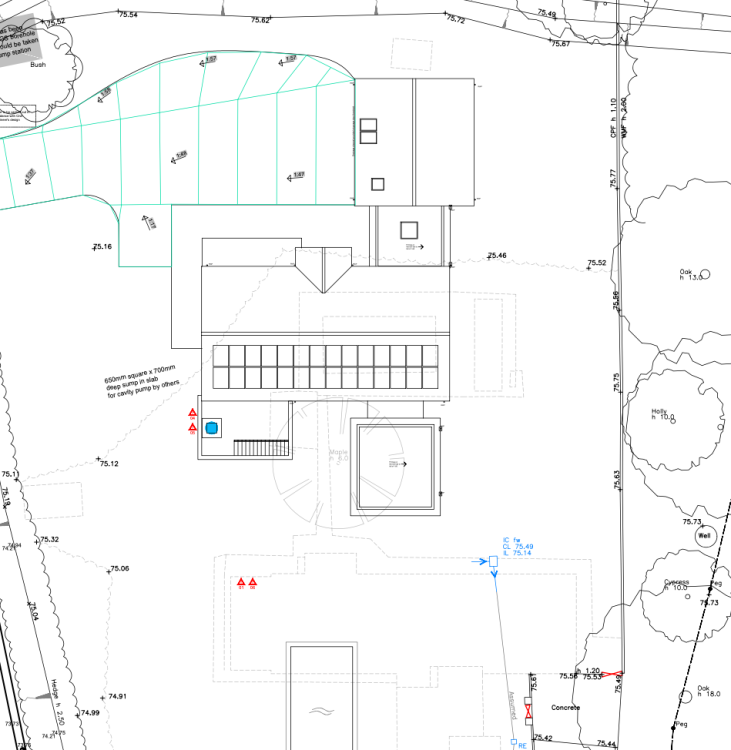
thought I'd add the land drain and sump to the site layout drawing to show that we're collecting water from all around the basement and it all feeds to the sump
-
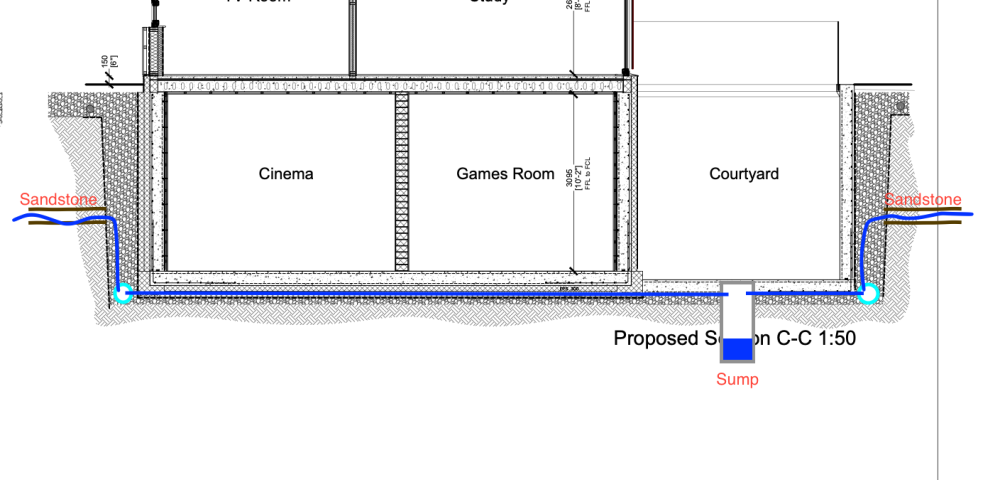
here's a couple of diagrams for you. the entire plot has the layer of sandstone and you can see that everything is flowing north to south downhill. in the first image I've added where we've cut through the sandstone so along the 15m length of the north side of the basement there would be water coming out of the sandstone and down to the land drain and who's to say that along both sides of the house (8m in length) water isn't coming out through the sandstone there as well as it's probably a path of least resistance. so, my theory is, that all of the groundwater north of us is flowing through the sandstone and ends up coming out around our basement and in to the sump. during periods of heavy rain that could be quite a bit of water! I know the pump(s) are working as I can see the water going out to the manhole and in to the RWH tank. so the only conclusion I can come to is that the pipe isn't wide enough to cope. although, it IS coping at the moment as the sump hasn't overflowed. but this whole thing is about mitigating the risk of the sump overflowing and so I'm leaning towards belt and braces and just putting the 50mm pipe in place and then forgetting about it (apart from yearly checks to make sure it's all working!). Also, if I do put the 3rd pump in connected to the 32mm pipe then I can do some magic where if the sump gets to the point of the high water alarm going off then I could automate supplying power to the 3rd 'summer' pump to aid in the removal of the water as I'd have a 50mm pipe AND a 32mm pipe which can only help.
-
if the TF company wish to specify an airtightness target then I would suggest you negotiate a maximum result of 2ACH and no minimum. for them to state a range between 1.5 - 3 means that they probably won't try very hard to get to the 1.5 level but if you specify a max of 2ACH then they have to achieve that and, in doing so, will probably end up at a much lower than 2ACH level. there is a spreadsheet on here that @Jeremy Harris created that will allow you to see the potential benefit of reducing your airtightness and also increasing U-values. as @Iceverge says, airtightness has a massive effect on energy usage and insulation has diminishing returns.
-
I'm also surprised the 32mm isn't coping in periods of heavy rain but I can think of no other reason. when I've been out and the sump is filling up I've checked in the manhole that the 32mm outputs to and the water is coming out at a fair whack so I think the pump is pumping and seems man enough. we have a layer of sandstone about 2m down from ground level on our plot and I believe that it's the main route of groundwater for the area with all the ground water tracking through the sandstone and heading south. since we've cut through that sandstone all the water is dropping down and being collected by our land drain around the basement. the basement is 15m x 8m so it's quite a big area. I'll try and get a video of the water coming out from the land drain during the next period of heavy rain so you can see. the only conclusion I can come to is that the 32mm pipe is the bottleneck. and, tbh, I'd rather not be sitting and worrying about it! if I can fit a 50mm pipe now then I know it'll cope. I can also get the Zoeller pumps as they're 2" outlets and I will be very safe in the knowledge that I've done my very best to mitigate the risk of the sump overflowing.
-
I've been (obviously as I'm really paranoid now!) monitoring our sump during the recent periods of heavy rain and there's been a couple of times I've noticed that the sump has started to fill up with one time it being about 100mm from the top of the sump (and our sump is about 1500mm deep!). so something isn't working correctly with the current setup. when it's not raining or not raining hard then it's all working perfectly but in heavy rain the amount of water coming out of the land drain in to the sump is quite a lot! so I'm thinking that maybe the 32mm pipe isn't big enough to cope. even though it eventually catches up as the rain eases I'm worried that if we have a prolonged period of heavy rain then the sump will overflow. As such, I've decided to run a separate 50mm pipe and try and hide it somewhere. this has led to a few questions! 1. we currently have a 225mm step down from the basement sliders to the courtyard. if I were to run a 50mm pipe across the courtyard and cover it in concrete that will reduce the 175mm. and then with paving slabs it'll be 150mm. is a 150mm step down within building regulations? 2. iirc we have somewhere around 25mm cover over the rebar in the courtyard slab so I could, in theory, channel out some of the concrete to lower the 50mm pipe into the slab a bit. what would the minimum amount of cover I could leave be? 3. what would the best pipe be for the 50mm pipe? it will need to be buried underground. I also think that, in the winter, there's too much water to run the sump output to the RWH tank. the RWH tank is just overflowing. I know we're not using the house at the moment but even with using RWH for toilets and washing machine the amount of rain will fill the tank without the need to put the sump water to it. But, in the summer, it would be great to have the sump water diverted to the RWH tank so in periods of no rain we would still have water in the tank. so I was thinking about keeping the 32mm outlet pipe attached to a 3rd pump and in the summer switch over to that pump and disconnect the 'winter' pumps so in the summer we get sump water in RWH tank but in the winter we use the 50mm pipes and output to the ditch next to the property. any comments on that? I guess the 'summer' pump could also act as an emergency pump in the winter if ever required as well.
-
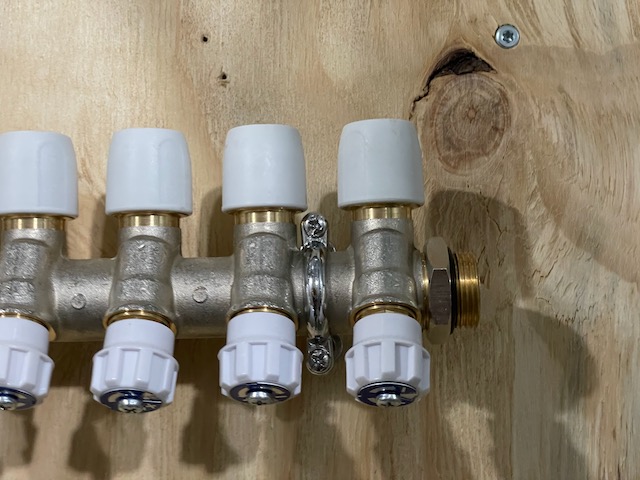
afternoon all and a happy new year to everyone. I have a quick question please. I'm looking to add a drain valve of some kind to the end of my water manifolds (hot and cold) so I can drain them down if ever necessary. what would you recommend to connect to this 3/4" male connector to allow this to happen?
-
I should’ve looked at these as I have a Huepar laser level and love that too.
-
I've got one of these. https://www.screwfix.com/p/bosch-glm-40-laser-rangefinder/1480x love it. wish I'd bought one sooner.
-
never learnt C. did a bit of Objective-C before Apple moved to Swift. and have done some Python and Perl.
-
I've not managed to sit down and learn 3D modelling just yet! I get all my stuff to print from Thingiverse. I've been lucky so far in that I've found models for what I've needed but no doubt the time will come when I can't find what I want and I'll have to model my own. without wanting to de-rail this thread.....any tips on learning 3D modelling?
-
only thing I can think of is being wary of the amount of ducting available to move it. I doubt there's any spare to pull it further so you'd have to move it along the length of the ducting.
-
i bought from rainwaterharvesting.co.uk and dealt with Rob there. Very good customer servicing and to deal with. i liked their Rain Director hardware that supported a 'holiday mode' which would flush the header tank and replace with mains water and stuff like that. our tank is in the ground as is currently full and overflowing as it's not been connected up to the house as yet. i can recommend them as a company to deal with and the product looks good but as it's not functional yet i can't advise on the longevity or functionality of it. hope this helps.
-
i was told i wouldn't need heating in my basement but i installed UFH loops throughout just in case. total materials weren't much more than £500 and we fitted it ourselves so no labour costs. for that sort of cost it's a no-brainer to install even if you never use it in my opinion.
-
I know people have said that they've used Cat7 for the thicker wire but it seems that Cat7 cable is 23AWG the same as Cat6a. so why choose Cat7 over Cat6a?
-
definitely recommend buying from German site Latzel
-
what thickness trirated? I presume that as it's a short distance within the cabinet voltage drop isn't an issue. but if I'm jumpering mains voltage lighting then I presume I'd need 1.5mm trirated/jumper cable? is a rule of thumb that the jumper cable should be the same thickness as the source cable?