Thorfun
-
Posts
4891 -
Joined
-
Last visited
-
Days Won
36
Everything posted by Thorfun
-
I sent an email to Mike and will see what he says. but I've also been looking at these https://www.aliexpress.com/item/32734822895.html that were mentioned in an article that @Dan F sent me about Loxone PWM frequencies and flicker. they seem too good to be true, right? £22 for each RGBW led strip seems stupidly cheap. I know that @joth had some S1-DR units which were supposed to be a little flakey but has anyone actually used one of these 4-channel drivers? the spec says 4A per channel so that would more than cover the 8A for a 10m run of 19.2W/m RGBW LED strip, right? and that's without running 2 x 5m strips in parallel (or have I got that wrong and do you add the 4A for each strip when running in parallel to get the same 8A as a single 10m run?) our WW Led strips are actually only 6 locations but some locations have a couple of strips or more, e.g. around a mirror, within bookshelves, around edge of false ceilings etc. so it sounds like I can buy 4 of these things and for under £100 I could run our entire 24V led strips. am I missing something here?
-
ok thanks. I see you what you mean. so a 5-core cable from the terminal block in the cabinet to the led strip and then a cable from the PSU to the +ve on the terminal block and one pin from each block on the whitewing to the RGBW wires of the 5-core on the terminal block. starting to make sense now! and yeah, an email to Mike might be useful! I'm also wondering if I could use the RGB dimmer for just Warm White LED strips? just use 2 of the 4 pins? I know he has a 32 channel LED DMX driver but if I could amalgamate our LED strips to use one controller it'd save money!
-
ok. so that's starting to make a little more sense, thank you! does the '+' HAVE to be on the first pin due to some internal electronics or is that simply a guide? is it simply a case of, as you say, running each pin to a terminal block in the cabinet and you can pick and choose what goes where? so, in theory, a single RGBW led strip could have 24V on block 9 pin 3, Red on block 4 pin 1, Green on block 1 pin 4, Blue on block 10 pin 2. I'm not saying that's wise to do but is it like that?
-
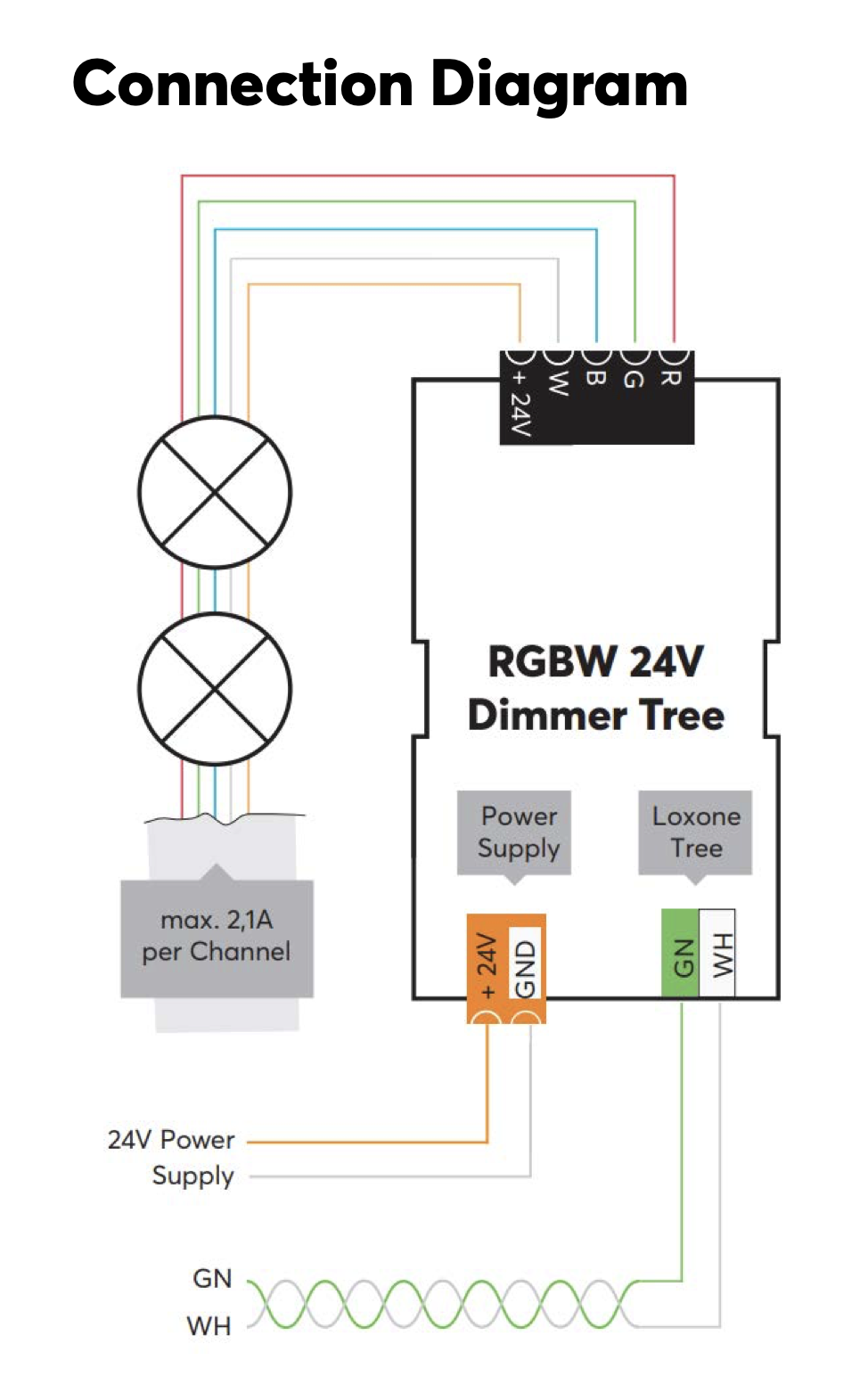
as much as I love the look and flexibility of @Rob99's solution I don't have the depth in my standard LXN5 to house those PSUs and any other large power DIN rail mounted 24V PSUs seem to be similarly deep. I like the simplicity of the Loxone PSU (not the price so much but such is life!) and also the reporting capability and the potential to reduce power to specific lights if too much power is being drawn. I honestly can't see ALL our LED strips being on full brightness at the same time, just like I can't see every audio stereo extension pumping out music full power at the same time so I'm confident that the Loxone solution gives adequate headroom so as to not be running it near capacity. As such, I've decided I like the 'neatness' of the Loxone power supply and backup unit and decision has been made to go with that and I can then power all my 24V LED strips centrally from the cabinet. now I just need to make a decision on how to control them! Can someone please explain to me how the Whitewing RGB Dimmer (http://whitewing.co.uk/rgbdim48.html) will work with wiring? let's start with the RGBW strips. I would presume I run a 5-core 1.5mm (a 12m run to a 5m RGBW Led strip of 19.2W/m is 4A and the voltage drop calculator shows a 0.93V drop over that distance. see I did learn and retain something @Dan F 🙂 ) but how does that 5-core cable get wired at the cabinet end? I'm confused by the 'channels' on the Whitewing and how the 24V power gets to the led strip. it's confusing and makes me want to choose the Loxone compact or Loxone RGBW Dimmer for the simplicity of it! I mean, they even give a simple wiring diagram that a fool like me can follow. that diagram makes sense to me. so I would take an output from the Loxone PSUB (my new acronym for Power Supply & Backup) to the Power Supply connectors on the dimmer tree and then a 5-core cable directly from the dimmer tree to the led strip. simple. the multiple 4 pin connectors on the whitewing doesn't seem logical as I need 5 wires per RGBW led strip. I'm sure it's not complicated but I can't get my head around it. ps. sorry for the long post! 🤦♂️

-
yeah, having that ability would be interesting and would tick the geek boxes in me. also, if I bought more expensive WW Led Strips that were only 5W/m then my total Wattage would be around 930W. Also, if I can keep the Loxone system and 24V lighting going in a power cut from 36V batteries it would reduce the load on my Solar Battery setup allowing me to run more things in a power cut! 😉
-
I think I'm leaning this way tbh. more research is required.
-
I guess something like this would do (I believe @joth has one in his cabinet). https://uk.farnell.com/mean-well/hdr-150-24/power-supply-ac-dc-24v-6-25a/dp/3265809 at £44 each I'd need 8 so cheaper than the Loxone Power Supply and Backup but I have a feeling that 8 of these will take up a lot more space in the cabinet! And also not have the reporting capabilities that the Loxone one does, e.g. per output power usage.
-
yeah, you know I was looking at it and even at £668+VAT it seemed reasonable when looking at the cost of multiple smaller PSUs especially when something like this Mean Well DIN PSU (https://uk.farnell.com/mean-well/wdr-240-24/power-supply-ac-dc-24v-5a/dp/2815676) is £230 on it's own! but I was concerned about it only having 7 outputs as I have 15 WW LED strips. but, I presume I can run more than one strip off one output as long as it doesn't exceed 10A/240W, right? so with an LED strip that is 9W/m I could, in theory, run 5 x 5m strips from one output?
-
I did look at these but the power rating per channel seemed low (48W @ 24V) so I discounted it, but that's probably me not knowing what I'm talking about! Also, each connector only has 4 pins so how does that work with RGBW? how does the power get sent to the led strip? I read through the detailed documentation on the website but I couldn't understand how it all worked. 🤦♂️ thanks. will take a read.
-
I even used a laser level to ensure the clips were inline. 🤦♂️
-
of course I am! 😂
-
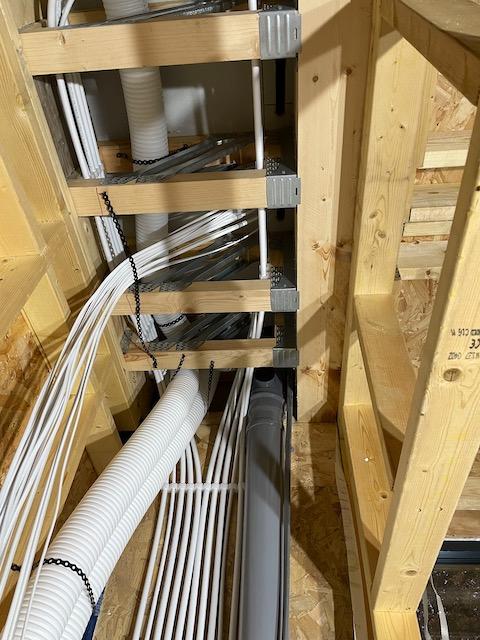
here ya go @pocster. some hep2o for you.


-
sure. was looking at multiple smaller Wattage PSUs yeah, I've got the miniserver needing and all the extensions needing 23W. so would just assume that would be covered by one of the many 24V PSUs. but, you're right, I might as well just add it all up together! cool. yeah, but that should be all of the 24V leds in the house. 15 warm white and 2 RGBW (lighting designer said I couldn't have more RGBW (as did SWMBO 😞 ) ok. thanks. I did read that report on PWM frequencies you sent and it was quite interesting but, unless I read it incorrectly, anything between 90Hz and 1250Hz can all produce flicker and it's down to the driver designer to ensure that a maximum percentage is allowed. so there's no evidence that the 123Hz of the Loxone drivers will produce flicker. but it's something I'll bare in mind. that was the plan! just thought I'd add it for completeness as it might've come up as a potential solution. 😉
-
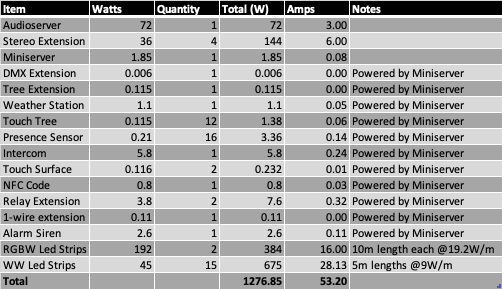
afternoon all, I think I'm improving my knowledge around the whole 24V led strips subject and my attention has moved to the power supplies required for my setup. As if I can get a handle on that I can decide if I want remote or central (or a combination of both) drivers. IF I've got an understanding of it all I calculate that I will need a total of around 1.3kW PSU!! here's my spreadsheet table showing the calculations: anything that says 'Powered by Miniserver' isn't included in the totals at the bottom for the Total Watts and Amps. have I got this completely wrong or does this seem about right for a system of this size? I could, in theory, move some of the LED strips to have remote drivers so they're powered by 230V cable like this that @Dan F sent me https://uk.rs-online.com/web/p/led-drivers/7066684. but I presume I will still need a control mechanism for the remote drivers, like a DMX driver (https://www.downlightsdirect.co.uk/dmx-driver-constant-voltage.html) but if I didn't want to use DMX how else would I control the lights? would that need to be a Loxone Dimmer extension (https://shop.loxone.com/enuk/dimmer-extension.html)? ps. I do have a Whitewing mains dimmer 16-channel (http://whitewing.co.uk/acdim.html)
-
this? https://shop.loxone.com/enuk/power-supply-backup.html that is rather expensive. will take a look though as I'm a sucker for simplicity.
-
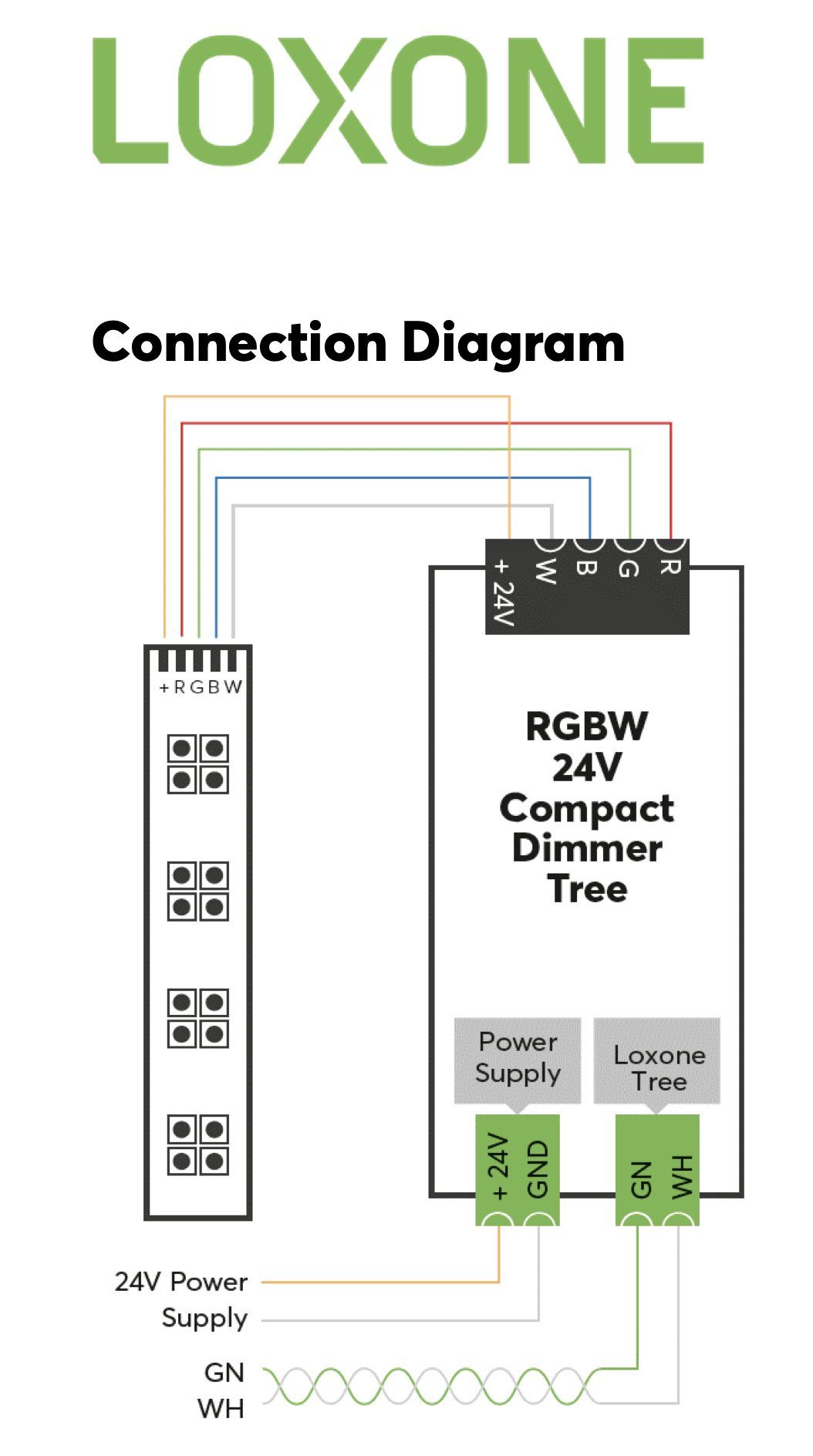
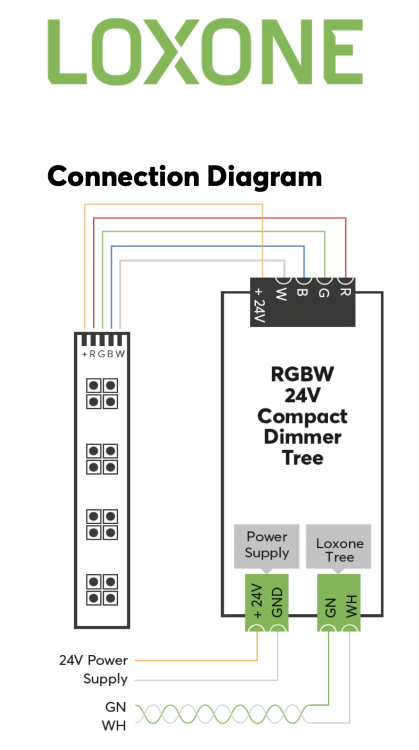
ok. so I am a little confused (electrics get me that way!). let's assume I've decided to go with the Loxone Compact RGBW Dimmer Tree solution. decision made. and let's also assume I've decided to go with 10m of these RGBW Led Strips (https://www.led-lighthouse.co.uk/shop/led-strip-lights/rgbw-led-strip-lights/24v-rgbw-led-strip-lights-ip65/). another decision made. from this diagram in the Compact dimmer datasheet: it shows a 24V power supply and a twisted pair for the Tree connection. Now, please correct me if I'm wrong, but can't the 24V supply be supplied by the Cat6A cable on the orange/white pair? just like a Loxone Touch? and then I would need a 5-core cable of sufficient size taking in to account the voltage drop run from the compact dimmer to the RGBW strip (as shown in the diagram above)? if all of that is correct then my confusion is around @Rob99's comment about needing a T&E and Cat6. can you see where my confusion is?
-
ok thanks. so, in my mind, the second option using a single 10m run of RGBW strip sounds a lot simpler. a single Cat6A from Loxone cabinet to the compact dimmer in the loft void above the room and a suitably sized cable from the compact dimmer to the strip. I presume that the Cat6A cable from the cabinet to the dimmer will take the power the dimmer requires? just like any other Tree device like a Touch or presence sensor?
-
ok. so each strip has a T&E back to the compact RGBW dimmer with both T&E cables terminating at the dimmer? that would be wiring in parallel, right? I did a quick google and found these RGBW LED strips that say 10m = 192W. https://www.led-lighthouse.co.uk/shop/led-strip-lights/rgbw-led-strip-lights/24v-rgbw-led-strip-lights-ip65/ so, in theory, I could get a 10m length of these and wire with a single T&E to the compact?
-
yeah, I just tucked that cable up and out of the way. the double 'X's on the wall denote where the socket is going. glad the SAF clip solution looks ok. I will crack on with that! thank you. 🙂
-
the strips will be run around 2 walls in each bedroom in an 'L' shape. one wall is 4m and the other 6m in length. so would I need 2 x compact RGBW dimmers per room then? 5m of LED into each? seems excessive! any voltage drop calculations I will leave to my electrician so will run any potential solution by him to check the calculations!
-
length will be about 12m from Loxone cabinet to both RGBW Led strip ends. LED length will be about 10m in total I don't know the wattage of the LED strip as I've not got that far yet! I could use remote drivers as there is a void above each bedroom in the roof eaves where I could put the driver and it could be accessible for replacement on failure which is why the solution @Rob99 is suggesting is quite appealing. it doesn't use Tree cable and I'm buying an excessively large amount of Cat6A for automation already so could incorporate another couple of runs easily
-
this is interesting Rob. I presume you mean these https://shop.loxone.com/enuk/rgbw-24v-compact-dimmer-tree.html? so this can go in the loft void above their bedrooms with a single Cat6A cable from the above linked compact dimmer back to the Loxone cabinet and a 1mm2 or 1.5mm2 cable from the above linked dimmer to the RGBW led strip? that seems easier than running 5-core 1mm2 from the loxone cabinet to the LED strip.
-
another question if I may. the kids rooms have planned RGBW Led strips mounted around the edge of the ceiling. I was discussing with the electrician today where the drivers would be and I said I'd probably prefer to put them in the Loxone cabinet and drive the led strips from there. if I'm doing this I presume I need to run 5-core 1mm cable from the Loxone cabinet to the bedrooms to a point where the RGBW led strips will join the cable? just trying to find out if this will work before I buy a drum of 5-core cable. I also presume that one of these https://shop.loxone.com/enuk/rgbw-24v-dimmer-tree.html per LED strip to control them via Loxone? or could I use the DMX extension to control them using a DMX RGBW dimmer? (can you tell I'm a little out of my depth with electrics?)
-
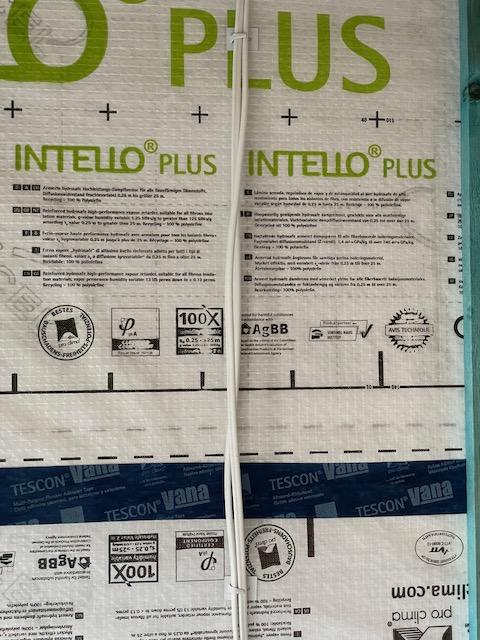
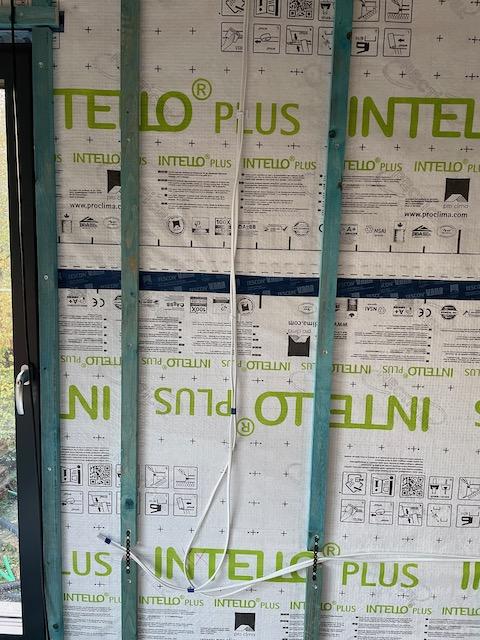
first fix electrics has started and my electrician has been down to tutor me for a day on running cables. where a socket is in the middle of service cavity battens he suggest not clipping the cable to the battens as there's a risk of an errant screw from the plaster boarding but to run the cable down the middle between the battens using SAF clips. I have done one run as a test and the cables are pulling the membrane away from the wall slightly. the electrician said this isn't an issue as they're just there to hold the cable back for boarding. as you can see it seems to work but I was wondering if there was another way? or rather, how have others done this without penetrating the AVCL?
-
you can get AV Venetian blinds which give more blackout. e.g. https://www.hallmarkblinds.co.uk/assets/trojanav90-spec-sheets.pdf