
Cpd
-
Posts
1627 -
Joined
-
Last visited
-
Days Won
7
Everything posted by Cpd
-
Out of interest @JSHarris what frost protection unit did you use, the heater I have has no thermostat.
-
also did this in a bathroom before fitting an extractor fan as the windows were always shut...... sorted out the problem until the fan was fitted. I have also allowed space and an electric socket for one to be fitted in my water treatment plant / cupboard as it’s outside.
-
Potentially Wise words from the wizard...... probably saying what some of us are thinking as we flinch reading this thread. I do hope it goes well but the way this contractor operates is something I personally could not cope with.
-

Silencer - can it be mounted horizontally?
Cpd replied to Weebles's topic in Mechanical Ventilation with Heat Recovery (MVHR)
I really don’t think it will make any difference at all, but will wait to see what others say. -
This was my feeling and why I suggested getting a cheep IR temperature measurer to eliminate this.
-
Might be worth investing in one of these, then measure the temp of the wall at different locations to see if you have some nasty cold spots. Then work out what to do. Image was just the first one of the internet, not recommending it but they are all very similar.

-
The word “estimate “ in the above sentence would give me sleepless nights.......
-
Cleaning/polishing oak flooring after the build
Cpd replied to joe90's topic in Wood & Laminate Flooring
Sorry to hear about this... I have a similar issue in that I have made a staircase with oak treads and put some 6mm ply over the treads to protect them until I could get round to varnishing them, dirt and grit has got under the ply and caused discolouring. My only option will be to sand it down a bit before I varnish it but it’s solid oak so that won’t be a problem. Hope someone can give you some good advice. -
Groundworks Weeks 1-3 and Time Lapse Video
Cpd commented on Red Kite's blog entry in Self Building two in North Wiltshire
Good god ! It looks like your building a supermarket by the size of the worksite..... I would have already been taken away to the funny farm by now if it was my site. I wish you the best of luck, you must have nerves of steel. Will be watching with interest. -
Sound advise.
-
Advice on who to get to inspect this issue
Cpd replied to diy mike's topic in Party Wall & Property Legal Issues
Very strange indeed. You want to be carful before accusing anyone but at the same time you need to find out where the water from the new drain next door is actually going to. Did you get any photos of the works being done, how much excavation etc ? Probably not as at the time it was not a problem. -
Advice on who to get to inspect this issue
Cpd replied to diy mike's topic in Party Wall & Property Legal Issues
Why have you dug out the corner ? Was this before or after the brickwork dropped ? Were you investigating why it had dropped ? -
Old Cottage Restoration + Extension Project
Cpd replied to JulianB's topic in General Self Build & DIY Discussion
https://www.ironmongerydirect.co.uk/product/schlegel-aq21-(ql3009)-aquamac-seal-25-metres-brown-518990# will post some photos later
-
Corrugated Metal Roof - how did you ventilate your panels
Cpd replied to Tom's Barn's topic in Roofing, Tiling & Slating
Best of luck. -
Corrugated Metal Roof - how did you ventilate your panels
Cpd replied to Tom's Barn's topic in Roofing, Tiling & Slating
My roof design is different as it’s vented on both sides of the sarking. I just put the tin directly onto the sarking board. battens and counter battens are the way to go though. My roof is on a glorified shed so not trying to meet any specific standard, more aiming to prevent water getting in and if any condensation does get in then making sure it is well vented. It’s blowing a gale outside right now with the water blowing up the 45 degree roof..... if the closer strips were not in place between the ridge flashing and the tin then the water would blow right up under the ridge flashing and onto the roof membrane and then have to travel all the way down the roof under the tin and out into the gutters !!!!! The closures at the top are essential to prevent this. The bottom of the tin is within the gutter so rain can not get in and wind is minimal but load if ventilation as no closer strips. -
Old Cottage Restoration + Extension Project
Cpd replied to JulianB's topic in General Self Build & DIY Discussion
The door is an easy fix in my opinion (if it opens internally) as I have done a number of my own doors. The quickest way is to attach an external lining round the door reveal. This is what I do. Get some 20-22mm thick timber, treated if possible or treat it yourself. It can be as wide as you like depending on how it looks in the frame. You can router a nice curved edge or cut a 30-40 degree angle on it to make it look better. Assuming that the door is relatively flat.... (check by putting a full length of flat timber up against it) you can then router the slot for the weather seal, remember to re treat the slot with wood preservative before putting the seal in. Once you have assembled / put the weather strip in your two sides and top you can do a dry run and place them in the frame to make sure they are all going to fit snugly. Pre drill holes for your ss screws and them put up your top piece first with the door shut. You need to apply a a bit of pressure to get the weather strip to compress and make sure there is an even gap between the door face and your timber insert. Screw it into place. Repeat this process for both sides. The bottom of the door is more tricky but a quick way to make at least some improvement is to fit a brush seal on the bottom of the door on the inside. A quick way to improve the thermal efficiency is to stick 25mm of rigid insulation to the inside face of the door and then stick some thin ply over this to protect it. You can faff around and make it as nice as you like but again if your looking to get a quick fix until a new door / frame can be fitted then this will make a huge difference.... I know as I have done this to a few doors and then checked with an Infer red temperature device to see the results. I have done these improvements and they are great if your starting from a totally crap draughty door...... This is the cheep and quick way of sealing the external doors with a minimum of one seal. I have just build 3 doors and frames from scratch and made sure that my design incorporated 2 seals all the way round. If you have the money then obviously ripping the whole lot out and replacing with of the shelf quality external doors and frames would be the way to go.... just not an option for me. I can provide more information on seals, equipment and some photos if you decide to go down this road, but I’m flat out doing my accounting at the moment so this is just a quick overview of one option to get you through the winter! -
Being a stonemason who specifically worked in the natural / wild environment that is subject to movement I would 100% agree with this.
-
Got broken in to last night ....
Cpd replied to ToughButterCup's topic in General Self Build & DIY Discussion
Yup still do but with more security boxes or big nasty dogs in with the kit. Still the probability of being robbed is very low compared to if you parked a ute full of tools in any built up area in this country and went to the coffee shop. As always mostly a problem in built up areas, our operations attracted attention as we were using expensive kit and leaving it stashed on site for months at a time so word would get round and eventually some scumbag would venture into the forest looking for plunder. We became very good at concealing our equipment. -
Corrugated Metal Roof - how did you ventilate your panels
Cpd replied to Tom's Barn's topic in Roofing, Tiling & Slating
Nothing in there for mice to be interested in, if anything the foam closures would be there “go to” on the menu. Spiders and a few other bugs might make a home In there but that’s not a concern to me as they won’t do any damage. My reasoning is that I wanted as much ventilation as possible to prevent possible condensation build up and if and when there was any condensation it would dry out as quickly as possible. -
Got broken in to last night ....
Cpd replied to ToughButterCup's topic in General Self Build & DIY Discussion
Very disheartening as always to hear this sort of thing, when living in Australia it was a constant job trying to hide / secure all our work equipment on semi remote sites.... worked most of the time but still had half a dozen incidences. Another fairly major reason why I choose to live in the middle of nowhere surrounded by water..... best of luck with the claim. -
Corrugated Metal Roof - how did you ventilate your panels
Cpd replied to Tom's Barn's topic in Roofing, Tiling & Slating
I have a building that faces south west and into most of the incoming storms, I left my tin open at the bottom and open at the top, I then put a vented ridge on and used the foam closures between the tin and where the ridge flashing met the tin to stop rain driving up under the flashing and onto the roof membrane. Air is free to travel up the roof below the tin and out the ride at either end, also I did not seal the joints of the ridge flashings as they have a good overlap and this will allow some further ventilation. Then just for good measure I left a vented gap below the timber sarking / sheeting and vented this out the gables. It’s a glorified shed so probably well over the top but living in an extremely wet environment I wanted to go overboard on ventilation. I have a tin roof on another house but this faces East with the gables facing north to south and never gets driving rain from anywhere but the gable ends so I did not use any closure strips and it works great. -
Totally agree, “words are wind’ good luck with your build and I look forward to some photos. C
-
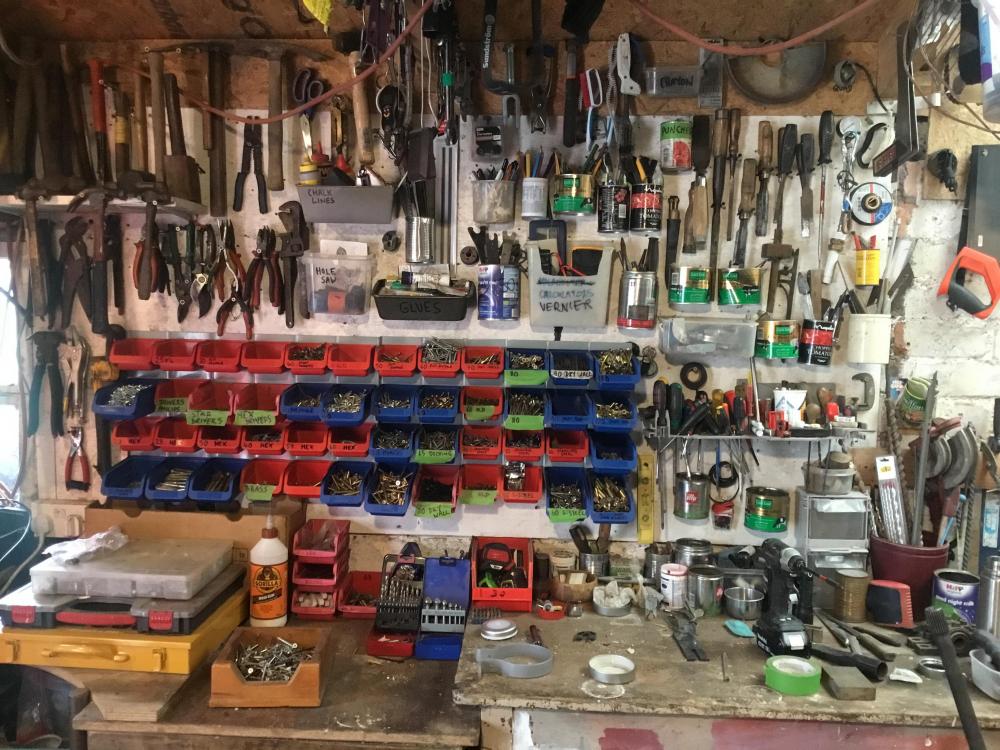
I have pretty much used / using 95% screws on my buildings, just used ss ring shank nails for the cladding and that was it. I constantly restock from 20mm all the way to 150mm as my project is ongoing and multi dimensional........ they are easy to access on the wall.
-
Flashing: some sympathetic advice please
Cpd replied to ToughButterCup's topic in General Self Build & DIY Discussion
This is how I do it as well. -
Pantry keeping it cool with mains water pipe underfloor
Cpd replied to passivhybrid's topic in Underfloor Heating
Sounds great !