


Conor
-
Posts
4165 -
Joined
-
Last visited
-
Days Won
12
Everything posted by Conor
-
Ok, that design is very reasonable and I wouldn't push him too hard on it. Just make sure the rebar is all bent and cut to spec at the factory as it'll be a nightmare to work with on site. I am assuming you will have a contractor doing this all and not yourself!!!
-
How are you finding the usability and reliability of the coolenergy unit? Good point about the rads, think I'll do the same. Are they on a supply each from the.manifold or shared?
-
Over here, the DPM normally goes on top of the concrete slab and under the insualtion. 100mm PIR isn't very much, and I'm worried that your architect only specified 75mm. What's their insualtion / cold bridging / airtightness strategy for the rest of the build??? What's your predicted SAP?
-
Is that a 240m² slab? As in you're building a three story, 720m² house?! If so I'm not surprised by the spec. It's a normal amount of steel but the 20mm bar is unusual. It will be very heavy and difficult to work with. Definitely ask if you can use two layers of mesh in the slab and 16mm starters.
-
What's your panel setup? I'm going for 50% south, 25% east and 25% west.
-

Temporary Stairs - Cut and Join two Halfs
Conor replied to NewToAllOfThis's topic in General Construction Issues
Made these stairs today. £100 of timber and about 6 hours. 3400mm going and 3000mm rise, 900mm tread width. Made with 225x50mm cls. The lack of a protractor and basic trigonometry skills easily added two hours to the build time. Might be able to repurpose them for the basement if they survive. (Yes, handrail etc to be added)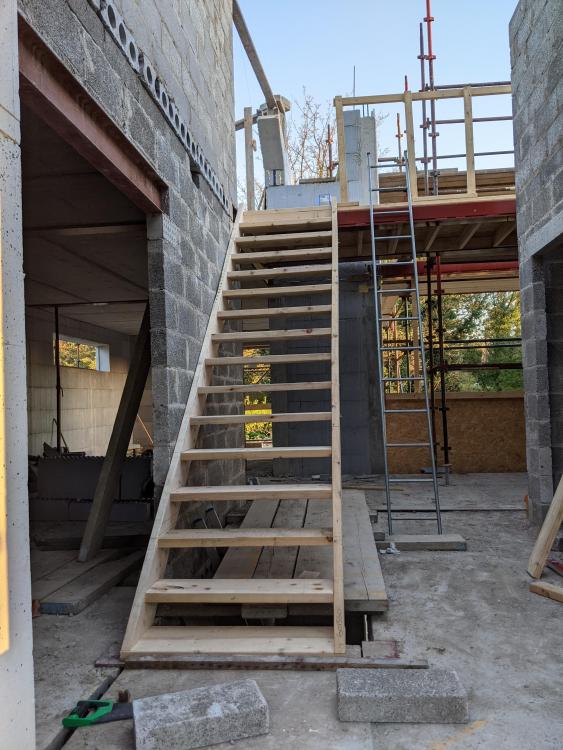
-
Top 3 MVHR brands?
Conor replied to ashthekid's topic in Mechanical Ventilation with Heat Recovery (MVHR)
If you're looking for high quality, you can't go wrong with anything passive House rated, e.g. zehnder -
You'd probably be best submitting an application now with your new build. You can chance your arm with an non material change with the planners and see if that gets through... If it's not too big and out of sight you should get away with it.
-
Steel straps as above is the only way to do it. You can't fix in to the top course as the course itself can be pulled off in high winds, that's why you strap and fix in several courses down.
-
Drilling Through 11mm Thickness Steel Beam
Conor replied to NewToAllOfThis's topic in RSJs, Lintels & Steelwork
Just go up in slightly bigger bits. E.g. 4mm, 6mm, 8mm etc. Nice and slow, loads of bodyweight and with some cutting paste. Buy loads of bits. I got a erbauer trade pack from Screwfix. I drilled a couple dozen 8mm holes like this in no time last week with my cordless Makita drill in same weight steel. -
Cheap Way To Raise Internal Floor Height By 150mm
Conor replied to Johnny Jekyll's topic in Heat Insulation
75mm is too thin for that amount of insualtion. Up it to 100mm. You should be able to get EPS boards for £20 or less. Ring round local merchants and ask for best price for the quantity you need. Some merchants don't bother much with EPS so you'll never get a good price. Trick is finding one that sells in high volume and trades regularly. -
Hi, we're new to self build, Glenarm, Northern Ireland
Conor replied to Kerry Rhodes's topic in Introduce Yourself
@Kerry Rhodes check with a mortgage broker how many lenders will cover a SIPs build with a non rendered cladding and a large flat roof. Might have limited choices when it comes to remortgaging after you have completed. -
The steels should be resting on high density padstones or pre stressed heads cut to size, not ordinary blocks. I can't tell from the photos what kind of blocks they are. Also, it would be better to use resined in bolts rather than expansion bolts. Either way, they need to be redone.
-
thoughts on using landscape designer
Conor replied to MarkyP's topic in Landscaping, Decking & Patios
We're in exactly the same position. 2.5m level change from front to back of the house, and another 7m down to the burn. We've been searching everywhere for a designer that shares our taste... Only one we found ghosted us after the initial consult lol. Seems gardening tastes here are very conservative and traditional, and designers seem just to cater to that. -
We're going for 3g Internorm alucald PVC units, from my research best compromise of performance, looks and cost. We're going for a very light silver colour on the outside, and the standard white PVC on the inside. We both agree that dark grey has been done enough. Our worst unit is about 0.8 (small bathroom), and the best are under 0.7.
-
@dpmiller a place at Temple that my ground worker found.
-
Your estimates are way off. A good ground worker in a 15t machine and a stream of tippers will have that done in a few days. Also try and keep as much as possible on site for future backfilling and landscaping. It's absolutely critical to do your homework and find a home for your excavation risings. We got a place that charged £120 to collect a 16t load, and £50 charge for our lorry to dump. All in, moving 750t of soil cost just under £10k. If we'd gone for the first place that was over £200 a load, that £10k would have been over £16k.
-
Get a price per slate. We've been quoted £1 per slate Inc valley lead, ridge and laths.
-
Feck. We've just measured up for our windows and assumed Alu cills. Assume too late to change to concrete as we'd need to rip out a portion of the wall openings?!
-
Heating required
Conor replied to stubiff's topic in Mechanical Ventilation with Heat Recovery (MVHR)
An MVHR can only move about 1.5kw of heat through it, unless you have massive flow rates. I'm incorporating a water heater matrix in my MVHR for the first floor as we've no heating up there. It's more to help cope with those rare very cold periods. We're building a passive House and the peak heat load is only 2.5kw, so this air heating should help in our case. Same for summer cooling. It'll take the edge off. The short answer is no, don't rely on an MVHR for significant heating, but look at your overall heat losses and peak heating loads. A well insualted air tight house (near passive) should need minimal heating and ground floor UFH once a day should keep you happy. -
Temporary Stairs - Cut and Join two Halfs
Conor replied to NewToAllOfThis's topic in General Construction Issues
Was in this position as well. Builder was going to hire me a set for £250 for "as long as I need it", or I could have bought flat pack stairs for about £300. But as the roof isn't on yet, they'd get ruined. In the end I've just ordered 5 lengths of 215x50mm timber for £100 and I'm going to make a set myself some evening. -
Starting first Fix - Manifolds and pipe types etc
Conor replied to Conor's topic in General Plumbing
Thanks all, very useful. I'll not worry about insulation then. So 10mm is fine to sink outlets then? That'll make things a bit easier and cheaper. -
Starting first Fix - Manifolds and pipe types etc
Conor replied to Conor's topic in General Plumbing
I thought it was a BC requirement? -
Starting my plumbing very soon and figuring out the design. From this wonderful forum, this is what I'm thinking: (300l UVC setup with ASHP, good mains pressure around 4bar, 32mm supply to the building) Hot and cold water manifolds - 22mm supplies. One pipe per outlet or one pipe (H&C) for each room? E.g. for a WC pipe for the cold wash basin and separate for the toilet or tee off? 10mm pipes are preferred for frequently used hot water outlets. Should I use 10mm for everything except showers and baths? Insulate hot water pipes - I can only get 16mm pre-insulated pipes locally. Is it a pain to lag pipes? Three story building - one set of manifolds in the basement or a separate one for the top floor? Pipe types. Pipe Life PEX pipe is the best value (10mm Qualpex). Is this the right pipe for the job or is something like this barrier pipe better? I don't see the difference.... This should get me started for now... I'm not worrying too much about the heating side just yet, just want to start bunging pipes in!
-
100mm EPS isn't nearly enough. We have 150mm in our basement plus an extra 50mm PIR. It's only about £20 for a 2.88m² sheet of 100mm EPS 70 silver. Would only take a day or two to stick it on to the entire basement with expanding foam adhesive.

