


Declan52
-
Posts
4449 -
Joined
-
Last visited
-
Days Won
10
Everything posted by Declan52
-
I set my heating to come in at 6am when it is the time for it to come on most days, October to April depending on how cold it gets. So my boiler is fired up and heating my 350l tank. At 6:30 my programs for all my stats kick in. I have the living room, kitchen, sun room set to 21, the other rooms 20. If at 6:30 any stat is lower than the set temp then it will call for heat and start to warm up my slab. They will continue to call for heat until they get to whatever temp they need to be, usually takes around 60 mins before you would feel heat under your feet then maybe another 60 mins and it will have got to 20-21 and turned the demand for heat of. The rest of the day the temp on the stats are set back so they don't call for heat unless it's really really cold as in -10 type weather. Then the next morning the cycle starts again. Some mornings depending on how cold it got during the night there might only be 1 zone or could be 5. So you are basically heating the slab up once in the morning, suits my family this time as the house feels warmer for kids going to school and me and the wife going to work, and then it will continue to heat the house after the stat has turned itself of for the rest of the day. This assumes that you have built your house to a high enough standard that it won't leak like a tea bag.
-

Flashing: some sympathetic advice please
Declan52 replied to ToughButterCup's topic in General Self Build & DIY Discussion
I would run a bead of whatever cheap silicone you have knocking about along the bottom edge of the wall to form a temp bellcast to throw the water out from the wall away from the gap till you are ready to finish that front. -
Flashing: some sympathetic advice please
Declan52 replied to ToughButterCup's topic in General Self Build & DIY Discussion
Fill the rest in and make sure you push it in so it completely fills the gap and then leave it smooth and nice and neat. It really should have been built in at the start but you are where you are. The other option would be a grinder and cut a slot into the wall but that won't be easy and will be very messy. What is your final finish on that section??? -
A lot of the details on your list your architect won't be one bit interested in. Things like your av equipment, lights and ethernet requirements will be dealt by your spark. All your bathroom details by your plumber and wherever you intend to buy the goods from. You need to strip that list right back to things like how you want the house to look from the outside, white render or wood cladding or stone. What you want it to be made from, timber, block etc. The size of the rooms and how you move from room to room, things like do you want a kitchen or a kitchen dining room play room entertaining room all in one type setup. Position of Windows and their heights so you can look at a view for example. How well insulated the want the house to be, you won't be able to sleep in a bedroom that is 24 degrees. Basically all the structural elements is the only things the architect really wants to know. Then it can be drew up and you can see if that suits what you had in mind. Change the bits you don't like then after a few revisions you will have your plan. Once you have your plan then you can go to a timber frame company, groundwork crew,spark, plumber,mhrv, lift supplier etc and let them have a look at it and see if it all can be done the way you want it to be done. You can then change an internal wall position for example if it needs to be done for your lift.
-
What about something as simple as a length of guttering. You can attach the gutter to a batten at whatever thickness suits so the gutter sits under the lip of your roof material. Then batten out to near enough plumb and put your cladding on as normal. You could chamfer the top length of cladding so it appears to slide behind the gutter to still look nice. Would be a simple relatively cheap solution and it doesn't really matter if it collects any water or not.
-
You look at old boreholes like you have done. Sometimes when you strike water its a tiny trickle that takes all day to fill the standpipe. Others it's like you have found old faithful geyser and the water hits 4/5m high and you get a free very cold shower. We hit an artesian well on a job in an underground car park in Belfast and very very nearly flooded the whole floor of the car park, about 8m depth of water. Had to be pumped out quicker than it came in which was a lot of water and then a large steel cap bolted to the floor, borehole filled with powdered bentonite to plug it and welded shut. That was a fun few days!!!
-
Ugly MVHR vents
Declan52 replied to vivienz's topic in Mechanical Ventilation with Heat Recovery (MVHR)
Very true there are weird things that will catch your eye that no-one else sees. I guess we are all a little ocd with different things. -
Ugly MVHR vents
Declan52 replied to vivienz's topic in Mechanical Ventilation with Heat Recovery (MVHR)
Mine are in over 5 years now and I can't remember walking into a room and looking up at the ceiling on my way in. Things like fire alarms and carbon monoxide detectors are far more unsightly than these vents. If you want to have mhrv then you will have vents in your ceiling. -
Could you do the ground floor as planned and use attic truss to form your roof. Your upstairs will then be ready for you to do what ever you need to do in the future when you feel the need.
-
Ugly MVHR vents
Declan52 replied to vivienz's topic in Mechanical Ventilation with Heat Recovery (MVHR)
Once you are in the house a while you don't even notice them on the ceiling. -
You could have set it on your top pad and had it hitting a piece of timber sitting upright on the bottom pad which would have gave you a precise height difference.
-
So they don't put any silicone down in behind, just a tiny bead on the top edge. Think I would want a bit more than that.
-
There is nothing above like any kind of flashing to stop rain hitting your wall and running straight on down till it hits the timber. You could loosen the Bolts a tiny bit and put some good quality silicone in between the upstand and the bricks. Tighten the bolts up and clean of any excess. Best long term option is to cut a lead tray into the brickwork.
-
Waste Pipes under B&B Foundation without Manhole
Declan52 replied to Patrick's topic in Waste & Sewerage
Put it like this if a brown trout gets stuck on its merry way down your pipe then how are you going to ensure its removal without a rodding point. -
Working platform suggestions - internal blockwork
Declan52 replied to Digmixfill's topic in Tools & Equipment
Buy better blocks!!! There isn't much you can really do if they are that bad. -
Working platform suggestions - internal blockwork
Declan52 replied to Digmixfill's topic in Tools & Equipment
It's much easier and quicker to check every 3 blocks assuming you have a good long level, 900mm. The top edge you can see how good they are by how close they are to your line. Then you plumb the middle of the first and 3rd block then use the level as a straight edge across the 3 blocks from the middle points to make sure you haven't the bottom edge in to far. The easiest method is to set your trowel on the wall flat and run it up and down to clean the snots. If it catches a block then it's sitting out to much. -
2cm isn't going to make much difference.
-
Working platform suggestions - internal blockwork
Declan52 replied to Digmixfill's topic in Tools & Equipment
Why would he be moving the scaffolding every hr?? Going by his 2.5m height he would be safer building it 6 course high from the ground then the other 5 from the scaffolding. Lifting blocks upto the 7th course is where it can all go wrong so better to leave that bit out. Your going slow problem is due to either one of 2 things. If the motar is skining over then your mix isn't right or you're bedded to much ahead of yourself. If your tapping away like a Morse code operator then your bedding isn't right. The weight of the block should take you to the line with a tap depending on how level you set the block down. You should only use the level to check for plumb every 2/3 course not every block. -
Working platform suggestions - internal blockwork
Declan52 replied to Digmixfill's topic in Tools & Equipment
A 4 meter run is just 3 trestles and 8 8ft plank, that's all he needs as 4m is the longest wall so why would he need to go longer. Takes a few mins to lift each trestle and 2 planks at a time and move to the next wall. You have never worked on a building site and watched how a full time squad work. They build flat out each hour, every day every week. Your always carrying money over to cover for lost days due to bad weather. It's how it's done. You asked how long it would take to build 9 blocks and I told you. You cant extrapolate that up at a block a min due to everything else that needs to be done.When your building block walls each day you aren't just building blocks. Your building your corners outside skin and inside if you haven't internal profiles, your setting your line, you have wall ties to put in and insulation if that needs done plus not forgetting to keep the wall plumb and clean on both sides. All your openings need cut blocks and then all need plumbed. Your lifting 4m 9*4 concrete lintels and matching 6" cills because everyone likes big windows except the poor buggers lifting these very heavy bits. Believe me once you have lifted a few of these first thing in the morning your not exactly bouncing out of you skin with energy. All of these things mentioned all take time some lots of time. Plus don't forget that if it's a 2&1 squad then both brickies have to also build enough to cover the labourers wage. They make his wage and the labourer makes theirs. If he hasn't the scaffold ready with blocks/ bricks and mortar ready then no one makes any money. -
Working platform suggestions - internal blockwork
Declan52 replied to Digmixfill's topic in Tools & Equipment
There is nothing wrong with using trestles as long as you understand their limits. They have no edge protection built in so unless you add this you can fall of pretty easily, been there and got that t shirt a few times. If your going to be loading up the platform then keep all the blocks stacked over the trestle and I mean a proper builders trestle not that you thing in the original post. A smart brickie wouldn't have motar out of the mixer going off when you are moving the trestles. If it takes you 50 mins to lay 9 blocks then you seriously need to stop looking at Facebook, Twitter, Instagram and buildhub, put your phone away and lift the trowel. 9 blocks for even an amateur should take no more than 9 mins and that's even taking the piss. -
What about a bevelled fence rail. https://www.mickgeorge.co.uk/cant-or-bevelled-fence-rail.html
-
Wow !..........so much to learn and so little time !
Declan52 replied to Canoehq's topic in Introduce Yourself
Is it not an option to go back to planning and see if you done a redesign and changed some of the glass sections to something like dark grey/black corrugated cement board. These sections will be much cheaper and will still keep the barn look that they want. Otherwise your going to be living in a greenhouse in the months when the sun is low in the sky. -
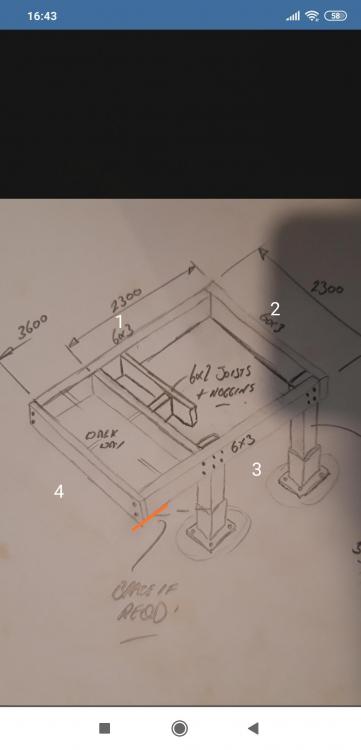
So make beam 1&2 up to give you the L shape. Have you posts cut and in the shoe but not fixed to the pads. Have your L beam resting on the top pad on the raised bit and your post with shoe and clamp. Move the L till it's level then clamp to the post. Mark with pencil under the beam for one side and use a level for the other edge then cut your notch on both sides. Then lift the L into place and onto the post and put a screw in just to hold it together. Lift beam 3 and rest it on the notch and do the same procedure with clamping it to the post with the shoe, leveling it,marking it and then notching it. Then lift on again to both notched posts and fix with a screw. Then beam 4 . Fix a temp piece of timber underneath beam 3 so it sticks out beyond so you can set beam 4 on the top pad raised bit and on the temp piece of timber. Then using your L brackets fix it in place. That will give you your square shape. Go round and make sure the diagonals are the same so it's square. Move if needed. Check all the beams for level and the posts for plumb. Move any bits that aren't. Once your happy every bit is plumb, level and square then bang the rest of the screws in so it's solid. Then check all again esp the diagonals. Mark the shoe holes in the pads. Slide the frame out of the way and drill your holes and fix the rods in place. Once they are set lift the frame up and drop it over the rods and put the nuts on and tighten it all up. Then that's the main bit all done. After that it's just measure your joist spacing at 400s and put the hangers on. Check and double check every thing. Don't just wack them on. The twist nails are a nightmare to pull out. With all the hangers on then measure and check and check and cut the joists, drop them into the hangers and fix. Deck complete. Open tin of beer and put fresh plasters on all your cuts and then set back and look on with pride.
-
You screw/nail the bracket to one of the beams then offer it up to the other and then fix it. Then put the coach screws in at the ends.
-
You use something like these. https://www.screwfix.com/p/sabrefix-heavy-duty-angle-brackets-galvanised-90-x-63mm-25-pack/69361 The weight will be on whatever you intend to use to lift your beam up. What have you chosen for this task.The fixings just hold it all together. Use your bars to fix the posts to the base. If you have some left over then use them for the beams to the post. Don't just be buying all your bits from Screwfix. I just use it as a guide to show you what I mean. Take the info for the coach screws and L shaped brackets and see if you can source them any cheaper closer to where you live. If Screwfix are the cheapest then fine but always try other places. Every penny counts.


