joth
-
Posts
2861 -
Joined
-
Last visited
-
Days Won
5
Everything posted by joth
-

Manifold system versus hot return system
joth replied to Russell griffiths's topic in General Plumbing
If it's only needed for the kitchen then it is not so essential as could be done via a TMV off of an instant boiling water tap like the quooker combi, which is what we're doing as we're having the boiling tap anyway Saves on some system complexity -
Air Source Underfloor Heating compatible with carpets?
joth replied to patp's topic in Underfloor Heating
Largely depends on how much insulation is under the UFH, and how energy efficient the rest of the house is. If you solve both those you can have as thick carpet as you like and the heat will eventually come into the house and stay there, as it has no where else to go. Caveat being very slow response times (as is common anyway in high thermal mass, high efficiency builds). If you have insufficient insulation under, or have a high heating demand because the rest of the house is inefficient or drafty, then the carpet is just yet another impediment in the way of the heat getting out of the pipes and into where you want it as fast as possible. -
Is it a cold basement or do you have floor insulation under the basement slab too? Only 100mm insulation really isn't much to put under ufh, you'll find a lot of energy escapes downward into the basement
-
Fan Coil Units for use with a (cooling) ASHP
joth replied to ProDave's topic in Air Source Heat Pumps (ASHP)
Of course, I meant zone 2 (downstairs) to the higher target temp... ? -
Fan Coil Units for use with a (cooling) ASHP
joth replied to ProDave's topic in Air Source Heat Pumps (ASHP)
We're using the mitsubishi FTC5 controller that has specific function to manage 2 zones at different flow temperatures, here's a snippet from the MI that explains it. Fan coil will be zone 1 and ufh zone 2, we'll set the zone 1 to a higher target temp so the fan coil should rarely come on. For cooling we'd probably reverse the preference so fan coil runs first.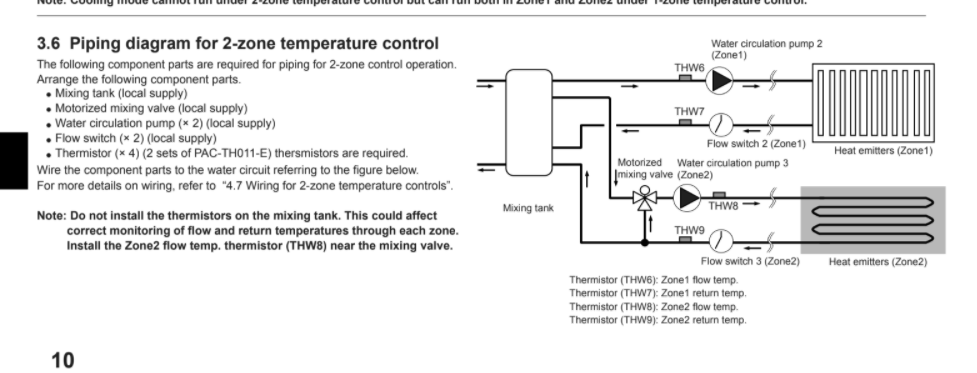
-
Fan Coil Units for use with a (cooling) ASHP
joth replied to ProDave's topic in Air Source Heat Pumps (ASHP)
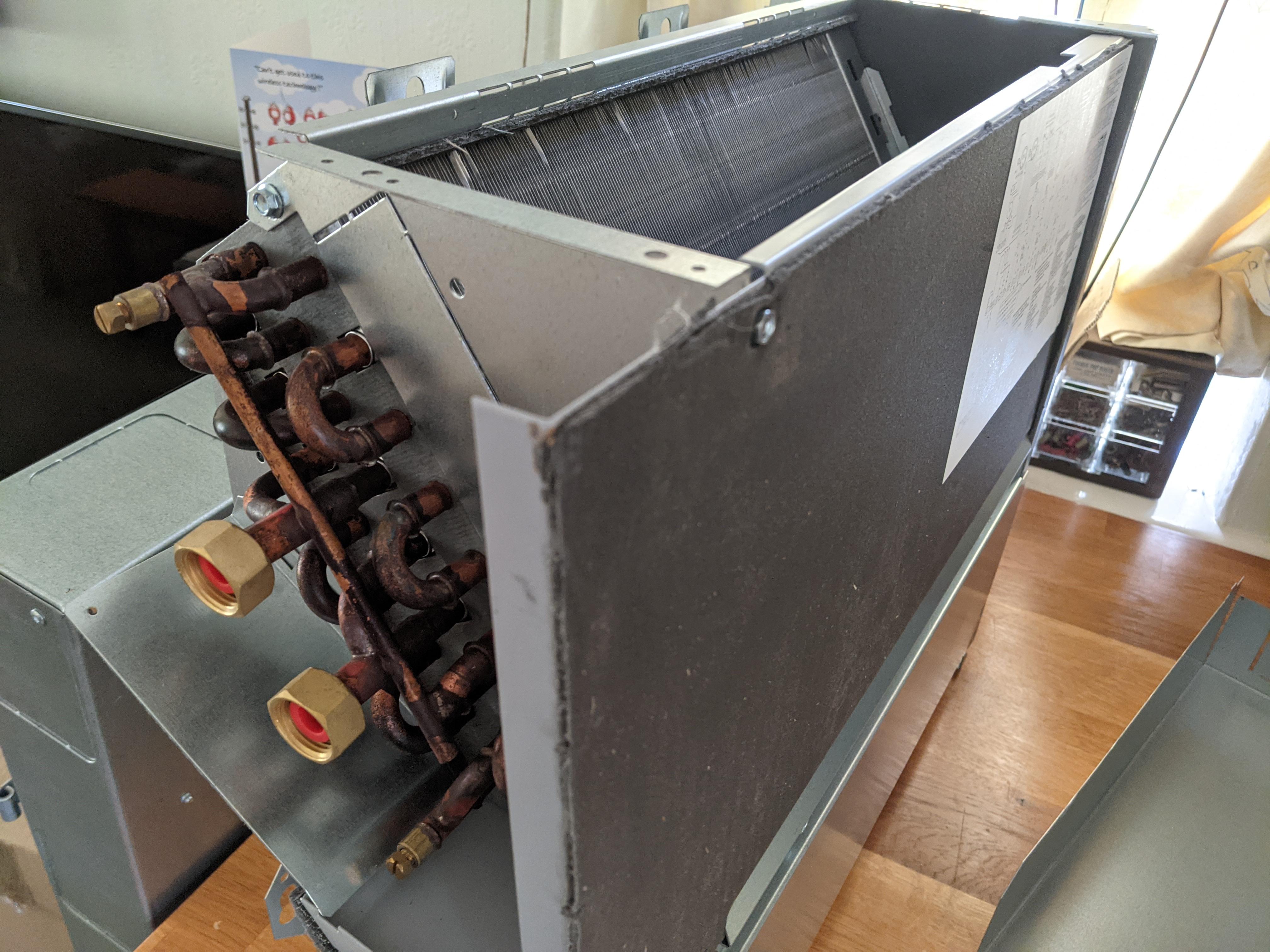
I ordered this one https://www.shopclima.it/en/panasonic-paw-fc-d15-aquarea-compact-fan-coil-with-left-side-connection-1-5-kw.html It's clearly just a systemair unit: https://shop.systemair.com/en/scc202plg2/p402066 (haven't worked out exactly which model number) - they didn't even bother reprinting the MI with Panasonic branding, says Systemair all over it -
The first internorm door I picked (random flick through the catalogue and stopped on a page that looked OK) cost more than the 2G in my entire last house (about 8k) so we discussed our front door asperations and realized having it in the exact same range as the windows and patio doors is absolutely fine. It's not even visible from the front of our house (around a corner) and we'll likely put a porch over it too, so all in all going undertstated felt just fine. @canalsiderenovation my guess is you'll love what you've chosen and a year or two of people complimenting it you'll wonder why you ever worried ? [same issue as I'm going through with internal lighting right now]. Out of interest do you have other visible timber details on that elevation? That would really tie it in, but even without that I expect it works great as a small accent. (The one look I'm really not keen on, but seems increasingly popular trend around our way, is where people have an oak frame porch around an all-oak UrbanFront-alike door, but the entirety of the rest of the fenestration on their 1930s multiple extended mini-mansion is in uPVC. )
-
Fan Coil Units for use with a (cooling) ASHP
joth replied to ProDave's topic in Air Source Heat Pumps (ASHP)
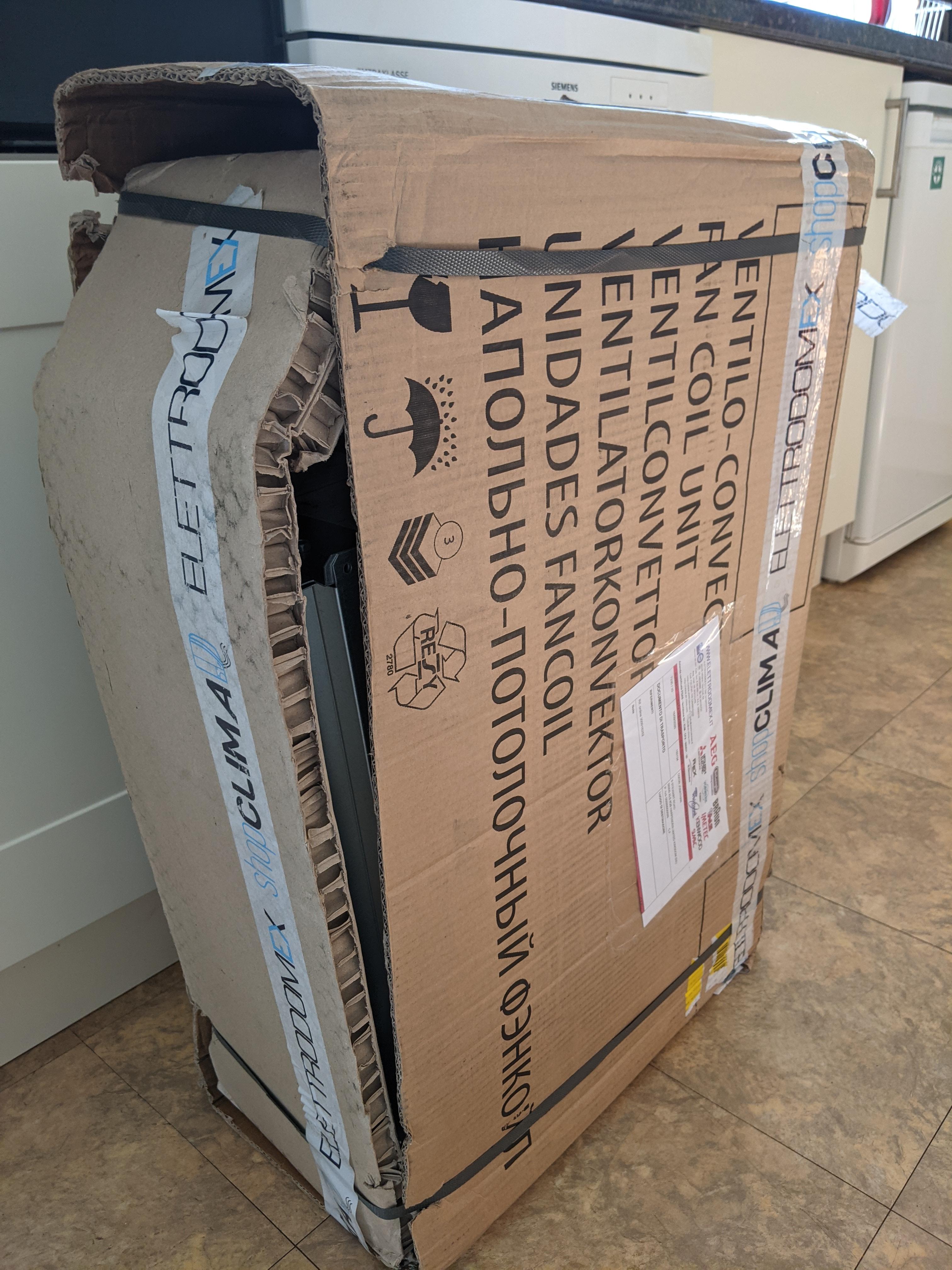
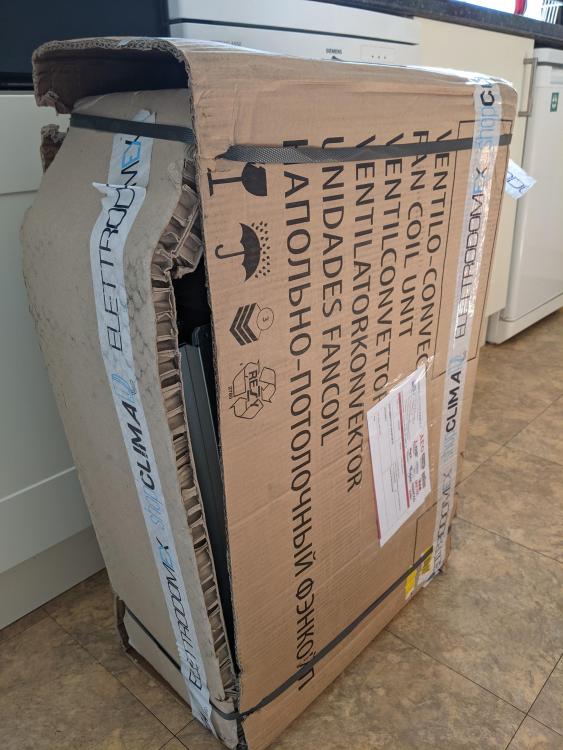
It has arrived! Although the box it arrived it was 90% destroyed, visual inspection it seems ok and mercifully the loose items in the box were still there. Next up will be an electrical and water (air??) leak test €289.00 delivered from ShopClima, took about a month from order to on-site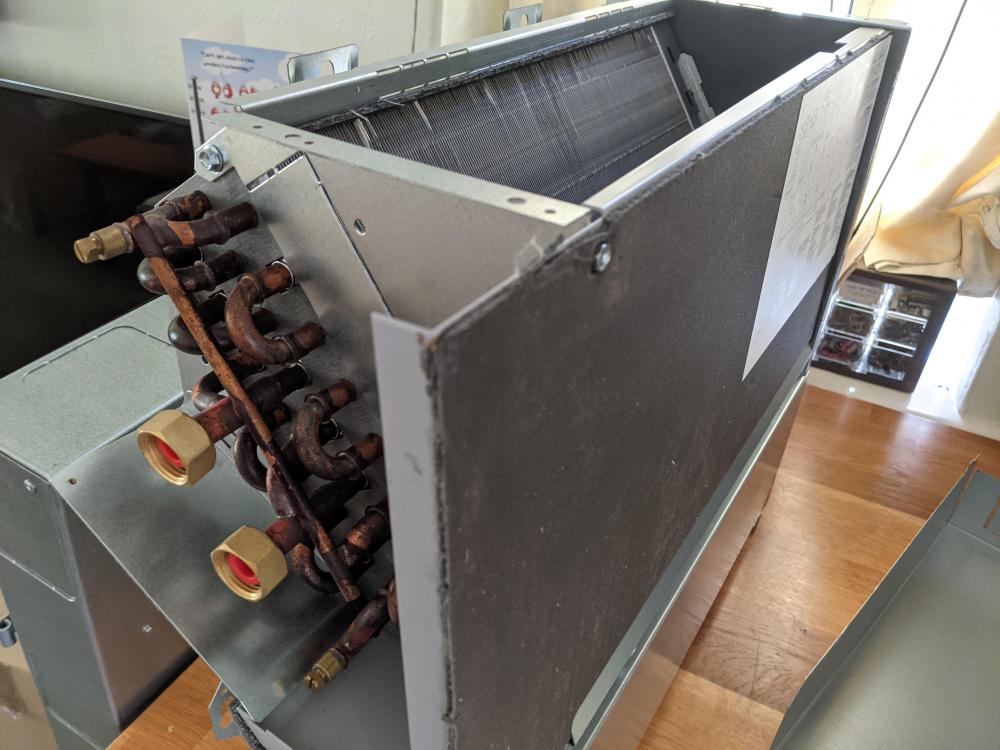
-
Yup. We had 2 heat loss calcs done for MCS and both came in well over twice the peak heating load that PHPP reckons. They tend to assume worst case on airtightness and one ignored our stated U values too. On the plus side, as a retro fit we could install the ASHP against the old EPC which makes it almost worth it. But GHG avoids that hoop jumping too.
-
I had 2 detailed quotes (and about 4 price indications) for my passivhaus retro fit with down-stairs only ASHP heating and none of these installer mentioned this requirement. This is with us having direct-heating in the upstairs bathrooms, and none in bedrooms. Check page 24 of https://www.ofgem.gov.uk/system/files/docs/2018/07/essentialguideforapplicants_july_2018.pdf possible confusion: - If you have "Backup heating" (including hybrid ashp/gas boilers) you DO need metering for payment. (But can still claim RHI, so long as you submit those meter readings) - Any backup heating source(s) that only warm a single room (such as portable electric heaters, or indeed my bathroom UFH mats & towel rails) do not trigger the above clause so metering for payment would not be needed. (Interesting that guide doesn't have a peep to say about needing metering for payment if the ashp supports cooling, which one installer claimed was the case. This makes total sense as any active cooling will not have any impact on the accuracy of room-by-room heat loss estimate of heating demand from the ASHP)
-
ASHP retrofit suitability - 1960s chalet bungalow
joth replied to Ommm's topic in Air Source Heat Pumps (ASHP)
Thanks! Could you point to where you found this? Just so I can continue my reading up to decide if I push for GHG or just go with RHI. GHG gets around the "must be metered for use (and metered for payment? who knows) if combined with cooling function" of RHI so simpler on that front. But GHG will require me to get a third "formal" quote, even though I already have a good price from someone that's being very helpful too. -
I've been annoyed by this too. Feels like it'd be fairly easy to have a standard protective ring to place over the plasterboard. Ah yes, this does exist: https://c-fix-downlighter.com/pages/c-fix-liner pretty good idea? (They also do a repair kit) In lieu of using that, I was going to postulate whether coating the plasterboard opening with PVA prior to inserting the DL would help. I was discussing exactly this with a lighting designer today, and for me the summary was, GU10s are great for the reasons you mention if generally aiming to wash an area in downlighters set-out in a grid. Integrated LED fittings come more into their own if used for very specific focused purposes as they offer a lot more control (beam angles, quality of dimming, high CRI, etc) but tend to be overkill in simple flooding an area with light sort of designs.
-
Sticking at 48V makes sense, above that DC becomes more dangerous for humans to deal with. (This is the reason PoE and phone networks both land at/around there) https://electronics.stackexchange.com/questions/267789/how-safe-is-48v-dc/267797
-
Yes I'm midway through a DMX install. I built up the LXN5 cabinet during lockdown part 1, 32channels of mains dimming and 48channels of LED 24V dimmers, plus some relays and options for constant current dimming. Starting 1st fix next week and currently panicking that my lighting design is inadequate/inappropriate/unimpressive and getting a professional designer to review and improve it so all subject to change! And real recommendations will need to wait 9 months until it's been in and used a while. But in meantime these are the parts I used and happy so far (as in, they all appear to work) https://m.aliexpress.com/item/4000831173626.html https://m.aliexpress.com/item/32837953011.html https://m.aliexpress.com/item/32445284627.html https://m.aliexpress.com/item/32444739690.html https://m.aliexpress.com/item/33040978707.html The final one is a dmx splitter which is very useful to allow branches in the bus, and avoids power on noise interference between the branches. The triac mains dimmers have about 2W standby draw do to save on 30W of base load I power them off completely with a relay when unused, but the do judder a bit when powered up. The mains stuff I wanted CE marked ("Chinese Export" scam as it is) and enclosed, but low voltage stuff I'm increasingly comfortable buying the boards and squeezing into my own DIN enclosure. Not sure I can help much for non loxone controls. Fwiw a minimal loxone install would be about £700 for a miniserver, 20 way Digital input, and a dmx bridge. To get value from it you at least need some motion sensors too, I'm using https://m.aliexpress.com/item/33001159734.html but with the noisy relays removed. Non-loxone wise I think the options for DMX are either completely proprietary professional install (control 4, high end lutron etc) at which point the control protocol behind it is fairly academic to the user/owner, or completely home brew perhaps using something like Home Assistant and an ethernet to DMX bridge. That needs internet access for setup and remote management, but otherwise should work on an airgapped network after a fashion. But again if going that route I might forgo the DMX completely and just use esphome flashed onto Tuya based smart light bulbs and so forth. The elephant in the room is KNX, being standards based and open with a lot of light switch vendors supporting it, it should be the obvious answer to work with. I found it more expensive than loxone, less appealing end result, and far far less inviting to self install (even with the loxone trend towards discouraging self install) but I know others have made this work for them. Most find DALI fits the KNX ethos better than dmx though (less centralised? More tunable white support?) but again that jacks up the costs. Finally, I think you can get DMX colour mix wall switches like https://www.google.com/amp/s/h5.aliexpress.com/item/32693927499.html but that honestly looks a mess and like it locks out all the benefits of home automation, but could be ok as a "get me started" choice. Someone once said words to the effect "home automation lighting control industry is a mess" and this still very much holds.
-
The daily kWh is largely irrelevant, what is the peak power in watts? (Or the peak amperage) An electric cooker alone is 3kW plus, which is 100amps at 24V so fairly challenging to power on it's own.
-
Experiences with larch and cedar cladding
joth replied to Nick1c's topic in General Construction Issues
Hi Lizzie Do you have any photos 1 more year on of how the house cladding is weathering? Has the new age gris been successful in avoiding any black spots forming? Thank you! -
Ufh manifold, blending valve with ASHP.
joth replied to Russell griffiths's topic in Underfloor Heating
https://www.jtmplumbing.co.uk/central-heating-controls-valves-c436/esbe-valves-controls-solid-fuel-products-c509/mixing-valve-c511/esbe-valves-actuators-3-point-p19117/s20737?utm_source=google&utm_medium=cpc&utm_term=esbe-valves-esbe-ara652-3-point-spdt-230v-6nm-60s-actuator-esbe-valves-esbe-valves-esbe-ara652-3-point-spdt-230vac-6nm-60s-actuator-12101700&utm_campaign=product%2Blisting%2Bads&cid=GBP&gclid=EAIaIQobChMIha-U0qrw6wIVgc_tCh0Q0gfiEAQYASABEgJx4fD_BwE Noice, thank you sir. Looks like ESBE ARA662 3-Point SPDT 230v 6NM 120S Actuator is the one: mains operated and 2minute open->close run time, which is the "default" and recommended setting in the FTC5 controller. (MI Page 44: "Set the Running time according to the specifications of the actuator of each mixing valve. It is recommended to set the interval to 2 minutes that is a default value. With the interval set longer, it could take longer to warm up a room.") ? do update us with what you find. The FTC5 looks pretty comprehensive and well thought through. Possibly a brain-ache to setup, but I am hopeful it's going to suit us really well. -
Ufh manifold, blending valve with ASHP.
joth replied to Russell griffiths's topic in Underfloor Heating
Right, the ASHP we're using (Ecodan 8.5kw) controller has an output to manage an electrically actuated mixing valve, see snippet from the MIs copied below. It has thermistors on the flow and return to the UFH so in priciple can be as good as a thermastic analog valve, failure modes excepted. This is quite a nice setup, as it means the ASHP can do the right thing to actively manage cooling as well as heating temperature for two emitters running simultaneously at different target temps, and also in principle could close off (set to bypass) the mixer valve when the zone is not being actively driven, which would allow the zone pump to overrun too (i.e. support 24/7 UFH recirculation as discussed above). Now assuming we don't trust this setup to protect our expensive floor finishes, yet would still like to have that motorized mixer valve for the fine control it gives, would it make sense to use both a blending TMV pumpset and the motorized valve? We'd put the TMV on the UFH side of the motorized valve (i.e. integrated with the pump). For this exception situation only use-case, using a standard (less expensive) TMV from wunda that only goes down to 30ºC maybe ~OK as this would only close off in error case anyway? (Still can't help it feels OTT. The alternative safety measure that comes to mind is to put an additional thermistor in the floor screed or on the UFH flow pipe, and have it trip a relay to cut out the pump if it ever exceeds a set point). Bonus question: recommend me an appropriate motorized valve? ? (2L+N connections) Cheers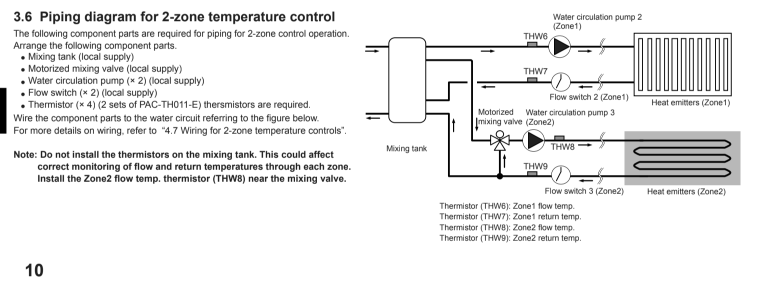
-
MVHR and vaulted ceilings
joth replied to Tom's topic in Mechanical Ventilation with Heat Recovery (MVHR)
See @Conor comment last week: -
RIP Buzby

-
Just found this was already discussed in depth last month over in this other thread, although I'm drawing different conclusion to there!
-
Thanks all! Yeah think I got that bit fine -- it's the opposite case, TMV is open (drawing in from the hot flow source rather than bypassing) but the ASHP isn't feeding the UFH zone (e.g. because it's being used to heat the UVC, or it's forced off during peak-rate price surge) that was my concern. Got it. So in summary, using a bufferless design and allowing 24/7 UFH recirculation are mutually incompatible. If we want the option of running the UFH pump when the heating is not on (e.g. to balance temperature in the very sunny south facing rooms with the cooler open plan north side of house, per JHarris's setup) we need to have a buffer tank of some sort. (And sizing it is the follow on question per OP) Final question: am I right in using "Buffer tank" and "Low loss header" interchangeably? Or is there a technical difference between them?
-
@ProDave do you have a separate pump for ufh circulation and a blending valve? This is the setup our ASHP installer has recommended (8.5kW ecodan, no buffer or LL header) and I'm wondering what happens when the ufh thermostat drops below setpoint so is "calling for heat" but the ASHP not on or is charging the cylinder? The ufh pump will be pushing against a closed valve?? So do you need to lock out the ufh circulation pump to only run when the ASHP is active for that zone? Put another way if we wanted to run the ufh pump all day to balance temperature of rooms (like @Jeremy Harris) we have to have a low loss header, right?
-
?

-
They don't really do panels only, but they were about 1.2 £/W including inverter for a part roof RIS supply only, jumping up to almost 2 £/W for a full roof including installation (and it took some negotiation to get it down to that price). The full roof is extremely specialist as the frame and panels have to be made _exactly_ sized to fit so they're pretty reluctant to provide it supply only. Also the aluminium frame is very unforgiving of the slightest undulation in the roof. Altogether a terrible choice for a renovation as we're now finding ?