


joth
-
Posts
2918 -
Joined
-
Last visited
-
Days Won
5
Everything posted by joth
-
 Left over from my build, all using protocols I decided not to go with in the end 1x GIRA KNX bus PSU (2nd hand from ebay) 1x Theben ts8f-2-e 8 way KNX digital input 7x Osram 350-1050mA constant current DALI LED dimmers (2nd hand from ebay) 1x 32 way modbus digital input (aliexpress special) Yours for the cost of P&P (or free free for collection in Herts or N1C London). If you feel compelled, or there's strong competition for any item, donations to buildhub coffers or shelter welcome ?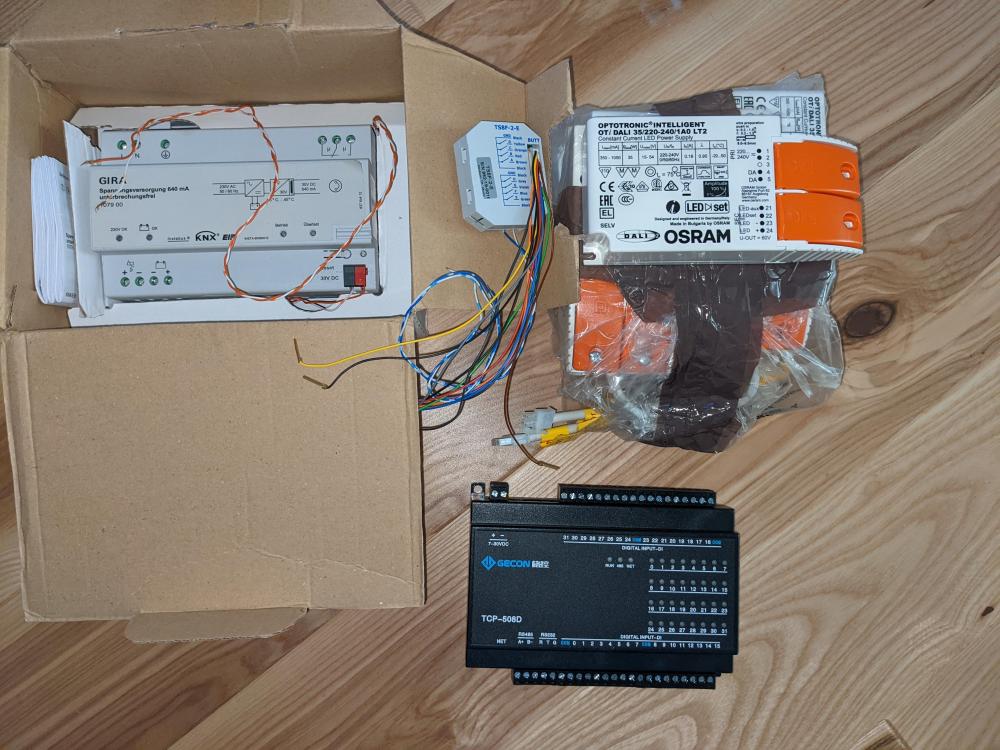
-
Octopus Go is 4x the price in peaks vs off-peak, so it'd take a massive drop in COP overnight to offset the financial benefit. I guess if the outside temperature subzero and so doing a lot of defrost cycles it might approach or even fall below a COP of 1, but I've not seen that in practice. If this was purely about Go I wouldn't be so interested, but the same applies on sunny days (like today) when the midday sun is generating >3kW we can run heating at 1/4 of the (opportunity) cost of importing electricity, and again it makes sense to run the ASHP as hard as possible when the electricity is cheap. Indeed, I can perhaps even modulate the flow temperature based on the exact level of excess generation, but I'm a long way off that! (Eventually I'd like to see if I can make the smarts smart enough to deal with dynamic pricing like Octopus Agile; while the last 6 months has shown the version of Agile they implemented reveals too much exposure to wholesale prices, I can imagine a future variant that has a capped 24-hour average price but dynamically shifts around the peaks and troughs of pricing throughout the day based on supply/demand patterns.) Altogether the project is see how far I can get with demand load shifting, before inevitably throwing in the towel and buying a house battery.
-
Ha. Well it was working ok but failed to come on last night: at some point yesterday I'd fat-fingered the thermostat control in Home Assistant and turned it from Flow to Room based control. Exactly the sort of error that shows how in appropriate HA is for heating controls unless really carefully done. Anyway in principle I can get much finer control driving flow temperature from Loxone as it can see every room temperature, outdoor temp (Inc recent averages and forecast), UF slab temperature, current energy price, number of people in the house, etc... My current project is maximizing heat output during the Octopus Go cheap rate, which means running it at the max safe flow temperature. So I can initially put e.g. 38°C water into the pipes and back it off as the screed starts to warm up, to stabilise around 29C flow temp for 26C screed max temp.
-
+1 to that. I have Loxone control system that can modulate the flow temperatures very nicely, but trying to get the ecodan to listen to it was a job of work: HTTP to Home Assistant, experimental for of the MELcloud integration sends it to the Mitsubishi cloud and from there back to my FTC6. . I wouldn't consider such a pukeworthy setup for long term use, but have done it for now just to test out how much more control it gives me over flow temperatures than using the FTC built in compensation curve. (actual call for heat is still done via the relay dry contact input to the FTC, so if the cloud is unavailable it should still all still work, just with suboptimal flow temps)
-
Looking for internal dimensions of Wago wiring center (L32 L60)
joth replied to joth's topic in Electrics - Other
I was passing TLC so I just bought one (L32)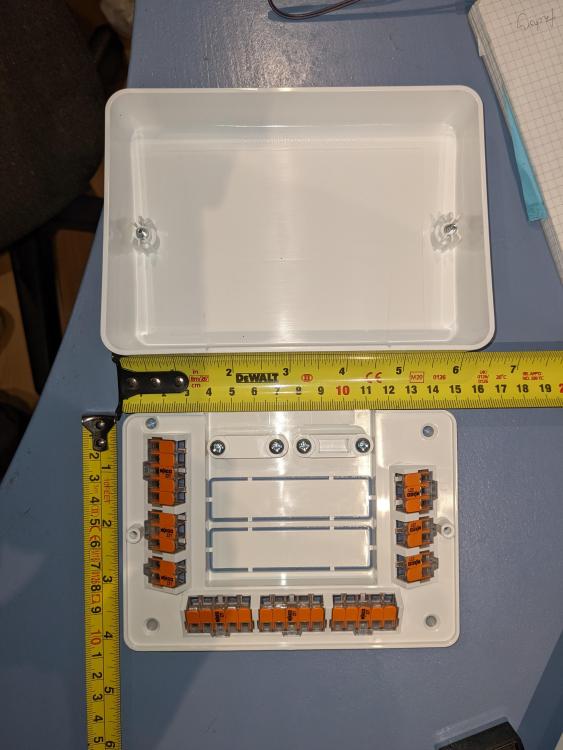
-
My experience (PV and ASHP) is Installers generally only work with a few brands, and often only have experience with a few specific models from that brand, so when they say "you can't do X" they actually mean "I've never done X" or "the brand I work most with doesn't support X" or "X is extra effort so I prefer not to quote for it". Do you have a smart meter? If so, there's definitely no downside to just putting the PV on a single phase. Batteries on a 3 phase installation is also a solved problem. Try some other installers. To be fair the extra £150 maybe just a faff factor for dealing with a non-standard install, which is their prerogative.
-
What cables to use within a HA cabinet?
joth replied to Hilldes's topic in Networks, AV, Security & Automation
@Hilldes If you don't already have one, invest in a good IDC tool with a metal bit and automatic cutters and a hook for when you mess one up ? -
Looking for internal dimensions of Wago wiring center (L32 L60)
joth replied to joth's topic in Electrics - Other
Cute! To be clear, I'm specifically not looking for DIN mount, but printing a holder had never occurred to me. I'm time-poor so if something like that is available commercially, for WAGO 221 3 or 5 way that would be ideal You are very neat with your cable tying. Have you considered a career in hand modelling? -
Anyone got any of these and could post a picture of it with a tape measure up against? https://www.tlc-direct.co.uk/Products/WAL32.html https://www.tlc-direct.co.uk/Products/WAL60.html Context is I'm looking for a small enclosure for ESP32 microcontroller, with captive terminal block (for easy wiring peripherals in, like 1-wire sensors). Ideally I'd like space to put a ESP-PoE in it, about 100mm long with the ethernet jack (a bit less if I can cut a hole in the case to have the jack externally accessible). I can use smaller wifi only devices too, if necessary. There's plenty of wiring centers with chock-block mounted inside, but not so much with sprung terminal connectors. Interested if there's other options available? For larger installations I have DIN rail cabinets, but DIN mounted terminals work out very space inefficient for remote sensor device where I just need a small microcontroller board and 3x 5 way Wago (for example).
-
It's even worse than that: you need a specific version of their controller hardware designed and tested to work with the specific heat pump make/model being installed. They literally build and ship different hardware depending on what it is going to be connected to. About as far from "drop in replacement" for a hot water tank as you can imagine. Goodness knows what happens when the heat pump controller FW is over-the-air updated and a corresponding change is needed to the SunAmp controller to continue to work with it. Shipping out a new revision of their hardware appears to be their state of the art.
-
The nearest I know of (I've not researched extensivley) is SolarEdge SE3680H can be oversized to 5700kWp of panels, and supports a DC-coupled battery. Solax have a similar offering X1-HYBRID-3.7T https://midsummerwholesale.co.uk/buy/solax/solax-x1-hybrid-3.7-triplepower https://www.solaxpower.com/wp-content/uploads/2021/05/X1-hybrid-datasheet-1.pdf
-
£7k to £9k. Do you have any link to a supplier for that? Most the systems I've seen designed for home install are just under 1£ per Wh, e.g. about £9000 for a 13.5kWh powerwall. So it'd be circa £27,000 to get (just over) 35kWh of storage the Tesla way.
-
I do. I'll try and find my copy of Excel and tidy up a version and DM you
-
Ducts for wires through external insulated walls?
joth replied to Dreadnaught's topic in Timber Frame
Pleasure! Forgot to mention the usual tip, angle the drill slightly downward on the way out and loop the wire downward on the outside, so if any weather does makes it way to it, it won't travel back along it into the timber frame. -
Ducts for wires through external insulated walls?
joth replied to Dreadnaught's topic in Timber Frame
FWIW where it was just one wire going out (external light / socket / speaker) we drilled through the whole lot with a 2 foot auger drill after the warmcell was blown in and sealed. Then fed the cable through a pro-clima grommet and then through the wall. Grommet taped down to the OSB airtight layer. This seemed simpler and allowed lots of flexibility in placing the wire much later in the process. In places where there's a bunch of services going through, we did the duct through the wall approach. For BT/virgin cable, I did debate running the duct all the way from the wall up to the AV cupboard, so new services (fiber etc) could be pulled right the way through in future, but decided it was too much effort and liable to snag anyway. https://www.ecologicalbuildingsystems.com/products/airtight-windtight-systems/pipe-and-cable-sealing/grommets https://www.ecomerchant.co.uk/walls/airtightness-products/service-grommets.html -
1/ definitely install "wet" underfloor heating pipes into whatever poured screen/concrete subfloor you are using. This can be powered from anything: direct electricity, electricity via a heat pump, gas, oil, wood burner, aviation fuel, burning stray kittens; any heat source really. Electric mat is a one-trick pony, whereas wet UFH is completely versatile: if it can be used to warm up water, it can be used to drive wet UFH. 2/ If ASHP is impossible mains gas would definitely be next best choice (pending confirmation of the connection price). but I'd definitely push back on UKPN. Have you got a contact to phone? I found them to be extremely helpful once I finally got through to the right person in the projects team. (About different matters: extending a G99 offer period, and repeatedly rearranging power connection schedules due to COVID reasons) A 12kW ASHP sounds large for a 100m2 property. Was it over-sized to allow for faster DHW reheat times? If so you maybe able to downsize it, and increase the UVC tank size (to avoid running out of HW). We have a 160m2 property (EnerPHit, so near-passivehaus) and we could have gone with a 5kW ASHP for heating demand. We upsized to 8kW for DHW reheat times, and I've never seen it draw more than 3kVA from the grid, same as a kettle.
-
I know exactly what you mean here, but I found once I had signed up and paid a deposit my MCS installer was happy to share the spreadsheet with me, and I could tinker with the numbers to bring it in line with our EnerPHit spec. The MCS model does include room-by-room air change/hr and even thermal bridge allowances Wish I'd known the the flow temperature was a key determining factor for RHI. We never run ours above 30ºC to protect the wood flooring, but the MCS cert has it as 35.

-
Internorm typically come with keyed-alike Winkhaus euro-cylinders. I got useful info on how to order additional keyed alike barrels by emailing their UK support (Julie responded to my request): Winkhaus UK Ltd Customer Care Telephone: +44 (0) 1536 316000, option 1 Mailto: enquiries@winkhaus.co.uk I would have replaced them all with Ultion key-alike cylinders, as they're much better security rating, but their largest size is 45 x 75 and several of the Internorm 3G doors need 45 x 85. What a difference 1cm make!! Lol.
-
Advice needed before I tackle the installers!
joth replied to MattB67's topic in Air Source Heat Pumps (ASHP)
They don't actually say that. They say allows lower temperature to be put into the heating circuit. In many houses (I'd almost wager the majority, certainly, the majority where CH was a retrofit) a lot of pipework is uninsulated and travels in cold voids outside the useful thermal envelope of the building (e.g. under floor voids or in the loft). By extracting more heat in the room (i.e. increasing delta T across the radiator itself) it will reduce the average temperature in the circulation pipes (esp the return pipe, but potentially also the supply pipe if the whole system can now run a bit lower) thereby reducing the wastage from the pipework blowing out the building in useless locations. Put simply, if you can improve the ratio of energy delivered to room vs energy wasted in the pipes, then getting the same amount delivered to the room will require less total output from the boiler. that is all irrelevant to a well designed system in a low energy house where "wastage" in the pipework is still in the thermal envelope so not wasted at all. -
Basically, no, solar PV never will. The second-by-second variation in sun hitting the panels would make it very unstable source, and unable to respond to a sudden increase in demand like the kettle being put on would cause a house brown out. So all PV inverters include automatic cutout function to avoid "islanding" in the case of grid outage. Many (most?) domestic batteries do support off-grid mode though, and these will often generate the appropriate waveform to "trick" the PV to think it's still connected to the grid and keep working. So second by second variations are buffered over by the battery, either consuming excess generation (charging the battery) or backfilling the gaps in generation by discharging the battery. It's possible the battery will even speed up or slow down the frequency it generates as the battery fills up, to signal to the PV to back off generation (analogous to how the grid frequency changes at times of over or under supply, and PV inverters are required to respond to as part of G98 regulations) There's also DC coupled batteries that solve all of this within the PV inverter. More specific answers would depend on exact make/model combos chosen.
-
This is just for the occasionally used shower, and the occasionally used basin tap? Seems kinda overkill and will likely lose as much in heat losses as actually get useful use. Why not an instant electric shower heater, and a boiling water tap with hot-water tank (like Quooker combi, but there are cheaper alternatives)? The latter will do for the office tea service too. Easy enough to put it on a timer or motion switch so it's not consuming anything during long winter months.
-
Yup: this is exactly my point. Interest from the paying customer has moved on significantly, and now the professionals have been caught napping on the job.
-
The north of England and Scotland use a different Long Range Radio system built by Arqiva, so entirely depends on whether they have coverage in your area, nothing to do with mobile signal https://www.smartme.co.uk/technical.html Rest of the countries use mobile phones, backed by O2.
-
What year was that? We found a night vs day difference in general interest in Passivhaus between starting our planning (Jan 2019) and completion (mid 2021). The local FB renovation group had never had one mention of passive house (or heat pump) at the start, and no local professional expertise. We were lucky to find and employ an architect fresh out of doing masters in PH design (so ours was her first certified project). But 2 years on, there's a question about low energy houses every other month, and a recent one had 4 people mention they're midway through a PH design using our architect ? But regardless - this is my point: RIBA should at very least have got basics in place so when a customer like you (or @puntloos) come along asking for energy efficiency measures, they could reference a check list of things to discuss, and know how to find specialists to advise on them. Otherwise you end up with the classic case of people being 3 weeks into the onsite phase and suddenly panic and ask their architect what "sustainability measures" they can add. Cue 2 crap solar panels retrofitted, and an EV charge point.
-
Yes you may be right. Cuppa tea before/after washing up ? If you have secondary return then it maybe fine? My Quooker combi is fed from the (softened) cold main but I have plumbing in place that I could put it in the DHW instead and draw off the secondary return from the junction with it. I have a motion sensor over the kitchen sink and a temperature probe on the pipework so easy to give the secondary a return a quick whizz when anyone is in the area if it's not at temperature. Practical savings of all of this are likely nil hence I've not bothered yet, but the idea still attracts me and yes, softened water makes for much better tea. There's a few areas where water is so hard that it's unadvised to drink it from a softener on a regular basis, but we're (just) clear of that area. It's minute levels of salt compared to one processed meal item.




