joth
-
Posts
2861 -
Joined
-
Last visited
-
Days Won
5
Everything posted by joth
-
 Yup condensation is a function of air humidity and flow temperature (assuming that it's impossible for the slab to be colder than the cold water entering it) so no in-slab sensor needed for the use case in mind That aside, +1 to DanF get some DS18B20 and drop in various locations. If you're at all handy with a soldering iron EspHome is easy to get running as a simple bridge to view the data in Home Assistant. I still have a few sensors burried just in case that I've not bothered to connect yet. But cost pennies to put them in. Note there's a lot of counterfeit sensors out there so if encasing in concrete may as well try and get the legit article https://github.com/cpetrich/counterfeit_DS18B20
 -
I think firmware rot is far more likely than the PSU. Tbf it's been doing this sporadically for quite a while, I've just been slow to address it. I would tinker more into it, but I bought the complete project in the hope I'd not have to do that. I much prefer tinkering in smaller (ESP) or larger (dockerised) systems. For some reason raspberry pi always seem to be the least sweet spot for my preferences.
-
My emonpi is randomly freezing (responds to Ping and ssh but taking forever to reply on port 80, and mqtt outputs no longer being issued) and needing a reboot for no apparent reason, so I'm pondering trying IoTaWatt instead. Can't see positive confirmation I can just plug emonpi CTs direct into IoTaWatt but seems very plausible. I'll need to figure a way to extend the 4 outdoor CTs into the house (rather than buy 2x IoTaWattt) but that's feasible over one length of CAT6-A (yay for screening). Main holdback is the lack of realtime API to display current values in Loxone. MQTT is low priority for the developers: https://community.iotawatt.com/t/availability-of-mqtt Just a primitive UDP output would be sufficient - in fact, much simpler to process in Loxone. All that said, now I have direct modbusTCP interrogation of my SolarEdge inverter, having real time data on all the other feeds in the house in Loxone is lot less critical. It's mostly of interest for logging (which is natively supported via influxDB or emoncms) as real time decisions are all about PV / storage / import/export levels. The only other real-time integration I have is automatically adjusting kitchen lighting and ventilation when the hob/cooker is on. Hmmm. The live view dashboard in Loxone is cute and I'd miss that, but it does but hellofa load on the miniserver (and on its SD card) which is not really critical to running the house, so maybe I'd be better offloading that to Home Assistant anyway - it looks like that now has a native IoTaWatt integration. Hmmmm.
-
I love ours, and doubly so in the After Times of working from home. But your case does sound very borderline. You know they're not frightfully hard to retrofit should the need ever arise. And I say this as someone with a irrational fear of plumbing
-
Thanks for this. I guess it was updated since 2019? Back then our M&E guy told us we had to have room controls (and though didn't need them) due to part L, and I read it up that was the case.... except for retrofits, so I pushed back on that basis. But we did design it to be easy to retrofit at least. Just continuing this thought. We have a room that is sometimes a spare guest bedroom, sometimes a music room, and sometimes a massage studio. Desirable temperature range from 17-23 °C depending on the guest / customer. How can this be achieved without messing with the whole house temperature, and without room specific controls?
-
That's even more funny. Given 0.1% of UK houses are designed right for whole house heating strategy, it explains why building regs require room by room control. As even with PH certified architect, ME designer and builder, we still have two bedrooms overheat, and guests complain of it being too warm hence retrofitting zone controls. Kodus to the geniuses that gets this right first time, but for the rest of us what's the alternative.
-
So if more guests stay in the room some days, or it's a particularly sunny day I should dig up the pipes and adjust the spacing 😂
-
Problem with this is that 25° is far too hot for a small fairly sealed bedroom, but you may want to keep the UFH running for a large open plan area that vents up through several floors. Indeed this is exactly the situation in our house and why I've spent the last couple weeks implementing zoning. By large I have all zones run at once, but when needed I can cap off the max temperature that the snug/guest room will heat up to. (it also has SW facing glazing so gets solar gains too)
-
Warm exhaust air in the winter?
joth replied to TonyMorris's topic in Mechanical Ventilation with Heat Recovery (MVHR)
That still doesn't look right: it's supplying air warmer than the internal temperature. Where is the extra energy coming from? -
Best floor type for the discerning selfbuilder. Go. :)
joth replied to puntloos's topic in General Flooring
I'd say 55 reviews on trustpilot is not statistically meaningful, given happy customers probably don't even think to go there and make a review - at most they'll drop a review with their supplier/installer. Obviously amtico are not actively harvesting reviews to there like big customer facing companies do. -
Warm exhaust air in the winter?
joth replied to TonyMorris's topic in Mechanical Ventilation with Heat Recovery (MVHR)
Can you get another thermometer into the exhaust airstream, to confirm if it's outgoing air is actually at that temperature, or if it's an error with the probe / controller? From the second photo, with 5°C outside but your supply air at 16°C it would appear the heat exchanger is working (or, you're violating the Law of conversation of energy) which leads me to suspect something is misreporting numbers. -
Lots! You can do a Masters degree or even a PhD in it. I'd start at the other end: rather than what do you need to DIY the design, what do you actually want as a home owner occupier? Is a pendant or two per room perfectly fine? Or when you view a house with many architectural lighting features, illuminating reveals, ceiling voids, work areas etc independently and with different scenes for mood/time of day, does that excite you? Do you want a simple on/off switch per room, or more elaborate/smart scene based controls? Depending on aspiration, you can either get an electrical contractor to throw up their stock solution, or pay a professional designer, or something in between
-
The 2018 version of PHPP also didn't have room by room analysis. It has "critical room" analysis for one room, for heating only. But PH is a whole-house philosophy and doesn't really think about rooms as individual units, especially not for cooling needs. So +1 @Nickfromwales about not getting lost while drinking passiv Kool-Aid
-
Neither. Ignore everything you already have purchased/acquired/done. First design from scratch a (recirculating) cooling system that would work well as cooling system. Then see if any part of it can be utilised as a fresh air supply too. You're far too deeply committed to prior decisions for this to be a realistic proposal now, but it's the real answer to your lamentation about not being able to share one set of ducting for 2 proposes. DW I too made the same "mistake", so now have 2 separate sets of ducts into rooms with a cool air supply.
-
Checkout https://www.saturnsales.co.uk/Panasonic-Aquarea-PAW-FC2A-Ducted Fan Coils.html has FCU up to 8kW cooling capacity, which should be good for a large area
-
Try thinking about it the other way around: install super sized (200mm) ducting for the a/c unit for each room, working in recirculating fashion, and once you have that in place it's fairly simple to feed the MVHR to the air intake for it to also use it's ductwork to supply fresh air too. This is how pretty much every modern commercial/office HVAC is designed. By analogy: design a road network for heavy goods vehicles and they can take the odd motorbike too with little effort. But design the roads with only motorbikes in mind, and you're going to have a bad time trying to squeeze and fleet of HGVs down it.
-
I think you're reinventing the water to air fan coil unit (FCU), as discussed many times on this forum. A standard split a/c indoor unit won't work as it requires refrigerant rather than cold water. An FCU is much simpler device as it's just a water pipe running through a heat exchanger.
-
Solar PV and hot Water Diverter - Advice
joth replied to bob the builder 2's topic in General Plumbing
Lots of unknowns impact this decision. Do you have a heat pump? If so the battery is a better investment as that allows you to efficiently run the heatpump from PV and heat up the DHW tank using 2-3 times less energy than the immersion. If not an ASHP, what is the other source of heating hot water? Will you be doing MCS install and going for paid export? How large is the DHW tank and how much hot water do you anticipate using per day (how many occupant's in the house) Do you anticipate using a lot of electricity per day on other appliances? -
Are the LEDs coming on on the wiring centers, and on the actuators, for the stuck zones?
-
Some thoughts on this, to try and help the process. I appreciate exactly why you're thinking this, but I fear that will just make the whole escapade drag on much longer. While you don't want to be ripped off (and want to be put right for the flagrant errors already made) I sense you also want this to be all be over and not have to spend more time and emotional energy on it any more. A sticking point seems to be the replacement of the inverter. Ultimately, if wanting to resolve via MCS, you have to give the original installer opportunity to put right their mistakes, so if they insist the replacement is needed the decision is kind of made for you. To ease the mind, you could post the _exact_ model numbers of old and new ones here so we can check the claims made. You can ask for confirmation the warranty for the inverter and the whole system will be extended (to start from the effective completion date). And ask them about additional guarantee / assurance they can provide. E.g. how they will test the system really is working correctly over a longer period, and provide clear evidence that it is working to you this summer.
-
No standard ASHP controller is anywhere near advanced enough to make good use of this. You need to boost the load compensation during the cheap rates (i.e. use a higher flow rate than would be normal) and have a slightly higher target temp, and also have a set back on those parameters during the surge price. The current trend is to push the smarts for that "to the cloud" which has all its own drawbacks. Doing this locally (offline) is not a simple project either. Even with my Loxone automation, making good use of this tariff would not be simple. (in large part because I can't yet control flow temperature programmatically. Next autumn's project).
-
We should have installed air conditioning… now what?
joth replied to Adsibob's topic in Other Heating Systems
To be clear: I'm not trying to argue you should rip out the functioning boiler and put in and ASHP. My point was that's what the previous few posts seemed to incorrectly assume you already had done. If you're going to install anything, I'd recommend an air to air heat pump aka air-conditioning unit in the specific room(a) that need it -
We should have installed air conditioning… now what?
joth replied to Adsibob's topic in Other Heating Systems
Completely. My 8.5kW ASHP cost £8.5k +VAT design, supply & installed, including MCS cert, supply ErP A 300L cylinder and connecting up UFH and a FCU for cooling. But this number is never the one quoted on here ... 🤷♂️ -
We should have installed air conditioning… now what?
joth replied to Adsibob's topic in Other Heating Systems
You said above you don't have a heat pump?? So first step would be getting one of those. For cooling I'd recommend a2a which really starts back at the top of this thread, doesn't it. -
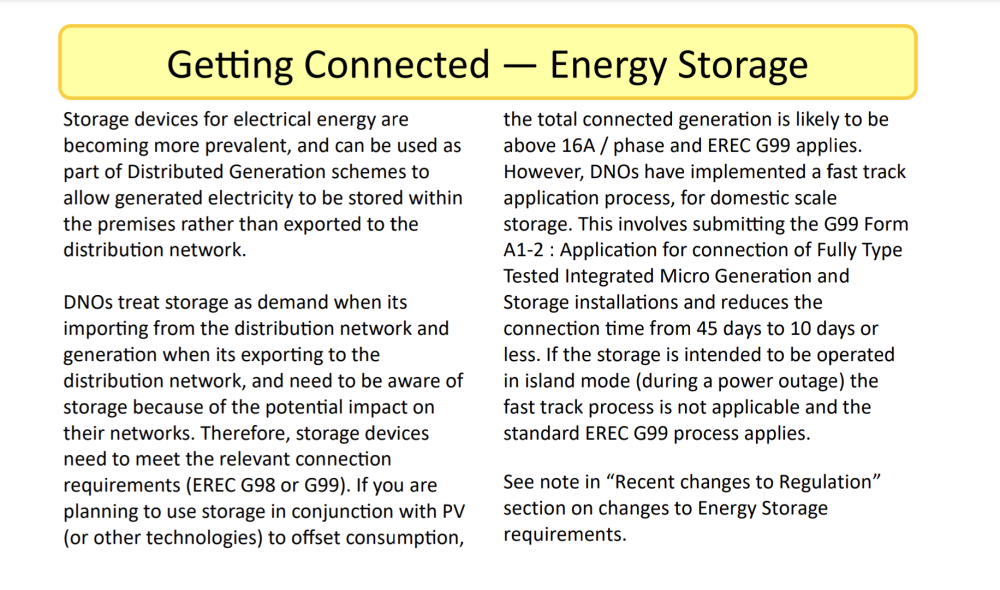
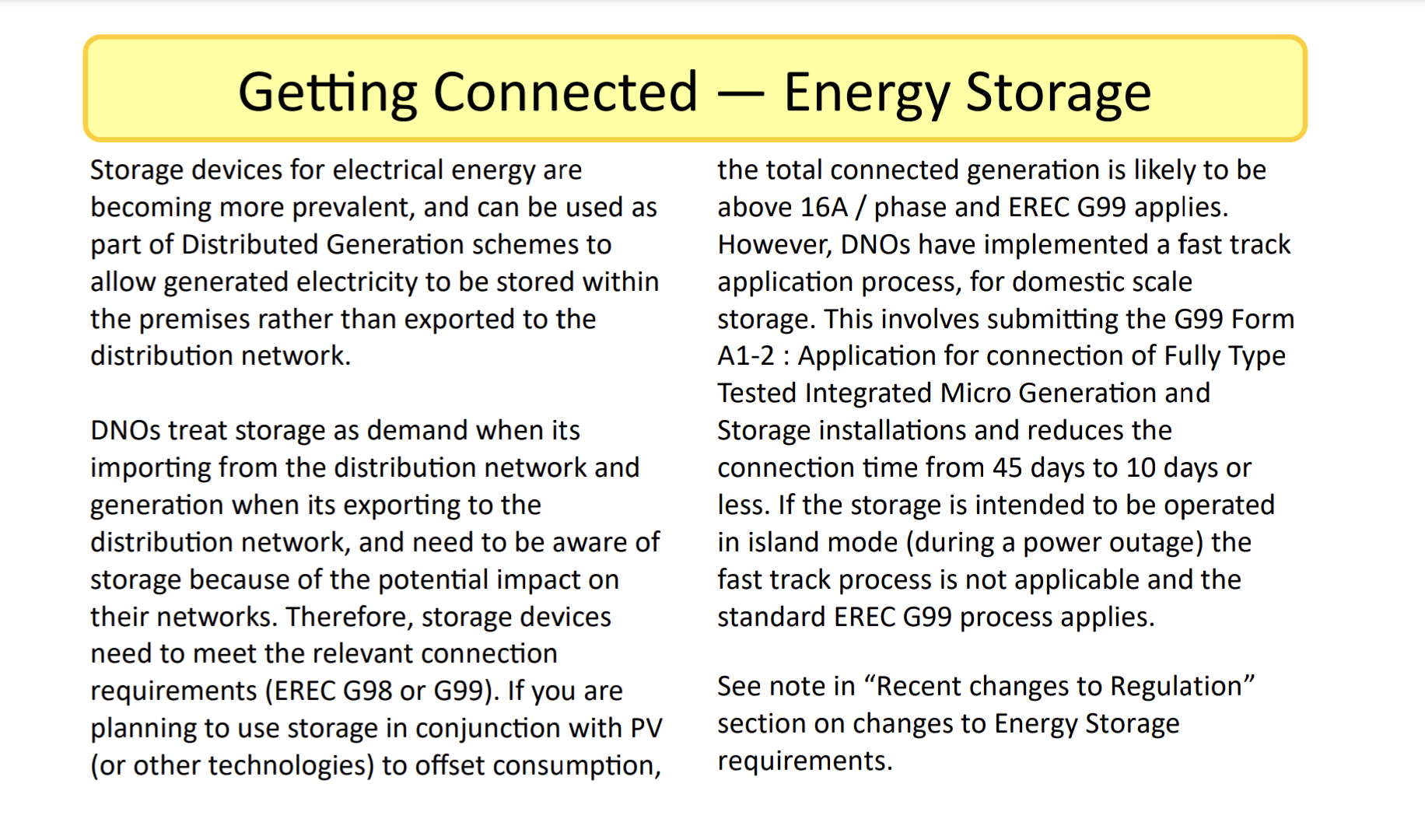
Yeah that's misleading, it's saying *additional* DNO notification is then needed, besides the G98/99. Page 34 of this guide is useful: https://www.energynetworks.org/assets/images/Resource library/G99 Type A Full Guide.pdf "G99 Form A1-2" apparently is your friend. Edit: actually probably not, reading that form it only applies to hybrid (integrated) PV + storage inverters