joth
-
Posts
2918 -
Joined
-
Last visited
-
Days Won
5
Everything posted by joth
-
 Last I looked at solar tiles (also GB sol) they cost 2x as much per m2 yet yield was 50% less per m2, so for a fixed roof size they give 1/4 of the kW/£ and half as much actual generation per year vs conventional panel. That alone is a none starter in my book. Having used gb sol infinity I very much doubt the tiles are ideal for DIY install either, but a quick phone call to them would answer that I think there's very few situations they aesthetic is really justified for the inefficiency. From what I know there wouldn't be many places your roof will be very visible from. The example photos above of GSE are misleadingly ugly as it's at a very close camera angle that in practice no one will ever be viewing a 3rd story roof from
 -
Depends a bit on the application, but I'd steer for external grade cat6 minimum. And got CAT6A with U/FTP shielding if using for anything slightly unusual (high bandwidth, main WAN connection, HDbaseT, non ethernet usage like Loxone, etc). In practice having bought a drum of external CAT6A I just used that for everything. (I actually preferred it for internal use too as the slick gloss jacket was easier to pull through narrow openings)
-
At least one MCS installer I know just turns up and sees how many they can fit on the day, having made a conservative estimate of kWp at quotation time. Do any wholesalers allow 30 days for returns? Possibly overorder on panels and trays and return what doesn't fit. Else sell them here.
-
I suggested up to 4. I.e a reasonable upper limit, not a definitive goal. HDMI extenders can work over 2x CAT6, and that leaves one for internet and one redundant spare. However in the 15 months since I wrote that I tried various hdmi over cat6 solutions and disliked them all, so I'd probably aim for 2 or 3 max in key locations these days.
-
17 shown there. 7 GF, 7 FF, and 3 external. I'm extending Loxone Link to an exterior cabinet with relays (and could add DI in future) to minimise airtight penetrations for all the exterior and landscape lighting
-
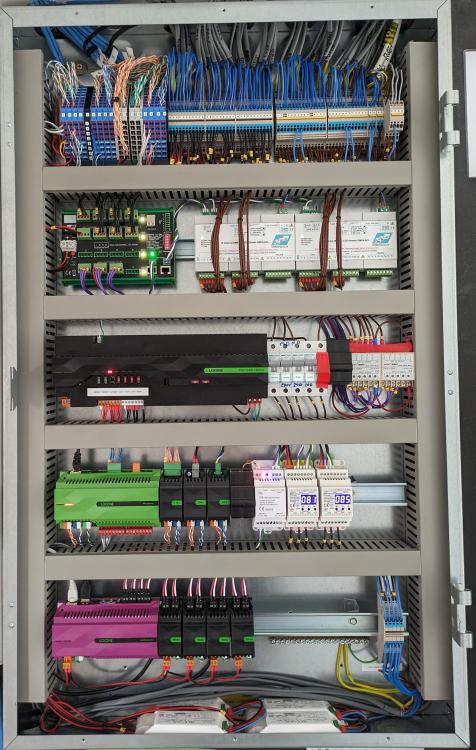
Ok so yes, I completed second fix of my 2nd install today, and I'm much happier with how the CAT6A termination into the cabinet is looking, if still not perfection. Top left corner: To recap, my approach here is I'm still not using external 110 pushdown but instead use 8 way din terminal blocks to fully terminate every incoming CAT6 core (hopefully once and for all), and then any changes (of which we've had a couple already) are made on the internal cabinet lacing side of the terminal block rather than rewiring the external facing CAT6 side.
-
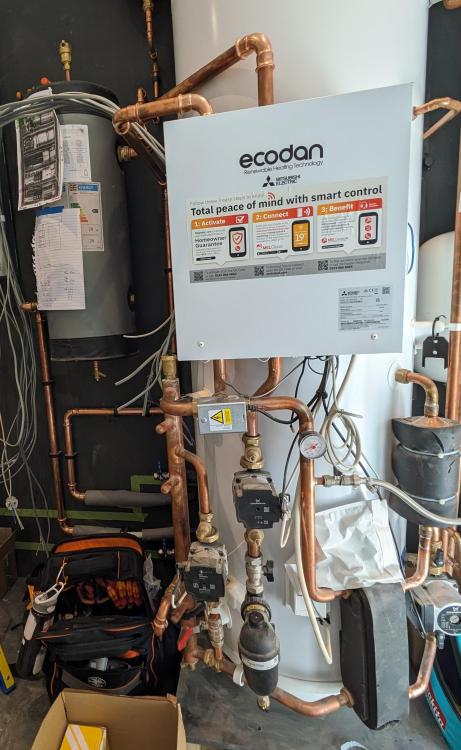
Yeah other than the buffer tank (and a lot of unrelated loose WIP wiring) this is all the preplumbed cylinder you're looking at here. It is a messy job even if you do want the 2 zones of space heating, but for a DHW only system it is crazy.
-
I stand corrected, the FTC6 does indeed have a output for controlling primary pump speed, and it is hooked up on the preplumbed cylinder. Marked CNPWM / WH on the motherboard. The MIs have it on the drawings but don't mention its purpose in the text at all, which is why I've never noticed it or tried to hook it up in my own install.
-
The rectangular one is almost same size as ours, we only have manifold, uvc, water softener, plus utility (sink and washing mc) and cat litter tray there and to me it feels really cramped to actually use the utility space. Adding a battery, electric distro, and MVHR definitely pushes it past being a useful utility space IMHO I think you need to allow more floor space for the uvc and all the misc plumbing (2 expansion tanks, pumps, filter, etc) and also our manifold inc pump ended up needing much more space than anticipated. If you have high ceilings getting some vertical stacking of items may help a little. (Our ceilings are not so high) Battery, depending on the system, can be much larger than you have shown there too
-
I'm working next to one of this mitsu cylinders today. I'll take a look at see if it's speed controlled, but 99% sure it isn't as the FTC6 does not have any connection for variable speed output. (It's also a kinda mad system design as it's being used for DHW only (passivehaus, no space heating) yet had a preplumbed cylinder with a couple redundant pumps and diverter valve in circuit. And then the primary side is so tiny (in part because of the PHE) that they've had to add a 50L buffer (volumizer) in series just to meet the manufacturer minimum system volume. Seems a lot of faff for a DHW only system.)
-
If you have a wiring centre it will still work after removing the actuators, but it's totally redundant; you can just pass the room stay call for heat straight through to the boiler relay input. (Modulo if there's a zone valve that needs to open you might want the delay start feature of a wiring centre, or to use the microswitch output of the zone valve to call for heat)
-
Fwiw just for variety I'll share what we did. My build team didn't use ducts at all. Each cable had it's own hope drilled right through (our retrofit is a mix of masonry and TF) and then individually grommeted and taped to the OSB on the inside. A couple places one grommet serves multiple cables. Some 30+ cables done this way. We achieved 0.5 ACH on a retrofit, so I'm happy with the result (although in a couple places having the option to pull more cables without drilling more hopes would be good)
-
Design SAP calc from TF company, what does it all mean?
joth replied to Post and beam's topic in Air Source Heat Pumps (ASHP)
I think the MCS song sheet says you have to use the MCS room-by-room calculation method. The SAP report likely has the necessary input data to plug into that other calculator, so maybe the easiest way for and ASHP supplier to bootstrap their work Beware MCS method assumes 5 ach and no MVHR, and it's hard to get installers to override that. Obviously going for a non-MCS install is one option! -
Power cycling if as you describe should be safe, as it's like what happens in a power cut. It may help. But don't trust me I'm just some guy on the internet 😂 I had to remove mine from the inverter and re-pair it to fix when it went wrong. SE warned against doing that as it may make things worse though.
-
within conservation area, MCS install or not
joth replied to Post and beam's topic in Air Source Heat Pumps (ASHP)
Got it. So there's three different Qs here, and there's very little interdependency between them. 1/ MCS vs self-install. You can choose this regardless of installing under PP or PD (or in breach thereof). The fact it's conservation area has little bearing on going MCS or not. 2/ Install under PP or PD. As JohnMo says, you can't use PD until completion. So the choices are doing it under PP or just close your eyes and claim it was done under PD post-completion. 3/ Conservation area. This is only relevant if doing it under PD, and the impact is minimal (slightly more restrictions on placement). As JohnMo says you can't do it under PD until after completion anyway. Another undiscussed issue is if you are claiming the £5k BUS grant. Then is must be an MCS install, and you need to declare the date of install which will probably be pre-completion which means it really needs to be covered by the PP. Which again as JohnMo says, if it's on the plans its covered. -
within conservation area, MCS install or not
joth replied to Post and beam's topic in Air Source Heat Pumps (ASHP)
Gosh. Well if someone wants to block the install on this basis, just unplug the external unit and shift it into a store room until they're gone the certificate issued, then bring it back out. 🙄 Do you have a reference for that? I can't find anything saying it must be at the rear (and indeed, ours isn't). Planning portal says "On land within a Conservation Area or World Heritage Site the air source heat pump must not be installed on a wall or roof which fronts a highway or be nearer to any highway which bounds the property than any part of the building" which is what a paraphrased as "not visible from the main road". (btw did you mean to say "irrelevant"? I think it's semi-relevant even if going through PP, as the PD rights will be the reasonable baseline the LPA will start with) -
within conservation area, MCS install or not
joth replied to Post and beam's topic in Air Source Heat Pumps (ASHP)
You can install an ASHP under permitted development even in a conversation area, so long as it's not visible from the main road and a few related location restrictions. Plus all the usual constraints (1m from boundary, comply with MCS section 20 noise design limits, be the first/only heat pump on the premises, not be used for cooling, etc) Is your concern related to your comment about PP being for it "on the south side" ? We don't have the context to interpret the relevance of that. In my experience (also in a conservation area, and we forgot to put the ASHP on the PP application at all), the LPA won't care about MCS, and the MCS installer won't care about PP/PD process. The only value in the paperwork is to cover your backside if anyone comes at you making complaints, or when you come to sell. Doing an MCS install it the easiest (in terms of effort, if not money) way to get an official looking piece of paper that says you followed the MCS noise guidelines. And that's only important if someone complains about the noise. -
Heat Pumps: What They Really Mean For You - BBC1 8pm today
joth replied to MAB's topic in Property TV Programmes
In addition to this, a company is entitled to charge some profit and overhead. They have to design the system, cover office staff, cover support & warranty call outs etc. 8% OH&P on the materials is not atypical Racks up though doesn't it. 6 men for over a week is a lot. Presume that's replacing rads and everything -
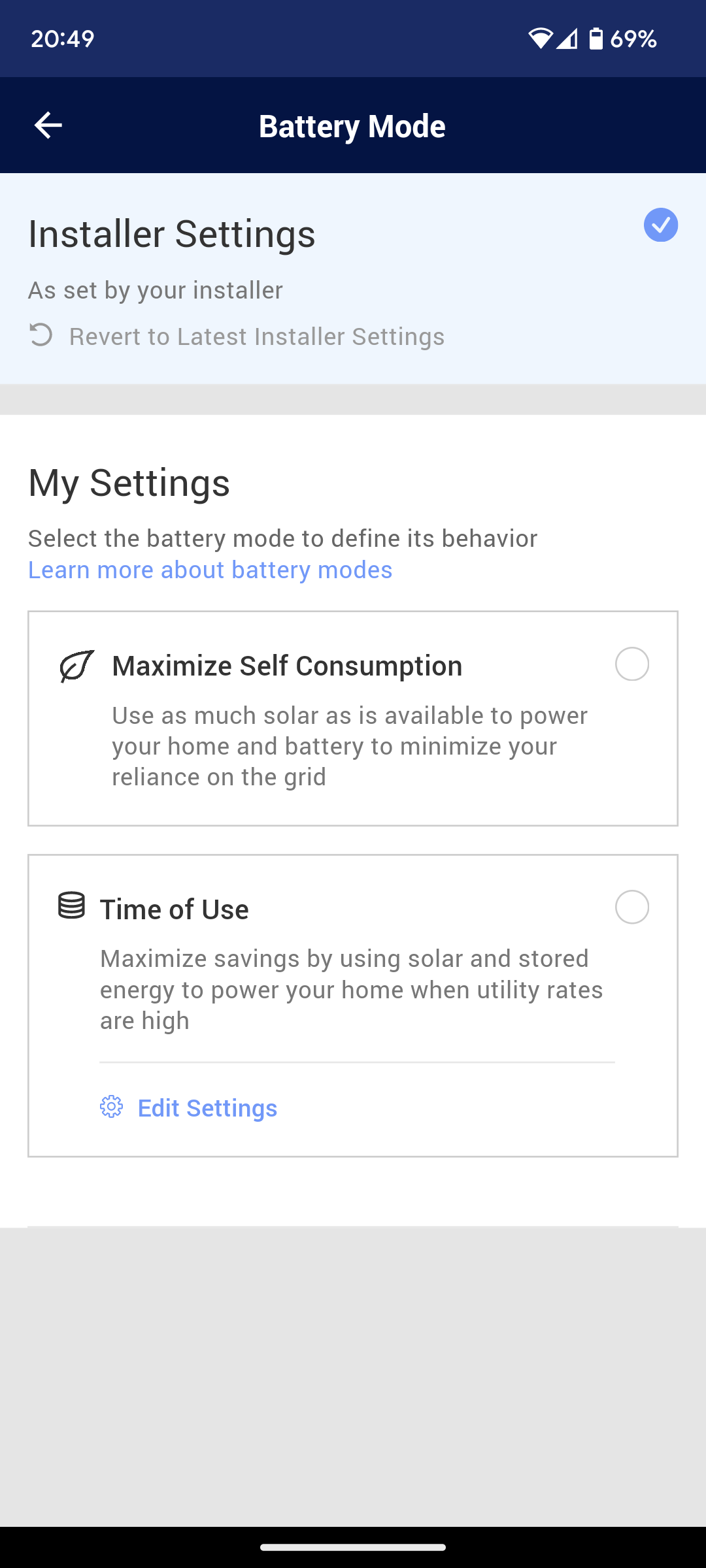
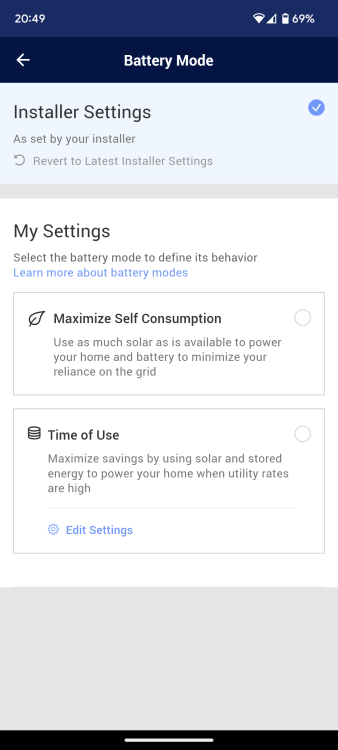
brief update: I happened to be awake at 1am and took a peak, and the TOU profile still had the battery discharging (to meet baseload) even though this was in cheap rate, so I clicked it back to "Installer defined" profile. A minute later it was happily charging from grid as wanted. So I can't say anything about how tou works (maybe it is supposed "learn" over days/weeks of use, but it already has years of our usage and generation data to analyse so that's a poor excuse). But I can at least say reverting back to installer settings worked fine for me. (I have admin rights on my installers portal so it's easy for me to edit my desired TOU profile there, but I appreciate not everyone has that luxury)
-
Yep, not difficult to see the Daily Mail have been instructed to go on an anti-green crusade rn, pushing anything to support the current Tory policy change. o/c there's underlying truth in the state of ASHP installation, a lot created by the tory policies that got us here, and which has all been done to death here already. just gotta take a big chill pill before attempting to wade into the green ink drama in the reporting. my ASHP is neither vast nor noisy nor in my garden, but then I also wasn't stupid enough to do it based on a cold call from a grant harvester.
-
If you have a battery it's very likely a win to use the ashp. If you have cheap rate overnight and paid export (even without the battery), it's very likley better to use ASHP overnight for HW and let the solar go to export. (I buy electricity for 5p overnight and sell PV for 15p in the day, and one night time DHW charge lasts us all day, so it makes zero sense to use the daytime PV on DHW, whether via heat pump or otherwise). If neither, then yeah more complex modelling needed. I actually have both the above, so it's a no-brainer. The PV divert now goes unused.
-
Yah I've seen many folks ruminate on benefits of 110 blocks but not heard many solid case studies from anyone that actually did it 😅 It seems with 2 enclosures you'll be lacing all the interconnects between them onsite rather than on the bench, so if you have time to do that what not lace it directly from the 110 to the Loxone extension device or whatever and skip the middle terminal block. Maybe a few of the interconnected blocks to act as distribution for power and Tree to keep it all neat. I think it all depends on intended install (and maintenance) workflow, on bench vs in-situ
-
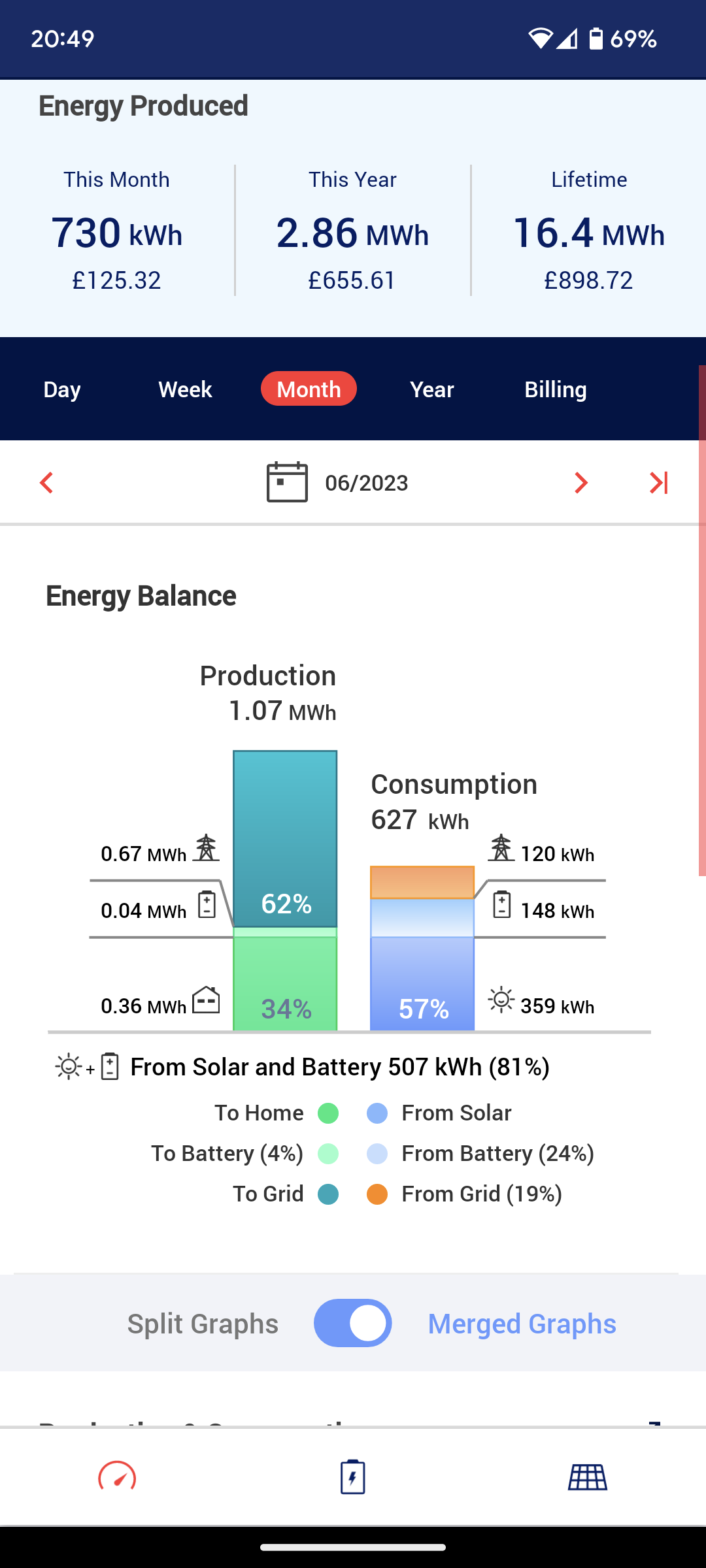
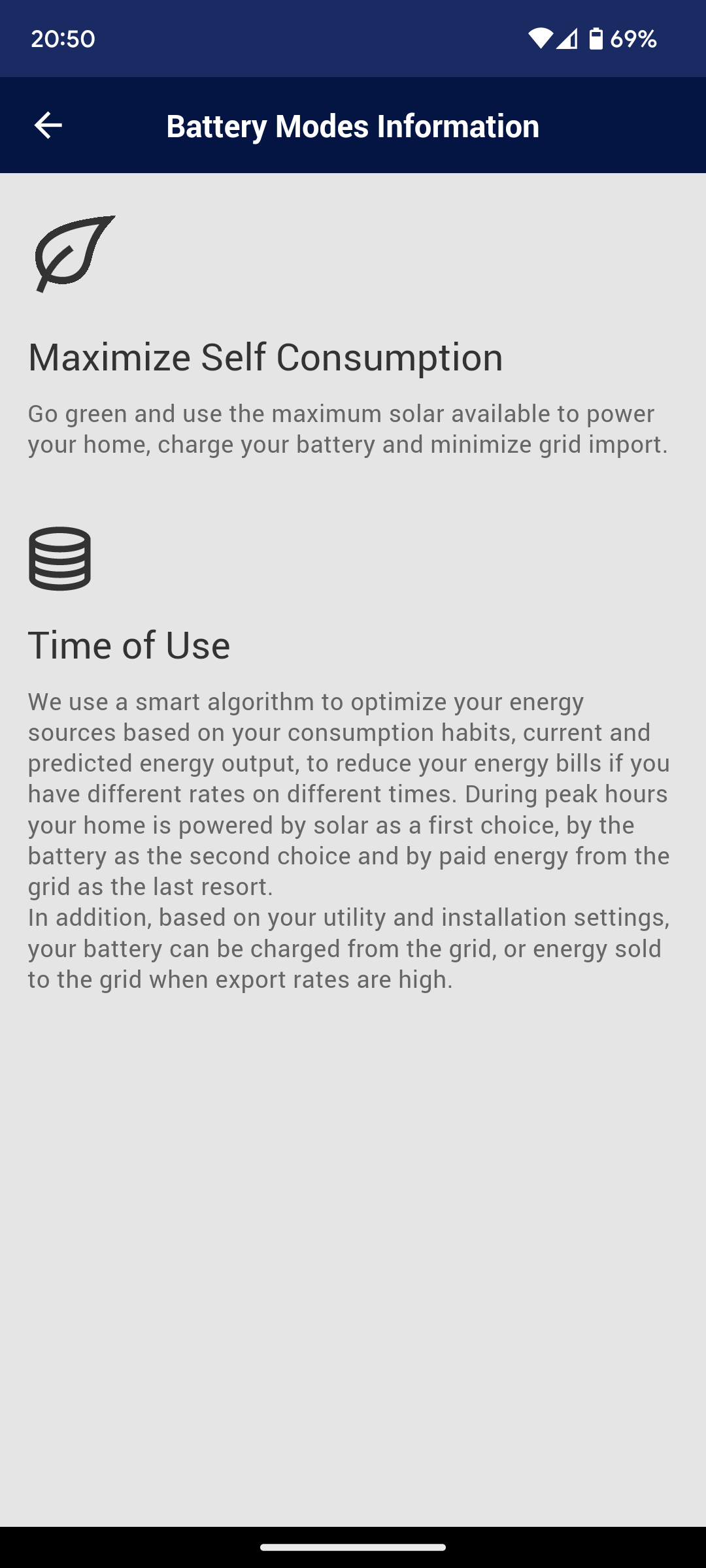
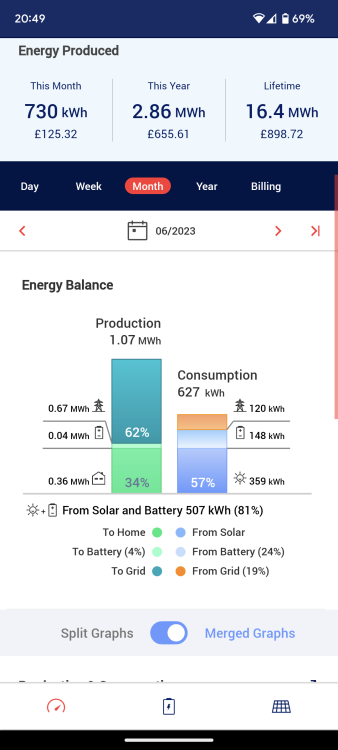
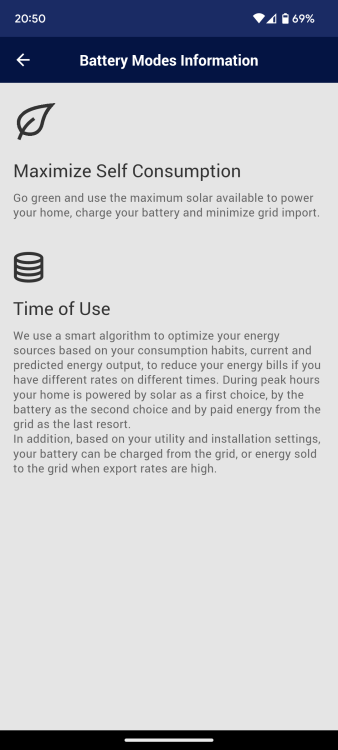
Just noticed android mySolarEdge has updated, with two noticeable improvements 1/ it now tracks and illustrates consumption and production sources/sinks correctly, even though I charge the battery from grid each night 2/ it has some (rudimentary) settings for the user to define their own storage profile (basically either optimise self use, or some supposedly smart TOU option). I'm trying the TOU but not got high hopes, as while it allows you to configure peak energy times (for octopus Go I did all day except the cheap 4 hours...), You can't set the price or import Vs export timings, so there's not way for it to take into account a varying price spread for TOU shifting. The help text hints it "may" even charge up the battery from grid if needed, but no clue as to when. I'll see and try to remember to report back
-
Ah yes in that case my advice is perhaps less useful. The approach I've adopted on my latest project was exactly to avoid me having to do that two enclosure trick. I'd be interested what utility you find the wiedmuller terminals offer in your setup, for their cost. In theory the quick onsite install could all be achieved with the punch down blocks alone.
-
Yes The interconnected ones have the black border around the connected terminals. I could make that more clear if documenting it for someone else, but this was enough for me to follow so far 😄